
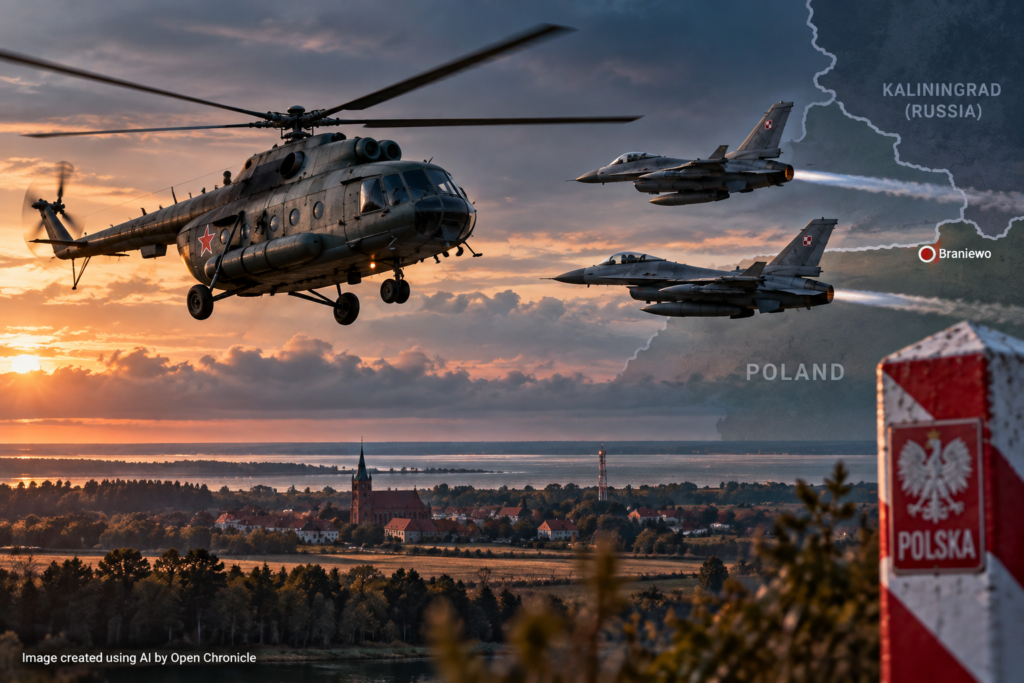
A Russian Mi-8 military helicopter entered Polish airspace near the Kaliningrad exclave on Wednesday, prompting an immediate response from Poland’s armed forces. The incident comes amid heightened military activity along NATO’s eastern flank and continuing Russian attacks on Ukraine.
By Open Chronicle with agencies
WARSAW, September 23, 2026. Polish fighter jets were scrambled on Wednesday morning after a Russian military helicopter briefly entered Polish airspace near Braniewo, in the Warmian-Masurian region, close to Russia’s Kaliningrad exclave.
According to Poland’s Operational Command of the Armed Forces, the Russian Mi-8 helicopter crossed into Polish territory at approximately 11:08 a.m. local time, penetrating around 300 metres beyond the border.
The aircraft remained in Polish airspace for approximately 42 seconds before leaving Polish territory.
Polish military radar systems continuously monitored the helicopter’s movements, allowing the armed forces to respond immediately to the incursion.
Fighter jets were scrambled, while ground-based air defence units remained on standby.
The Operational Command said the circumstances of the incident suggested that Russia may have been attempting to assess the readiness of Poland’s air defence systems.
“The nature of the incident indicates that Russia is once again testing the readiness of our air defence,” the command said in a statement.
The Polish military emphasised that its air surveillance and defence systems operate continuously to protect the country’s territory.
Russian helicopter enters Polish airspace near Kaliningrad
The incident occurred near Braniewo, a town in northern Poland situated close to the border with Russia’s Kaliningrad Oblast.
Kaliningrad is a Russian exclave located between Poland and Lithuania, with access to the Baltic Sea.
The territory hosts Russian military installations and occupies an important position along NATO’s northeastern flank.
According to the Polish Armed Forces, the Mi-8 helicopter approached from Kaliningrad before briefly crossing the international border.
Although the aircraft entered Polish territory by only around 300 metres, the violation prompted an immediate military response.
The helicopter’s movements were tracked throughout the incident by Polish radar systems.
The Operational Command did not report any direct confrontation between Polish fighter jets and the Russian helicopter.
The Polish military’s assessment that the incident may have been intended to test its air defence readiness remains an interpretation of the aircraft’s behaviour. The information released does not independently establish the intentions of the Russian crew.
Polish fighter jets scrambled as air defence units remain on alert
Poland’s armed forces activated their response procedures following the helicopter’s entry into national airspace.
Fighter jets were scrambled, and ground-based units remained ready to respond to further developments.
The Operational Command said the country’s air defence system maintains continuous surveillance of Polish territory.
“The crews of Poland’s air defence systems maintain round-the-clock surveillance and remain in constant readiness to ensure the security of Polish airspace,” the command stated.
Poland has strengthened its air surveillance and military readiness amid continuing Russian military activity near NATO territory.
The country’s geographical position makes it particularly exposed to developments involving Russia’s Kaliningrad exclave, Belarus and the war in neighbouring Ukraine.
Polish military authorities have repeatedly emphasised that aircraft operating near the country’s borders are monitored to identify potential threats and respond to violations of national airspace.
Russian attacks on Ukraine trigger additional NATO air operations
Wednesday’s helicopter incident occurred on the same day that NATO fighter jets were scrambled in response to Russian attacks on Ukrainian territory.
Polish military authorities activated aircraft as Russian forces conducted strikes in Ukraine, raising concerns about potential threats near the Polish border.
Residents of the Lublin region received an alert from Poland’s Government Security Centre, known as the RCB.
Operations at Lublin and Rzeszów airports were temporarily suspended as military aviation activity intensified.
Both airports are located in eastern and southeastern Poland, relatively close to Ukrainian territory.
Rzeszów has also played an important logistical role in international military and humanitarian assistance to Ukraine.
Following the completion of the military response, Poland’s Operational Command announced that the air operations had ended.
The command also explained that a loud boom heard in central Poland had been caused by combat aircraft breaking the sound barrier.
“Air operations were conducted in a controlled manner, in accordance with the applicable regulations and safety procedures,” the military said.
Polish military reports interception of Russian reconnaissance aircraft
The helicopter incursion followed another incident involving Russian military aviation near Polish territory.
On Tuesday, Deputy Prime Minister and Defence Minister Władysław Kosiniak-Kamysz announced that Polish fighter jets had intercepted a Russian Ilyushin Il-20 reconnaissance aircraft.
The aircraft was operating approximately 40 kilometres from the Polish coast.
The Il-20 is a military reconnaissance aircraft designed to collect intelligence using electronic surveillance equipment and other sensors.
Its presence near Polish territory prompted a response from the country’s air defence forces.
“Russia is regularly testing NATO’s eastern flank,” Kosiniak-Kamysz said following the interception.
Similar incidents have previously been reported near Łeba and Koszalin, along Poland’s Baltic coastline.
Poland’s Operational Command has reported an increase of more than 250% in interceptions of Russian aircraft along NATO’s eastern flank, although the supplied figures do not specify the comparison period.
The increase has contributed to concerns among Polish military authorities about the frequency of Russian aviation activity near NATO territory.
Russian strikes near Poland’s border prompt repeated alerts
Poland has also activated its air defence systems on several occasions in response to Russian attacks against western Ukraine.
During incidents reported the previous week, fighter jets were scrambled as Russian forces conducted strikes near the Polish border.
Air raid alerts were issued in the Subcarpathia and Lublin regions, while operations at Rzeszów and Lublin airports were temporarily suspended.
Prime Minister Donald Tusk reported that a Russian drone had struck a petrol station in Ukraine near the Dorohusk border crossing.
The incident occurred close to Polish territory, highlighting the proximity of Russian military operations to NATO’s eastern borders.
Further alerts were reported the following morning, with military aviation remaining active until approximately 9 a.m.
Polish authorities have maintained heightened surveillance during Russian attacks on western Ukraine because of the possibility of missiles or drones approaching or crossing the country’s airspace.
These precautionary operations are intended to protect Polish territory and allow military units to respond rapidly if an aerial threat is detected.
Russian drone recovered from Baltic Sea
Another incident involving Russian military equipment was recorded earlier in September.
A Russian Gerbera 2 unmanned aerial vehicle was discovered and recovered from the Baltic Sea near Rusinowo, close to Jarosławiec in Poland’s West Pomeranian region.
The discovery prompted attention from Polish authorities amid concerns about Russian drone activity near the country’s coastline.
The Gerbera is a Russian unmanned aerial vehicle associated with military operations against Ukraine.
The circumstances surrounding the drone’s arrival in the Baltic Sea and its recovery near the Polish coast were not fully established in the supplied reporting.
The incident nevertheless added to a series of events involving Russian military aircraft and unmanned systems operating near Polish territory.
Poland expands protection of its airspace
On September 3, Defence Minister Władysław Kosiniak-Kamysz announced that he had decided to expand measures protecting Polish airspace.
The decision followed an increase in incidents involving Russian military activity near Poland.
In a statement published on X, the defence minister said recent developments demonstrated that threats could emerge in locations previously considered relatively secure.
“Recent weeks have shown that provocations from Russia are taking different forms and pose a threat in places that until now have been considered safe,” he wrote.
Kosiniak-Kamysz also assured the public that Polish authorities were continuously monitoring the situation along the country’s eastern border.
The expanded protective measures form part of Poland’s broader efforts to strengthen air defence capabilities and maintain military readiness amid the continuing war in Ukraine.
Poland has also been working with NATO allies to reinforce surveillance and defensive operations along the alliance’s eastern flank.
NATO’s eastern flank remains under heightened surveillance
Poland’s location places it at the intersection of several major European security concerns.
The country shares borders with Ukraine, Belarus and Russia’s Kaliningrad exclave, making developments in all three areas directly relevant to its national defence planning.
Since Russia’s full-scale invasion of Ukraine in February 2022, NATO has increased its military presence and surveillance activities in eastern member states.
Air policing operations, radar monitoring and rapid-response aircraft are important elements of the alliance’s defensive posture.
The latest helicopter incursion demonstrates the challenges involved in monitoring military activity near international borders, particularly when aircraft operate close to NATO territory.
However, the brief violation of Polish airspace does not, by itself, establish that Russia intended to initiate a military confrontation with Poland.
Polish authorities have characterised the incident as a possible test of their defensive readiness.
Russia’s explanation for the helicopter’s flight was not included in the information available at the time of publication.
Polish armed forces maintain readiness following latest incident
The Polish military has reiterated that its air defence systems remain operational around the clock following Wednesday’s violation.
The Russian helicopter’s entry into Polish territory lasted approximately 42 seconds, but the incident prompted an immediate response from fighter aircraft and ground-based defence units.
The incursion follows the interception of a Russian reconnaissance aircraft near the Polish coast and repeated military alerts linked to Russian attacks on western Ukraine.
Together, these developments illustrate the continuing demands placed on Poland’s air surveillance and defence capabilities.
Polish authorities have said they will maintain close monitoring of the country’s borders and respond to further violations of national airspace.
The latest incident also underscores the importance of coordination between Poland and its NATO allies as military activity continues near the alliance’s eastern borders.
Further information concerning the Russian helicopter’s flight and any subsequent diplomatic response had not been announced in the supplied reporting.