
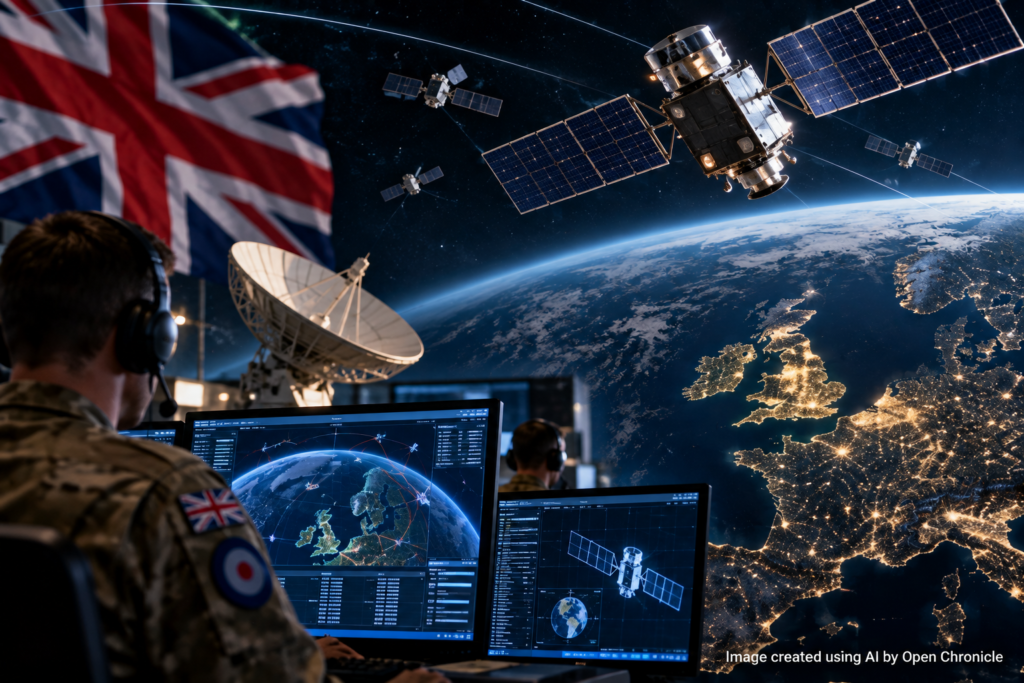
Britain is creating a new Royal Air Force squadron to protect critical satellite infrastructure and strengthen its ability to respond to hostile activity in space. The unit will bring together military specialists and use advanced technologies, including electronic warfare, to defend systems essential to national security and everyday life.
By Open Chronicle with agencies
LONDON, September 23, 2026. The United Kingdom has announced the creation of a new Royal Air Force squadron dedicated to protecting British satellites and countering hostile activity in space, marking an expansion of the country’s military capabilities beyond traditional land, sea and air operations.
The new unit, designated No III Space Effects Squadron, will bring together specialist personnel from across the British armed forces to protect satellite systems that support military communications, missile warning, navigation and other essential services.
According to the Ministry of Defence, the squadron will use advanced technologies, including electronic warfare capabilities, to disrupt, degrade and deny hostile actions targeting British space infrastructure.
The announcement reflects the growing importance of space to modern military operations and national security, as governments become increasingly dependent on satellites for communications, intelligence gathering and the coordination of military forces.
Defence Secretary Wes Streeting said Britain must keep pace with developments in the space domain as competition over orbital infrastructure intensifies.
The new squadron will complement two existing RAF units responsible for monitoring space activity and identifying potential threats.
A new military unit dedicated to space defence
No III Space Effects Squadron will focus on responding to threats against British space systems rather than simply detecting and monitoring them.
The unit will bring together personnel with expertise in space operations, electronic warfare and other military disciplines.
Its principal responsibility will be to protect satellite infrastructure that provides essential services to the armed forces and supports wider national security requirements.
These systems include satellites used for missile warning, military communications and navigation.
Satellite technology also supports the movement of military aircraft and ships, allowing forces to maintain communications and coordinate operations across large geographical areas.
The Ministry of Defence said the new squadron will strengthen Britain’s ability to respond to hostile actions directed against these systems.
Its capabilities are expected to expand as additional technologies enter service.
The announcement does not specify the squadron’s initial personnel strength, operational location or the full range of equipment it will employ.
Critical satellite services
Space-based systems support military operations, national security and essential civilian activities.
Missile warning
Satellites can detect missile launches and provide early warning information to military authorities.
Military communications
Satellite networks allow armed forces to exchange information and coordinate operations over long distances.
Navigation and positioning
Space-based navigation systems support the movement of aircraft, ships and military units.
Surveillance and intelligence
Satellite systems provide information that can support situational awareness and military planning.
Moving beyond surveillance to active protection
The creation of No III Space Effects Squadron represents an expansion of the Royal Air Force’s existing space operations structure.
Britain already operates two specialist RAF units responsible for monitoring activity in space and identifying potential threats.
No I Space Operations Squadron focuses on space surveillance and operational monitoring, while No II Space Warning Squadron provides warning of threats affecting the space environment.
The new squadron will complement these functions by developing capabilities to respond directly to hostile activity.
The Ministry of Defence said the unit will use technologies designed to disrupt, degrade and deny hostile actions.
These capabilities could involve electronic warfare measures intended to interfere with activities threatening British satellite systems.
However, the government has not disclosed the specific technologies or operational procedures that the squadron will employ.
The distinction between monitoring threats and responding to them is central to the new unit’s mission.
While surveillance systems provide information about potential dangers, the new squadron is intended to strengthen the armed forces’ ability to take protective action when necessary.
Electronic warfare becomes central to space security
Electronic warfare will form an important part of the new squadron’s capabilities.
Modern satellites depend on radio-frequency communications to exchange information with ground stations and users on Earth.
These signals support a wide range of functions, including navigation, communications and the transmission of military information.
Electronic interference can affect the availability or reliability of satellite services, creating risks for military operations and civilian infrastructure.
The Ministry of Defence said the new squadron will use electronic warfare technologies to counter hostile actions in the space domain.
The government’s description of the unit’s mission includes both offensive and defensive space operations.
Defensive capabilities are intended to protect British systems and preserve access to essential satellite services.
Offensive capabilities may involve measures designed to interfere with hostile systems or activities, although the government has not provided detailed information about the specific operational options available to the new squadron.
The announcement does not indicate that Britain intends to deploy weapons capable of physically destroying satellites.
Why satellites are essential to modern military operations
Satellites have become fundamental to the operation of modern armed forces.
They provide capabilities that cannot always be replicated through conventional ground-based infrastructure, particularly when military operations extend across large geographical areas.
Surveillance and intelligence
Satellite systems provide information that can support situational awareness and military planning.
Disruption to these services can affect the ability of armed forces to communicate, navigate and maintain awareness of developing threats.
The consequences may also extend beyond military operations.
Civilian aviation, maritime transport, emergency services and telecommunications depend on space-based infrastructure for various functions.
Protecting satellites therefore forms part of a broader effort to preserve the reliability of systems that support national security and economic activity.
Britain seeks to maintain its position in the new space race
Defence Secretary Wes Streeting presented the establishment of the new squadron as part of Britain’s response to the growing strategic importance of space.
He compared the role of space in modern security with the importance of naval and air power during previous centuries.
“Control of the waves was the essential ingredient in 19th-century deterrence,” Streeting said.
He argued that maritime power had shaped Britain’s military capabilities during the nineteenth century, while control of the skies became increasingly important during the twentieth.
“This century will depend on control of space,” he added.
The comparison reflects the growing reliance of modern armed forces on satellite communications, navigation and surveillance.
Space infrastructure has become an important component of military planning, allowing governments to coordinate operations and maintain access to information across national borders.
The Ministry of Defence said the new squadron will help Britain maintain its capabilities as technological developments create new opportunities and security challenges in orbit.
Protecting space infrastructure against emerging threats
The creation of No III Space Effects Squadron comes as military planners increasingly recognise that satellite systems can be vulnerable to interference and disruption.
Space-based infrastructure operates in an environment where technical failures, orbital debris and deliberate hostile activity can affect essential services.
Potential security threats include electronic interference with satellite communications, cyberattacks against supporting infrastructure and actions directed against satellites themselves.
The new British unit is intended to strengthen the country’s ability to respond to hostile activity affecting its space systems.
The Ministry of Defence has not identified a specific incident as the immediate reason for establishing the squadron.
Nor has it publicly detailed the operational scenarios in which the unit’s capabilities would be employed.
The announcement instead places the new squadron within Britain’s broader effort to develop military capabilities suited to an increasingly contested space environment.
Offensive and defensive capabilities to expand over time
The Ministry of Defence said No III Space Effects Squadron will support both offensive and defensive space operations.
Its capabilities are expected to develop as new technologies become available.
The announcement does not provide a timetable for the introduction of individual systems or specify when the squadron will reach full operational capability.
The unit’s development will add a further element to Britain’s existing space defence structure, combining surveillance, threat detection and operational response.
By bringing together specialist personnel from across the armed forces, the government intends to strengthen coordination between different military disciplines involved in space security.
The squadron’s future activities will depend on the equipment introduced, its operational responsibilities and the wider requirements of Britain’s defence strategy.
Space becomes an increasingly important military domain
The establishment of the new RAF squadron illustrates the growing role of space in national defence planning.
Modern military operations rely on information and services provided by satellites, while civilian infrastructure also depends on the continued availability of space-based systems.
The ability to monitor, protect and respond to threats against these assets has therefore become an important consideration for governments developing their military capabilities.
For Britain, the creation of No III Space Effects Squadron adds an operational response capability to the RAF’s existing space surveillance and warning structure.
The Ministry of Defence says the unit will help protect essential satellite services while strengthening the country’s ability to respond to hostile activity in orbit.
As new technologies enter service, the squadron is expected to expand its capabilities and contribute to Britain’s wider military space operations.
The announcement marks another stage in the development of the United Kingdom’s space defence capabilities, reflecting the importance of satellite infrastructure to both military security and everyday life.