
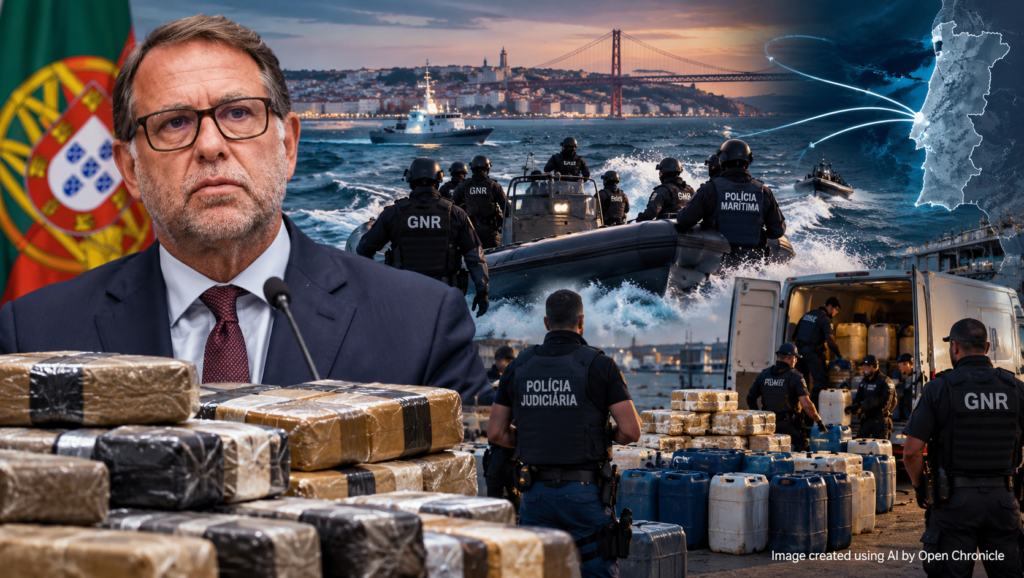
Portugal is being used as a strategic gateway for cocaine entering Europe, Interior Minister Luís Neves has warned, describing drug trafficking as the country’s leading internal security threat and announcing stronger police operations in areas particularly affected by drug related crime.
By Open Chronicle with agencies | September 27, 2026
LISBON, Portugal — Drug trafficking has become the most significant threat to Portugal’s internal security as transnational criminal organisations increasingly exploit the country as an entry point for cocaine destined for European markets, Interior Minister Luís Neves has warned.
“Drug trafficking is today the number one threat to internal security in Portugal,” Neves told parliament during a debate on the 2025 Annual Internal Security Report, known as RASI.
The report provides a broad assessment of security conditions across Portugal and is coordinated by the Internal Security System using information supplied by approximately 25 organisations, including the country’s security forces and services.
Neves said Portugal remains internationally recognised as a safe country, but warned that maintaining that position requires permanent vigilance as organised crime and other security challenges evolve.
Portugal becoming a strategic gateway for cocaine
According to Neves, Portugal is facing pressures similar to those confronting several other European countries.
Its geographical position and connections with international maritime routes have made the country attractive to transnational criminal organisations seeking to introduce cocaine into the European market.
Portugal, the minister said, is being “used as a strategic gateway for cocaine into Europe”.
The changing scale of cocaine production internationally is contributing to the problem.
“The new factor is the large increase in cocaine production that drug traffickers want to distribute because profits in Europe are much higher,” Neves said.
The warning comes amid increasing concern in Portugal about the activities of international drug trafficking organisations and their use of Portuguese territory and infrastructure.
Drug trafficking ‘fuels theft, threats and assaults’
Neves argued that the consequences extend far beyond the trafficking of narcotics itself.
Drug related criminal activity can have what he described as a “tremendous social impact on the lives of communities”.
According to the minister, drug markets contribute to theft, robbery, threats, assaults and other offences associated with consumption and competition for control of drug selling locations.
The effects can become particularly visible in urban communities where trafficking and consumption occur openly.
Neves said public drug consumption can degrade public spaces, affect economic activity and reduce quality of life.
It can also significantly increase perceptions of insecurity among residents, even when broader crime indicators present a more complicated picture.
PSP and GNR to increase operations
The government intends to reinforce the police presence in areas where these problems are particularly visible.
Neves said the PSP and GNR will increase police visibility and operational activity in specific locations, particularly in Lisbon and Porto.
The strategy is intended to address both criminal activity and the broader effects of open drug consumption on neighbourhoods and commercial areas.
Greater police visibility is expected to form part of a wider response involving intelligence, criminal investigations and action against organised trafficking networks.
The challenge for Portuguese authorities increasingly involves both local drug markets and sophisticated international organisations capable of moving narcotics across several countries.
Overall crime increased 3.1 percent in 2025
The parliamentary debate also examined Portugal’s broader crime figures.
According to Neves, general crime increased by 3.1 percent during 2025.
The minister argued, however, that the increase should not automatically be interpreted as evidence of an equivalent deterioration in public safety.
He said part of the rise reflected greater operational activity by security forces.
“We are not simply talking about more crimes, we are talking about more action by the state, greater police proactivity. A raw number is not the same as real danger,” Neves told lawmakers.
The distinction is important when interpreting crime statistics because police operations themselves can uncover offences that might otherwise have remained undetected.
Neves nevertheless said the government accepts the RASI figures without attempting to minimise them.
Rape figures reach highest level of the decade
The minister highlighted sexual violence as another area requiring particular attention.
Neves said recorded rape offences in 2025 reached their highest level of the decade.
He told parliament that those figures must be treated with “particular seriousness”.
The government intends to prioritise specialised training for security forces and strengthen coordination with the justice system.
“In this area, we have made specialised training for the security forces and coordination with Justice a priority in order to reduce response times for these victims,” Neves said.
The figures add another dimension to the national debate about security, demonstrating that different categories of crime can evolve independently of overall crime trends.
National victimisation survey planned
Portugal will also conduct a national victimisation survey coordinated with the Internal Security System.
Such a survey can provide information beyond crimes formally recorded by police by examining experiences reported directly by members of the population.
Neves said the initiative forms part of the government’s effort to develop a more detailed understanding of crime and insecurity.
The minister also said security forces are already collecting information concerning detained foreign nationals, distinguishing between residents and non residents.
Those figures could be available for inclusion in next year’s internal security report.
Portugal remains safe, but security cannot be taken for granted
Despite the warnings contained in the RASI debate, Neves reiterated that Portugal continues to be recognised as a safe country.
He described that reputation as a “strategic advantage to preserve”.
Safety contributes not only to everyday quality of life but also to Portugal’s wider international position and economic attractiveness.
The minister warned, however, that the country cannot assume that its current security environment will remain unchanged.
Organised criminal networks adapt quickly to differences in legislation, policing, transport routes and market conditions.
The rapid expansion of international cocaine production and the higher profits available in European markets are creating additional incentives for trafficking organisations to expand their operations.
International organised crime presents growing challenge
Neves’ assessment places international drug trafficking at the centre of Portugal’s evolving security landscape.
The challenge involves several interconnected levels.
At the international level, transnational organisations seek routes capable of bringing large quantities of cocaine into Europe.
At the national level, police and judicial authorities must identify trafficking infrastructure, investigate criminal networks and prevent Portugal from becoming an increasingly important logistical platform.
At the community level, authorities face the consequences of local distribution and consumption, including associated violence, theft and deterioration of public spaces.
The government’s response will therefore require more than seizures of individual drug shipments.
Police visibility, intelligence gathering, international cooperation, criminal investigations and coordination with the justice system will all form part of the effort to respond to what the interior minister now describes as Portugal’s principal internal security threat.
For Neves, Portugal’s reputation for safety remains an important national asset.
Preserving it, however, will require continued adaptation to criminal organisations whose methods, routes and international reach are constantly evolving.