
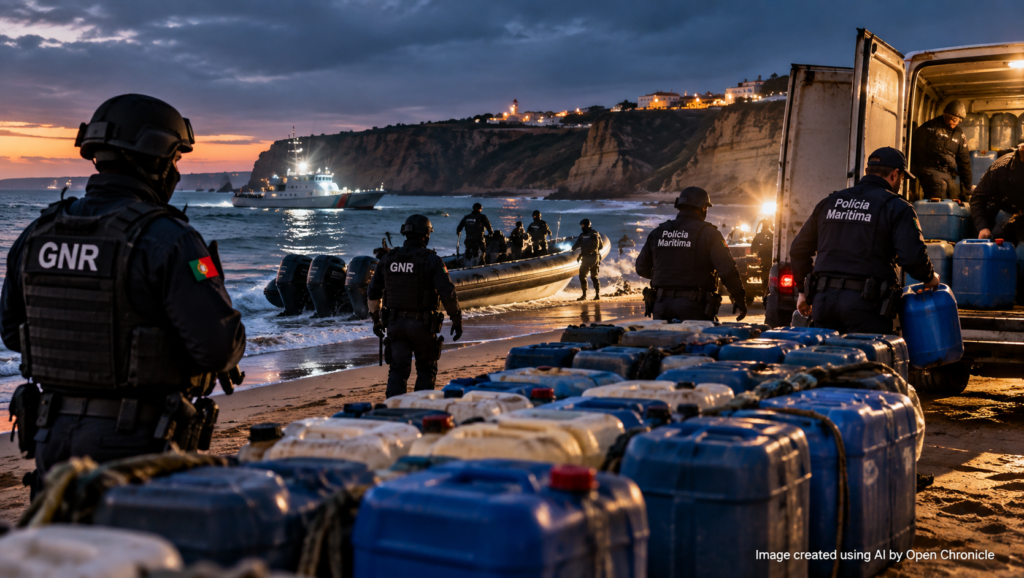
International drug trafficking networks are strengthening their presence in Portugal and increasingly exploiting the Portuguese coastline to move narcotics into Europe, according to the head of the Faro Department of Investigation and Criminal Action, who is calling for urgent legal changes and greater resources for law enforcement.
By Open Chronicle with agencies | September 27, 2026
FARO, Portugal — International drug trafficking organisations are increasingly establishing operations in Portugal and using the country’s coastline as part of their routes into Europe, according to António Ventinhas, director of the Department of Investigation and Criminal Action, DIAP, in Faro.
“The international drug trafficking networks are establishing themselves in Portugal,” Ventinhas warned.
The prosecutor argues that Portugal needs urgent legislative changes alongside greater human and material resources for police and other security authorities confronting increasingly sophisticated trafficking operations.
One of the most immediate concerns involves large quantities of specially prepared fuel used to supply high speed boats associated with maritime drug trafficking.
Around 100,000 litres of such fuel have recently been seized from groups linked to trafficking in the Algarve alone, according to the information cited by Ventinhas.
Seizures in the region are now occurring on a daily basis.
100,000 litres of fuel seized in the Algarve
The enormous quantity of fuel currently held by authorities is connected to several criminal investigations.
Some of the seized fuel has already been authorised by the Public Prosecutor’s Office for use by security force vessels.
Other quantities have been destroyed.
Ventinhas argues that destruction creates an additional financial burden for the Portuguese state and believes the situation exposes a significant weakness in the country’s existing legislation.
The prosecutor points particularly to differences between Portuguese and Spanish law.
Fuel is cheaper in Spain, but Spanish legislation criminalises possession of specially prepared fuel when authorities can demonstrate that it is intended to supply high speed boats operating offshore or from beaches.
Portugal does not currently have an equivalent provision covering the possession of the fuel itself under the same circumstances.
According to Ventinhas, trafficking organisations have identified that difference and adapted their operations accordingly.
Traffickers crossing into Portugal with fuel
The prosecutor says criminal networks are increasingly transporting fuel across the border into Portugal in vehicles, even when their broader logistical structures remain based in Spain.
This allows groups operating high speed vessels to take advantage of differences between the legal systems on either side of the border.
Ventinhas said suspects detained by Portuguese police have demonstrated an awareness of the legislative distinction.
“The suspects caught by the police go as far as saying that they know that in our country they will be released if they are caught with fuel,” he said.
For the Faro DIAP director, Portugal should therefore criminalise possession of this type of fuel when it can be connected to maritime trafficking operations.
He argues that such legislation would complement measures already adopted concerning high speed boats themselves.
High speed boats at the centre of maritime trafficking
High speed vessels have become an important element of drug trafficking operations around the Iberian Peninsula.
Their speed allows criminal organisations to move narcotics and supplies rapidly between larger vessels, coastal areas and clandestine landing points.
The fuel required to maintain these operations has consequently become an important part of the trafficking infrastructure.
Large quantities can be positioned near the coast or transported by road to locations where boats can be refuelled.
For investigators, disrupting that logistical network could make maritime trafficking operations more difficult and expensive.
Ventinhas believes Portuguese legislation needs to evolve accordingly.
Portugal and Spain face unequal resources
The prosecutor is also warning about what he considers a significant difference between the resources available to Portuguese and Spanish authorities.
Joint operations involving agencies from both countries have, according to Ventinhas, highlighted disparities in personnel, equipment and operational capabilities.
The difference becomes particularly important when authorities confront international criminal organisations capable of operating simultaneously on land and at sea.
Portugal’s extensive Atlantic coastline and proximity to established trafficking routes create significant challenges for surveillance and interception.
Ventinhas argues that Portuguese security forces need additional personnel and equipment if they are to respond effectively.
South American cocaine networks using Portuguese coast
Authorities are particularly concerned about South American criminal networks involved in cocaine trafficking.
Ventinhas says such organisations are increasingly using the Portuguese coastline as part of their operations to introduce cocaine into Europe.
At the same time, authorities continue confronting hashish trafficking originating from Morocco.
Portugal therefore faces pressure from different maritime trafficking routes.
Its geographical position on Europe’s western Atlantic frontier makes the country potentially attractive to criminal networks attempting to move narcotics from international waters onto European territory.
The Algarve is especially exposed because of its long coastline and proximity to routes connecting North Africa, the Atlantic and southern Europe.
Faro prosecutors also face staffing shortages
The challenge is not limited to police resources.
The Faro DIAP itself is operating with limited personnel.
Ventinhas currently has four prosecutors working under his direction.
Two are responsible for investigations in the eastern Algarve and another two cover the western part of the region.
Another prosecutor recently left the department.
The staffing situation adds pressure to a unit dealing with increasingly complex investigations involving organised crime, maritime trafficking and international networks.
Cases involving several countries can require extensive cooperation between prosecutors, police forces and foreign authorities.
2,000 litres of petrol discovered in Almada
The prosecutor’s warning comes as Portuguese authorities continue making seizures associated with suspected trafficking logistics.
During the early hours of Wednesday, the Maritime Police, supported by the PSP, discovered 99 fuel containers carrying approximately 2,000 litres of petrol inside a commercial vehicle in the Olho de Boi area of Almada.
The seizure illustrates how significant quantities of fuel can be transported by road before potentially being transferred to maritime operations.
The incident occurred far from the Algarve, suggesting that the logistical challenge is not restricted to Portugal’s southern coastline.
Ten suspects investigated after Aljezur incident
Another operation took place during the early hours of Wednesday in Aljezur, in the Algarve.
The GNR identified eight Spanish citizens and two Moroccan citizens as formal suspects following information provided by a fisherman.
Some of the suspects are believed to have arrived at an Aljezur beach aboard a high speed boat.
Two other Spanish citizens were reportedly found in a vehicle.
The circumstances surrounding the incident are being investigated.
The presence of people of different nationalities also reflects the cross border nature of the trafficking networks Portuguese authorities are attempting to confront.
Portugal faces an evolving organised crime challenge
Ventinhas’ warning points to a broader transformation in Portugal’s position within international narcotics trafficking.
Rather than being used only as a transit point, the prosecutor believes international networks are increasingly establishing a more permanent operational presence in the country.
That development would require authorities to address not only drug shipments themselves but also the infrastructure supporting them.
Vehicles, fuel supplies, high speed boats, coastal landing locations and cross border logistics can all become essential components of sophisticated trafficking networks.
The legal differences between Portugal and Spain may also influence where those organisations decide to position particular parts of their operations.
For Ventinhas, closing those gaps has become urgent.
His proposal to criminalise possession of specially prepared fuel linked to trafficking represents one potential response.
But legislation alone, he argues, will not be sufficient.
Greater numbers of investigators, prosecutors and security personnel, together with improved equipment and stronger cross border cooperation, will be required if Portugal is to prevent international trafficking organisations from consolidating their presence along the country’s coastline.