
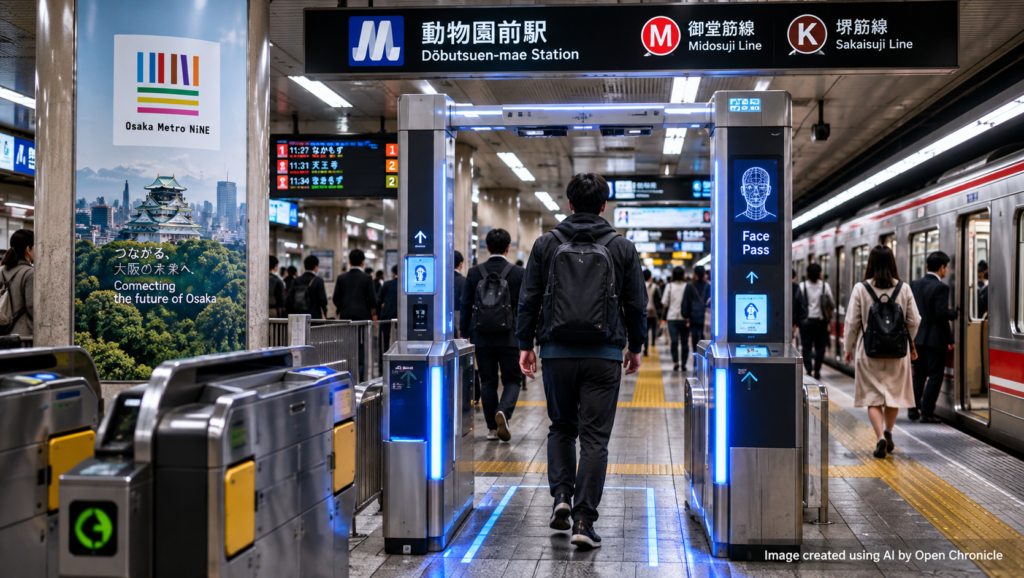
Japan is experimenting with walk through facial recognition ticket gates that allow passengers to enter stations without touching a card or presenting a conventional ticket. The technology looks futuristic, but registration requirements and concerns about providing facial data may be slowing adoption.
By Open Chronicle | September 27, 2026
Japan’s railway system has long been associated with efficiency, automation and technological innovation. Now a new generation of ticket gates is attempting to remove one of the few remaining actions required of passengers: presenting a ticket or tapping a transport card.
The technology is called Face Pass, a facial recognition system designed to identify registered passengers as they walk through a station gate.
There is no ticket to insert and no card to tap. In principle, passengers simply approach the illuminated gate, have their face recognised and continue walking.
The experience looks like something taken directly from science fiction.
Yet despite the apparent convenience, passengers are not exactly rushing to use it.
The reason appears to lie not in the gate itself, but in everything passengers must do before they can walk through it.
A ticket gate that recognises your face
The concept behind Face Pass is straightforward.
Instead of requiring passengers to stop or move a card toward a reader, cameras and facial recognition technology identify the traveller approaching the gate and connect that identity with an eligible digital ticket.
The result is intended to create a smoother flow through stations.
For commuters navigating some of Japan’s busiest transport networks, even eliminating the few seconds required to reach for a card could eventually make a difference when multiplied across thousands of passengers.
The technology also offers a glimpse of how public transportation could evolve as biometric identification becomes more sophisticated.
For now, however, using Face Pass requires considerably more preparation than simply buying a ticket.
Registration comes first
Passengers cannot simply arrive at a station and decide to try the facial recognition gate.
They first need to register as an eMETRO member.
The registration process involves providing personal information and recording facial image data so that the system can recognise the passenger when they approach the gate.
That requirement creates an immediate barrier.
While tapping an existing transport card is familiar and requires almost no thought, facial recognition asks passengers to make a more deliberate decision about sharing biometric information.
For people who are cautious about how their facial data is collected and stored, the convenience of walking through a gate may not yet outweigh those concerns.
Then comes the digital ticket
Creating an eMETRO account and registering a facial image is still not enough.
Passengers must also associate their facial information with a digital ticket.
Instructions at the gate tell users to “Set your facial image on your digital ticket.”
For passengers unfamiliar with the system, that additional step can make something designed to simplify travel initially feel more complicated.
Instead of purchasing a conventional ticket or tapping a card, a first time user must understand the membership system, register personal information, provide facial data and determine how that information connects to the appropriate digital ticket.
Only after completing those preparations does the futuristic simplicity appear.
Then, theoretically, the passenger simply walks.
Technology faces the convenience paradox
Face Pass illustrates a recurring challenge for new consumer technologies.
A system can make the final action dramatically easier while making the initial setup significantly more complicated.
Traditional railway gates already work extremely well.
Millions of passengers understand how to use tickets and electronic transport cards. The process is fast, predictable and deeply embedded in everyday behaviour.
Facial recognition therefore has to compete not against an obviously outdated system, but against one that passengers already find convenient.
That creates a high threshold for adoption.
Saving a few seconds at the gate may be attractive, but passengers first need a reason to register for another service and provide biometric information.
Privacy becomes part of the journey
Facial recognition also changes the nature of the information passengers provide to a transport operator.
A conventional ticket proves that someone has paid for a journey.
A facial recognition system must establish who the registered passenger is by comparing their physical features with stored biometric information.
That distinction can affect how travellers perceive the technology.
People routinely carry smartphones capable of facial authentication, but using biometric information for public transport involves a different relationship between the individual and the organisation operating the system.
The question is therefore not simply whether facial recognition works.
Passengers must also decide whether the additional convenience is worth registering their face in the first place.
Japan is already testing the idea beyond Osaka
The concept is not confined to the Osaka system.
Similar facial recognition ticket gate technology was introduced at two stations on Tokyo’s Tobu Tojo Line in July.
The appearance of biometric gates on different railway networks suggests that operators are actively exploring whether facial recognition could become a practical component of Japanese public transportation.
The experiments also provide an opportunity to observe how passengers respond outside controlled demonstrations.
Technical performance is only one measure of success.
The more important question may be whether ordinary travellers actually choose the facial recognition gates when conventional alternatives are standing beside them.
The strange sight of an empty futuristic gate
That creates one of the most interesting contradictions surrounding Face Pass.
The gate is designed to represent effortless travel.
Yet passengers can stand nearby using traditional ticket gates while the technologically advanced alternative remains comparatively quiet.
The hesitation does not necessarily mean passengers have rejected facial recognition permanently.
New transportation systems often require time before travellers understand them and incorporate them into their routines.
But the situation demonstrates that technological advancement alone does not guarantee adoption.
A technology must also be understandable, accessible and sufficiently useful to persuade people to change familiar habits.
From science fiction to the railway station
The visual impression of Face Pass is unmistakably futuristic.
Its illuminated structure and ability to recognise passengers without physical interaction evoke the kind of technology long imagined in cyberpunk fiction.
Japan has an especially interesting cultural relationship with that vision.
Works such as Ghost in the Shell, whose world is set in 2029, imagined societies in which sophisticated digital systems, artificial intelligence and biometric technologies had become integrated into ordinary life.
With 2029 now approaching, elements of that imagined future increasingly resemble technologies appearing in the real world.
Facial recognition on smartphones has become commonplace. Artificial intelligence systems can communicate conversationally. Autonomous machines are becoming more capable. Digital identity systems are expanding.
And now a passenger in Japan can potentially enter a railway station simply by showing their face to a machine.
The future still needs to convince the passenger
Face Pass demonstrates that the future of transportation is not determined solely by what engineers can build.
It is also determined by what passengers are prepared to use.
Facial recognition gates could eventually reduce congestion and make station entry almost invisible for registered travellers. If the technology becomes widely adopted, reaching for a ticket or transport card could one day feel as dated as feeding coins into an old mechanical turnstile.
But the current experience reveals an important obstacle.
For passengers accustomed to extremely efficient existing ticket systems, facial recognition must offer more than technological novelty. It must provide enough practical benefit to justify registration, learning a new digital ticket process and providing facial information.
Japan may already have railway gates that look as though they belong in 2029.
The harder challenge is persuading passengers that walking through them is easier than simply tapping the card already in their pocket.