
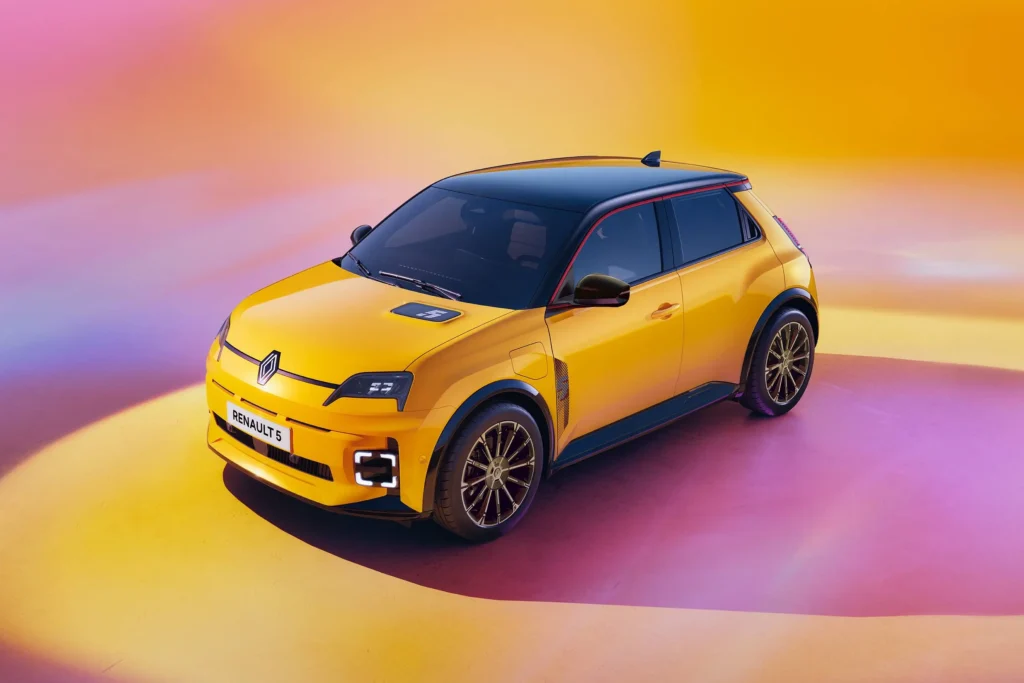
Image courtesy of Renault
By Open Chronicle Auto Magazine
The Renault 5 E Tech has already achieved something many electric cars struggle to accomplish: it has developed a personality.
Awards and enthusiastic reviews have established the reborn Renault 5 as one of the most talked about small electric cars in Europe. But specifications, design awards and first drives only reveal part of the story.
The more important question is what happens after the excitement of delivery fades.
Can the Renault 5 work as an everyday car?
After several months of regular use, the answer is becoming increasingly clear. The little Renault combines character, efficiency and genuinely enjoyable handling in a package that occasionally exposes the compromises involved in turning a compact EV into a family car.
Perhaps most surprisingly, it also seems capable of creating something increasingly rare in modern motoring: a sense of community.
An EV People Actually Notice
Drivers waving at each other because they own the same car feels like something from another era.
Owners of classic Minis, Land Rovers and certain sports cars will recognize the ritual immediately. Seeing another example approaching becomes an excuse for a small acknowledgement between strangers.
The Renault 5 appears to be developing something similar.
That says a great deal about the car’s character. Many electric vehicles are technically impressive but emotionally anonymous. The R5 is difficult to ignore.
Its retro inspired shape recalls the original Renault 5 without simply copying it. Strong proportions, distinctive lighting and unusual colours give it an identity that stands apart from the increasingly crowded small EV market.
Pop Green and Pop Yellow make the car especially conspicuous, while Midnight Blue provides a more restrained alternative.
Renault has also expanded the visual possibilities for the 2026 model, including gold wheels for higher specification Techno+ and Iconic+ versions.
Combine those wheels with Midnight Blue paint and the connection with another famous Renault becomes difficult to miss.
The result evokes the legendary Clio Williams of the 1990s, one of the defining European hot hatchbacks of its generation.
Other additions include Flame Red paint, roof graphics and new exterior detailing, giving buyers even more opportunities to personalize the R5.
More Range for 2026
The more important changes are happening underneath the bodywork.
Renault has extracted additional range from the larger 52 kWh battery offered in Techno+ and Iconic+ versions. The official figure increases from 252 miles to 267 miles, strengthening the R5’s credentials as something more than an urban commuter.
The entry level Evolution model is also changing.
Its previous 40 kWh battery is being replaced by a 36.5 kWh lithium iron phosphate unit related to the battery used by the new Renault Twingo.
The resulting official range is expected to be around 190 miles, while maximum charging speed is 80 kW.
That may appear like a backwards step on paper, but lithium iron phosphate chemistry can provide important cost and durability advantages. If Renault can translate those savings into a lower purchase price, the entry level R5 could become particularly interesting for urban drivers who simply do not need a large battery.
The existing R5 starts at £21,495 in the UK, placing affordability at the heart of the car’s appeal.
Real Range Matters More Than Laboratory Range
Official figures tell only part of the EV story.
In everyday driving, the larger battery Renault 5 does not necessarily reproduce its laboratory range estimate. A full charge can produce a realistic indicated range of approximately 215 to 220 miles, depending on conditions and driving style.
Average efficiency of around 4.4 miles per kWh demonstrates how effective a relatively small and lightweight electric hatchback can be.
Home charging makes the economics particularly compelling.
With overnight electricity priced at 6.9p per kWh, energy costs can fall to roughly 1.5p per mile.
For regular commuters able to charge at home, that represents one of the strongest arguments for electric ownership.
Public charging tells a very different story. Rapid charging prices can be many times higher than domestic electricity tariffs, creating an increasingly important divide between EV owners with access to inexpensive home charging and those dependent on public infrastructure.
The Renault 5 demonstrates both sides of the modern EV equation remarkably well.
Renault Has Not Forgotten About Driving
Efficiency alone would not make the Renault 5 interesting.
What distinguishes it from many small electric cars is the attention Renault has given to its chassis.
The company chose a multi link rear suspension rather than the cheaper torsion beam arrangement commonly found in small cars. It adds manufacturing cost, but the investment becomes apparent from behind the wheel.
Turn in feels eager. Steering provides useful feedback and the suspension maintains tight body control without making the car unnecessarily uncomfortable.
Electric vehicles can sometimes feel heavy and detached because of the mass of their batteries. The R5 largely avoids that sensation.
Its immediate electric torque gives it the responsiveness expected from a compact EV, but the chassis adds something more important: involvement.
The Renault 5 feels like a small car designed by people who still care about driving.
That connection matters, particularly for a company responsible for some of Europe’s greatest hot hatchbacks.
A Digital Cabin With Some Rough Edges
Technology naturally plays an important role inside the R5.
Smartphone integration, connected services and a modern touchscreen interface give the cabin the digital character expected from a contemporary EV.
There are still imperfections.
Apple CarPlay connectivity can occasionally be reluctant, while Renault’s voice activated Reno assistant can sometimes interpret ordinary conversation as a request for assistance.
The AI powered system demonstrates how rapidly artificial intelligence is entering the automotive environment, but also illustrates an important challenge facing manufacturers.
A digital assistant is only useful when it understands when it is actually wanted.
Some harder plastics around the centre console can also reveal the cost constraints involved in producing an affordable EV. Areas exposed to frequent contact may begin showing wear earlier than expected.
None of these issues fundamentally undermines the experience, but they prevent the R5 from feeling completely polished.
The Biggest Compromise Is Space
There is one limitation that software updates cannot solve.
The Renault 5 is small.
That compact footprint makes it excellent in towns and enjoyable on narrow roads, but families will quickly encounter its packaging limitations.
Rear legroom can become restrictive for taller teenagers and adults, particularly on longer journeys.
Boot capacity stands at 326 litres. That is adequate for everyday shopping and smaller luggage loads, but anyone expecting the versatility of a compact SUV may find themselves wanting more.
This is precisely where Renault’s expanding electric range begins to make sense.
The Renault 4 offers a more practical, SUV inspired alternative for customers who appreciate the design philosophy and technology of the R5 but require additional passenger and luggage capacity.
The two cars effectively address different interpretations of affordable electric mobility.
Character Still Matters
Perhaps the most important achievement of the Renault 5 is not measurable through battery capacity, charging speed or acceleration.
It makes people care about it.
The automotive industry’s transition toward electrification has produced extraordinary technological progress, but it has also generated many vehicles that feel remarkably similar. Large screens, smooth acceleration and minimalist interiors have become common across the sector.
Renault chose another path.
The R5 uses history without becoming trapped by nostalgia. It combines recognizable design with modern electric engineering, digital technology and a chassis that retains some of the playful character traditionally associated with small French cars.
There are compromises.
Real world range remains below the official figure. Rear passenger space is limited. Public charging can be expensive. Some interior materials reveal the realities of building an affordable electric vehicle.
Yet none of those shortcomings erase the Renault’s central achievement.
Three months into ownership, it remains a car capable of making an ordinary journey enjoyable.
And when drivers of another Renault 5 start waving from the opposite side of the road, perhaps that tells us something specifications cannot.
The electric car does not have to become an anonymous appliance.
It can still have character.
It can still create enthusiasm.
And occasionally, it can even create a community.