
Image: from Alex Xplore X @AlexXplore
By Open Chronicle Auto Magazine
The Renault 5 E Tech is already proving that its retro inspired design can work far beyond the conventional city car market. In Switzerland, the electric hatchback has now been given a very different assignment: police duty.
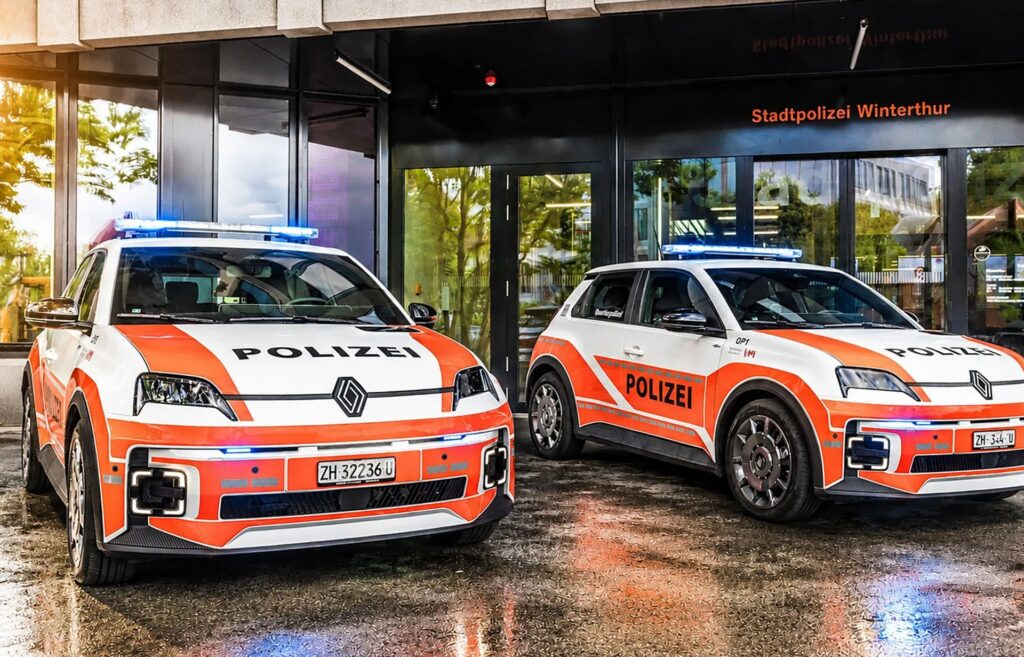
Winterthur City Police, in the canton of Zurich, has introduced seven Renault 5 E Tech electric cars for its neighbourhood policing operations. The vehicles were officially handed over on June 30 and entered regular service from July 1, 2026, replacing the Smart cars that had been associated with the city’s neighbourhood police for more than two decades.
It is an unusual but logical role for Renault’s compact EV. Small dimensions, electric propulsion and urban manoeuvrability make the R5 particularly well suited to patrol work in densely populated areas.
And beneath the distinctive Swiss police livery, these are remarkably close to the Renault 5s available to ordinary customers.
A Renault 5 Built for Police Duty
Winterthur selected the Evolution version of the Renault 5 E Tech electric, equipped with the 120 hp electric motor and 40 kWh Urban Range battery.
The configuration offers a WLTP range of approximately 312 kilometres, or 194 miles. With a length of just 3.92 metres and a wheelbase of 2.54 metres, the R5 is compact enough to negotiate narrow urban streets while still providing the practicality required for everyday neighbourhood patrols.
These are not simply standard cars wearing police graphics.
The seven vehicles were converted specifically for operational use. Their equipment includes an integrated police radio, siren, blue emergency lighting and a roof mounted light bar. The technical conversion was undertaken in Switzerland by Marty Systemtechnik AG, while Indi Graphics in Oberwinterthur produced the exterior markings. Local Renault dealer Hutter Auto is involved in supporting the fleet.
The Pearl White bodywork is combined with Winterthur’s distinctive orange police graphics, transforming one of Europe’s most recognizable new electric hatchbacks into a surprisingly convincing patrol car.
Why an Electric Hatchback Makes Sense
Police vehicles are often associated with powerful saloons, SUVs and specialist pursuit cars, but neighbourhood policing involves very different requirements.
Officers working inside cities spend much of their time travelling relatively short distances between communities, residential areas and public spaces. High top speed matters far less than manoeuvrability, visibility, low operating noise and ease of use.
This is precisely the environment for which the Renault 5 was designed.
Winterthur Police Commander Anjan Sartory said the compact, quiet and locally emission free cars fit the requirements of urban operations and support neighbourhood officers in their daily work.
The electric drivetrain also offers another characteristic that can be useful in neighbourhood policing: silence.
A patrol vehicle can move through residential streets without the constant engine noise associated with an internal combustion car, particularly during low speed operations.
Even the emergency equipment has been considered in relation to efficiency. According to Hutter Auto, the modern LED blue lights consume so little electricity that their impact on the car’s practical range is negligible.
Part of a Larger Fleet Transformation
The seven Renaults are more than an experiment.
Winterthur has been gradually changing the composition of its municipal vehicle fleet, and the police department says the new R5s represent another step in that transition. The city aims to equip its entire fleet with alternative powertrains by 2040.
For electric vehicles, municipal fleets can offer an especially suitable operating environment.
Routes are relatively predictable, vehicles frequently return to a central base and charging infrastructure can be installed where cars are parked between shifts. Those characteristics can eliminate some of the uncertainties associated with long distance private EV ownership.
Police work also provides manufacturers with something particularly valuable: demanding real world usage.
Cars may be driven repeatedly throughout the day, exposed to different drivers and required to operate reliably regardless of weather or traffic conditions.
For Renault, seeing the R5 adopted by a public authority therefore provides a different kind of validation from a conventional consumer sale.
Renault and the Police Have Met Before
There is also a historical dimension to the story.
Renault vehicles have served European police forces for generations. The relationship stretches back to models such as the 4CV in the postwar era and continued through subsequent Renault generations.
The original Renault 5 itself became part of European motoring culture during the 1970s and 1980s, appearing in an enormous variety of civilian and institutional roles.
Now its electric successor is continuing that tradition in a very different technological era.
The contrast is striking.
The original R5 belonged to a world of small petrol engines, mechanical simplicity and analogue dashboards. Its modern descendant arrives with an electric motor, connected infotainment, regenerative braking and sophisticated electronic assistance systems.
Yet the fundamental idea remains surprisingly familiar: build a compact, practical car suited to everyday European streets.
From Retro EV to Working Vehicle
Much of the attention surrounding the reborn Renault 5 has focused on its styling.
That is understandable. Renault deliberately created a car capable of evoking one of its most recognizable historic models while avoiding the appearance of a simple retro replica.
But Winterthur’s decision highlights another side of the R5.
This is not merely an electric fashion statement.
It is a compact working vehicle.
The 120 hp powertrain does not need extraordinary performance for neighbourhood duties. A range of slightly more than 300 kilometres is more than sufficient for many urban patrol patterns, while the compact dimensions make considerably more sense in a European city than a large SUV.
There is also something fitting about seeing the Renault 5 return to public service.
More than half a century after the original model became part of everyday European street life, its electric successor is doing much the same thing.
Only this time, some of them arrive with blue lights.