
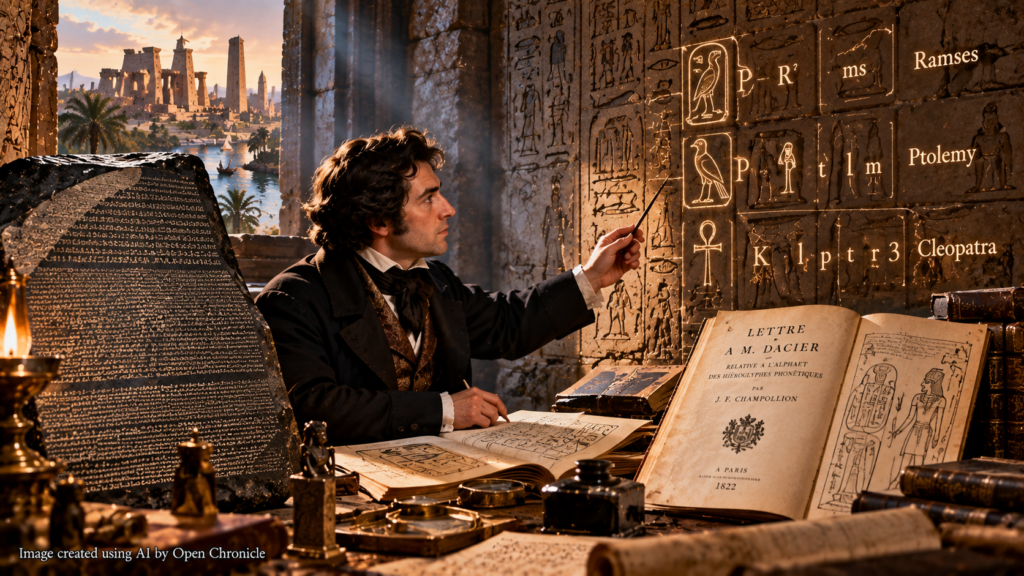
How a brilliant French linguist broke the code of Egyptian hieroglyphs and allowed a civilization silent for centuries to speak again
By Open Chronicle History Desk
For centuries, the temples and tombs of ancient Egypt had been covered with words that almost nobody could read.
Across the walls of Karnak, Luxor, Philae and countless other monuments, human figures, birds, animals, eyes, crowns, plants and mysterious symbols formed elaborate inscriptions.
Europeans could see them.
They could copy them.
They could collect them.
But they could not understand them.
The knowledge required to read Egyptian hieroglyphs had disappeared in late antiquity. By the beginning of the nineteenth century, the writing of one of the world’s most influential ancient civilizations had effectively become a lost language.
Then came Jean-François Champollion.
On September 27, 1822, the 31-year-old French scholar presented his famous Lettre à M. Dacier to the Académie des Inscriptions et Belles-Lettres in Paris.
It was one of the great intellectual breakthroughs in the history of archaeology.
Champollion had begun to unlock the Egyptian hieroglyphic system.
The monuments of ancient Egypt could begin to speak again.
1. A Civilization Covered in Writing
Ancient Egypt was a civilization of writing.
Hieroglyphs appeared on temples, tombs, statues, obelisks, funerary objects and monumental inscriptions.
Egyptian scribes also employed other forms of writing, particularly hieratic and later demotic.
The hieroglyphic system developed more than five thousand years ago and remained in use, in changing forms, for an extraordinarily long period.
But languages and religious traditions changed.
Christianity spread through Egypt during the Roman and Byzantine periods. Older temple institutions declined, and knowledge of hieroglyphic writing gradually disappeared.
After the end of the fourth century AD, the ability to read hieroglyphs was effectively lost.
The symbols remained everywhere.
Their meaning did not.
2. The Mystery of the Hieroglyphs
Later generations developed many theories about Egyptian writing.
Some European scholars believed hieroglyphs were essentially symbolic.
A bird might represent an abstract concept.
A sun might represent light, divinity or creation.
A throne might represent kingship.
There was some truth in the idea that Egyptian signs could carry symbolic meaning.
But it was incomplete.
The crucial problem was that scholars had not yet understood the extraordinary flexibility of the Egyptian writing system.
Hieroglyphs could represent ideas.
They could represent entire words.
But they could also represent sounds.
Recognizing that phonetic dimension would eventually become essential to decipherment.
3. Napoleon’s Expedition to Egypt
The modern story of decipherment became closely connected with Napoleon Bonaparte’s expedition to Egypt.
In 1798, French forces invaded Egypt.
The expedition was military, but Napoleon also brought scholars, engineers, artists, scientists and antiquarians.
They documented monuments, landscapes, plants, animals and archaeological remains.
Their work eventually contributed to the monumental Description de l’Égypte, which helped generate enormous European interest in ancient Egyptian civilization.
Then, in 1799, French soldiers encountered an object that would become one of the most famous archaeological discoveries in history.
A broken stone slab near the town of Rashid, known to Europeans as Rosetta.
It became known as the Rosetta Stone.
4. The Rosetta Stone
The Rosetta Stone carried essentially the same decree in different scripts.
The inscription included:
Egyptian hieroglyphs
Demotic Egyptian
Ancient Greek
The Greek text could be read.
The Egyptian texts could not.
That created an extraordinary possibility.
If scholars could compare the known Greek text with the Egyptian inscriptions, perhaps they could identify corresponding words, names and phrases.
The Rosetta Stone was therefore not a dictionary.
It did not simply place one Egyptian word beside one Greek translation.
Decipherment would require years of linguistic analysis.
But it provided scholars with an essential comparative tool.
The British Museum notes that both Thomas Young and Champollion used the Rosetta Stone and related inscriptions in the process that ultimately led to understanding the Egyptian scripts.
5. The Stone Goes to Britain
France did not retain the Rosetta Stone.
Following the defeat of French forces in Egypt, the stone passed into British possession under the terms associated with the surrender at Alexandria.
It arrived in Britain in 1802.
The Rosetta Stone entered the collection of the British Museum, where it remains today.
But possession of the physical object did not mean exclusive possession of its information.
Copies of the inscriptions circulated among European scholars.
The race to understand Egyptian writing was underway.
6. Thomas Young Enters the Puzzle
Champollion was not working in an intellectual vacuum.
One of the most important figures preceding and overlapping his research was the English polymath Thomas Young.
Young was a remarkable scholar whose interests extended across medicine, physics, optics and languages.
Studying the Rosetta Stone, he made important progress in understanding demotic and hieroglyphic writing.
One particularly important clue came from cartouches.
These oval enclosures appeared around certain groups of hieroglyphs.
Scholars suspected that they contained royal names.
Young demonstrated that some hieroglyphs could function phonetically in the name of the Ptolemaic ruler Ptolemy.
This was a major advance.
The assumption that hieroglyphs operated purely as symbols was beginning to collapse.
7. Jean-François Champollion
Jean-François Champollion was born in Figeac, France, in 1790.
From an early age, he demonstrated an exceptional fascination with languages.
That linguistic background would prove crucial.
Champollion studied Latin and Greek, but also languages associated with the Near East and the ancient Mediterranean.
Most importantly for his later work, he became deeply familiar with Coptic.
Coptic represented the final historical stage of the ancient Egyptian language, written primarily using an adapted Greek alphabet.
Champollion increasingly understood something fundamental.
If Coptic descended from ancient Egyptian, then it might preserve sounds and vocabulary that could help reconstruct the language written in hieroglyphs.
This was one of the intellectual bridges that helped him move beyond simply identifying royal names.
8. The Importance of Coptic
Imagine trying to decipher an unknown writing system without knowing what language lies behind it.
That was one of the central problems confronting early Egyptologists.
Champollion’s knowledge of Coptic gave him an advantage.
He did not treat hieroglyphs simply as visual symbols.
He increasingly approached them as representations of an actual language.
The insight was transformative.
Ancient Egyptian writing was not merely a collection of mystical pictures.
It recorded speech.
And if the language could be reconstructed, the signs could potentially be read.
9. The Cartouches
Royal names provided another crucial opening.
The names of Greek and Roman rulers had been written in Egyptian inscriptions.
Because scholars already knew which rulers were likely being mentioned, these cartouches provided something similar to a cryptographic foothold.
Names such as Ptolemy and Cleopatra could be compared across inscriptions.
If the same signs appeared in corresponding positions, scholars could begin assigning possible sounds to them.
Thomas Young had already made important progress in this direction.
Champollion pushed the method much further.
He began constructing increasingly sophisticated correspondences between signs and sounds.
The code was beginning to open.
10. The Crucial Realization
The breakthrough was not simply discovering that some hieroglyphs represented sounds.
The deeper realization was that the writing system was mixed.
Hieroglyphs could operate in several ways.
Some signs represented sounds.
Others represented words.
Others helped clarify the meaning or category of a word.
This complexity explained why previous attempts based on a single theory had repeatedly failed.
Egyptian hieroglyphic writing was neither simply pictorial nor simply alphabetic.
It combined different principles.
The BnF summarizes Champollion’s mature understanding as a system simultaneously figurative, symbolic and phonetic.
That insight changed everything.
11. September 1822: The Breakthrough
The decisive moment came in September 1822.
According to the famous account, on September 14, Champollion rushed to see his brother Jacques-Joseph.
He had been examining inscriptions and royal names.
He believed he had finally understood the principle.
Champollion reportedly exclaimed that he had solved it and then collapsed from exhaustion or excitement.
The dramatic anecdote became part of the mythology surrounding the birth of Egyptology.
What is certain is that Champollion rapidly prepared his findings.
His work became the celebrated:
Lettre à M. Dacier
The Collège de France records that he completed the letter on September 22 and presented his findings five days later.
12. September 27, 1822
On September 27, 1822, Champollion’s findings were presented before the Académie des Inscriptions et Belles-Lettres in Paris.
The British Museum describes the public reading of the Lettre à M. Dacier as the moment conventionally regarded as the decipherment of Egyptian hieroglyphs.
The full title was considerably longer:
Lettre à M. Dacier relative à l’alphabet des hiéroglyphes phonétiques employés par les Égyptiens pour inscrire sur leurs monuments les titres, les noms et les surnoms des souverains grecs et romains.
The original 1822 edition comprised 52 pages and 16 plates, according to the catalogue of the Bibliothèque nationale de France.
Its importance went far beyond its length.
Champollion had demonstrated a systematic method for reading phonetic hieroglyphs.
A door that had remained closed for centuries was opening.
13. More Than an Alphabet
The phrase “hieroglyphic alphabet” can be misleading.
Ancient Egyptian writing was much more complicated than a modern alphabet.
Some signs represented individual consonantal sounds.
Others represented combinations of consonants.
Still others represented complete words or concepts.
Determinative signs could indicate the semantic category of a word without necessarily being pronounced.
The system was extraordinarily sophisticated.
Champollion gradually recognized this complexity.
His achievement was therefore not merely assigning letters to pictures.
He was reconstructing the underlying logic of an entire writing system.
14. Reading the Pharaohs
Once scholars could begin reading hieroglyphs, Egyptian history changed fundamentally.
Previously, much knowledge about ancient Egypt depended on Greek and Roman authors, biblical traditions, archaeological interpretation and later historical accounts.
Now Egypt’s own inscriptions could increasingly be read.
Pharaohs could be identified.
Royal genealogies could be reconstructed.
Military campaigns could be studied.
Religious texts could be translated.
Administrative records could be understood.
Funerary beliefs could be examined through Egyptian words rather than only through later interpretations.
Ancient Egyptians were becoming historical voices rather than merely archaeological subjects.
15. Ramses and the Ancient Egyptian Language
One of the decisive steps in Champollion’s reasoning came when he applied his developing phonetic system not merely to Greek and Roman royal names, but to names of much older Egyptian rulers.
This mattered enormously.
If phonetic signs had been used only for foreign names such as Ptolemy or Cleopatra, they might have been a late adaptation.
But if similar principles appeared in genuinely ancient Egyptian royal names, then phonetic writing belonged to the deeper structure of the hieroglyphic system itself.
Champollion’s study of inscriptions associated with rulers such as Ramesses helped confirm this.
The implications were profound.
The phonetic principle was not an exception.
It was fundamental.
16. Was the Rosetta Stone Really the Entire Key?
Popular history often tells a simplified story:
Rosetta Stone discovered.
Champollion studies it.
Hieroglyphs solved.
The reality was more complicated.
The Rosetta Stone was enormously important, but Champollion used a much wider collection of inscriptions and comparative material.
The Collège de France emphasizes that he examined hieroglyphic, hieratic and demotic texts from numerous sources, including published inscriptions and objects in European collections. It describes the Rosetta Stone less as a solitary “key” than as a crucial catalyst within a much broader body of evidence.
Decipherment was therefore a cumulative intellectual achievement.
17. Young and Champollion
The relationship between Thomas Young’s work and Champollion’s breakthrough has generated debate for two centuries.
Young unquestionably made important earlier advances.
He recognized phonetic elements in royal names and contributed significantly to understanding demotic and hieroglyphic writing.
Champollion knew of some of this work.
But Champollion went substantially further.
His knowledge of Coptic and his broader linguistic approach allowed him to understand the Egyptian language behind the signs and develop a much more comprehensive interpretation of the writing system.
Modern accounts therefore recognize both the cumulative nature of decipherment and Champollion’s decisive role in establishing the system that made sustained reading possible.
18. The Birth of Egyptology
The consequences extended far beyond linguistics.
Egyptology could now become a textual as well as archaeological discipline.
Researchers were no longer restricted to studying architecture, statues, pottery, tombs and material remains.
They could increasingly read what ancient Egyptians had written.
The British Museum describes the 27 September presentation as marking the birth of Egyptology. Museu Britânico
A civilization spanning thousands of years possessed an enormous surviving textual record.
Decipherment made that archive increasingly accessible.
19. Champollion Goes to Egypt
Champollion did not stop with the breakthrough of 1822.
In 1824, he published his Précis du système hiéroglyphique des anciens Égyptiens, developing his ideas further. BnF – Site institutionnel
He studied Egyptian collections across Europe.
Then came the journey he had dreamed about for years.
In 1828, Champollion travelled to Egypt as part of a Franco-Tuscan expedition with the Italian scholar Ippolito Rosellini.
Now he could test his system directly against the monuments themselves.
Temple walls that had appeared silent to generations of European visitors had become readable documents.
The experiment had moved from libraries to Egypt itself.
20. Reading History from Stone
Imagine standing before an Egyptian temple in 1700.
The walls are covered with writing.
You know the inscriptions contain information.
But you cannot read a single sentence.
Now imagine returning after Champollion’s breakthrough.
The signs begin revealing royal names.
Titles.
Gods.
Battles.
Offerings.
Prayers.
Dates.
Places.
The walls cease being merely decoration.
They become documents.
This was the intellectual revolution created by decipherment.
21. The Rediscovery of Egyptian Voices
Perhaps the most important consequence was not simply discovering facts about pharaohs.
It was recovering Egyptian voices.
Ancient Egyptian civilization had often been interpreted through outsiders.
Greek historians described Egypt.
Roman writers described Egypt.
Biblical traditions described Egypt.
European travellers described Egypt.
Now scholars could increasingly study Egyptian civilization through texts produced by Egyptians themselves.
That did not eliminate problems of interpretation.
But it fundamentally changed the evidence available.
22. Hieroglyphs Were Never Merely Pictures
Champollion’s work also destroyed one of the most persistent misconceptions about ancient Egyptian culture.
Hieroglyphs were not simply mystical images.
They formed a sophisticated writing system capable of recording language with remarkable precision.
Egyptian scribes could express administration, theology, biography, royal ideology, literature, medicine, mathematics and everyday affairs through writing.
The apparent pictures concealed an extraordinarily advanced linguistic technology.
23. Champollion’s Short Life
Champollion’s triumph came at a relatively young age.
He was born in 1790.
He made his decisive breakthrough in 1822.
He became the first curator of the Egyptian collection at the Louvre after the establishment of its Egyptian antiquities department, and continued developing his research. BnF – Site institutionnel
But his career was brief.
Champollion died in Paris in 1832.
He was only 41 years old.
He had spent barely a decade developing the discovery that would permanently attach his name to ancient Egypt.
24. The Rosetta Stone Today
More than two centuries after Champollion’s breakthrough, the Rosetta Stone remains one of the most recognizable objects in archaeology.
Its importance lies not primarily in the decree recorded upon it.
Its significance comes from what the multilingual inscription allowed modern scholars to accomplish.
The stone became a bridge between readable Greek and previously unread Egyptian scripts.
Today, the expression “Rosetta Stone” has entered everyday language as a metaphor for anything that provides the key to understanding a previously mysterious system.
Few archaeological objects have influenced language itself so profoundly.
25. Why September 27 Matters
September 27, 1822 represents something larger than the achievement of one scholar.
It demonstrates how lost knowledge can sometimes be reconstructed.
The Egyptian writing system had vanished from living intellectual tradition.
For centuries, no scholar could reliably read the inscriptions covering Egypt’s ancient monuments.
Yet the evidence survived.
On stones.
On papyri.
On statues.
On temple walls.
And through comparative linguistics, archaeology, painstaking observation and the accumulated work of several scholars, the system could eventually be reconstructed.
Champollion’s achievement did not resurrect ancient Egypt.
It did something more intellectually remarkable.
It restored humanity’s ability to read what ancient Egyptians had written about themselves.
September 27, 1822: When Ancient Egypt Found Its Voice Again
For centuries, hieroglyphs had survived without readers.
The temples remained.
The obelisks remained.
The tombs remained.
The inscriptions remained.
But the connection between the symbols and the language behind them had been broken.
Then scholars began rebuilding that connection.
Thomas Young identified important pieces of the puzzle.
The Rosetta Stone supplied extraordinary comparative evidence.
Coptic preserved a linguistic bridge to ancient Egyptian.
And Jean-François Champollion assembled those strands into a system capable of opening the written world of ancient Egypt.
On September 27, 1822, that breakthrough entered public scholarly history.
The consequences were immense.
Pharaohs whose names had been silent could be named.
Religious texts could be translated.
Historical inscriptions could be examined.
Ancient Egyptian language could become an object of systematic scholarship.
A civilization had not been discovered.
It had never disappeared.
Its monuments had stood for millennia.
Its descendants and cultural legacy had endured.
What changed was the ability of modern scholarship to hear one of its most important surviving voices.
And that is why September 27, 1822 remains one of the defining dates in the history of archaeology.
Open Chronicle History
Historical Sources and Further Reading
Selected institutional resources documenting the decipherment of Egyptian hieroglyphs,
the Rosetta Stone, Jean-François Champollion and the development of modern Egyptology.
01 · Decipherment Timeline
British Museum
Egyptian Hieroglyphs: Decipherment Timeline
A historical chronology of the efforts to decipher ancient Egyptian writing, including
the Rosetta Stone, the contributions of Thomas Young and Jean-François Champollion,
and the breakthrough announced in 1822.
02 · Primary Historical Source
Bibliothèque nationale de France
Champollion’s 1822 Lettre à M. Dacier
Bibliographic record for Jean-François Champollion’s landmark 1822 publication explaining
his discoveries concerning the phonetic hieroglyphs used in Egyptian inscriptions.
03 · Historical Reassessment
Collège de France
Was the Rosetta Stone Really the Key to the Mystery?
A scholarly examination of the decipherment process and the wider body of inscriptions
and linguistic evidence used by Champollion, providing a more nuanced account than the
familiar idea that the Rosetta Stone alone unlocked hieroglyphic writing.
04 · Champollion & Egyptology
Bibliothèque nationale de France
Jean-François Champollion (1790–1832)
An institutional overview of Champollion’s life and scholarship, his study of Egyptian
writing and his central role in establishing the foundations of modern Egyptology.
Editorial Note
Open Chronicle History draws upon museum collections, primary documents, institutional
archives and historical scholarship. The decipherment of Egyptian hieroglyphs was a
cumulative scholarly process. While Jean-François Champollion’s breakthrough in 1822
was decisive, it built upon earlier research, comparative inscriptions, knowledge of
Coptic and contributions by scholars including Thomas Young. The Rosetta Stone was a
crucial source of evidence, but it was not the only material used to reconstruct the
ancient Egyptian writing system.