
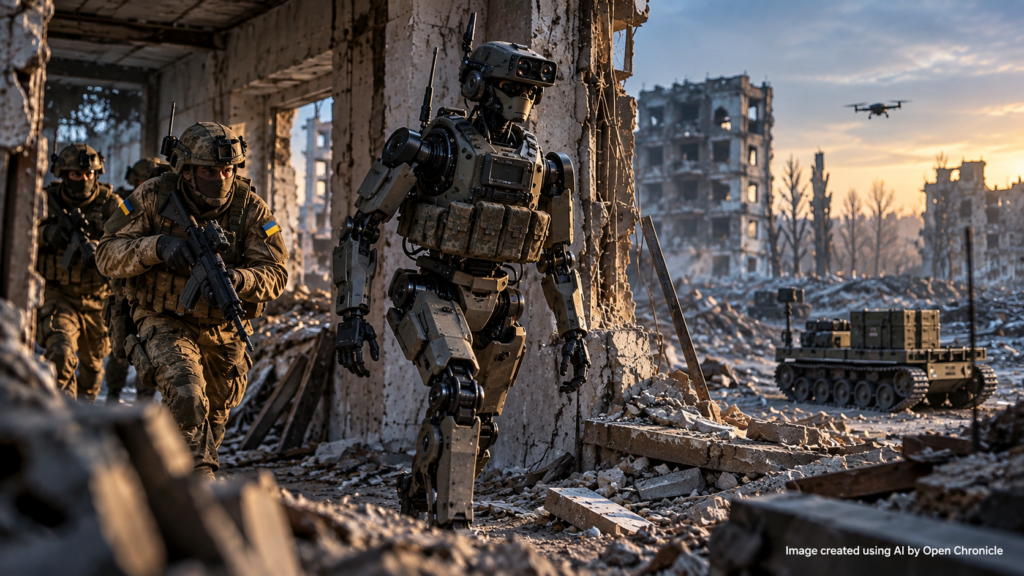
Humanoid robots are beginning to move from factories into military experimentation. Ukraine is providing a real world testing environment for a technology that could eventually transform logistics, reconnaissance, urban combat and the relationship between human soldiers and machines.
By The Grand Strategy Institute Research Division
Grand Strategy Analysis | September 2026
For generations, the idea belonged to science fiction.
A machine shaped like a human walks through a battlefield. It climbs stairs, opens doors, carries equipment, enters buildings too dangerous for soldiers and interprets the physical world through artificial intelligence.
Eventually, perhaps, it carries a weapon.
That future has not arrived.
But something important has changed.
Humanoid robots are beginning to move beyond laboratories and controlled industrial environments into military experimentation. The war in Ukraine, already one of the most important testing grounds for drones and unmanned warfare in modern military history, is now contributing to that transition.
The American robotics company Foundation Future Industries has tested its Phantom humanoid robots in Ukraine. Its chief executive, Sankaet Pathak, has said the company expects to begin exploring armed applications as early as 2027.
For now, however, the publicly described missions are considerably less dramatic.
The machines have been tested for tasks including material handling, moving supplies between indoor and outdoor environments, reconnaissance, mapping interiors and operating inside buildings.
That distinction is essential.
There is no verified evidence that Phantom humanoids are currently operating as autonomous infantry in Ukraine, independently selecting and attacking Russian soldiers.
Calling them autonomous robot soldiers today would therefore exaggerate what has actually been demonstrated.
What is happening may nevertheless prove historically significant.
Ukraine is helping determine whether a machine built around the physical form of a human can perform military tasks that previously required a human body.
And that could open an entirely new chapter in warfare.
Ukraine Has Already Crossed the Robotic Threshold
The humanoid experiment cannot be understood in isolation.
Ukraine is already moving rapidly toward the large scale integration of robots into ground warfare.
By July 2026, Ukrainian defence procurement authorities reported that more than 22,000 unmanned ground vehicles had been contracted for the country’s defence forces during the year, almost twice the number contracted throughout 2025.
Most were logistics platforms, followed by engineering and combat systems.
Ukrainian authorities also reported a sharp increase in logistics and evacuation missions performed by ground robotic systems.
These machines do not generally resemble humans. Many look more like compact tracked vehicles, robotic carts or small unmanned armoured platforms.
But strategically, they demonstrate something much more important.
The progressive removal of human beings from dangerous battlefield tasks has already begun.
Ground robots are increasingly being used to transport ammunition and supplies, evacuate casualties, conduct reconnaissance and undertake missions in areas where sending a soldier would create unnecessary risk.
The humanoid robot is therefore not the beginning of robotic warfare.
It may represent its next branch.
Why Make a Robot Human Shaped?
This is the first question military planners should ask.
Tracks are mechanically simpler than legs.
Wheels are cheaper.
A conventional unmanned ground vehicle can carry substantial loads.
A drone can fly over obstacles rather than climb them.
If the objective is simply to deliver explosives or transport ammunition across open ground, a humanoid may be unnecessarily complicated.
Its potential advantage lies elsewhere.
Modern civilisation has been constructed around the human body.
Doors are positioned for human hands.
Stairs assume human legs.
Ladders assume human proportions.
Vehicles contain controls positioned for human operators.
Weapons have grips and controls designed for human hands.
Factories, warehouses, ships, power stations and military installations contain countless systems built around human reach and movement.
A sufficiently capable humanoid does not require all that infrastructure to be redesigned.
Instead, engineers attempt to adapt the machine to the human world.
That could ultimately become the humanoid robot’s greatest military advantage.
It is not primarily that the machine resembles a soldier.
It is that the machine could potentially operate inside a world built for soldiers.
Phantom Enters the Experiment
Foundation Future Industries is attempting to develop exactly this kind of general purpose physical machine.
Its Phantom programme spans industrial and defence applications. The approximately human sized Phantom MK-1 has been used as the basis for the company’s early military experimentation.
The company is also developing a more capable successor, the Phantom MK-2, with greater environmental protection, increased carrying capacity and more powerful onboard computing.
The company’s ambitions extend beyond military robotics.
Foundation sees humanoids as general purpose machines capable of operating in industrial environments designed around human workers.
That connection between industry and defence is important.
A robot capable of lifting components in a factory, manipulating tools and navigating a human workplace is developing many of the same fundamental physical capabilities that could later prove useful in military logistics.
But defence presents a radically more difficult environment.
Factories are structured.
Battlefields are chaotic.
A factory floor is usually predictable.
A battlefield contains mud, craters, rubble, broken stairs, damaged buildings, smoke, darkness, mines and obstacles that can change within minutes.
Industrial robots generally operate within stable communications environments.
Military robots may operate while an adversary is deliberately trying to jam, deceive, hack or destroy them.
Ukraine therefore provides something that laboratories cannot fully reproduce.
Reality.
Ukraine Is Already Changing the Robot
The Ukrainian trials have reportedly influenced Foundation’s next generation hardware.
According to the company, experience from demanding outdoor conditions has demonstrated the need for greater resistance to water and dust, stronger mechanical components, improved tolerance to falls and substantially greater carrying capacity.
Foundation says the Phantom MK-2 is being developed with a payload capacity approaching 80 kilograms, compared with roughly 25 to 30 kilograms for the earlier system.
The company has also described dramatically improved tolerance to physical impacts and a battery system with approximately 3 kilowatt hours of capacity.
These figures should be treated carefully.
They are manufacturer specifications and development objectives rather than independently verified battlefield performance.
That distinction is particularly important in military robotics.
A machine that performs impressively during a demonstration may behave very differently after days of exposure to rain, mud, dust, freezing temperatures, debris and repeated physical impacts.
Reliability may ultimately prove more important than intelligence.
A soldier who falls can usually stand up.
A sophisticated robot with a damaged actuator may become an extremely expensive piece of immobile equipment.
The First Humanoid Soldiers May Not Fight
The most important early military applications may be surprisingly mundane.
Logistics
Moving ammunition, batteries, water, food and medical equipment toward frontline positions repeatedly exposes soldiers to artillery, mines, snipers and drones.
A robot does not need to replace an infantryman to save an infantryman’s life.
It merely needs to carry the ammunition instead.
Reconnaissance
A humanoid could enter a building before soldiers.
It could map corridors and rooms, inspect basements, identify obstacles and transmit imagery to troops waiting outside.
The ability to move through stairs, doorways and other human infrastructure could become particularly valuable in urban combat.
Casualty Support
Ground robots are already being used in Ukraine for casualty evacuation.
Specialised wheeled or tracked systems will often remain better suited to transporting wounded personnel, but more dexterous robots could eventually help reach casualties inside buildings or confined environments.
Engineering
Future humanoids could manipulate tools, move obstacles, inspect damaged infrastructure or operate in chemically, biologically or radiologically contaminated areas.
Explosive Ordnance Disposal
Military robots have performed bomb disposal missions for decades.
Greater dexterity and mobility could expand the range of objects and environments that machines can safely manipulate.
None of these missions requires a robot independently deciding to kill someone.
Yet collectively they could substantially transform ground warfare.
From Logistics Robot to Armed Robot
This is where the technological development becomes considerably more controversial.
Sankaet Pathak has said Foundation expects to begin exploring armed use cases as early as 2027.
His argument is that humanoids could eventually become useful in situations where military objectives require precision rather than mass destruction.
The reasoning is straightforward.
If the objective is to destroy a building, a missile or bomb will almost certainly be cheaper and more effective than sending a humanoid robot through its front door.
But destruction is not always the mission.
Sometimes soldiers must enter a structure.
Sometimes infrastructure must remain intact.
Sometimes civilians may be nearby.
Sometimes intelligence must be recovered.
Sometimes a target must be located inside a complex physical environment.
A sufficiently capable humanoid could theoretically occupy the operational space between remote destruction and human infantry.
But attaching a weapon to a robot does not automatically create an autonomous weapon.
There are several profoundly different technological thresholds:
A machine carries a weapon.
A human remotely controls that weapon.
AI identifies possible targets but requires human authorisation.
The machine independently selects and attacks a target.
These scenarios are not equivalent.
The final transition is where one of the most difficult questions in the history of military technology begins.
Who Decides to Kill?
Imagine a robot entering a damaged apartment building.
Its sensors detect movement.
Computer vision identifies a person.
The system determines that the person is carrying an object.
Its artificial intelligence classifies that object as a weapon.
The classification is wrong.
The person is a civilian.
The machine fires.
Who made the decision?
The commander who deployed the robot?
The operator who activated it?
The company that designed the system?
The engineers who trained the model?
The military authority that approved its use?
The algorithm itself cannot carry legal or moral responsibility.
This is why the debate over autonomous weapons extends far beyond robotics.
The central question is human agency over lethal force.
International humanitarian law continues to apply regardless of whether force is delivered by a soldier, aircraft, missile, drone or autonomous system.
Distinction between civilians and combatants remains essential.
Proportionality remains essential.
Precautions in attack remain essential.
But increasingly autonomous systems create difficult questions about predictability, accountability and the degree of human judgement necessary before lethal force is applied.
The Law Is Racing the Technology
The international debate has consequently intensified.
The United Nations, the International Committee of the Red Cross and governments around the world have been discussing the implications of lethal autonomous weapon systems.
UN Secretary General António Guterres has warned repeatedly about machines capable of selecting and attacking human targets without meaningful human judgement.
The ICRC has similarly called for legally binding international rules addressing autonomous weapons.
Its position includes calls to prohibit systems whose behaviour cannot be sufficiently understood, predicted or controlled, as well as autonomous systems designed or used specifically to target human beings.
Discussions among states continue under the framework of the Convention on Certain Conventional Weapons.
But no comprehensive global treaty specifically governing all autonomous weapons has yet resolved the issue.
Technology and diplomacy are therefore advancing simultaneously.
The danger is that technology may advance faster.
Artificial Intelligence Gives the Robot a Physical Mind
A conventional industrial robot generally repeats programmed actions.
An intelligent military robot faces a much harder problem.
It must perceive and interpret a constantly changing physical environment.
Foundation says it is concentrating heavily on what are commonly described as world models.
These differ conceptually from the large language models familiar through generative AI.
A language model predicts relationships within language.
A world model attempts to construct a representation of physical reality and predict how that reality may change.
A robot needs to understand questions such as:
Where is the door?
Can I fit through it?
Is the floor stable?
Can I step over this obstacle?
What happens if I lift this object?
Where will that moving object be several seconds from now?
Can I climb those stairs?
Can I recover if I fall?
Humans acquire an intuitive understanding of such problems through years of interacting with the physical world.
Robots must reproduce portions of that understanding through sensors, simulation, training data and artificial intelligence.
This emerging field is increasingly described as physical AI.
Artificial intelligence leaves the screen and acquires a body.
For warfare, that transition could be profound.
Electronic Warfare Will Be the Humanoid’s Enemy
There is another reason why military organisations are interested in greater machine autonomy.
Communications cannot always be guaranteed.
The war in Ukraine has demonstrated the enormous importance of electronic warfare.
Radio links can be jammed.
Navigation signals can be disrupted.
Drone operators can lose communication with their aircraft.
Data links can reveal the location of operators.
A remotely controlled robot that becomes useless whenever its communications link disappears has serious battlefield limitations.
Greater onboard intelligence could allow a machine to continue navigating or completing a limited mission after losing communication.
But that creates a paradox.
The more resilient the machine becomes to communications disruption, the more independent it may need to become.
And the more independent it becomes, the harder continuous human supervision becomes.
The engineering requirement for battlefield resilience can therefore collide directly with the political and ethical desire to maintain human control.
The Robot Will Need Cyber Defence Too
A rifle cannot normally be hacked.
A sophisticated military robot potentially can.
Its cameras can be deceived.
Its communications can be intercepted.
Its software can contain vulnerabilities.
Its navigation data can be manipulated.
Its sensors can receive deliberately misleading information.
Its artificial intelligence may encounter adversarial inputs designed specifically to produce incorrect classifications.
Its supply chain could contain compromised components.
Future robotic forces will therefore require cybersecurity as much as physical protection.
Military cyber defence and battlefield survivability will increasingly converge.
A robot may need protection against bullets, artillery fragments, electronic warfare and malicious software simultaneously.
The Industrial Question May Be Bigger Than the Robot
Prototype capability attracts attention.
Production capacity wins wars.
Foundation has outlined ambitious manufacturing plans for its humanoid systems, including factories potentially capable of producing thousands and eventually tens of thousands of robots annually.
Such figures remain corporate ambitions rather than demonstrated production capacity.
But the strategic principle matters.
One humanoid is a demonstration.
Ten are an experiment.
One hundred constitute a specialised capability.
Ten thousand could begin altering force structure.
One hundred thousand would represent an entirely different military phenomenon.
The decisive breakthrough may therefore come not when the first humanoid successfully carries a rifle, but when humanoids become cheap, reliable and manufacturable at industrial scale.
A New Defence Industrial Base
Mass producing military humanoids would require a defence industrial ecosystem very different from that of the twentieth century.
The supply chain would include:
Advanced semiconductors.
AI accelerators.
Electric motors.
Precision gearboxes.
Actuators.
High density batteries.
Cameras.
Thermal imaging.
Force sensors.
Secure communications equipment.
Rare earth materials.
Artificial intelligence models.
Simulation infrastructure.
Software.
Cloud computing.
Automated factories.
The defence industry and technology industry would become increasingly difficult to separate.
Foundation’s collaboration with AMD illustrates this convergence.
Military power would depend not only on tanks, aircraft, missiles and ammunition factories, but increasingly on processors, robotics manufacturing, AI research and advanced electronics.
The future defence industrial base may resemble a fusion of traditional arms production, advanced manufacturing and the technology sector.
The China Factor
This transformation has wider geopolitical consequences.
The United States possesses substantial strengths in artificial intelligence, advanced computing, defence technology and software.
China possesses enormous capabilities in manufacturing, electronics, batteries, commercial drones and robotics supply chains.
A future military robotics competition would therefore intersect directly with the broader technological competition between Washington and Beijing.
The decisive question may not be which country can demonstrate the most sophisticated humanoid.
It may be:
Who can manufacture reliable intelligent machines fastest, cheapest and in the greatest numbers?
That is not merely a robotics question.
It is a question of industrial power.
The Manpower Revolution
There is another reason governments will be interested.
People are expensive.
A professional soldier requires recruitment, salary, equipment, housing, healthcare and years of training.
Experienced personnel cannot simply be manufactured when war begins.
Many advanced economies also face ageing populations and difficulties recruiting and retaining military personnel.
Robotics introduces the possibility of partially separating military mass from population size.
A force capable of automating logistics, reconnaissance, perimeter security, engineering and other dangerous activities could concentrate scarce human personnel on missions where judgement and adaptability remain indispensable.
This does not mean robots eliminate soldiers.
It means they could change the ratio between people and machines inside military organisations.
Mechanisation did not eliminate infantry.
Aircraft did not eliminate armies.
Drones have not eliminated pilots.
Humanoid robots may not eliminate soldiers.
They may redefine what soldiers do.
The Political Paradox
There is, however, a darker consequence.
Human casualties constrain governments.
Every dead soldier represents a family, a community and potentially a political cost.
Machines alter that equation.
Losing one thousand soldiers is a national tragedy.
Losing one thousand robots is primarily an industrial and financial problem.
That distinction could weaken one of the traditional political constraints surrounding military operations.
Robotics may therefore create a profound paradox:
The technology that makes war safer for soldiers could also make some decisions to use military force politically easier.
That possibility deserves as much attention as the engineering.
Humans and Machines Will Probably Fight Together
The most plausible military future is not an army composed entirely of humanoid robots.
It is something less cinematic and potentially far more consequential.
Human machine formations.
Imagine an infantry unit operating with reconnaissance drones above it.
Electronic warfare systems search for hostile transmissions.
Tracked robots transport ammunition.
Other machines evacuate casualties.
A humanoid enters buildings ahead of soldiers.
AI systems combine information from dozens of sensors into a shared battlefield picture.
Human commanders define objectives and retain authority over critical decisions.
The distinction between infantry, robotics, intelligence and communications begins to blur.
The military unit becomes a network composed of people and machines.
The human soldier remains central.
But the human is no longer alone.
Ukraine Is Building the Bridge
Ukraine is particularly important because the war has demonstrated how rapidly military organisations can adapt when survival demands it.
Ukraine did not invent drones.
It transformed how drones are integrated into warfare.
It did not invent unmanned ground vehicles.
It is accelerating their operational adoption.
The reported contracting of more than 22,000 ground robotic systems during 2026 illustrates the potential transition from experimentation toward industrial scale.
Humanoid robots should therefore be viewed as part of a much broader continuum:
Aerial drones → Ground robots → Intelligent ground robots → General purpose humanoids → Armed humanoids → Potential autonomous lethal systems
Not every step is inevitable.
Not every military will take every step.
Some applications may prove too expensive.
Others may prove technically unreliable.
International law may restrict or prohibit certain forms of autonomy.
Governments may deliberately retain human control.
But the direction of technological experimentation is now visible.
Strategic Assessment
The Grand Strategy Institute assesses that humanoid robots remain an emerging rather than mature military capability.
Current evidence does not establish that autonomous humanoid soldiers are independently fighting in Ukraine.
The Phantom programme should therefore not be presented as the arrival of a robotic infantry army.
Its importance lies elsewhere.
Ukraine is helping determine whether humanoid machines can survive demanding military environments and perform useful tasks traditionally requiring human mobility and dexterity.
At the same time, Ukraine’s much larger adoption of conventional unmanned ground systems demonstrates that the broader robotisation of land warfare is already progressing.
Three thresholds should consequently be distinguished.
The first threshold is physical presence
Robots operate alongside soldiers and undertake dangerous physical tasks.
That threshold has already been crossed.
The second threshold is weaponisation
Machines carry or operate weapons while humans retain authority over lethal force.
Versions of this capability already exist across military robotics, while Foundation has indicated its intention to explore armed applications for humanoid systems.
The third threshold is lethal autonomy
The machine independently selects and engages targets.
That is the threshold around which the deepest legal, ethical and strategic controversy is developing.
The future of military humanoids will depend substantially on where states decide to draw that final line.
The Real Revolution
The image of the robot soldier attracts attention because it resembles science fiction.
But the deeper revolution is not the robot’s shape.
It is the progressive separation of military power from direct human physical presence.
For thousands of years, projecting force on land ultimately required placing a human being somewhere dangerous.
Artillery increased the distance.
Aircraft increased it further.
Missiles extended it across continents.
Drones allowed aircraft to fight without pilots aboard.
Ground robotics is beginning to challenge the final domain where the human body has remained indispensable.
The battlefield itself.
If machines become capable of moving through the same environments, using the same infrastructure and eventually operating some of the same equipment as humans, the nature of land warfare could change profoundly.
The Phantom MK-1 does not prove that future has arrived.
It demonstrates that serious organisations are beginning to build toward it.
Ukraine demonstrates why militaries will continue trying.
Every box carried by a machine instead of a soldier, every building inspected before infantry enters, every casualty retrieved without exposing another human being and every dangerous position approached first by a robot creates a powerful military incentive.
That logic will drive robotic warfare forward even if autonomous killing is ultimately prohibited.
The world should therefore avoid asking only when the first humanoid robot will fire a weapon.
There is a more important question.
At what point does an army become fundamentally different because machines perform enough of the fighting around its human soldiers?
Ukraine may be where that answer is beginning to emerge.
Key Findings
Fifteen strategic findings on humanoid military robotics, battlefield autonomy and the emerging transformation of land warfare.
Humanoid military robotics has entered real world experimentation
Foundation Future Industries has tested Phantom humanoid systems in connection with the war in Ukraine. Publicly described missions have centred on logistics, material handling and reconnaissance rather than verified autonomous lethal combat.
Weaponisation is a future threshold, not a demonstrated Phantom capability
Foundation has indicated that it expects to begin exploring armed applications as early as 2027. This represents a development objective rather than evidence that armed Phantom robots are currently operational in Ukraine.
Ukraine’s robotic transformation extends far beyond humanoids
Ukraine is integrating large numbers of unmanned ground systems into logistics, casualty evacuation, reconnaissance, engineering and combat related missions.
Human compatibility may be the humanoid’s defining advantage
Human shaped robots could eventually operate in buildings, vehicles and infrastructure designed around human anatomy without requiring the physical environment to be redesigned.
Support roles may become important before direct combat
Logistics, reconnaissance, engineering, inspection, casualty support and operations in dangerous environments may provide more immediate military value than attempting to replace infantry soldiers.
Artificial intelligence is turning robotics into physical AI
World models, machine perception and onboard computing could allow increasingly sophisticated robots to understand and navigate complex physical environments.
Electronic warfare creates pressure for greater autonomy
Machines dependent on uninterrupted remote control may be vulnerable to communications disruption. Greater onboard autonomy improves resilience but complicates continuous human supervision.
Cybersecurity becomes battlefield protection
Future military robots will require defence against electronic manipulation, software vulnerabilities, adversarial AI techniques and compromised communications alongside conventional physical protection.
The decisive legal issue is not whether a robot carries a weapon
The critical distinction concerns who selects the target and who authorises lethal force.
International rules remain incomplete
Existing international humanitarian law applies to autonomous weapons, but international debate continues over whether additional binding restrictions or prohibitions are required.
Manufacturing scale could matter more than technological spectacle
A handful of sophisticated humanoids would have limited strategic significance. Reliable mass production could eventually influence military force structure.
Robotics connects military power to advanced industrial ecosystems
Semiconductors, batteries, actuators, sensors, artificial intelligence, software and advanced manufacturing could become increasingly important components of defence industrial capacity.
Demographics could accelerate military adoption
Countries facing ageing populations and recruitment difficulties may find increasing incentives to automate dangerous and labour intensive military functions.
Human machine teaming is more plausible than human replacement
The foreseeable transformation is likely to involve soldiers operating alongside increasingly numerous specialised machines rather than autonomous humanoid armies replacing human forces.
Ukraine may be defining the transition
The strategic importance of Ukraine lies not in demonstrating that robot soldiers have already arrived, but in accelerating the process through which unmanned systems move from experimentation to routine military operations.
The Grand Strategy Institute
Continue Exploring Strategic Analysis
Return to The Grand Strategy Institute for strategic assessments, long-form analysis and research examining geopolitics, military affairs, international security, emerging technologies and the changing international order.
← Back to The Grand Strategy Institute