
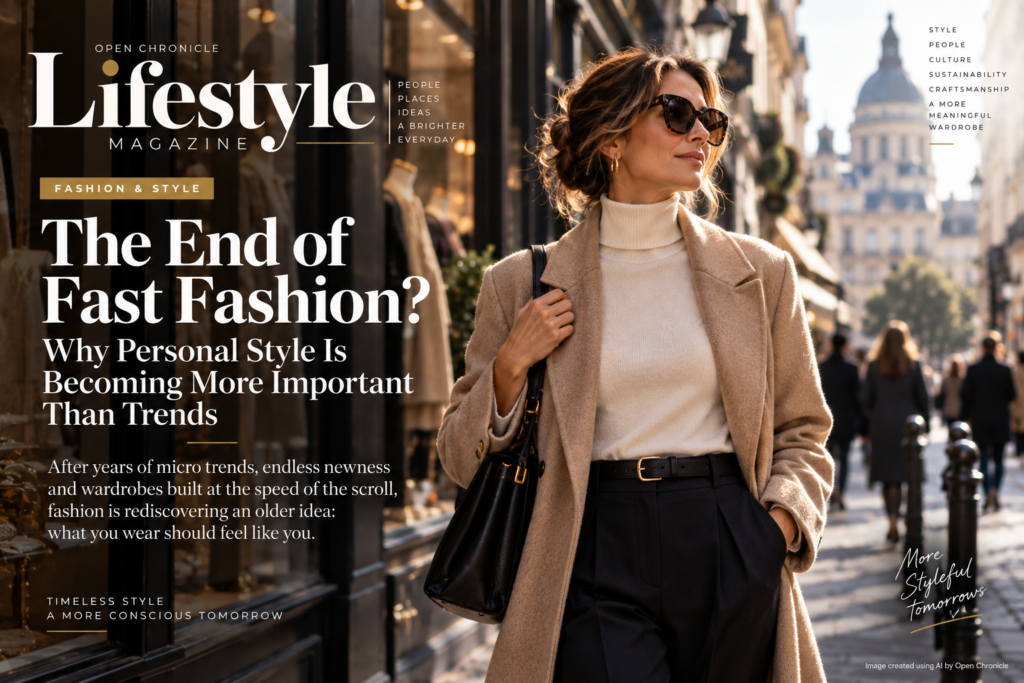
OPEN CHRONICLE LIFESTYLE MAGAZINE · FASHION & STYLE
After years of micro trends, endless newness and wardrobes built at the speed of the scroll, fashion is rediscovering an older idea: the most interesting thing you can wear may simply be something that feels like you.
By Open Chronicle Lifestyle Magazine
Fashion has always changed.
Hemlines rise and fall. Colours disappear and return. Silhouettes once dismissed as outdated become desirable again. Every generation discovers something in the wardrobe of the generation before it and gives it another name.
But something fundamental has changed in the rhythm of fashion.
Trends that once developed across seasons can now appear, peak and disappear within weeks. A particular shoe, silhouette or colour suddenly seems to be everywhere. Social media fills with interpretations of the same aesthetic. Retailers respond. Consumers buy.
Then the algorithm moves on.
Another look arrives.
Another purchase becomes tempting.
Another version of ourselves waits inside the shopping basket.
Fashion has never offered so much choice, so quickly, to so many people.
And yet, somewhere inside this abundance, another idea is beginning to feel surprisingly radical.
What if we stopped trying to keep up?
What if getting dressed became less about following the latest aesthetic and more about understanding what we actually like?
The answer does not mean that fast fashion is disappearing. Far from it. Clothing consumption remains high, ultra-fast retail continues to operate at enormous scale and the economics of inexpensive, frequently changing fashion remain powerful.
But alongside that system, something else is developing.
Resale is expanding. Repair is returning to the policy conversation. Vintage has become part of mainstream fashion culture. Craftsmanship is being rediscovered. European regulators are pushing manufacturers towards greater durability and circularity.
And perhaps most interestingly, personal style is becoming valuable again.
Not because trends have disappeared.
Because there are now so many of them that following everything has become almost impossible.
1. Fashion Has Never Moved This Fast
There was once a recognisable rhythm to the fashion calendar.
Designers presented seasonal collections. Magazines interpreted them. Retailers adapted them. Consumers encountered trends gradually through shops, advertising, film, television and street culture.
The system was never slow, but it contained pauses.
Digital fashion has removed many of them.
A runway image can circulate globally within seconds. A celebrity outfit can generate thousands of imitations before the week is over. An unexpected styling choice can become a social media aesthetic, acquire a name and inspire products across multiple retailers almost immediately.
The smartphone effectively placed the fashion cycle in our hands.
Instead of encountering trends periodically, we can encounter them continuously.
The result is a strange compression of fashion time.
What feels new today can feel familiar tomorrow and exhausted shortly afterwards.
This acceleration did not begin with social media. Fast fashion had already transformed the industry by shortening production cycles, increasing the number of collections and making fashionable clothing available at relatively low prices.
Research published by the Ellen MacArthur Foundation found that clothing production roughly doubled between 2000 and 2015, while the average number of times garments were worn before being discarded declined substantially over the same period.
The model changed our relationship with clothes.
A garment no longer had to remain desirable for years.
It only needed to feel desirable now.
But when fashion accelerates indefinitely, novelty itself begins to lose some of its power.
If everything is constantly changing, perhaps the most distinctive choice is no longer following the change.
Perhaps it is knowing when not to.
2. When the Trend Cycle Became a Scroll
Social media did more than accelerate fashion.
It changed who could create a trend.
Fashion authority was once concentrated among designers, editors, buyers, photographers and a relatively small group of cultural figures.
That hierarchy has fractured.
A teenager filming an outfit in a bedroom can influence millions of people. A forgotten shoe discovered in a vintage shop can suddenly become desirable. An aesthetic can emerge from music, television, gaming, streetwear or an online subculture and spread across continents without waiting for approval from the traditional fashion establishment.
There is something democratic and creative about this transformation.
People have access to extraordinary archives of visual inspiration. They can discover Japanese street style, Italian tailoring, West African textiles, Scandinavian minimalism or decades of fashion history without leaving home.
Someone interested in clothes has arguably never had more opportunities to develop an individual visual language.
But abundance creates another problem.
When inspiration never stops arriving, inspiration can become instruction.
Wear this.
Buy that.
This colour is back.
That silhouette is over.
These shoes are essential.
This aesthetic defines the season.
The scroll transforms fashion from an occasional source of discovery into a permanent stream of suggestions.
And because digital platforms reward novelty, the next aesthetic is always waiting.
The paradox is obvious.
We have unprecedented freedom to discover our own style while simultaneously being exposed to unprecedented pressure to change it.
3. The Rise of the Micro Trend
Traditional trends could survive for years.
The contemporary micro trend may barely survive a season.
A particular neckline, handbag shape, shoe, fabric or styling combination can spread rapidly through social media before disappearing almost as quickly.
Some of these trends are playful and harmless.
Fashion should contain experimentation. Trying something unfamiliar can be one of the pleasures of clothing.
The problem begins when experimentation becomes continuous consumption.
When every new aesthetic requires another purchase, the wardrobe becomes a physical record of abandoned identities.
The dress bought for one version of ourselves.
The shoes associated with another.
The jacket that seemed essential for three months.
The colour we loved because everyone else suddenly loved it too.
None of this means that consumers are irrational.
Fashion has always operated partly through desire, imagination and social belonging.
Clothes are practical objects, but they are also emotional ones.
We buy possibilities.
A suit can represent confidence. A dress can represent romance. A pair of trainers can represent membership in a particular cultural world.
Fashion allows us to experiment with identity without saying a word.
The micro trend industrialises that desire for transformation.
There is always another version of ourselves available for purchase.
Eventually, however, a question emerges.
Which version is actually us?
4. Why Personal Style Is Returning
Personal style is difficult to define precisely because it is personal.
It might involve wearing almost the same silhouette for decades.
It might mean mixing vintage clothing with contemporary pieces.
It could be built around tailoring, denim, colour, jewellery, workwear, dresses, trainers or an apparently chaotic combination that somehow makes perfect sense on one particular person.
Personal style is not necessarily expensive.
It is not necessarily minimalist.
And it certainly does not require ignoring fashion.
Someone with strong personal style can love trends.
The difference is selection.
Instead of asking, “What is fashionable?”, the question becomes, “Does this belong in my life?”
That small change can transform the way we shop.
A trend can be admired without being purchased.
A beautiful garment can be recognised as beautiful without needing to become ours.
A wardrobe can gradually become more coherent because new pieces must negotiate with what is already there.
This is where fashion becomes more interesting.
Clothes stop functioning as isolated purchases and begin forming relationships with one another.
The jacket works with the trousers bought five years ago.
The vintage bag changes the character of a simple dress.
The coat has been worn so often that it has become associated with the person wearing it.
These are not merely outfits.
They are accumulated visual memories.
Personal style takes time precisely because identity takes time.
It cannot be delivered overnight.
5. Quiet Luxury and the Appeal of Restraint
Few recent fashion ideas illustrate the desire for permanence more clearly than the popularity of so-called quiet luxury.
The aesthetic became associated with restrained colours, traditional materials, precise tailoring and products whose value was supposedly communicated through construction rather than obvious branding.
Its cultural influence extended far beyond the genuinely wealthy consumers able to purchase expensive luxury clothing.
Mass-market retailers quickly produced their own interpretations.
Social media transformed restraint itself into another recognisable aesthetic.
The irony was almost perfect.
An idea built around escaping conspicuous trends became a trend.
Yet beneath the marketing language was something more interesting.
Many consumers appeared attracted to the idea of clothes that did not immediately announce when they had been purchased.
A well-cut coat, a simple knit or a carefully made pair of trousers could theoretically survive multiple seasons because their appeal was not dependent on a particularly obvious moment.
That does not automatically make such clothing sustainable.
An expensive garment can still be produced irresponsibly. A minimalist wardrobe can still contain unnecessary purchases. A luxury label is not proof of durability, ethical production or environmental responsibility.
Price and quality are related imperfectly.
But the popularity of restraint revealed an important desire.
In an environment saturated with visual novelty, permanence began to look sophisticated.
The ultimate luxury may not be owning the newest thing.
It may be owning something you still want years later.
6. Vintage, Resale and the Pleasure of Finding Something Unique
For decades, secondhand clothing occupied several different cultural worlds.
For some people it was an economic necessity. For others it was associated with charity shops, vintage collecting or subcultures that rejected mainstream fashion.
Digital resale platforms changed the scale of the market.
Secondhand clothing can now be searched, photographed, priced and purchased with much of the convenience associated with conventional online retail.
The 2026 Resale Report published by ThredUp, based on research conducted by GlobalData, projects that the global secondhand apparel market could reach $393 billion by 2030 and grow at roughly twice the rate of the overall apparel market.
Because ThredUp operates within the resale industry, its projections should be understood as industry research rather than an independent forecast.
Nevertheless, the scale of the market indicates that secondhand fashion has moved significantly beyond a niche activity.
Its appeal is not exclusively environmental.
Resale offers something increasingly difficult to find in conventional retail: unpredictability.
A conventional shop presents a collection.
A secondhand shop presents possibilities.
The perfect jacket may be twenty years old. The bag may no longer be manufactured. The coat may come from a label someone has never encountered.
The search itself becomes part of the experience.
And uniqueness acquires new value in a fashion culture where millions of people can see and purchase the same viral product simultaneously.
Vintage also complicates the idea that fashion must always move forward.
Sometimes the most contemporary-looking garment in a room was made decades ago.
7. Craftsmanship in an Age of Disposable Clothing
There is a particular pleasure in encountering something well made.
A beautifully constructed seam.
Leather that develops character rather than simply deteriorating.
A jacket whose lining has received almost as much attention as its exterior.
A shoe designed to be repaired.
A piece of jewellery carrying evidence of the hands that produced it.
Craftsmanship slows our attention.
It asks us to look closer.
This matters because one of the consequences of extremely inexpensive clothing is that construction can become almost invisible to the consumer.
When a garment costs less than a restaurant meal, it is easy to forget the extraordinary chain of agriculture, chemistry, manufacturing, logistics and human labour required to create it.
The environmental consequences of that system are substantial.
The United Nations Environment Programme reported in its 2025 annual reporting that the textile industry is responsible for an estimated 2 to 8 percent of global greenhouse gas emissions and has a significant water and chemical footprint.
Those figures encompass textiles more broadly and should not be attributed solely to fast fashion.
But they demonstrate why the longevity of garments matters.
A more durable product does not automatically solve the environmental challenges of fashion.
Its value depends partly on whether it is actually used for longer.
A beautifully made coat that remains unworn is still an underused object.
Craftsmanship becomes environmentally meaningful when quality encourages longevity, repair and continued use.
That changes the relationship between buyer and object.
Instead of asking whether a garment can survive this season, we begin asking whether we might still want it in five years.
That is a much more demanding question.
8. Can Fashion Ever Really Become Sustainable?
The word “sustainable” has become almost unavoidable in fashion.
It is also one of the industry’s most difficult words.
Fashion requires materials, energy, manufacturing, transport and labour. Producing something new inevitably creates impacts somewhere in the system.
Different fibres create different environmental pressures. Natural does not automatically mean sustainable. Synthetic does not automatically mean disposable. Recycling technologies have limitations, and claims made about individual products can be difficult for consumers to evaluate.
There is no simple fabric, label or shopping rule capable of resolving the industry’s environmental challenges.
The scale of consumption matters.
According to the European Environment Agency, average apparent consumption of clothing, footwear and household textiles in the European Union reached approximately 19 kilograms per person in 2022, equivalent to around 8.5 million tonnes across the EU.
The same agency estimated that EU countries generated approximately 6.94 million tonnes of textile waste in 2022, around 16 kilograms per person.
Those figures help explain why European policy is increasingly moving beyond voluntary sustainability claims.
Since 19 July 2026, large companies operating under EU rules have been prohibited, with defined exceptions, from destroying unsold clothing, clothing accessories and footwear.
The measure forms part of the Ecodesign for Sustainable Products Regulation, which seeks to encourage products that are more durable, repairable, reusable and resource-efficient.
This represents an important shift.
For years, much of the sustainability conversation focused on what consumers should buy.
Increasingly, regulators are also asking what companies should design, disclose, preserve and avoid wasting.
That distinction matters.
The environmental transformation of fashion cannot depend solely on individuals standing in front of a clothing rail trying to determine which label is morally perfect.
There is no morally perfect wardrobe.
Systemic problems require systemic change.
Consumers can influence demand, but designers, manufacturers, retailers, policymakers and waste systems determine much of what is possible before a garment ever reaches a wardrobe.
9. Building a Wardrobe Instead of Chasing One
Perhaps the most useful alternative to trend chasing is not a capsule wardrobe, a shopping ban or another set of rules.
It is simply learning to pay attention.
Open the wardrobe.
Which clothes are actually worn?
Which pieces consistently make getting dressed easier?
Which colours work together?
Which fabrics feel good?
Which shoes survive real life rather than the imagined life in which they were purchased?
And which garments remain untouched?
The answers are often more revealing than any fashion forecast.
A personal wardrobe is a form of data accumulated over years.
It records our real preferences.
Someone may repeatedly buy dramatic dresses but spend most of life in trousers.
Another person may believe they prefer neutral colours while constantly reaching for a bright red jacket.
We sometimes discover our style not by imagining who we want to be, but by observing who we already are.
This does not require dressing predictably.
A coherent wardrobe can contain eccentricity.
It can evolve.
People change jobs, bodies, cities, relationships and tastes. Clothes should be allowed to change with them.
The difference is that evolution need not require constant replacement.
A wardrobe can develop through editing, repairing, altering, exchanging, reselling and occasionally buying something genuinely new.
The Ellen MacArthur Foundation argues that circular fashion models should increase clothing use through approaches including resale, rental, repair and remaking.
In 2026, the Foundation also noted that businesses built around resale and repair were expanding while still competing within economic structures that often make producing new garments cheaper than circulating existing ones.
That is the strange economics of contemporary fashion.
Sometimes repairing the thing we already own is more difficult than replacing it.
Changing that equation may ultimately matter more than persuading everyone to buy a supposedly perfect sustainable T-shirt.
10. The Future of Style May Be More Personal
Fast fashion is not ending tomorrow.
Nor are trends.
Fashion depends on change. Designers need experimentation. Culture needs novelty. People will continue to enjoy discovering new ways of dressing.
There is nothing inherently shallow about that pleasure.
Clothing is one of the most immediate creative languages available to us.
Every morning, consciously or otherwise, we construct an image and send it into the world.
The question is who controls that image.
The designer?
The retailer?
The influencer?
The algorithm?
Or the person wearing the clothes?
Perhaps the next meaningful shift in fashion will not be another silhouette or colour.
Perhaps it will be a change in attention.
Buying less impulsively.
Looking more carefully.
Learning what quality feels like.
Repairing something worth keeping.
Finding a vintage piece nobody else has.
Wearing an old favourite without worrying whether it still belongs to the current moment.
And occasionally buying something new simply because it is beautiful and we know we will use it.
Personal style offers something that the accelerating trend cycle cannot.
Continuity.
A favourite coat accumulates winters.
A watch can outlive fashions.
A handbag carries journeys.
A dress remembers celebrations.
Clothing becomes interesting not only because of who designed it, but because of what happens after we take it home.
Perhaps that is why the idea of personal style feels newly relevant.
In a fashion culture capable of telling us what to want every time we open our phones, knowing what we already love becomes a form of independence.
The future of fashion may still move extraordinarily fast.
But style does not have to.
Open Chronicle Lifestyle Magazine · Fashion & Style
Sources and Further Reading
Research, policy documents and industry analysis
informing this feature on fashion consumption,
circularity, craftsmanship, resale and the changing
relationship between clothing and personal style.
01 | Textile Consumption & Circularity
European Environment Agency
Circularity of the EU Textiles Value Chain in Numbers
Research covering textile consumption, material
pressures, waste generation, collection and
circularity across the European Union.
02 | Fashion & Environmental Impact
United Nations Environment Programme
Minimizing Fashion’s Environmental Footprint
Research and programme information examining
greenhouse gas emissions, water consumption,
chemicals and circular approaches within the
textile sector.
03 | Circular Fashion
Ellen MacArthur Foundation
Fashion and the Circular Economy
Research exploring clothing utilisation,
durability, circular design, resale, repair
and alternative business models for fashion.
04 | Resale & Repair
Ellen MacArthur Foundation
May 2026
The New Bottom Line: Policy Levers to Scale
Resale & Repair for Fashion
An examination of the economic and regulatory
barriers affecting clothing resale and repair,
and the policy conditions that could help
circular fashion models operate at greater scale.
05 | European Fashion Policy
European Commission
July 2026
Ban on Destruction of Unsold Clothes
and Shoes Enters into Application
Official information on European Union rules
applying to large companies from 19 July 2026
and the wider Ecodesign for Sustainable Products
Regulation.
06 | Secondhand Fashion Market
ThredUp / GlobalData
2026
2026 Resale Report
Industry research examining the development
of the global secondhand apparel market.
Research Context
The report is industry research commissioned
within the resale sector. Its market forecasts
should therefore be interpreted as industry
estimates rather than independent projections.
Editorial Transparency
This feature combines environmental and market
research, European policy developments and original
fashion commentary. References to changes in personal
style, consumer attitudes and the cultural appeal of
particular aesthetics describe broader fashion
developments rather than universal consumer behaviour.
The headline asks whether fast fashion is ending;
available evidence does not establish that it is.
Instead, the article examines the simultaneous growth
of high-volume fashion and alternative models centred
on resale, durability, repair and longer clothing use.
Discover More Lifestyle Stories
Explore inspiring stories about contemporary living, remarkable people, travel, style, wellbeing and the experiences that shape our everyday lives.
← Back to Open Chronicle Lifestyle