
How a coordinated assault from Gaza overwhelmed Israel’s border defenses, killed around 1,200 people, carried 251 hostages into Gaza and triggered a war whose consequences reshaped the region
By Open Chronicle History Desk
At approximately 6:30 on the morning of October 7, 2023, southern Israel came under a massive barrage of rockets and mortar fire from the Gaza Strip.
Within minutes, something far more consequential was happening along the border.
Hamas-led Palestinian armed groups breached the barrier separating Gaza from Israel at numerous points.
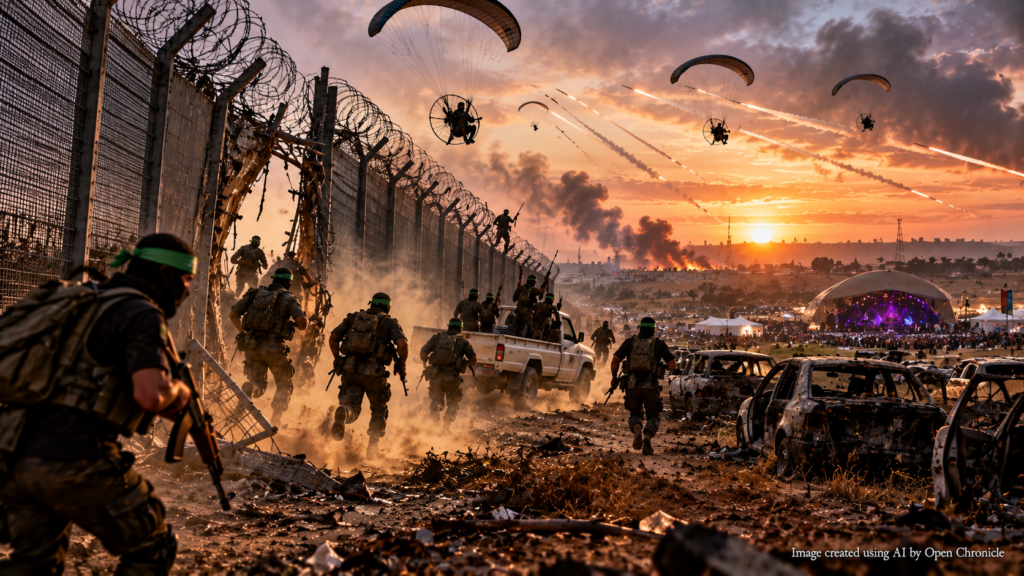
Attackers crossed by land. Others arrived by sea. Motorized paragliders carried additional assailants through the air.
Israeli military positions were attacked.
Communications and surveillance systems were disrupted.
Armed groups entered towns, kibbutzim and other civilian communities.
They reached an outdoor music festival near Re’im.
People were killed in their homes, on roads, at military installations and at the festival.
Others were seized and transported into Gaza.
By the time Israel regained control of the affected communities, roughly 1,200 Israelis and foreign nationals had been killed, making October 7 the deadliest single day in Israel’s history. The final official accounting established that 251 people were abducted and taken into Gaza, including civilians, soldiers, women, children, elderly people and foreign nationals.
The attack represented one of the greatest intelligence and security failures in Israeli history.
It also became the beginning of something much larger.
Israel responded by declaring war against Hamas.
The Gaza war that followed devastated the territory and produced an immense Palestinian civilian toll and humanitarian crisis. The conflict expanded across the Middle East, involving Hezbollah in Lebanon, the Houthis in Yemen, Iran, militias in Iraq and Syria, and direct military exchanges between Israel and Iran.
Three years later, October 7 remains more than a date.
It is a historical dividing line.
1. Gaza Before October 7
The attack did not emerge from a political vacuum.
The Israeli-Palestinian conflict stretched back generations.
Wars, displacement, occupation, terrorism, settlement, failed negotiations, uprisings and competing national movements had shaped the region long before 2023.
The Gaza Strip became one of the central arenas of that conflict.
Israel captured Gaza from Egypt during the Six-Day War of 1967.
For decades afterward, Israel maintained a military presence and settlements inside the territory while Palestinian resistance and militant organizations developed.
The political landscape changed significantly during the 1990s.
2. Oslo and the Hope for a Different Future
The Oslo Accords of the 1990s created the Palestinian Authority and appeared, for a time, to offer a pathway toward a negotiated settlement.
That process ultimately failed to produce a permanent agreement.
The assassination of Israeli Prime Minister Yitzhak Rabin in 1995, continuing settlement expansion, Palestinian militant attacks, political divisions, the failure of later negotiations and the violence of the Second Intifada progressively destroyed much of the optimism surrounding Oslo.
Hamas, which opposed the Oslo process and rejected recognition of Israel, became increasingly important.
3. Hamas
Hamas was founded in 1987, during the First Intifada.
It developed both a political organization and an armed wing, the Izz al-Din al-Qassam Brigades.
The United States, European Union, United Kingdom and several other governments designate Hamas as a terrorist organization.
Hamas combined Palestinian nationalism with Islamist ideology and became a major rival to Fatah, the dominant faction within the Palestinian Authority.
That rivalry would eventually divide Palestinian politics geographically as well as politically.
4. Israel Withdraws From Gaza
In 2005, Israel unilaterally withdrew its permanent military presence and settlements from inside the Gaza Strip.
The following year, Hamas won Palestinian legislative elections.
Political conflict between Hamas and Fatah intensified.
In 2007, Hamas seized control of Gaza after violent clashes with Fatah.
The Palestinian political system effectively fractured.
Hamas governed Gaza.
The Palestinian Authority, dominated by Fatah, remained in control of parts of the West Bank.
Israel and Egypt imposed severe restrictions around Gaza’s borders, with Israel maintaining extensive control over access by air and sea and major aspects of movement into and out of the territory.
The conflict increasingly became cyclical.
5. Gaza’s Repeated Wars
Israel and Hamas fought repeated rounds of conflict.
2008–09.
There were also numerous smaller escalations.
Hamas and other armed organizations launched rockets toward Israel.
Israel conducted airstrikes and military operations inside Gaza.
Ceasefires repeatedly restored temporary calm.
But the fundamental political conflict remained unresolved.
By the early 2020s, Israeli security thinking increasingly treated Hamas as a threat that could be contained rather than eliminated.
That assumption would prove catastrophic.
6. The Barrier
Israel had invested heavily in sophisticated defenses surrounding Gaza.
Sensors.
Cameras.
Observation towers.
Remote weapons.
Electronic surveillance.
An underground barrier designed to prevent tunnels.
Physical fencing.
Military bases.
Israel possessed one of the world’s most technologically advanced intelligence and military establishments.
The border appeared highly monitored.
That technological sophistication helped create confidence.
October 7 would demonstrate the danger of confusing surveillance capability with strategic understanding.
7. Hamas Prepares
The attack required extensive preparation.
Hamas trained assault units.
It studied Israeli positions.
It developed methods for breaching the border.
It prepared rocket forces.
It coordinated different forms of attack.
The planning was designed to overwhelm the Israeli system rather than confront every defensive component individually.
Later Israeli military and security investigations concluded that Israel had fundamentally underestimated Hamas’s intentions and capabilities.
The Israeli military acknowledged that its assumptions about Hamas had been deeply flawed, while Shin Bet subsequently concluded that different action before and during the night of the attack might have prevented the disaster.
8. The Assumption That Hamas Wanted Calm
A crucial failure involved interpretation.
Israeli decision-makers had developed an assumption that Hamas was primarily interested in maintaining its control over Gaza and improving economic conditions rather than initiating a major war.
Hamas appeared to have incentives to avoid an overwhelming Israeli military response.
That interpretation influenced how warning signs were evaluated.
It was not simply that Israel lacked intelligence.
The deeper problem was that available information was filtered through an analytical framework that proved incorrect.
History had seen this before.
Exactly fifty years earlier, in October 1973, Israeli intelligence had also misinterpreted warning signs before the Yom Kippur War.
The parallel was impossible to ignore.
9. October 7, 2023
It was Saturday morning.
It was also Simchat Torah, a Jewish holiday.
At approximately 6:30 a.m., rockets and mortars began flying from Gaza toward Israel.
The barrage provided cover for the ground assault.
The attack was coordinated across multiple domains.
Israeli communities received rocket warnings.
But the scale of what was happening along the border was not yet understood.
Within a short period, attackers were inside Israel.
10. Breaking the Border
Explosives were used against sections of the barrier.
Bulldozers widened openings.
Motorcycles and pickup trucks crossed through breaches.
Attackers also approached by sea.
Motorized paragliders flew over the barrier.
The effect was overwhelming.
Israeli military investigations later described dozens of attack routes and an assault far larger than the forces positioned along the border were prepared to contain.
The defensive system did not merely bend.
In several locations, it collapsed.
11. Military Bases Are Attacked
Hamas-led forces attacked Israeli military positions near Gaza.
Some bases were overrun.
Soldiers were killed.
Others were captured.
Observation and communications capabilities were disrupted.
The attacks on military infrastructure had a wider strategic purpose.
They delayed Israel’s ability to understand what was happening in civilian communities and organize an effective response.
The opening phase produced confusion.
Reports arrived simultaneously from multiple locations.
12. The Communities Near Gaza
The region surrounding Gaza contains kibbutzim, towns, villages and military installations.
Several communities became major scenes of violence.
Among them were Be’eri, Kfar Aza, Nir Oz, Nahal Oz and others.
Armed attackers entered residential areas.
Civilians hid in safe rooms.
Families called police, soldiers and relatives.
Some remained concealed for hours.
Local security teams attempted to resist.
In some communities, fighting continued for much of the day.
The United Nations later concluded that civilians had been deliberately killed and that serious violations of international law had occurred during the assault.
13. Be’eri
Kibbutz Be’eri became one of the places most closely associated with October 7.
Attackers entered the community and killed residents.
Others were abducted.
Israeli security forces fought to regain control.
The battle lasted for hours.
The events at Be’eri later became the subject of Israeli military investigation, not only because of the actions of Hamas but because of questions surrounding the speed and effectiveness of Israel’s response.
The community became a symbol both of the massacre and of the failures that allowed it to occur.
14. Kfar Aza
Kfar Aza also suffered devastating violence.
Residents were killed.
Homes were attacked and burned.
People were abducted.
The scale of destruction became visible to the wider world only after Israeli forces regained access to the area.
Images from the kibbutz became some of the most recognizable photographs of the aftermath.
For survivors, however, October 7 was not an abstract geopolitical event.
It was the destruction of homes, families and communities.
15. Nir Oz
Nir Oz experienced a particularly severe assault.
A large proportion of its residents were killed or abducted.
The community’s experience illustrated one of the defining characteristics of October 7.
Hostage-taking was not incidental to the attack.
It occurred on a very large scale.
People were transported across the border into Gaza.
The hostage crisis would become one of the central political and human dimensions of the war that followed.
16. The Nova Music Festival
Several thousand people had gathered near Re’im for the Nova music festival.
When rockets appeared overhead, the event was halted.
Participants attempted to leave.
Then armed attackers reached the area.
People fled across fields.
Others hid in bushes, shelters, vehicles and nearby locations.
Many were killed.
Others were abducted.
The festival massacre became one of the largest individual sites of killing on October 7 and one of the most powerful symbols of the attack on civilians.
17. The Roads
Violence was not confined to communities or the festival.
Attackers moved along roads in southern Israel.
Vehicles were ambushed.
People attempting to escape encountered armed groups.
Israeli soldiers, police officers and civilians fought in scattered engagements.
Because the front line had effectively disappeared, nobody could easily determine which roads or communities were secure.
For hours, southern Israel became a fragmented battlefield.
18. Local Resistance
The national response was slow in many locations.
Local resistance therefore became crucial.
Kibbutz security teams fought attackers.
Police officers moved toward combat zones.
Off-duty soldiers attempted to reach threatened communities.
Civilians helped evacuate wounded people.
Some individuals drove repeatedly into dangerous areas to rescue festival participants and residents.
These actions could not reverse the strategic failure.
But in individual communities they saved lives.
19. The Hostages
One of the most consequential elements of the attack was the abduction of 251 people into Gaza.
The group included 226 civilians and 25 members of the Israeli security forces, according to a later UN Commission of Inquiry accounting. It included 90 women and 36 children, as well as elderly people and foreign nationals.
Some were taken alive.
Bodies of some people killed during the attack were also carried into Gaza.
The hostages were held in different locations, including tunnels and buildings.
Their fate would dominate Israeli public life for years.
20. Captivity
The hostages had no normal access to the outside world.
The International Committee of the Red Cross was not granted routine access to them.
Later investigations documented severe mistreatment of hostages, including torture and other cruel treatment, and found evidence of sexual violence in captivity.
Some hostages were released through negotiated agreements.
Others were rescued in Israeli military operations.
Some died or were killed in captivity.
The hostage issue became inseparable from every subsequent ceasefire negotiation.
21. Sexual Violence
One of the most sensitive aspects of October 7 concerns sexual and gender-based violence.
Because early reports included claims that varied greatly in reliability, historical treatment requires particular care.
Subsequent UN investigations found reasonable grounds and documented evidence supporting the conclusion that sexual violence occurred during the October 7 attacks and against some hostages in captivity.
At the same time, not every individual claim circulated in the immediate aftermath was independently verified.
A responsible historical account therefore distinguishes between documented findings and unverified stories rather than treating all early reports as equally established.
22. The Death Toll
Initial reports placed the Israeli death toll considerably higher.
As bodies were identified and records reconciled, the number was revised.
The broadly accepted figure is now approximately 1,200 people killed, including Israeli civilians, security personnel and foreign nationals. The United Nations describes the assault as the deadliest attack in Israel’s history.
The scale of the loss was unprecedented in the history of the Israeli state.
23. Israel Realizes the Scale
During the first hours, Israeli authorities struggled to understand the scale of the attack.
Reports were arriving from numerous communities simultaneously.
Some fighting continued into the following days.
Reservists were mobilized.
Military formations moved south.
Israel gradually regained control of the communities and border region.
But by then the strategic landscape had already changed.
The country had suffered an attack that its security establishment had considered extraordinarily unlikely.
24. Benjamin Netanyahu
Prime Minister Benjamin Netanyahu addressed the country as the attack unfolded and said Israel was at war.
The government faced an immediate military crisis.
But October 7 also raised profound questions about political responsibility.
Netanyahu had built much of his political identity around security.
His governments had pursued policies intended, among other goals, to contain Hamas and manage the Palestinian conflict.
After October 7, those assumptions came under intense scrutiny.
Debate over responsibility for the failures preceding the attack became one of the defining political questions inside Israel.
25. The Intelligence Failure
The attack represented a failure across multiple levels.
Intelligence collection.
Intelligence interpretation.
Operational readiness.
Force deployment.
Border defense.
Command response.
Strategic assumptions.
Later Israeli military investigations acknowledged major failures in understanding Hamas and preparing for the possibility of a large-scale assault. Shin Bet likewise acknowledged its own failures.
The issue was not merely that Hamas had surprised Israel.
It was that the surprise occurred despite Israel’s extraordinary surveillance and intelligence capabilities.
26. Technology Was Not Enough
October 7 became a warning about technological dependence.
Cameras could monitor a border.
Sensors could detect movement.
Algorithms could process information.
Electronic systems could identify threats.
But technology could not compensate for flawed assumptions about enemy intentions.
Nor could sophisticated defenses replace sufficient forces when those defenses were breached.
The lesson extended far beyond Israel.
Military establishments around the world studied what had happened.
27. Israel Declares War
Israel launched airstrikes against Gaza and mobilized hundreds of thousands of reservists.
On October 8, the Israeli government formally declared a state of war.
The objective announced by Israeli leaders was to destroy Hamas’s military and governing capabilities and recover the hostages.
The campaign rapidly expanded.
Airstrikes struck targets across Gaza.
A ground offensive followed later in October.
The consequences for Gaza’s civilian population would be enormous.
28. Gaza
Gaza is one of the most densely populated territories in the world.
Its civilians were now trapped inside a major war zone.
Israel ordered evacuations from parts of the territory.
Hundreds of thousands and eventually most of Gaza’s population were displaced.
Homes and infrastructure were destroyed on a vast scale.
Hospitals struggled to function.
Access to food, water, medicine, fuel and shelter became critical.
The humanitarian consequences became one of the central international issues arising from the war.
29. October 7 Does Not Justify Everything That Followed
A historical account has to hold two facts simultaneously.
The Hamas-led attack of October 7 deliberately targeted civilians, involved mass killing and hostage-taking, and constituted grave violations of international law.
The suffering of Israeli civilians does not eliminate the legal protections owed to Palestinian civilians.
The suffering of Palestinian civilians does not erase what happened on October 7.
Understanding one does not require denying the other.
This distinction is essential to any serious history of the conflict.
30. The War Expands North
The conflict quickly spread beyond Gaza.
Hezbollah began exchanging fire with Israel across the Lebanese border.
Northern Israeli communities were evacuated.
Lebanese civilians were displaced.
For months, both sides remained in an escalating confrontation.
Eventually, the northern front developed into a much larger conflict.
The consequences of October 7 were spreading geographically.
31. The Houthis Enter the Conflict
In Yemen, the Houthi movement began launching missiles and drones toward Israel and attacking commercial shipping in and around the Red Sea.
International maritime trade was disrupted.
The United States and allied states conducted military operations intended to protect shipping.
A conflict beginning around Gaza was now affecting one of the world’s most important maritime trade routes.
32. Iran
Iran had long supported Hamas, Hezbollah and other armed groups hostile to Israel.
October 7 intensified the confrontation between Israel and the wider Iranian-led regional network.
Over time, the conflict moved beyond proxy warfare.
Israel and Iran exchanged direct attacks.
The long-standing shadow confrontation between them became increasingly overt.
The strategic architecture of the Middle East was changing.
33. The United States
The United States moved quickly to support Israel.
American military assets were deployed to the region.
Weapons and other military assistance were provided.
Washington simultaneously became deeply involved in efforts to prevent regional escalation and negotiate hostage releases and ceasefires.
As the Gaza war continued and Palestinian casualties mounted, American policy also became the subject of intense domestic and international controversy.
October 7 had once again placed the Israeli-Palestinian conflict at the center of American Middle Eastern policy.
34. November 2023: The First Major Hostage Agreement
Diplomacy produced a temporary pause in fighting in November 2023.
Hostages held in Gaza were exchanged for Palestinian prisoners held by Israel under an agreement mediated principally by Qatar, Egypt and the United States.
Dozens of Israeli women and children and foreign nationals returned from captivity.
Palestinian prisoners were released.
Humanitarian assistance entered Gaza in larger quantities.
For several days, the war paused.
Then fighting resumed.
35. The Hostage Families
The families of hostages became a major force in Israeli public life.
They organized demonstrations.
They met foreign leaders.
They demanded agreements capable of bringing relatives home.
Their pressure sometimes placed them in direct conflict with government strategy.
The hostage question therefore became more than a humanitarian issue.
It became a central political debate over the objectives of the war itself.
Could Hamas be destroyed while hostages remained in Gaza?
Should a ceasefire be accepted to secure their release?
Those questions divided Israeli society.
36. Israeli Society After October 7
October 7 produced profound psychological consequences.
Communities near Gaza were evacuated.
Families were displaced.
Reservists spent long periods away from civilian life.
The hostage crisis remained visible every day.
Memorials appeared across the country.
Political divisions that had dominated Israel before the attack temporarily changed form but did not disappear.
Arguments over responsibility, strategy and the future of the country intensified as the war continued.
Three years later, the trauma remains central to Israeli society.
For Palestinians, the war that followed October 7 became catastrophic.
Gaza suffered enormous destruction and displacement.
Tens of thousands of Palestinians were reported killed during the conflict.
Entire neighborhoods were devastated.
The humanitarian system came under extreme pressure.
The destruction would shape Palestinian society for generations.
Thus October 7 produced two interconnected historical memories.
For Israelis, massacre, hostage-taking and national trauma.
For Palestinians, the beginning of a devastating war in Gaza.
Neither history can be understood adequately by pretending the other does not exist.
38. The World Reacts
The attack and subsequent war triggered enormous demonstrations around the world.
Some demanded the release of Israeli hostages and condemned Hamas.
Others demanded a ceasefire and protested the destruction of Gaza.
Antisemitic incidents increased in numerous countries.
Anti-Muslim and anti-Arab hostility also increased.
Universities became centers of protest.
Governments faced domestic political pressure.
International institutions became arenas of bitter legal and diplomatic conflict.
The war transformed politics far beyond the Middle East.
39. International Law
International humanitarian law became central to the global debate.
Deliberately targeting civilians is prohibited.
Taking hostages is prohibited.
Indiscriminate attacks are prohibited.
All parties to armed conflict are required to distinguish between military objectives and civilians.
The October 7 attacks were investigated for war crimes and other serious violations.
Israel’s subsequent conduct in Gaza also became the subject of major international legal scrutiny.
Historical analysis does not require choosing which civilian population deserves protection.
International humanitarian law applies regardless of identity.
40. The Failure of the Status Quo
Before October 7, much regional diplomacy appeared increasingly able to move forward without resolving the Israeli-Palestinian conflict.
Israel had normalized relations with several Arab states through the Abraham Accords.
Negotiations involving possible normalization between Israel and Saudi Arabia were under discussion.
The Palestinian issue appeared, to some policymakers, increasingly containable.
October 7 destroyed that assumption.
The Palestinian question returned violently to the center of regional politics.
41. Why Did Hamas Attack?
No single explanation is sufficient.
Hamas presented the operation within its ideological and political struggle against Israel and invoked disputes surrounding Jerusalem, the Al-Aqsa Mosque, Palestinian prisoners, Gaza and Israeli policies toward Palestinians.
Strategically, the attack also disrupted a regional order moving toward deeper Israeli integration with Arab states.
But explaining motives is not the same as justifying actions.
Historical analysis can examine why an organization acted while still recognizing that deliberate attacks on civilians and hostage-taking violate fundamental rules of war.
42. The Question of Responsibility Inside Israel
The question of who was responsible for failing to prevent October 7 remained politically explosive.
Military and intelligence leaders acknowledged failures.
Some resigned.
Internal investigations examined operational decisions.
But the broader question extended to government policy and political strategy.
Should Israel establish a full independent state commission of inquiry?
What decisions during the years before October 7 contributed to the disaster?
Those questions continued to divide Israeli politics long after the attack itself.
43. October 7 and October 6, 1973
The historical parallel is striking.
On October 6, 1973, exactly fifty years and one day earlier, Egypt and Syria launched the surprise attack that began the Yom Kippur War.
In both cases, Israel possessed sophisticated intelligence capabilities.
In both cases, warning signs existed.
In both cases, assumptions about enemy intentions shaped how intelligence was interpreted.
In both cases, surprise shattered confidence in the country’s security establishment.
The wars were profoundly different.
But the intelligence lesson was disturbingly familiar.
44. A Historical Turning Point
Some events divide history into a before and an after.
September 11, 2001 did this for the United States.
October 6, 1973 did it for an earlier generation of Israelis.
October 7, 2023 became such a date for Israel.
The political assumptions of October 6 could not simply be restored on October 8.
The belief that Hamas could be contained was shattered.
The security architecture around Gaza had failed.
The hostage issue transformed Israeli politics.
The Gaza war transformed regional politics.
The consequences spread from Lebanon to Yemen and Iran.
The Middle East entered another historical period.
45. Why October 7 Matters
October 7 matters because the attack was not merely another escalation in the Israeli-Palestinian conflict.
It represented the largest single-day loss of life in Israel’s history.
Around 1,200 people were killed.
251 people were taken hostage.
Israeli border defenses were overwhelmed.
Intelligence assumptions collapsed.
Entire communities were devastated.
The attack triggered a war that devastated Gaza.
It destabilized the wider Middle East.
It reshaped Israeli politics.
It changed the regional relationship between Israel and Iran.
It affected global diplomacy.
And it returned the unresolved Israeli-Palestinian conflict to the center of international politics.
Its history is still being written.
October 7, 2023: The Morning Israel Changed
Imagine southern Israel just before dawn.
A Saturday morning.
Families asleep.
Young people still dancing at a music festival.
Soldiers occupying quiet observation posts along a border protected by cameras, sensors and fences.
Then, at approximately 6:30, sirens.
Rockets rise from Gaza.
The sky fills with interception trails.
Explosions are heard.
Phones begin ringing.
Then reports arrive that nobody expected.
Armed men have crossed the border.
Then another report.
And another.
A military base is under attack.
Gunmen are inside a kibbutz.
People are trapped in their homes.
Festival participants are running across open fields.
Soldiers cannot reach communities quickly enough.
Families hide in darkened safe rooms while hearing voices outside.
Some send their final messages.
Others wait for hours before rescue arrives.
By evening, Israel understands that something unprecedented has happened.
But even then, the full scale is not yet known.
Bodies have not been identified.
Hostages have disappeared into Gaza.
Some communities remain contested.
The country’s assumptions about its own security have collapsed in a single morning.
The war that follows will devastate Gaza and spread across the region.
Years later, historians will continue debating the decisions that preceded the attack and the consequences that followed it.
But the dividing line itself will remain unmistakable.
Before October 7.
After October 7.
For Israelis, Palestinians and the wider Middle East, the distinction changed history.
Historical Sources and Further Reading
The October 7, 2023 attacks remain the subject of extensive
historical, military, judicial and international investigation.
The sources below provide documentation concerning the attacks on
Israeli communities and military positions, the killing of civilians,
hostage-taking, subsequent investigations and the intelligence and
operational failures that preceded the assault.
Investigation of the October 7 Attacks
The United Nations Independent International Commission of Inquiry
investigated the attacks carried out in Israel on October 7, including
attacks against civilian communities and military positions,
killings, hostage-taking and allegations of sexual and gender-based
violence. Its reports are important for distinguishing documented
findings from claims that circulated before independent investigation
was possible.
United Nations Documentation on October 7 and the Hostages
United Nations documentation provides an international record of
the October 7 attacks, the killing of Israeli civilians and foreign
nationals, the abduction of hostages into Gaza and the humanitarian
and diplomatic consequences that followed. Statements and reports
from the Secretary-General and other UN bodies also provide important
chronological documentation as casualty and hostage figures were
clarified.
OCHA · Humanitarian Situation and Casualty Documentation
OCHA maintains extensive documentation concerning the humanitarian
consequences of the conflict that followed October 7. Its reporting
is useful for tracing displacement, casualties, humanitarian access
and the evolving conditions affecting civilians in Israel and the
occupied Palestinian territory.
IDF Investigations into the Failures of October 7
The Israel Defense Forces conducted internal investigations into
the events surrounding October 7, examining military preparedness,
intelligence assessments, the defense of communities near Gaza,
command decisions and the response of Israeli forces after the
border was breached. These investigations provide an important
Israeli institutional perspective on the military failures exposed
by the attack.
Intelligence and Security Failures Before October 7
Findings published by Israel’s internal security service are
important for examining the intelligence picture before the attack,
assessments of Hamas’s intentions, warning indicators and the
institutional assumptions that contributed to Israel’s failure to
anticipate and prevent the assault.
Why Some Early Figures Changed
Figures reported during the first days after October 7 changed as
bodies were identified, duplicate records were removed and Israeli
authorities reconstructed what had occurred at dozens of separate
attack sites. The death toll was initially reported at a substantially
higher level before being revised. The established historical record
places the number killed in the Hamas-led attack at approximately
1,200 people. A total of 251 people were abducted and taken into Gaza.
Contemporary figures should therefore be used rather than repeating
preliminary estimates published during the chaotic immediate
aftermath of the attack.
October 7 was documented during conditions of extreme violence,
confusion and incomplete information. In the immediate aftermath,
casualty estimates and descriptions of individual atrocities
circulated before investigators had been able to reconstruct events
at each location. Some early reports were subsequently confirmed,
others were corrected or refined, and some specific allegations
could not be independently substantiated.
Open Chronicle History therefore distinguishes between documented
findings, official investigations, corroborated testimony and claims
that remain unverified. The approximately 1,200 people killed and
251 people abducted should likewise be understood as figures
established after identification and reconciliation of records,
rather than the preliminary estimates published during the first
days after the attack.
This distinction does not diminish the documented scale of the
Hamas-led assault. It reflects the responsibility of historical
reporting to separate what has been established through evidence
from what was reported during the uncertainty of an unfolding
attack.