
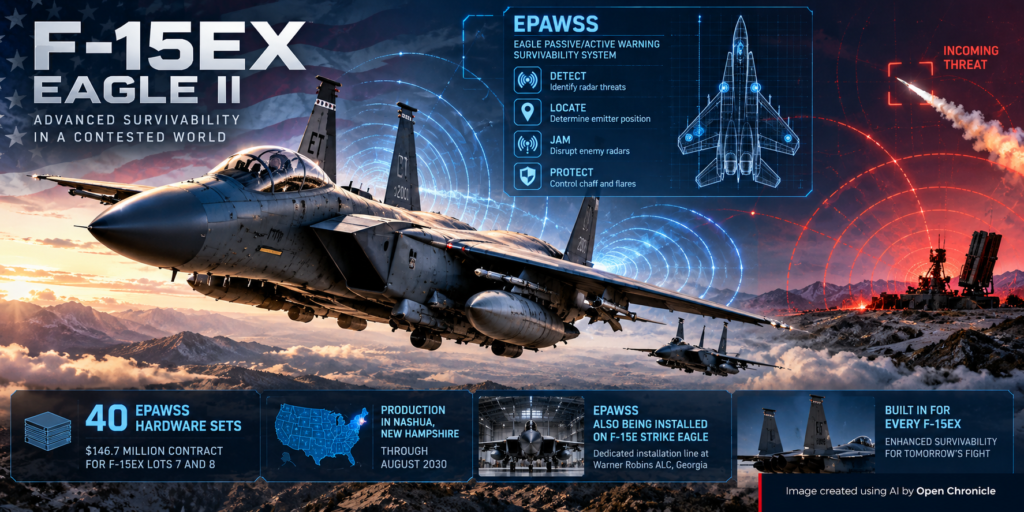
A $146.7 million contract awarded to BAE Systems will provide 40 new EPAWSS electronic warfare hardware sets for future F 15EX Eagle II fighters, strengthening the aircraft’s ability to detect, locate and counter radar guided threats as the U.S. Air Force expands its next generation F 15 fleet.
By Open Chronicle
The U.S. Air Force is expanding the electronic warfare capabilities supporting its F 15EX Eagle II fleet with a new $146.7 million contract for 40 Eagle Passive Active Warning Survivability System hardware sets.
The sole source award to BAE Systems covers aircraft associated with the seventh and eighth production lots of the F 15EX programme.
Under the contract, BAE Systems will manufacture 40 EPAWSS production hardware sets together with magazines and retainers associated with the aircraft’s countermeasure dispensers.
Production will take place in Nashua, New Hampshire, with completion expected by August 31, 2030.
The Air Force obligated $58.8 million in fiscal 2025 and 2026 procurement funding when the contract was awarded.
Based on the overall contract value, the procurement represents approximately $3.7 million for each hardware set.
EPAWSS Is the Eagle II’s Electronic Shield
EPAWSS is one of the most important survivability systems installed aboard the modern F 15.
Rather than being carried externally in a pod, the system is integrated directly into the aircraft.
Its role begins with detecting hostile radar emissions.
When an enemy radar searches for, tracks or attempts to engage the fighter, EPAWSS can warn the crew and help determine the location of the emitter.
The system can then employ electronic countermeasures against the threat while also controlling the aircraft’s deployment of expendable countermeasures such as chaff and flares.
The result is a layered electronic defence intended to make the F 15 significantly more difficult to track and engage.
Every F 15EX Receives EPAWSS
EPAWSS is not an optional addition to the new Eagle II fleet.
Every F 15EX is built with the system installed at Boeing’s production facility in St. Louis.
The latest contract therefore helps align electronic warfare equipment procurement with the aircraft that will emerge from future production lots.
Lots 7 and 8 will form part of the continuing expansion of the F 15EX fleet over the coming years.
The Air Force’s fiscal 2027 budget request has also sought another 24 F 15EX aircraft, illustrating the continuing importance of the Eagle II within the service’s fighter force.
Modernizing the F 15E as Well
EPAWSS is not restricted to newly manufactured F 15EX aircraft.
The Air Force is also installing the system aboard part of its existing F 15E Strike Eagle fleet.
For those aircraft, EPAWSS replaces an older analog electronic warfare suite whose origins stretch back to the 1980s.
That transition represents a substantial technological change.
The electromagnetic environment confronting combat aircraft has evolved enormously since the F 15E entered service. Modern air defence networks can employ digitally controlled radars, rapidly changing waveforms and interconnected sensors.
Electronic warfare systems therefore increasingly require sophisticated digital processing and the ability to recognize and respond to complex threats.
EPAWSS brings those capabilities to both the new Eagle II and upgraded Strike Eagles.
A Dedicated Installation Line for the F 15E
The Air Force has also created infrastructure intended to accelerate the modernization programme.
A dedicated EPAWSS installation line has been established at the Warner Robins Air Logistics Complex in Georgia.
The facility allows F 15E aircraft to receive the new electronic warfare equipment outside their normal scheduled depot maintenance cycles.
That approach can increase the rate at which operational aircraft are upgraded rather than waiting for each fighter to reach its conventional maintenance window.
EPAWSS reached full rate production in early 2025, clearing the way for broader installation across the selected F 15 fleet.
Radar Warning Is Only Part of the Problem
The latest EPAWSS order comes as the Air Force examines another layer of protection for the F 15EX.
On September 29, the F 15 programme office asked industry for an already qualified missile warning system capable of being installed aboard the aircraft.
The Eagle II has six sensor locations designed to accommodate such equipment.
The distinction between the two systems is important.
EPAWSS is principally focused on threats within the radio frequency environment. It can detect radar activity, identify emitters and help counter radar based targeting.
But not every missile needs radar guidance.
Infrared guided weapons can home on the heat generated by an aircraft without transmitting the radar signals that an electronic warfare receiver would detect.
A dedicated missile warning system instead looks for signatures associated with an incoming weapon, such as the heat or light produced by its rocket motor.
Combining the two would provide the F 15EX with complementary forms of threat detection.
Building a More Complete Defensive Architecture
The concept illustrates how aircraft survivability is increasingly based on multiple overlapping systems.
An F 15EX entering contested airspace may encounter surveillance radars, tracking radars, radar guided surface to air missiles, infrared missiles and airborne threats.
No single sensor can necessarily identify every danger.
EPAWSS provides one major component of that defensive architecture by concentrating on the electromagnetic environment.
A dedicated missile warning system could add another layer capable of detecting threats that do not announce themselves through radar emissions.
Chaff, flares and electronic jamming would then provide different methods of attempting to defeat those threats.
The objective is not simply to warn the crew, but to provide enough information and countermeasures for the aircraft to respond rapidly.
The F 15EX Is a Very Different Eagle
Although descended from the original F 15, the Eagle II represents a heavily modernized version of the aircraft.
The two seat fighter is being acquired primarily to replace ageing F 15C and F 15D aircraft in the U.S. Air Force inventory.
Its continued relevance depends partly on combining the proven F 15 airframe with modern avionics, sensors, computing and electronic warfare systems.
EPAWSS is therefore central to the philosophy behind the aircraft.
The F 15EX does not rely on the low observable characteristics associated with stealth fighters. Instead, electronic warfare forms an important part of its approach to survivability.
Detecting an enemy radar early, determining its position and disrupting its ability to produce a reliable targeting solution can become critical when operating around sophisticated air defences.
Electronic Warfare Becomes Increasingly Important
The latest contract also reflects a broader transformation taking place in modern air warfare.
Combat is increasingly extending into the electromagnetic spectrum.
Aircraft are surrounded by radar emissions, communications networks, navigation signals, data links and electronic countermeasures. Controlling or exploiting that environment can influence what pilots can see, what weapons can target and whether an aircraft can be successfully tracked.
That makes electronic warfare equipment increasingly important even aboard aircraft whose basic designs originated decades ago.
The F 15 is a particularly striking example.
Its aerodynamic origins belong to the Cold War, but the sensors and electronic systems inside the newest Eagle II represent a very different technological generation.
Preparing the Next F 15EX Production Lots
The procurement of another 40 EPAWSS sets is therefore more than a routine equipment order.
It ensures that electronic warfare hardware is being prepared for F 15EX aircraft scheduled to enter production over the next several years while the Air Force continues modernizing selected F 15Es already in service.
With production work scheduled through August 2030, the contract also demonstrates how the electronic warfare modernization programme is becoming embedded in the longer term future of the Eagle fleet.
The F 15EX brings considerably more modern technology to one of America’s longest serving fighter families.
EPAWSS is a central part of that transformation.
And as radar, missile and electronic threats continue to evolve, the ability of the Eagle II to understand and fight within the electromagnetic spectrum could become as important as the weapons carried beneath its wings.