
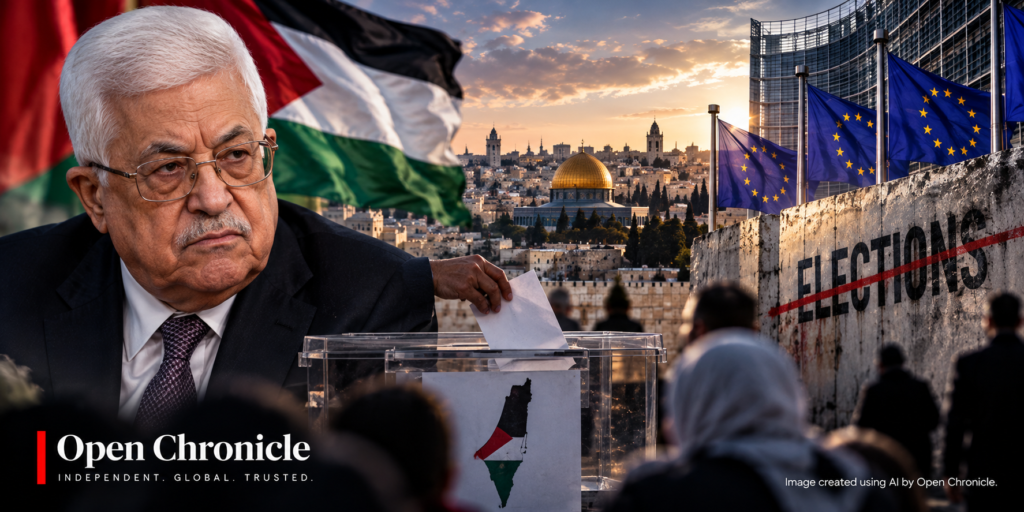
Palestinian President Mahmoud Abbas has postponed legislative elections previously scheduled for November, citing security and logistical obstacles. The decision has drawn criticism from Israel and comes despite European Union calls for renewed democratic legitimacy in Palestinian institutions.
By Open Chronicle with agencies
RAMALLAH, October 10, 2026 — Palestinian President Mahmoud Abbas has postponed legislative elections until September 11, 2027, delaying a long-awaited vote that European officials had described as an important opportunity to renew the legitimacy of Palestinian political institutions.
The Palestinian news agency Wafa reported on Saturday that Abbas had issued a presidential decree setting September 11, 2027, as the new date for both presidential and legislative elections.
The vote had previously been scheduled for November 28, 2026.
According to the Palestinian presidency, the postponement was necessary because of security, logistical and practical difficulties preventing the establishment of appropriate conditions for elections.
The decision was subsequently approved by the Executive Committee of the Palestine Liberation Organisation (PLO), which said circumstances had changed fundamentally since the original election announcement.
Palestinian Leadership Cites Security and Logistical Obstacles
The Palestinian presidency said the decision reflected difficulties in organizing elections under current conditions.
In its announcement, the presidency referred to “security, logistical and on-the-ground obstacles to establishing the conditions necessary for elections.”
The PLO Executive Committee, which represents the Palestinian people internationally, endorsed the postponement, according to Wafa.
The committee said conditions had changed significantly since the electoral process was announced, although the information released did not provide a detailed explanation of how those developments would affect voting arrangements.
The postponement means Palestinians will have to wait almost another year for the opportunity to elect a new legislature.
It also raises questions about the timetable for political and institutional renewal within the Palestinian Authority.
European Union Had Supported November Elections
The decision follows public expressions of support from senior European Union officials for holding the elections before the end of 2026.
Earlier this week, EU foreign policy chief Kaja Kallas said the planned vote represented an opportunity to strengthen the democratic legitimacy of Palestinian institutions.
The elections “would offer a long-overdue opportunity to renew the legitimacy of Palestinian institutions,” Kallas said.
She emphasized that Palestinians should be able to choose their representatives through a democratic process.
“Palestinians have the right to choose their representatives in elections that are credible, inclusive and transparent,” she added.
The European Union had regarded the planned November vote as an important step toward strengthening political representation and institutional accountability.
In September, European Commissioner for the Mediterranean Dubravka Šuica also welcomed the decision to organize elections before the end of the year.
“The elections will be an important democratic moment,” Šuica wrote on social media.
She added that ensuring a fair and inclusive process was essential to strengthening Palestinian institutions.
The latest postponement comes after those statements of European support. No updated response from Kallas or Šuica to Saturday’s announcement was included in the initial reporting.
Israel Accuses Abbas of Breaking Election Promises
Israel criticized the prospect of another postponement even before the Palestinian announcement was formally reported.
On Friday, Israeli Foreign Minister Gideon Sa’ar accused Abbas of “fooling the international community by canceling once again promised elections.”
His remarks followed reports suggesting that the Palestinian leadership was preparing to delay the vote.
The Israeli government has repeatedly questioned the legitimacy of Palestinian political institutions, while Palestinian officials have cited the difficulties of conducting elections under conditions of conflict and insecurity.
The latest disagreement reflects wider tensions over Palestinian governance, international recognition and the future political arrangements in the Palestinian territories.
No Palestinian Legislative Elections Since 2006
The postponement comes against the background of a prolonged absence of Palestinian legislative elections.
The last such vote took place in January 2006, when Hamas defeated Fatah, the movement led by Abbas.
The result was followed by a deepening political confrontation between the two factions.
In 2007, Hamas took control of the Gaza Strip, while the Palestinian Authority, dominated by Fatah, continued to administer parts of the occupied West Bank.
The political division has remained a central obstacle to efforts to establish unified Palestinian governance.
Repeated attempts to reconcile the factions and organize new national elections have failed to produce a lasting settlement.
The absence of regular legislative elections has also generated longstanding questions about political representation and democratic accountability.
Renewed Questions Over Palestinian Political Representation
The decision to move the elections to September 2027 leaves unresolved questions about how Palestinian institutions will renew their democratic mandates.
For European officials, elections have been presented as an important element of institutional reform and political legitimacy.
For the Palestinian leadership, the immediate concern is whether conditions exist for an electoral process that can be organized safely and effectively.
The ability to hold an inclusive vote will also depend on broader political and security developments, including the relationship between Palestinian factions and conditions in the Palestinian territories.
The new decree establishes September 11, 2027, as the intended election date, but the practical arrangements for the vote have not yet been detailed in the information released.
For now, the postponement extends a political situation in which Palestinians have not elected a new legislature for more than two decades.