
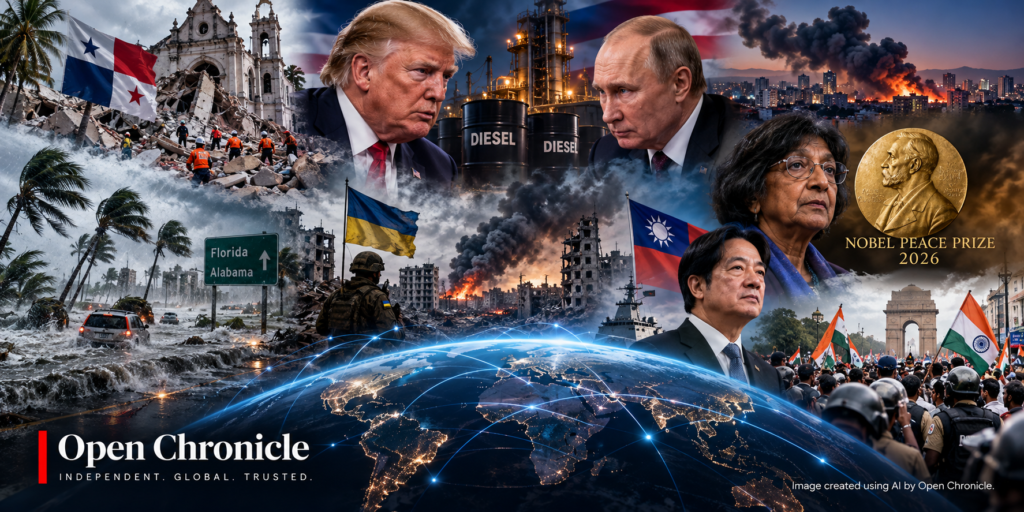
A series of powerful earthquakes has prompted a major emergency response in Panama, while a controversial diesel agreement between Donald Trump and Vladimir Putin has opened a new dispute over sanctions and the war in Ukraine. Russian attacks continue to claim civilian lives, Hurricane Isaias has caused widespread power outages in the United States, and tensions remain high across the Middle East and Asia.
By Open Chronicle with agencies
October 10, 2026
The international news agenda is being dominated by natural disasters, military escalation and a series of political decisions with consequences extending far beyond national borders.
Panama is assessing damage following two powerful earthquakes and multiple aftershocks. In Washington, President Donald Trump’s agreement to facilitate Russian diesel exports has provoked criticism from Ukraine and raised questions about the future of American sanctions against Moscow.
At the same time, Russian air attacks have killed civilians in Ukraine, Israeli military operations continue in Gaza and Lebanon, and renewed fighting in Yemen is threatening regional stability.
Elsewhere, Hurricane Isaias has disrupted communities along the United States Gulf Coast, Indian authorities have detained protest organizers ahead of demonstrations in New Delhi, and Taiwan’s president has reaffirmed the island’s determination to defend its democratic freedoms.
Americas
Panama Declares Major Disaster After Two Powerful Earthquakes
Panamanian authorities have declared a major disaster following two powerful earthquakes that struck the country on Friday, prompting evacuations, damaging buildings and triggering tsunami alerts along parts of the Pacific coast.
The first earthquake, reported at magnitude 7.7, struck central Panama near Pitaloza Arriba in Herrera province. A second earthquake, reported at magnitude 6.6, followed as communities were already dealing with repeated aftershocks.
Reports of structural damage included the collapse of a cathedral and damage to a hotel facade in Penonomé, in Coclé province.
Residents fled homes and offices in Panama City and other urban centres, while emergency services began assessing the condition of roads, buildings and essential infrastructure.
Authorities warned that aftershocks could pose additional dangers, particularly to structures weakened by the initial earthquakes.
The reported seismic measurements and the full extent of the damage remained subject to confirmation as emergency assessments continued.
Hurricane Isaias Leaves Hundreds of Thousands Without Electricity
Hurricane Isaias struck the Florida Panhandle and neighbouring Alabama, bringing destructive winds, heavy rainfall and widespread electricity outages.
Reports indicated that hundreds of thousands of customers had lost power across affected communities.
The storm made landfall along the United States Gulf Coast as a Category 2 hurricane, prompting evacuations and emergency warnings.
Utility companies began assessing damaged electrical infrastructure as authorities urged residents to avoid flooded roads and fallen power lines.
The hurricane also raised concerns about coastal flooding and the ability of emergency services to reach isolated communities.
Officials continued monitoring the storm’s movement and the potential for additional flooding as recovery operations began.
Chile Declares Disaster Zone After Heavy Rain and Mudslides
Authorities in Chile declared part of the Santiago metropolitan area a disaster zone following heavy rainfall and destructive mudslides.
The Las Condes district was among the affected areas, with reports describing vehicles swept along flooded streets and significant damage to roads and residential neighbourhoods.
Emergency crews worked to clear debris, restore access and assess risks in areas vulnerable to further landslides.
The disaster has renewed attention to the vulnerability of urban infrastructure during extreme rainfall events.
Trump Appoints Katie Zacharia as White House Press Secretary
President Donald Trump has reportedly appointed Katie Zacharia as the new White House press secretary.
Zacharia, described in the supplied reporting as a former Fox News commentator and adviser associated with Trump’s Truth Social platform, is expected to become a prominent public representative of the administration.
The appointment comes at a politically sensitive moment, with the White House facing questions over energy prices, immigration, military policy and the approaching congressional midterm elections.
The administration’s communication strategy will be closely watched as Republicans seek to defend their congressional majority.
Pentagon Execution Plan Sparks Political and Legal Controversy
Trump has expressed support for a reported Pentagon proposal to livestream the execution of Nidal Malik Hasan, the former US Army psychiatrist convicted of carrying out the 2009 Fort Hood shooting.
The proposal has generated criticism from civil liberties advocates and lawmakers concerned about the public broadcasting of an execution.
Opponents argue that such a broadcast would raise serious ethical questions and could turn capital punishment into a public spectacle.
Supporters have emphasized the gravity of Hasan’s crimes and the suffering of victims and their families.
The controversy has reopened a wider American debate over the death penalty, military justice and the limits of public access to executions.
The reported plan’s legal status and implementation details require further confirmation.
US Senator Calls for Investigation Into West Bank Killings
A United States senator has called for a public hearing into allegations that authorities failed to adequately investigate the killings of American citizens in the occupied West Bank.
The demand adds to growing scrutiny of the protection of American nationals in conflict zones and the accountability of security forces.
The supplied reports did not identify the specific cases or provide details of the evidence underlying the senator’s allegations.
Europe and the War in Ukraine
Trump Reaches Diesel Agreement With Putin, Drawing Criticism From Kyiv
President Donald Trump’s decision to facilitate Russian diesel exports has become one of the most consequential international developments of the day.
Following a telephone conversation with Russian President Vladimir Putin, Trump announced an agreement under which Russia would make substantial quantities of diesel available to international markets.
The president said the arrangement was intended to reduce fuel prices, which have risen sharply amid the war in Iran.
According to the announced schedule, Russia would initially supply more than 300,000 tonnes, followed by 500,000 tonnes in November, another 1 million tonnes and a further 3 million tonnes over an unspecified period.
The United States Treasury Department reportedly issued temporary sanctions relief to allow the transactions.
The agreement marks a significant change in Washington’s approach to Russian energy exports after years of restrictions imposed over Moscow’s invasion of Ukraine.
Ukrainian President Volodymyr Zelenskyy criticized the decision, describing it in the supplied reporting as a gift to Putin.
Ukrainian Foreign Minister Andrii Sybiha also warned that easing economic pressure on Russia could encourage Moscow to continue its military campaign.
The arrangement has drawn criticism from American lawmakers who argue that additional Russian energy revenues could undermine the sanctions framework.
The White House has not clarified the commercial terms, final destinations or delivery timetable for all the fuel involved.
Russian Strikes Kill Civilians in Ukraine
Russian attacks continued across Ukraine as diplomatic controversy surrounding the diesel agreement intensified.
Reports from Zaporizhzhia described a devastating glide bomb attack that killed civilians, including children.
Initial casualty figures varied as emergency services continued searching damaged areas. Some reports placed the death toll at seven or eight, while later accounts indicated at least 12 deaths and another reported 15.
These figures should be treated as provisional rather than combined into a single confirmed total.
Ukrainian authorities condemned the strikes and renewed calls for stronger international pressure on Moscow.
The attacks came amid continuing Russian operations against Ukrainian cities, infrastructure and defensive positions.
Ukraine has also maintained its campaign of drone strikes against Russian energy facilities, with reports of an attack on an oil terminal in Rostov.
Kyiv has indicated that it intends to continue targeting facilities it considers important to Russia’s military and economic capacity.
Diplomatic Efforts Continue Despite Military Escalation
Representatives from the United States, Ukraine and European countries have reportedly been discussing security guarantees and possible terms for a political settlement.
Talks in Miami were overshadowed by Trump’s diesel agreement with Putin.
Reports also suggested that Moscow remained reluctant to accept some proposed conditions for de-escalation.
The contrasting developments underline the difficulty of pursuing negotiations while military operations continue and the parties remain divided over territory, security guarantees and sanctions.
Finland, meanwhile, approved another military assistance package for Ukraine, reflecting continued European support for Kyiv.
Russia Expands Trade Outside the Dollar
Putin has highlighted the growing use of national currencies in trade among members of the Commonwealth of Independent States.
According to the Russian president, approximately 90 percent of trade within the grouping is now conducted without the US dollar.
Moscow has promoted alternative payment arrangements as part of its response to Western financial sanctions.
The shift reflects Russia’s efforts to reduce exposure to dollar-based financial systems, although the supplied figures have not been independently verified.
France Faces Scrutiny Over Police Response to Student Protests
France’s continuing student demonstrations have placed police tactics under renewed scrutiny.
Reports of injuries caused by so-called less-lethal weapons have intensified criticism of crowd-control methods.
The protests, driven by concerns over education policy, economic conditions and police conduct, have spread across several cities.
The government faces pressure to address protesters’ demands while maintaining public order.
Middle East
Gaza Ceasefire Remains Fragile One Year Later
A year after the reported Gaza ceasefire, humanitarian organizations say many of its central promises remain unfulfilled.
More than 100 nongovernmental organizations have reportedly warned that the truce exists largely in name, citing continuing military operations, restrictions on humanitarian access and deteriorating living conditions.
Reports on Saturday described five Palestinians killed in Israeli strikes in Gaza.
The casualty figures and circumstances of individual incidents had not been independently verified for this edition.
Humanitarian agencies continue to warn about hunger, malnutrition, inadequate shelter and damage to essential services.
Disagreements over Hamas disarmament, governance arrangements and security guarantees remain major obstacles to a durable settlement.
Palestinians Welcome Navi Pillay’s Nobel Peace Prize
Palestinian officials welcomed the reported awarding of the 2026 Nobel Peace Prize to South African jurist Navanethem Navi Pillay.
Pillay, a former United Nations High Commissioner for Human Rights and international judge, has spent decades working on accountability for serious violations of international law.
She also chaired a United Nations investigative commission examining alleged violations in Israel and the occupied Palestinian territories.
The commission’s conclusions concerning Gaza have been rejected by Israel.
The Nobel announcement has drawn renewed attention to the role of international courts and investigative institutions in conflicts involving allegations of war crimes and other serious violations.
Trump, meanwhile, criticized the Nobel decision and questioned why he had not received the award.
United States Imposes New Sanctions on International Criminal Court
Washington has reportedly introduced additional sanctions against the International Criminal Court.
The Trump administration argues that the court should not exercise jurisdiction over American nationals without US consent.
The measures follow earlier disputes over ICC investigations involving American personnel and Israeli officials.
The court has rejected attempts to restrict its operations, maintaining that it must be able to conduct investigations and prosecutions independently.
The dispute highlights widening tensions between the administration and international legal institutions.
Yemen Conflict Intensifies as Houthis Continue Regional Attacks
The conflict in Yemen has entered another dangerous phase following Houthi attacks against Saudi Arabia and renewed military operations by the Saudi-led coalition.
Riyadh’s international airport reportedly resumed normal operations after disruptions caused by earlier attacks.
At the same time, coalition forces announced operations against Houthi positions, while Yemeni government forces reported repelling an attack near the Bab el-Mandeb strait.
A United Nations envoy warned that Yemen risked returning to full-scale war and urged renewed dialogue.
Humanitarian organizations have raised concerns about displacement, shortages of shelter and rising food and fuel prices.
The fighting also threatens maritime security near one of the world’s most important shipping routes.
Lebanon Welcomes US Decision on Air Travel Restrictions
Lebanese authorities welcomed a reported decision by Trump to lift longstanding restrictions on direct air travel between Lebanon and the United States.
The move could create opportunities for improved transport connections and economic exchange, although operational and regulatory details remain unclear.
Meanwhile, Israeli military operations continued in southern and eastern Lebanon, with reports of shelling, drone strikes and casualties.
The developments illustrate the contrast between diplomatic openings and continuing regional instability.
Iran Retains Military Capabilities Despite Strikes
A new report cited in the supplied headlines suggests that Iran retains significant missile and drone production capabilities despite months of US and Israeli attacks.
The findings, if confirmed, would raise questions about the effectiveness of efforts to weaken Tehran’s military-industrial infrastructure.
Washington has also issued security warnings to American citizens in the region amid concerns about further escalation.
Reports indicate that diplomatic discussions over Iran’s nuclear programme remain possible, although military pressure continues.
Asia and the Indo-Pacific
Taiwan President Says Peace Cannot Come at the Expense of Freedom
Taiwanese President Lai Ching-te has reaffirmed the island’s commitment to peace while insisting that its people will not surrender their democratic freedoms.
Speaking amid continuing pressure from Beijing, Lai defended plans to increase military spending and strengthen Taiwan’s defensive capabilities.
The president argued that greater preparedness is intended to deter conflict rather than provoke it.
He also called for closer cooperation among Indo-Pacific democracies.
China considers Taiwan part of its territory and has not ruled out the use of force to bring the island under its control.
Taiwan’s government rejects Beijing’s sovereignty claims and maintains that the island’s future must be determined by its people.
Indian Authorities Detain Protest Leaders Ahead of New Delhi Demonstrations
Indian police have detained leaders of an emerging youth protest movement ahead of planned demonstrations in New Delhi.
The movement, referred to in the supplied reports as the Cockroach Party, has organized protests over electoral administration and broader dissatisfaction with the government.
Authorities reportedly increased police deployments and introduced transport restrictions before the demonstrations.
The protests have drawn attention to allegations concerning voter registration and the independence of electoral institutions.
Some reports included claims that large numbers of voters had been removed from electoral rolls, but those figures were not independently established.
The detentions have raised concerns among critics about freedom of assembly and political dissent.
Elon Musk Drawn Into Indian Political Dispute
Elon Musk has shared reports concerning political donations by companies associated with the Reliance business group to India’s ruling Bharatiya Janata Party.
The development comes amid commercial tensions involving Musk’s Starlink satellite internet service and India’s telecommunications market.
The supplied reports also describe public exchanges involving Reliance chairman Mukesh Ambani.
The underlying donation claims and any connection to commercial regulatory decisions require independent verification.
Türkiye Introduces Social Media Restrictions for Children
Türkiye has announced restrictions on access to social media services for children under 15, with reports indicating that the rules are due to take effect on November 1.
The measure forms part of a wider international debate over children’s online safety, platform responsibility and the effects of social media use on young people.
Questions remain about how age verification will operate and how the restrictions will affect privacy and access to information.
South Korea and China Face New Technology Security Questions
Reports that South Korean banks may have been targeted by a China-based threat actor using an artificial intelligence agent have renewed concern about emerging cybersecurity risks.
Separately, American authorities announced action against digital infrastructure allegedly used by China-linked hackers to target critical systems.
The developments illustrate the growing role of artificial intelligence and advanced digital tools in international security disputes.
Attribution of cyber operations remains complex and should be distinguished from independently established responsibility.
Africa
Kenya Faces Ebola Concerns Following Reported Death
Kenyan health authorities are reportedly investigating the country’s first Ebola-related death and tracing possible contacts after reports that an infected patient travelled across three countries without being detected.
The situation has prompted concern about cross-border disease surveillance and the speed of public health responses.
The supplied reports do not establish the precise circumstances of the case or the extent of any potential outbreak.
Ethiopia Fighting Raises International Concern
The United Nations Secretary-General has expressed serious concern over renewed fighting in Ethiopia.
The escalation raises fears of additional civilian displacement and worsening humanitarian conditions.
The supplied reports did not provide sufficient detail to establish the scale of the latest clashes.
Tanzania Bus Fire Kills 28
At least 28 people were reported killed in Tanzania after a bus caught fire following a collision with a timber truck.
The incident has raised renewed concerns about road safety and emergency response capabilities.
Authorities were expected to investigate the circumstances of the crash.
Morocco’s King Calls for Greater Focus on Young People
Morocco’s King has called for youth concerns to become a central priority in public policy.
The appeal comes amid wider debates over employment, economic opportunities, education and the expectations of younger generations.
Global Economy, Technology and International Security
Energy Markets Remain Under Pressure
The Trump-Putin diesel agreement illustrates the growing influence of geopolitical conflict on global energy markets.
The war in Iran has disrupted expectations for oil and refined fuel supplies, while Western sanctions continue to shape Russian energy exports.
Governments face increasing pressure to secure affordable energy without undermining broader foreign policy objectives.
The effects are being felt by transport companies, agricultural producers and consumers facing higher operating and living costs.
Artificial Intelligence Raises New Security Concerns
Artificial intelligence remains at the centre of debates over cybersecurity, corporate accountability and public safety.
Reports concerning an AI agent allegedly providing misleading information to police, alongside allegations of AI-assisted cyberattacks, have intensified scrutiny of automated systems.
The incidents raise questions about reliability, oversight and the consequences of deploying increasingly autonomous technologies in sensitive environments.
International Institutions Face Growing Political Pressure
The Nobel Peace Prize announcement and the US sanctions dispute with the International Criminal Court have placed international law back at the centre of global political debate.
Supporters of international judicial institutions argue that accountability mechanisms are essential to protecting civilians and preventing impunity.
Critics question the jurisdiction, independence and political application of some international courts.
The competing positions reflect a broader disagreement over how international law should operate when powerful states reject or challenge the authority of global institutions.
A World Confronting Multiple Crises
The developments of October 10 illustrate the growing overlap between military conflict, economic pressure, natural disasters and domestic political instability.
In Panama and the United States, emergency authorities are responding to major natural hazards.
In Ukraine and the Middle East, civilian populations continue to bear the consequences of prolonged military operations.
In Washington, decisions concerning Russian energy supplies are testing the relationship between economic priorities and sanctions policy.
Across Asia, governments are confronting questions of national security, democratic freedoms and technological change.
The immediate outcomes of many of these developments remain uncertain.
What is clear is that decisions taken in one region are increasingly influencing conditions elsewhere, from global fuel prices and international trade to diplomatic relations and humanitarian security.
For governments and international institutions, the challenge is not simply to respond to individual crises, but to manage their consequences in an increasingly interconnected and unstable international environment.