
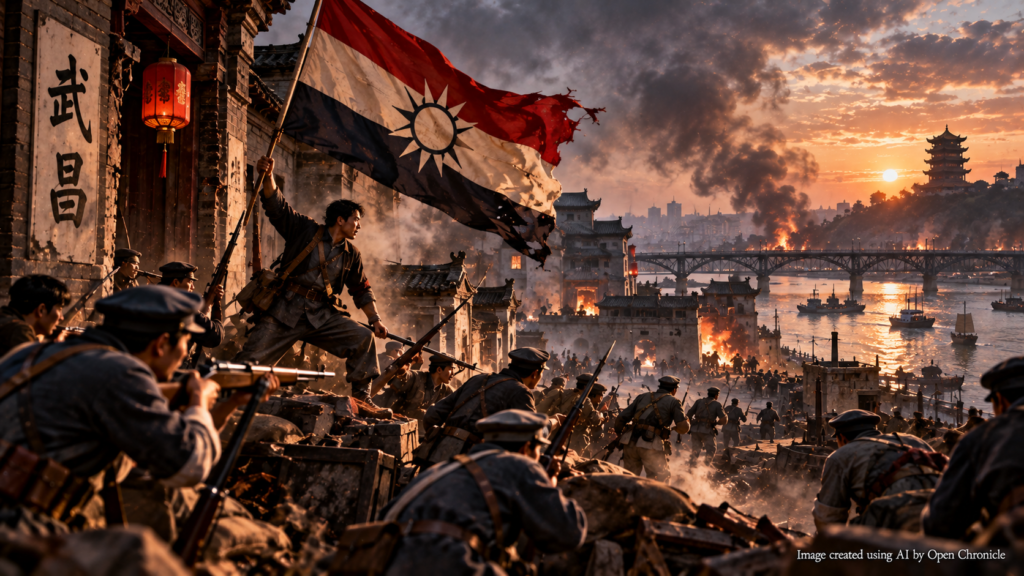
How a military revolt in central China triggered the Xinhai Revolution, brought down the Qing dynasty and ended more than two thousand years of imperial rule.
By Open Chronicle History Desk
On the evening of October 10, 1911, gunfire erupted in Wuchang, a city on the Yangtze River in central China.
What began as a military rebellion would become one of the most consequential revolutions in modern Asian history.
Within hours, revolutionary soldiers had seized important military positions. Government authority in the city was collapsing, and the Qing dynasty, which had ruled China since the seventeenth century, faced a crisis that would soon spread across the empire.
The uprising had not unfolded according to a carefully executed national timetable. Its immediate outbreak was accelerated by an accident, police discoveries and fears of arrest among revolutionary conspirators.
Yet the political conditions that made it possible had been developing for decades.
China had endured military defeats, foreign intervention, internal rebellions, financial crises and increasingly bitter disputes over political reform.
The Qing government had attempted to modernize the country while preserving the imperial system. Reformers wanted constitutional government. Revolutionaries demanded the overthrow of the dynasty altogether.
On October 10, those competing visions collided.
Four months later, China’s last emperor would abdicate.
The imperial system that had shaped Chinese political life for more than two millennia would come to an end.
But the revolution would also reveal a difficult truth: destroying an old political order was far easier than constructing a stable replacement.
1. China at the End of an Imperial Age
At the beginning of the twentieth century, China remained an empire governed by the Qing dynasty.
Founded by Manchu rulers who conquered Beijing in 1644, the Qing had presided over an enormous state encompassing diverse peoples and territories.
During the eighteenth century, the dynasty had experienced a period of considerable expansion and prosperity.
By the nineteenth century, however, it faced growing challenges.
Population pressures strained agricultural resources. Administrative corruption weakened government institutions. Internal rebellions devastated entire regions.
Foreign powers increasingly challenged China’s sovereignty.
The imperial system had survived centuries of political upheaval, but its ability to respond to a rapidly changing world was now under serious pressure.
2. The Opium Wars and the Crisis of Sovereignty
China’s defeats in the Opium Wars of the nineteenth century exposed the military and technological imbalance between the Qing Empire and industrializing European powers.
The treaties that followed opened ports to foreign trade and granted privileges to foreign governments and merchants.
Britain acquired Hong Kong Island following the First Opium War.
Other powers secured commercial concessions and extraterritorial rights.
For many Chinese officials and intellectuals, these developments demonstrated that the empire could no longer rely on traditional institutions alone.
China needed military reform, industrial development and new forms of education.
But reforming an empire without undermining its foundations proved extraordinarily difficult.
3. Internal Rebellions and Imperial Weakness
Foreign intervention was only one part of the crisis.
The Taiping Rebellion, which began in 1850, became one of the deadliest civil conflicts in world history.
Other uprisings challenged Qing authority across the country.
Regional military forces became increasingly important in suppressing these rebellions.
This development had long-term consequences.
The central government grew more dependent on provincial commanders and locally organized armies.
By 1911, military power was no longer concentrated entirely in the hands of the imperial court.
That fragmentation would help determine the outcome of the revolution.
4. The Defeat by Japan
The First Sino-Japanese War of 1894–1895 was another devastating blow.
Japan, which had undertaken rapid political and military modernization during the Meiji period, defeated Qing China.
The Treaty of Shimonoseki forced China to recognize Korean independence from the Qing tributary relationship and cede Taiwan and the Penghu Islands to Japan, alongside other concessions.
The defeat had profound psychological consequences.
Japan had once looked to Chinese civilization for cultural and political models.
Now it had defeated China in a modern war.
Chinese reformers increasingly concluded that the empire’s political institutions required fundamental transformation.
5. Reform or Revolution?
Two broad approaches emerged.
Some intellectuals believed the Qing dynasty could survive through constitutional reform.
They wanted a modernized monarchy, representative institutions and a stronger national government.
Others believed the dynasty itself had become an obstacle.
For them, reform under imperial rule would never go far enough.
The distinction became one of the defining political arguments of late Qing China.
Should China modernize its empire?
Or should it abolish the empire entirely?
6. The Hundred Days’ Reform
In 1898, the Guangxu Emperor supported an ambitious reform program.
Reformers proposed changes to education, administration, military organization and government institutions.
The initiative became known as the Hundred Days’ Reform.
But conservative opposition within the imperial court was powerful.
Empress Dowager Cixi and her allies suppressed the reform movement.
Leading reformers were executed or forced into exile.
The failure reinforced the belief among many radicals that meaningful transformation could not be achieved within the existing political system.
7. The Boxer Uprising
The Boxer Uprising of 1899–1901 deepened the crisis.
Anti-foreign violence escalated in northern China.
Foreign diplomatic missions in Beijing came under siege.
An international military coalition intervened.
The Qing government ultimately accepted severe financial and political penalties.
The settlement further weakened the dynasty’s legitimacy.
For critics of the imperial government, China appeared trapped between foreign domination and domestic political paralysis.
The demand for national renewal grew stronger.
8. Sun Yat-sen and the Revolutionary Movement
One of the most important figures in the movement against Qing rule was Sun Yat-sen.
Born in 1866 in Guangdong province, Sun became a leading advocate of republican revolution.
He spent significant periods outside China, building networks among overseas Chinese communities and political activists.
In 1905, revolutionary groups united in Tokyo to establish the Tongmenghui, or Revolutionary Alliance.
Sun’s political program became associated with the Three Principles of the People:
Nationalism, democracy and the people’s livelihood.
These ideas would become central to the ideology of the Chinese republican movement.
But Sun was not the direct military commander of the Wuchang Uprising.
When the rebellion began, he was abroad.
The revolution emerged from a much broader network of activists, soldiers, provincial leaders and political organizations.
9. The New Army
The Qing government had attempted to modernize its military forces.
Western-style training, new weapons and revised organizational structures were introduced.
These reforms created the New Army.
Ironically, the modernization program also provided revolutionary activists with new opportunities.
Educated soldiers were exposed to nationalist ideas.
Military schools became centers of political discussion.
Secret revolutionary societies developed within army units.
In Hubei province, especially around Wuchang, revolutionary organizers established networks among soldiers.
The government was creating a modern army.
Some of the men serving in that army were preparing to overthrow it.
10. The Railway Protection Movement
In 1911, controversy over railway policy intensified opposition to the Qing government.
The imperial authorities moved to nationalize important railway projects and negotiate foreign loans.
Provincial investors and local elites feared losing control over projects they had helped finance.
Protests erupted, particularly in Sichuan.
The Railway Protection Movement became a major political crisis.
Government forces were diverted to suppress unrest.
The movement also demonstrated how financial grievances, provincial autonomy and nationalist opposition to foreign influence could combine against the dynasty.
This crisis helped create the conditions for the uprising in Hubei.
11. Wuchang: A Strategic City
Wuchang stood on the southern bank of the Yangtze River, opposite Hankou and Hanyang.
Together, these cities formed an important commercial, industrial and military center in central China.
The area occupied a strategic position along major river and transportation routes.
Military arsenals, barracks and communications facilities made it especially significant.
If revolutionaries could seize Wuchang, they would gain more than symbolic control of a provincial city.
They could acquire weapons, establish a military headquarters and encourage rebellions elsewhere.
The location would prove decisive.
12. The Accidental Explosion
The immediate sequence leading to the uprising began on October 9, 1911.
An accidental explosion occurred at a revolutionary bomb-making site in the Russian concession at Hankou.
The incident attracted police attention.
Authorities discovered materials and information connected to revolutionary activity.
Members of the underground movement feared that their identities had been exposed.
Arrests and executions followed.
Revolutionary soldiers now faced a stark choice.
They could wait and risk being arrested.
Or they could begin the uprising before the authorities dismantled their networks.
The planned rebellion became an emergency.
13. October 10, 1911
On the evening of October 10, revolutionary soldiers in Wuchang began their revolt.
They attacked loyalist positions and moved against key military installations.
Fighting spread.
Rebel forces gained control of important facilities, including the arsenal.
The uprising gathered momentum as additional troops joined the rebellion.
By the following day, revolutionary forces had established effective control over Wuchang.
The imperial government’s authority in the city had collapsed.
What had begun as an urgent response to a police crackdown had become the opening act of a national revolution.
14. The Birth of a Revolutionary Government
The insurgents needed political leadership.
One of the central figures to emerge was Li Yuanhong, a senior military officer who had not originally led the revolutionary conspiracy.
Revolutionaries brought him into the leadership of the new military government.
The Hubei revolutionary authorities proclaimed their opposition to Qing rule and adopted republican objectives.
Their actions sent an extraordinary signal across China.
The dynasty could be challenged successfully.
A provincial capital had fallen.
The rebellion was no longer merely a clandestine movement.
It had become an alternative government.
15. The Revolution Spreads
News of the Wuchang Uprising travelled rapidly.
In the weeks that followed, provinces across China declared independence from Qing authority.
The revolutionary movement was not uniform.
Some uprisings were led by soldiers.
Others depended on provincial assemblies, local elites or revolutionary organizations.
Some transitions involved significant fighting.
Others were negotiated.
But the cumulative effect was devastating for the dynasty.
Imperial authority began disintegrating across the country.
The Qing court could no longer assume that provincial officials and military commanders would remain loyal.
16. The Battle for Wuhan
The uprising did not end the fighting in central China.
Qing forces launched a counteroffensive.
The cities of Hankou and Hanyang became major battlefields.
Imperial troops eventually recovered both cities after intense combat.
Wuchang, however, remained under revolutionary control.
The battles demonstrated that the Qing government still possessed substantial military power.
Yet they also revealed the political limitations of military success.
Even as imperial troops won local victories, additional provinces were abandoning the dynasty.
The revolution was becoming too widespread to suppress through one campaign.
17. Yuan Shikai Returns
The Qing court turned to Yuan Shikai, one of China’s most powerful military and political figures.
Yuan had played a major role in developing modern Chinese military forces.
His Beiyang Army was among the strongest military organizations in the country.
The imperial government needed his support.
But Yuan also understood that the dynasty was weakening.
His position allowed him to negotiate with both the Qing court and the revolutionaries.
He would become one of the most consequential figures in the transition from empire to republic.
18. Sun Yat-sen Returns to China
Sun Yat-sen learned of the uprising while travelling abroad.
He returned to China in December 1911.
By then, the revolutionary movement had already transformed the political situation.
Delegates representing revolutionary provinces met to establish a provisional republican government.
Sun was selected as provisional president.
On January 1, 1912, the Republic of China was formally inaugurated in Nanjing.
The republic had been proclaimed.
But the Qing emperor had not yet abdicated.
China temporarily faced rival centers of political authority.
19. The Last Emperor
The last Qing emperor was Puyi.
Born in 1906, he had ascended the throne as a child in 1908.
He was only six years old when the dynasty collapsed in 1912.
Political decisions were made by regents, court officials and senior military leaders.
The fate of the empire increasingly depended on negotiations between Yuan Shikai, the imperial court and republican representatives.
The monarchy had survived countless rebellions.
This time, its political foundations had disintegrated.
20. February 12, 1912: The Qing Dynasty Abdicates
On February 12, 1912, an imperial abdication edict was issued on behalf of Puyi.
The Qing dynasty came to an end.
With it ended the institution of imperial monarchy that had shaped China’s political order since antiquity.
The transition was negotiated rather than completed through the total military destruction of the Qing court.
Arrangements allowed the former emperor to retain certain privileges.
The new republic inherited a vast country, but it also inherited profound political, military and economic problems.
The imperial era had ended.
The struggle over China’s future was only beginning.
21. Sun Yat-sen Steps Aside
The revolutionaries faced a difficult political reality.
Sun Yat-sen possessed considerable revolutionary prestige, but Yuan Shikai controlled military forces essential to the new political settlement.
A compromise emerged.
Sun agreed to relinquish the provisional presidency in favor of Yuan once the Qing abdication had been secured.
Yuan became provisional president in 1912.
The decision was intended to unify the country and avoid a prolonged civil war.
Yet it also placed enormous political power in the hands of a military leader whose commitment to parliamentary republicanism was uncertain.
The contradiction would soon become apparent.
22. The Republic’s Difficult Beginning
The new republic inherited many of the problems that had weakened the empire.
Provincial loyalties remained powerful.
Military commanders retained considerable autonomy.
Government finances were fragile.
Foreign powers continued to exercise extensive influence.
Political parties competed over the structure of the state.
Republican institutions existed, but their authority remained insecure.
The revolution had removed the emperor without resolving the deeper problem of how China should be governed.
23. Yuan Shikai and the Return of Authoritarian Power
Yuan increasingly concentrated power in his own hands.
Parliamentary institutions were weakened.
Political opponents faced repression.
In 1915, Yuan attempted to establish a new monarchy with himself as emperor.
The proposal generated fierce opposition.
Provincial leaders rebelled.
Yuan abandoned the imperial project in 1916 and died later that year.
His failure demonstrated how decisively the legitimacy of hereditary imperial government had been damaged.
Yet it also showed that republican government had not become politically secure.
24. The Warlord Era
After Yuan’s death, China entered a period of fragmentation commonly known as the Warlord Era.
Regional military commanders competed for territory, revenue and political influence.
The central government struggled to exercise authority.
Military alliances shifted.
Armed conflicts disrupted economic life.
Foreign governments continued to influence Chinese affairs.
The revolution had ended the Qing dynasty, but it had not created a unified and stable republic.
This distinction is fundamental to understanding 1911.
25. The Rise of New Political Movements
The failures of the early republic encouraged Chinese intellectuals and activists to search for alternative political ideas.
The New Culture Movement challenged traditional assumptions about society, education and authority.
The May Fourth Movement of 1919 intensified demands for national sovereignty and political transformation.
Liberalism, nationalism, socialism and Marxism gained influence.
In 1921, the Chinese Communist Party was founded.
The Nationalist movement associated with Sun Yat-sen also continued to develop.
The political struggles of twentieth-century China were increasingly shaped by movements that emerged or expanded in the aftermath of the imperial collapse.
26. The Revolution and the Chinese Nationalists
Sun Yat-sen’s political movement eventually developed into the Kuomintang, or Chinese Nationalist Party.
After Sun’s death in 1925, Chiang Kai-shek became its dominant military leader.
The Nationalists launched the Northern Expedition in 1926 to defeat rival warlords and reunify much of China.
A Nationalist government established its capital at Nanjing in 1927.
The republican movement had survived, but its political character had changed substantially since 1911.
Military force remained central to the struggle for national unity.
27. From Revolution to Civil War
The rivalry between the Chinese Nationalists and Communists eventually developed into prolonged armed conflict.
Japan’s invasion of China further transformed the political situation.
After the Second World War, the Chinese Civil War resumed on a massive scale.
In 1949, the Communist Party established the People’s Republic of China on the mainland.
The government of the Republic of China relocated to Taiwan.
The political division that emerged in 1949 remains a central issue in East Asian history and international relations.
The events of 1911 did not predetermine this outcome.
They did, however, mark the beginning of the republican era from which these later political struggles developed.
28. October 10 and Taiwan
October 10 remains an especially important commemorative date in Taiwan.
It is observed as the National Day of the Republic of China, commonly known as Double Ten Day.
The name refers to the tenth day of the tenth month.
The holiday commemorates the beginning of the 1911 revolution rather than the formal establishment of the republic on January 1, 1912.
This distinction reflects the extraordinary symbolic importance of Wuchang.
A rebellion launched in one city became the foundational event of a new political era.
29. How Mainland China Remembers 1911
The 1911 Revolution also occupies an important place in historical narratives in the People’s Republic of China.
Sun Yat-sen is widely recognized as a major figure in the struggle against imperial rule.
The revolution is understood as a turning point in China’s transformation from empire toward a modern nation-state.
Interpretations differ, however, concerning its achievements and limitations.
The revolution ended the monarchy but did not fully overcome foreign influence, social inequality or political fragmentation.
Its legacy is therefore celebrated and debated across different Chinese political traditions.
30. Was the Revolution Inevitable?
Looking backward, the collapse of the Qing dynasty can appear inevitable.
The empire had suffered repeated defeats.
Its institutions were under pressure.
Revolutionary organizations had expanded.
Provincial opposition was growing.
But history was not predetermined.
Constitutional reform remained a possible political path.
The imperial government still possessed significant military resources.
The Wuchang Uprising itself was accelerated by an unexpected explosion and the exposure of revolutionary networks.
Its success depended on decisions made by soldiers, provincial leaders and military commanders.
The collapse of the dynasty was the result of structural weakness combined with contingent events.
31. The End of Two Thousand Years of Imperial Rule
The significance of 1911 extends beyond the fall of one dynasty.
China’s imperial political tradition had developed over more than two millennia, beginning with the Qin unification in 221 BCE.
Dynasties rose and fell.
Territories expanded and contracted.
Administrative systems evolved.
But the institution of the emperor remained a central feature of the political order.
In 1912, that institution disappeared.
China would continue to experience authoritarian government, military conflict and revolutionary upheaval.
But the hereditary imperial system was no longer the accepted framework of national political legitimacy.
That was a profound historical transformation.
32. Why October 10 Matters
October 10, 1911 marks the beginning of the uprising that set the Qing dynasty’s final collapse in motion.
It demonstrated that revolutionary organizations had penetrated the modernized imperial army.
It exposed the fragility of central authority.
It encouraged provincial declarations of independence.
It created the political momentum that led to the Republic of China.
It opened a new period of nationalism, republican experimentation, military fragmentation and ideological conflict.
And it brought an end to an imperial institution that had shaped Chinese civilization for centuries.
The Wuchang Uprising was not the completion of China’s political transformation.
It was its dramatic beginning.
October 10, 1911: The Night an Empire Began to Fall
Imagine Wuchang on the evening of October 10.
The streets are tense.
Soldiers gather inside barracks.
Revolutionary organizers fear arrest.
The authorities have discovered evidence of a conspiracy.
For men who have spent months preparing for rebellion, the moment of decision has arrived earlier than expected.
Then gunfire breaks the silence.
Revolutionary soldiers move against imperial positions.
The arsenal becomes a crucial objective.
Officers struggle to maintain control.
News spreads through the city.
By morning, the Qing government’s authority in Wuchang has collapsed.
The rebellion might still be suppressed.
Imperial forces remain powerful.
The court in Beijing still commands armies and possesses the formal authority of the state.
But something fundamental has changed.
For the first time, a revolutionary military government has established itself in a major provincial center and openly challenged the dynasty’s right to rule.
Other provinces begin watching.
Then they begin acting.
Within weeks, the empire is breaking apart.
Within months, the last emperor abdicates.
And a political system that had endured for more than two thousand years comes to an end.
October 10, 1911 was the night a local military uprising became the beginning of a national revolution.
Historical Sources and Further Reading
The article is supported by historical documentation
concerning the Wuchang Uprising, the 1911 Revolution
and the establishment of the Republic of China.
The Chinese Revolution of 1911
Historical overview of the revolutionary movement,
the collapse of Qing authority, Yuan Shikai’s
political role and the emergence of the republic.
Read the Historical Overview →
Sun Yat Sen Nanyang Memorial Hall:
The Wuchang Uprising
Institutional historical material detailing the
uprising of October 10, the capture of Wuchang
and the revolutionary transition of 1911–1912.
Read the Museum’s Historical Material →
Reform and Revolution in China:
The 1911 Revolution in Hunan and Hubei
Academic study of revolutionary organization,
regional politics and the social and military
conditions surrounding the uprising.
Manchus and Han:
Ethnic Relations and Political Power in
Late Qing and Early Republican China,
1861–1928
Historical scholarship examining Qing political
structures, ethnic relations and the transition
from imperial government to republican rule.
Open Chronicle History distinguishes between
the Wuchang Uprising of October 10, 1911,
the establishment of the Republic of China
on January 1, 1912, and the formal abdication
of the Qing emperor on February 12, 1912.
The revolution began in October 1911,
but the end of imperial rule resulted from
a wider process of provincial rebellions,
military conflict and political negotiation.