
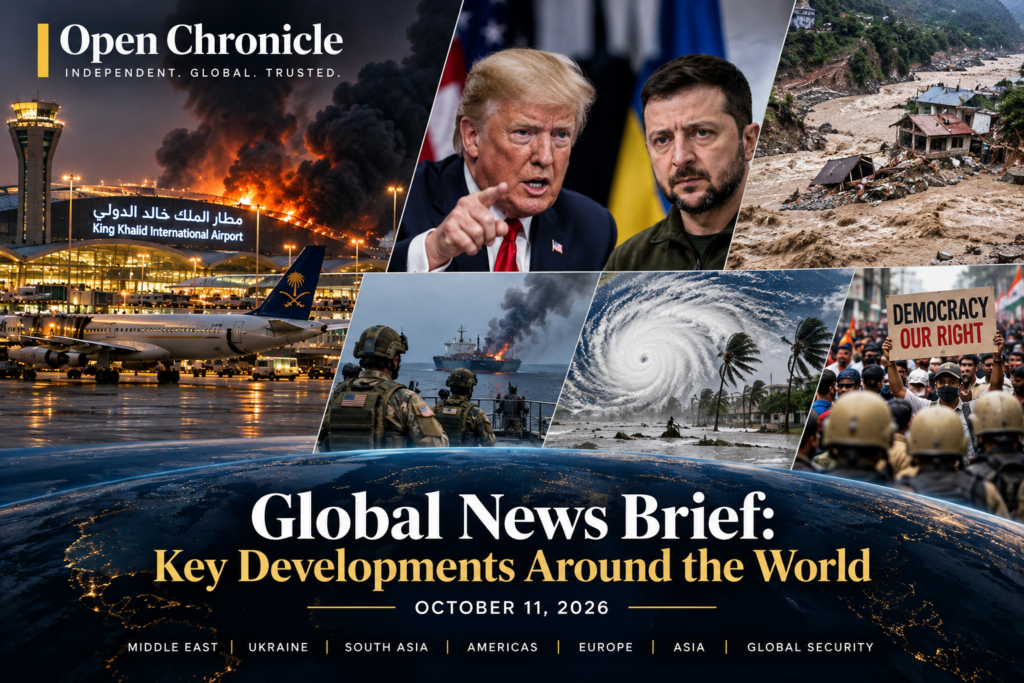
Global News Brief: Key Developments Around the World, October 11, 2026
A deadly missile attack on Riyadh’s international airport has raised fears of a wider Middle East confrontation, while Donald Trump’s criticism of Ukraine’s leadership deepens tensions between Washington and Kyiv. Pakistan faces a new political crisis, floods have devastated communities in Nepal, and Hurricane Isaias has left a trail of destruction across the southeastern United States.
By Open Chronicle with agencies
October 11, 2026
A reported missile attack on King Khalid International Airport in Saudi Arabia has killed at least 12 people and injured more than 300, prompting international condemnation and warnings of possible military retaliation.
The attack, attributed in the latest reports to Yemen’s Houthi movement, has become one of the most serious developments in an increasingly volatile regional security environment. Saudi Arabia has threatened a decisive response, while US President Donald Trump has indicated that Washington is considering its own reaction.
Elsewhere, Trump’s call for new political leadership in Ukraine has provoked criticism from Kyiv and European governments, particularly as his administration pursues a controversial arrangement involving Russian diesel supplies.
In South Asia, Pakistan has reportedly imposed emergency rule in Khyber Pakhtunkhwa, removing the provincial government controlled by former Prime Minister Imran Khan’s party. Nepal is responding to devastating floods along the Budhi Gandaki River, while India continues to experience youth-led demonstrations and disputes over police detentions.
The day’s developments also include reported American military action in the Gulf of Oman, Ukrainian attacks against Russian digital infrastructure, a deadly migrant boat disaster off Djibouti and growing humanitarian concerns across the Middle East.
Middle East: Riyadh Airport Attack Kills 12 and Injures Hundreds
Saudi Arabia is confronting a major security crisis following a reported missile attack on King Khalid International Airport in Riyadh.
According to the latest figures in the supplied reports, 12 people were killed and 309 injured in the attack, which has been attributed to Yemen’s Houthi movement.
The incident followed heightened security warnings and temporary restrictions on airport operations in the Saudi capital.
King Khalid International Airport is among the kingdom’s most important aviation hubs, handling domestic and international flights and serving as a major gateway to Riyadh.
The reported strike has raised serious concerns about the vulnerability of civilian transport infrastructure during the expanding regional confrontation.
Saudi Arabia’s military coalition warned that it would respond decisively, although no details of a potential operation were announced.
Trump Considers American Response
President Donald Trump said he would decide how the United States should respond to the attack.
In comments reported by several outlets, Trump described the Houthi action as unacceptable.
The possibility of American involvement has added another layer of uncertainty to a conflict already affecting maritime security, energy supplies and regional diplomatic relations.
Any direct military intervention against Houthi positions could increase tensions across the Arabian Peninsula and the Red Sea.
The Houthis have reportedly renewed warnings to airlines and travellers using Saudi airports, further complicating aviation security.
United Nations and European Union Condemn Attack
United Nations Secretary-General António Guterres condemned the reported attack on the airport.
The European Union also expressed solidarity with Saudi Arabia, warning that the incident represented a dangerous escalation.
Bangladesh, Pakistan, Kuwait, Malaysia and other governments issued statements condemning the violence.
The Gulf Cooperation Council described the targeting of civilian aviation infrastructure as a serious threat to regional security.
A Syrian woman was reportedly among those killed, according to diplomatic statements cited in the supplied coverage.
Saudi authorities have not established a timetable for the complete restoration of normal airport operations in the information provided.
United States and Iran: American Forces Target Vessel in Gulf of Oman
US military forces have reportedly struck and disabled a commercial cargo vessel accused of attempting to breach an American blockade involving Iran.
The incident occurred in the Gulf of Oman, an important maritime corridor connecting the Arabian Sea with the Strait of Hormuz.
Reports attributed the operation to US Central Command, although the identity of the vessel and the precise circumstances of the interception were not established in the supplied information.
The operation comes amid growing military and economic pressure on Tehran.
Separately, a tanker was reportedly struck by an unidentified projectile in the Strait of Hormuz, causing a fire.
The incidents have renewed concerns about commercial shipping in waters through which substantial volumes of the world’s oil and liquefied natural gas supplies pass.
Continued disruption could increase insurance costs, delay cargo deliveries and place additional pressure on international energy markets.
Iranian officials have also warned about environmental consequences arising from the conflict and have discussed the possibility of changes to the country’s nuclear doctrine.
Those statements reflect the increasingly serious strategic calculations facing governments across the region.
Russia and Ukraine: Trump Calls for New Ukrainian President
Donald Trump has reportedly called for Ukraine to replace President Volodymyr Zelenskyy, intensifying tensions between Washington and Kyiv.
The American president also blamed Ukrainian policies for contributing to high diesel prices in the United States.
His remarks follow a reported agreement with Russian President Vladimir Putin concerning additional Russian diesel supplies.
The arrangement has provoked criticism from Ukrainian officials and lawmakers in the United States who argue that increased purchases of Russian fuel could weaken economic pressure on Moscow.
Ukrainian Foreign Minister Andrii Sybiha responded that only Ukrainians have the right to determine their country’s political leadership.
European officials, including representatives of Germany and Britain, also criticized the reported intervention in Ukrainian domestic politics.
British officials reaffirmed their support for Ukraine and its elected leadership.
Washington’s Russian Diesel Agreement Faces Opposition
The reported fuel arrangement has become a source of controversy in Washington.
American lawmakers are preparing proposals intended to restrict or prohibit purchases of Russian fuel, according to the supplied reports.
Critics argue that energy imports could provide Moscow with additional revenue while Russian forces continue military operations against Ukraine.
Supporters of increased fuel supplies emphasize the economic pressure created by high energy prices.
The dispute illustrates the difficulty of reconciling domestic energy priorities with sanctions policy and international security commitments.
Zelenskyy Proposes Energy Infrastructure Truce
Zelenskyy has indicated that Ukraine would consider halting attacks on Russian oil refineries if Moscow stopped striking Ukraine’s energy infrastructure.
The proposal would establish a limited reciprocal arrangement designed to protect energy facilities on both sides.
Ukrainian officials have said Kyiv is prepared to consider several ceasefire formats, although any agreement would require Russian participation.
The proposal comes as both countries continue targeting infrastructure with strategic and economic significance.
No agreement has been announced.
Ukraine Intensifies Attacks on Russian Technology Infrastructure
Ukrainian drone operations have reportedly damaged a third Russian data centre in four days.
The latest reported strike targeted a facility associated with technology company Yandex in Russia’s Vladimir region.
Earlier incidents were reported in Ryazan and Kaluga.
Some accounts suggested that the attacks disrupted dozens of digital services, although the extent of the damage and the duration of the interruptions remain unclear.
The incidents illustrate an emerging dimension of the conflict in which information technology infrastructure is increasingly exposed to long-range attacks.
Data centres support telecommunications, cloud services, commercial platforms and other digital operations.
Their disruption can affect civilian businesses and public services as well as systems with potential military applications.
Separately, reports indicated that a Russian air defence position caught fire in Sochi following a drone attack.
The incidents reflect the growing geographical reach of the conflict.
Pakistan: Emergency Rule Removes PTI Government in Khyber Pakhtunkhwa
Pakistan has reportedly imposed emergency rule in Khyber Pakhtunkhwa, removing the provincial administration controlled by Pakistan Tehreek-e-Insaf, the party associated with former Prime Minister Imran Khan.
The decision marks a major escalation in Pakistan’s continuing political confrontation.
Khyber Pakhtunkhwa has long been a significant political stronghold for PTI.
The removal of its provincial administration could fundamentally alter the balance of power between the federal government and opposition forces.
The supplied reports do not establish the precise constitutional provisions invoked or the duration of the emergency measures.
The development comes amid security concerns, political polarization and disputes over the treatment of opposition leaders.
Separately, an Election Commission official was reportedly shot dead by unidentified attackers in Tank district.
No connection between that killing and the emergency declaration has been established.
Nepal: Landslide-Blocked River Triggers Devastating Flooding
A landslide that blocked the Budhi Gandaki River has been identified by Nepalese military authorities as a reported cause of the sudden flooding in Gorkha district.
According to the latest information, the blockage contributed to a rapid release of water that swept away homes and damaged infrastructure downstream.
Between 35 and 40 houses were reportedly destroyed, while bridges and a hydropower project sustained damage.
At least four people were reported missing.
The Nepal Army joined rescue operations as authorities ordered evacuations in vulnerable communities.
The disaster demonstrates the danger posed by unstable mountain slopes and temporary river blockages in Himalayan valleys.
When accumulated water breaks through such barriers, downstream settlements can face sudden and destructive flooding.
Authorities are continuing to assess damage and the risk of additional landslides.
United States: Hurricane Isaias Leaves Four Dead and Hundreds of Thousands Without Power
Hurricane Isaias has reportedly killed at least four people as it moved across the southeastern United States.
Approximately 670,000 electricity customers were reported without power following the storm’s passage through Florida, Alabama and surrounding areas.
Heavy rainfall, damaging winds and flooding disrupted communities and damaged infrastructure.
Emergency personnel responded to flooded roads, fallen trees and damaged buildings.
Electricity providers began restoration work as authorities warned that dangerous conditions could continue after the strongest winds had passed.
The storm has again highlighted the vulnerability of coastal communities and power networks to severe tropical weather.
Further assessments will be required to determine the full economic impact.
India: Court Orders Release of Youth Protest Leaders
An Indian court has reportedly ordered the release of leaders associated with the so-called Cockroach movement following their detention during a police crackdown on demonstrations.
The protests have focused on electoral administration and concerns about political accountability.
Thousands of people were reportedly detained as authorities increased security measures in New Delhi.
The court’s intervention comes amid criticism of the authorities’ response to youth-led demonstrations.
Protest organizers have accused the government of restricting peaceful assembly, while police have defended their actions as necessary to maintain public order.
The movement has attracted attention because of its youth participation and unconventional political identity.
The developments raise broader questions about civil liberties, public protest and the relationship between citizens and electoral institutions.
Palestinian Territories: Abbas Faces Anger Over Election Postponement
Palestinian President Mahmoud Abbas is facing renewed criticism following the postponement of presidential and legislative elections until September 2027.
The decision has frustrated Palestinians who have waited years for an opportunity to elect new national representatives.
Palestinian legislative elections were last held in 2006.
The absence of regular national elections has contributed to continuing concerns about democratic legitimacy and political representation.
The European Union has previously supported renewed Palestinian elections as an opportunity to strengthen institutional accountability.
The postponement comes amid continued conflict in Gaza, political divisions between Palestinian factions and uncertainty surrounding the territory’s future governance.
Reports also described further injuries among Palestinian civilians during Israeli military operations in Gaza.
The humanitarian situation remains severe, with concerns about food insecurity, displacement and access to essential services.
Djibouti: Migrant Boat Disaster Leaves at Least 109 Dead
At least 109 migrants have reportedly died after a boat capsized off Djibouti.
A further 116 people were reported missing, making the incident one of the deadliest maritime disasters in the region in recent reporting.
The waters around Djibouti are part of a migration route used by people travelling between the Horn of Africa and the Arabian Peninsula.
Migrants frequently face dangerous sea conditions, overcrowded vessels and exploitation by trafficking networks.
Search and rescue operations were reportedly continuing.
The disaster has renewed attention to the humanitarian risks associated with irregular migration routes.
Europe: Political and Security Developments
Polish authorities are investigating a possible threat against Prime Minister Donald Tusk and Defence Minister Władysław Kosiniak-Kamysz.
The investigation comes amid wider security concerns in Poland following several incidents involving schools.
In the Netherlands, reports described increasingly confrontational language concerning Russia and the possibility of future conflict involving NATO.
Slovakia has reportedly resumed military contacts with Russia at the defence attaché level.
Meanwhile, Czech Prime Minister Andrej Babiš’s ANO party faces a political test in Senate elections.
In Portugal, demonstrators took to the streets over rising living costs.
Spain is also experiencing political tensions surrounding housing affordability and migration, with Prime Minister Pedro Sánchez beginning an election campaign amid protests.
These developments reflect the diverse political and economic pressures facing European governments.
Vatican: Pope Leo Reportedly Scheduled for Lung Surgery
Pope Leo is reportedly preparing to undergo surgery to remove a nodule from his lung.
The announcement has raised questions about the pontiff’s health, although the supplied report did not establish the nature of the nodule, the expected duration of the procedure or the anticipated recovery period.
Further information from the Vatican would be necessary to clarify the medical circumstances.
The development comes as the pontiff continues to address international humanitarian concerns, including the death penalty and armed conflict.
Asia: China, North Korea and Technology Competition
A Chinese court has reportedly sentenced a former mayor of Wuhan to 14 years in prison for bribery.
The case forms part of China’s continuing campaign against corruption among public officials.
In North Korea, authorities marked the anniversary of the ruling Workers’ Party with comparatively modest celebrations.
Separately, South Korean intelligence officials denied reports concerning restrictions on American intelligence-sharing about North Korean missiles.
In India, Elon Musk has reportedly renewed promises to expand affordable Starlink satellite internet services, intensifying competition with established telecommunications providers.
The developments illustrate the intersection of domestic governance, regional security and technology competition across Asia.
Environment: Water Scarcity and Natural Disasters Raise Global Concerns
Beyond the immediate emergencies in Nepal and the United States, environmental pressures are affecting communities across several regions.
Reports from Mexico describe declining river flows and contaminated wells in a once-fertile agricultural valley.
Water scarcity and pollution are threatening farming livelihoods and raising concerns about long-term sustainability.
The United Nations has also warned about increasing pressure on freshwater resources as river flows decline in vulnerable regions.
Meanwhile, Panama has reportedly declared a state of emergency following a powerful earthquake and continuing aftershocks.
The combined developments highlight the growing importance of disaster preparedness, resilient infrastructure and sustainable water management.
Global Outlook: Security Crises and Humanitarian Emergencies Converge
The developments of October 11 reflect an international environment shaped by overlapping military, political and humanitarian pressures.
The reported attack on Riyadh airport has intensified fears of further escalation across the Middle East.
Washington’s confrontation with Kyiv over Ukrainian leadership and Russian energy supplies has added uncertainty to diplomatic efforts concerning the war in Europe.
Pakistan’s emergency measures have deepened its political crisis, while protests in India and several European countries demonstrate continued pressure on national institutions.
At the same time, floods, hurricanes, earthquakes and maritime disasters are placing vulnerable communities under severe strain.
The immediate challenge for governments and international organizations will be to contain military escalation, protect civilian populations and maintain essential services while political and economic uncertainty continues.
Many of the developments remain fluid, with casualty figures, official decisions and operational details subject to further clarification.