
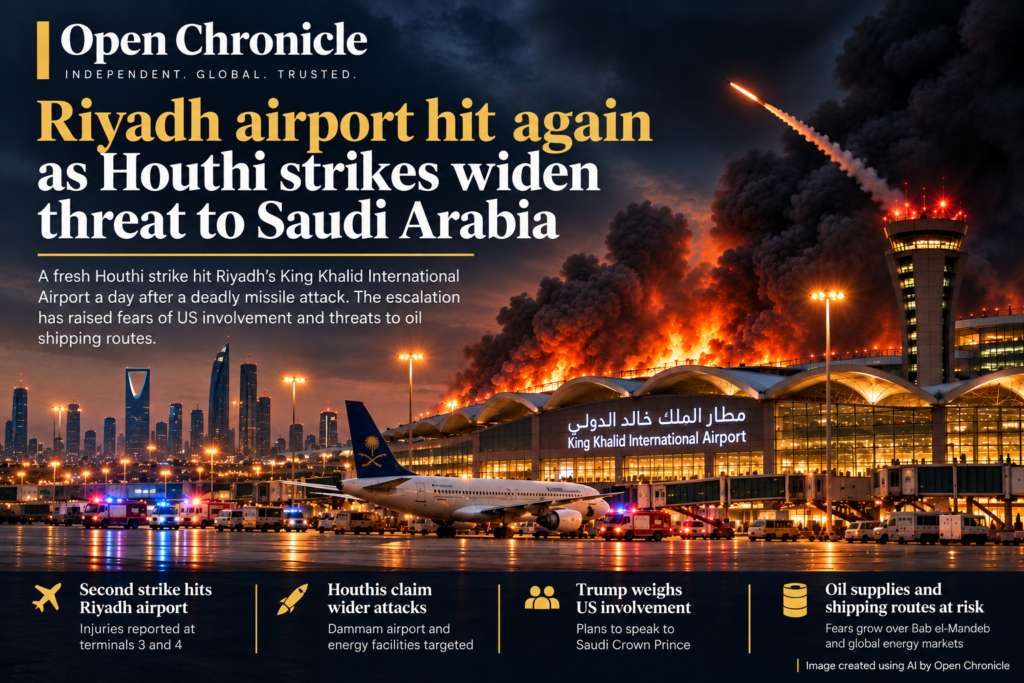
A second attack on Riyadh’s King Khalid International Airport has intensified fears of a wider regional war, with the Houthis also claiming strikes against an airport and energy facilities in eastern Saudi Arabia. The escalation comes as Washington considers possible military involvement and concerns grow over oil supplies and shipping through the Red Sea.
By Open Chronicle with agencies
RIYADH, October 11, 2026 — A fresh projectile strike hit a passenger terminal at King Khalid International Airport in Riyadh on Sunday, just one day after a deadly missile attack killed at least 12 people and wounded more than 300, according to the Saudi-led coalition fighting Yemen’s Houthi movement.
The latest attack struck the airport complex serving terminals 3 and 4, which handle domestic flights. Saudi authorities reported injuries but did not immediately provide a detailed casualty figure.
The Houthis claimed responsibility for the attacks, extending a campaign against Saudi civilian infrastructure that has raised fears of a broader military confrontation across the Arabian Peninsula.
Saudi authorities said Saturday’s attack was the deadliest in a Gulf Arab country since the current war involving Iran began. The airport remained closed on Sunday as security forces assessed the damage and the continuing threat.
India’s embassy in Saudi Arabia said an Indian citizen had died from injuries sustained in Saturday’s strike, potentially raising the death toll to 13.
The escalation has also drawn the attention of Washington, where President Donald Trump has indicated that the United States could consider joining military operations against the Houthis.
Riyadh Airport Targeted for a Second Consecutive Day
Sunday’s strike followed a missile attack that caused extensive casualties at King Khalid International Airport on Saturday.
According to Saudi authorities, the earlier attack killed 12 people and injured approximately 300 others, some critically.
The victims included Saudi citizens and foreign nationals, reflecting the airport’s importance as an international transport hub serving residents, migrant workers and travellers from around the world.
Saudi officials identified the dead as four Saudi citizens, two Bangladeshis, a Palestinian, an American, an Egyptian, a Jordanian, a Syrian and a Sudanese.
Egyptian state television identified the Egyptian victim as Azza Ramzy, a flight attendant employed by the Saudi airline Flynas.
The Syrian victim was identified by her country’s embassy as Buthaina Ahmad Oweida, a widowed mother living in Saudi Arabia.
The subsequent reported death of an Indian national would increase the toll beyond the initial Saudi figure, although an updated consolidated casualty count had not been issued in the supplied reporting.
The latest strike on Sunday further complicated efforts to restore airport operations.
Several international airlines have suspended flights to Saudi Arabia for varying periods as aviation authorities assess security risks.
King Khalid International Airport is one of the kingdom’s principal gateways, connecting Riyadh with major destinations across the Middle East, Europe, Asia and other international markets.
The airport’s continued closure threatens to disrupt passenger travel, business activity and international connections.
Houthis Expand Attacks to Dammam and Saudi Energy Facilities
The violence has extended beyond the Saudi capital.
Saudi authorities said King Fahd International Airport in Dammam, in the kingdom’s Eastern Province, had also been attacked, although they provided few immediate details.
The Houthis subsequently claimed responsibility for targeting the airport, along with oil and gas facilities in eastern Saudi Arabia.
The claims have raised concerns that the group is expanding its campaign from Riyadh to infrastructure linked to the country’s energy industry.
Saudi Arabia is one of the world’s leading oil exporters, and attacks against its production, storage or transport facilities can have consequences beyond the kingdom’s borders.
Any sustained disruption to energy infrastructure could affect global oil supplies, increase market volatility and place additional pressure on fuel prices.
The Houthis have warned airlines, airport employees and travellers against using Saudi airports and airspace, describing them as potential targets of further military operations.
According to the group, Saudi aviation facilities have become part of the operational area of its forces.
Such threats have intensified concerns about civilian safety and the risks facing commercial aviation.
The reported attacks against Dammam and energy installations have not been accompanied by a comprehensive independent assessment of damage.
Trump Weighs Possible US Military Intervention
The widening attacks have raised the possibility of greater American involvement in the conflict.
President Donald Trump said he was considering whether the United States should participate in military operations against the Houthis.
He also indicated that he intended to speak with Saudi Crown Prince Mohammed bin Salman, who has reportedly been seeking additional assistance to counter the attacks.
There was no immediate White House comment on Sunday concerning a decision to intervene.
Any direct American military involvement could significantly change the conflict’s trajectory.
The United States has extensive military interests in the Gulf region, including the protection of shipping routes, energy infrastructure and regional partners.
However, intervention could also increase the risk of retaliatory attacks against American forces and commercial vessels.
The Houthis have previously demonstrated their ability to threaten maritime traffic in the Red Sea, and renewed military confrontation could prompt further action against shipping.
For Washington, the decision involves balancing support for Saudi Arabia against the risk of widening an already volatile regional conflict.
Bab el-Mandeb Strait Emerges as a Critical Flashpoint
One of the most serious consequences of the escalation concerns the Bab el-Mandeb Strait, the narrow maritime passage connecting the Red Sea with the Gulf of Aden.
The waterway is essential to international shipping, providing access to the Suez Canal and connecting European and Asian trade routes.
The Houthis have reportedly seized important areas near the strait in recent weeks, prompting the Saudi-led coalition to support Yemeni government forces attempting to reverse those gains.
Control of territory around Bab el-Mandeb carries significant strategic importance.
Military operations near the passage can threaten merchant vessels, raise shipping insurance costs and force commercial operators to consider longer alternative routes.
The risk has become particularly significant amid disruptions affecting the Strait of Hormuz, another major energy transport corridor.
If both maritime passages face sustained military threats, global energy and shipping markets could experience further pressure.
Analysts warn that American participation in attacks against the Houthis could prompt the movement to intensify restrictions on commercial traffic through Bab el-Mandeb.
Such a development would create additional uncertainty for oil shipments and international trade.
Saudi Arabia Faces Growing Pressure on Air Defences
The continued attacks have also raised questions about Saudi Arabia’s ability to maintain adequate air defence coverage during a prolonged confrontation.
Regional officials told The Associated Press last month that the kingdom was facing shortages of missile interceptors and had requested assistance from several international partners.
According to those accounts, Saudi Arabia approached France, Britain, Pakistan and Egypt about deploying additional air defence support.
One regional official also suggested that American interceptor stocks had been reduced during military operations involving Iran.
These reports highlight the pressure that sustained missile and drone attacks can place on defensive systems.
Intercepting incoming projectiles requires sophisticated radar networks, air defence batteries and a continuing supply of missiles.
A prolonged campaign involving repeated attacks on airports, energy facilities and other strategic locations could stretch available resources.
The latest strikes have therefore increased the urgency of Saudi Arabia’s efforts to reinforce its defensive capabilities.
Attacks Threaten Saudi Arabia’s Economic Ambitions
The renewed violence comes at a sensitive moment for Saudi Arabia’s economic development strategy.
Under Crown Prince Mohammed bin Salman, the kingdom has invested heavily in infrastructure, tourism, entertainment, technology and international business initiatives.
Riyadh is hosting a major international energy conference, with further investment events scheduled in the coming weeks.
The attacks threaten to undermine the image of stability that Saudi Arabia has sought to project to international investors and visitors.
Speaking at the energy conference on Sunday, Saudi Energy Minister Prince Abdulaziz bin Salman Al Saud insisted that the kingdom would remain resilient.
“There is no way that somebody will break our back. We are like a phoenix; we come out of the ashes all the time,” he said.
The minister also indicated that Saudi Arabia was working on additional pipeline infrastructure beyond its existing East-West pipeline.
That pipeline had reportedly been attacked and forced out of service for several days during the previous month.
He did not provide details about the additional projects.
The remarks underline the importance Saudi Arabia places on protecting energy exports and maintaining confidence in its ability to withstand security threats.
Yemen Reports Civilian Casualties in Suspected Saudi Airstrike
The escalation has also brought renewed reports of civilian casualties in Yemen.
Earlier on Sunday, the Houthi-run health ministry said a child had been killed and six other people wounded in a suspected Saudi airstrike against a house in Sanaa.
The ministry also claimed that 91 Yemenis had been killed in Saudi-led coalition attacks during the previous five weeks, with women and children accounting for approximately 60 percent of the victims.
Saudi authorities did not immediately comment on those allegations.
The casualty figures could not be independently verified from the information available.
The reported strike followed Houthi claims that the airport in Sanaa, the rebel-held Yemeni capital, had again been targeted by Saudi forces.
The competing accusations illustrate how the confrontation is increasingly affecting civilian infrastructure on both sides of the border.
Humanitarian organizations have repeatedly warned that renewed fighting could worsen conditions in Yemen, where years of conflict have damaged healthcare facilities, disrupted food supplies and displaced large numbers of people.
A Conflict Rooted in More Than a Decade of War
Saudi Arabia and the Houthis have been engaged in conflict since 2015, when the kingdom intervened in Yemen’s civil war in support of the internationally recognized government.
The Houthis had seized Sanaa and other important areas, triggering a prolonged military confrontation involving regional powers.
The conflict caused extensive destruction and one of the world’s most serious humanitarian emergencies.
A United Nations-backed truce in 2022 helped reduce large-scale fighting, although it did not produce a comprehensive political settlement.
The relative calm deteriorated in July, when the Houthis resumed attacks following accusations that Saudi forces had targeted Sanaa airport as an aircraft from Iran attempted to land.
Since then, the confrontation has intensified.
The Houthis, who maintain close ties with Iran, have developed increasingly sophisticated missile and drone capabilities.
Although they initially remained largely outside the current war involving Iran, their recent operations indicate a growing willingness to participate directly in the wider confrontation.
The Saudi-led coalition has meanwhile increased military support for Yemeni government forces attempting to recover territory near Bab el-Mandeb.
The combination of territorial fighting, airstrikes and attacks on infrastructure has reduced prospects for an immediate de-escalation.
Houthi Pressure Could Strengthen Saudi Resolve
The Houthis appear to be attempting to increase the military and economic costs of Saudi Arabia’s campaign in Yemen.
By targeting airports, energy installations and potentially shipping routes, the movement may hope to pressure Riyadh into reducing its military operations.
However, analysts warn that the strategy could produce the opposite result.
Ahmed Nagi, senior Yemen analyst at the International Crisis Group, suggested that attacks against critical Saudi infrastructure could reinforce the kingdom’s determination to continue military action.
“Rather than pushing Riyadh to step back, attacks on critical Saudi infrastructure could make the Saudis more determined to continue the campaign,” he said.
The assessment reflects the risks facing both sides.
For Saudi Arabia, failure to respond could encourage further attacks and undermine confidence in the security of its infrastructure.
For the Houthis, continued escalation could provoke a more extensive military campaign involving Saudi Arabia and potentially the United States.
The result could be a broader conflict with significant consequences for civilians, regional security and international commerce.
A Widening Crisis With Global Consequences
Sunday’s reported strike on Riyadh airport has deepened a crisis already involving civilian casualties, attacks on strategic infrastructure and threats to vital shipping routes.
The possible rise in Saturday’s death toll to 13, the reported attack on Dammam airport and the competing claims of strikes in Sanaa illustrate the widening geographical scope of the confrontation.
Saudi Arabia faces the challenge of protecting its airports, energy facilities and commercial infrastructure while maintaining its military campaign in Yemen.
The Houthis, meanwhile, are increasing pressure through missile attacks and threats against aviation and maritime transport.
Washington’s response could prove decisive.
Direct American intervention might strengthen Saudi Arabia’s military position but could also encourage further Houthi attacks against regional shipping and US interests.
With the Strait of Hormuz already under pressure and Bab el-Mandeb facing renewed security threats, the consequences extend far beyond Yemen and Saudi Arabia.
The immediate priority remains the protection of civilians and the prevention of further escalation.
Whether the latest attacks lead to renewed diplomatic efforts or a broader military confrontation will depend on decisions taken in Riyadh, Washington and Sanaa in the coming days.