
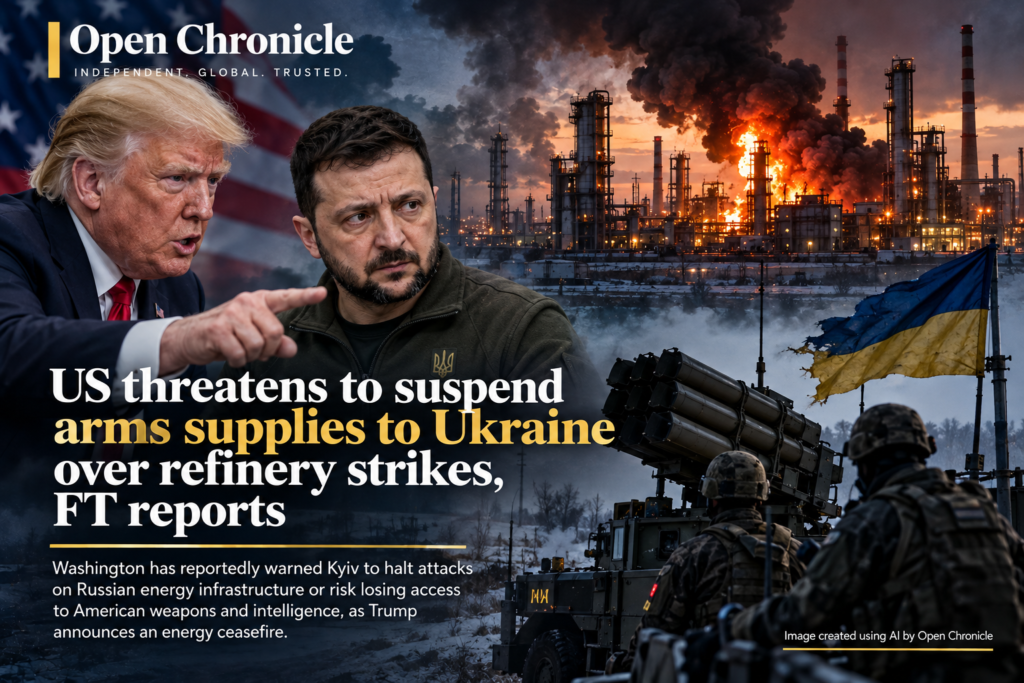
Washington has reportedly warned Kyiv that continued attacks on Russian oil refineries could jeopardize access to American weapons and intelligence, as President Donald Trump announces an immediate energy ceasefire between Russia and Ukraine. Ukrainian President Volodymyr Zelenskyy says his government is awaiting further details of the proposed agreement.
By Open Chronicle with agencies
WASHINGTON, October 11, 2026 — The United States has threatened to suspend a mechanism used to supply American weapons to Ukraine unless Kyiv halts attacks against Russian energy infrastructure, the Financial Times reported on Sunday, citing European officials familiar with the discussions.
According to the newspaper, Washington has pressed Ukrainian and European representatives to stop strikes against Russian oil refineries, warning that continued operations could affect military assistance and intelligence cooperation.
The reported pressure includes the possibility of suspending the Prioritised Ukraine Requirements List (PURL), a procurement mechanism designed to facilitate the delivery of American weapons to Ukraine.
US officials have also reportedly raised the prospect of restricting intelligence sharing with Kyiv.
The Financial Times report comes amid a new diplomatic initiative by President Donald Trump, who has announced what he described as an immediate energy ceasefire between Russia and Ukraine.
However, the status and precise terms of that arrangement remain unclear.
Reuters said it could not independently verify the Financial Times report, while the White House did not immediately respond to a request for comment.
Washington Reportedly Links Military Assistance to Energy Strikes
The reported American warning represents a potentially significant development in Washington’s relationship with Kyiv.
Since Russia’s full-scale invasion of Ukraine in February 2022, American weapons and intelligence have played an important role in supporting Ukraine’s military operations.
According to the Financial Times, the Trump administration is now seeking to use access to those resources as leverage to discourage Ukrainian attacks against Russian energy facilities.
The reported warning focuses particularly on oil refineries, which have become recurring targets of Ukrainian long-range drone operations.
Kyiv has sought to weaken Russia’s capacity to finance and sustain its military campaign by striking facilities involved in fuel production and distribution.
Washington’s reported position suggests that the administration is placing increasing emphasis on limiting attacks against energy infrastructure as part of its diplomatic efforts.
However, no formal suspension of American weapons deliveries or intelligence cooperation has been confirmed.
The distinction is important: the Financial Times describes a reported threat to restrict assistance, rather than an announced decision to terminate it.
PURL Mechanism at Centre of Reported Dispute
The Prioritised Ukraine Requirements List has emerged as a central element of the reported discussions.
The mechanism is intended to support Ukraine’s access to American military equipment through a structured procurement process.
According to the Financial Times, US officials warned that the mechanism could be suspended if Ukrainian strikes against Russian refineries continued.
Such a move could complicate Ukraine’s efforts to secure weapons and other military supplies at a time when the country remains engaged in a prolonged war with Russia.
The report also suggests that Washington could restrict intelligence sharing, potentially affecting Kyiv’s ability to monitor military developments and plan operations.
The practical consequences would depend on the scope, duration and implementation of any restrictions.
At present, there has been no publicly confirmed decision to suspend the PURL mechanism.
Neither the precise conditions reportedly presented to Ukraine nor the extent of any proposed intelligence restrictions have been independently established.
Trump Announces Immediate Energy Ceasefire
The Financial Times report follows Trump’s announcement of an energy ceasefire between Russia and Ukraine.
The American president said the arrangement had taken effect immediately and called on both sides to respect its terms.
The initiative appears intended to reduce attacks against energy infrastructure, which have become an important feature of the conflict.
Russian strikes have repeatedly targeted Ukraine’s electricity generation and distribution systems, while Ukrainian operations have increasingly focused on Russian refineries and other energy-related facilities.
A reciprocal halt to such attacks could reduce damage to civilian infrastructure and ease pressure on energy supplies.
However, the details of Trump’s announcement remain uncertain.
The information available does not establish whether Moscow and Kyiv have formally accepted identical commitments, what infrastructure would be covered or how compliance would be monitored.
Nor has an independent verification mechanism been described.
Without clear terms and agreement from both parties, the announcement cannot yet be treated as evidence that a fully operational ceasefire has been established.
Zelenskyy Says Ukraine Awaits Details
Ukrainian President Volodymyr Zelenskyy responded by saying Kyiv was awaiting further details of the proposed energy ceasefire.
His comments indicate that important questions remain unresolved regarding the agreement’s scope and implementation.
Ukraine has previously expressed willingness to consider reciprocal arrangements under which Kyiv would halt strikes against Russian refineries if Moscow stopped attacking Ukrainian energy infrastructure.
Such an arrangement would require commitments from both governments.
For Kyiv, the central concern is whether restrictions on Ukrainian operations would be matched by equivalent Russian restraint.
A ceasefire that prevented Ukraine from targeting Russian refineries while allowing continued attacks against Ukrainian electricity infrastructure would raise significant strategic questions.
The Ukrainian government has not, in the information provided, confirmed acceptance of the specific arrangement announced by Trump.
Zelenskyy’s statement instead suggests that Kyiv is seeking clarification before determining its position.
Energy Infrastructure Becomes a Diplomatic Flashpoint
Energy facilities have become an increasingly important element of the Russia-Ukraine war.
Russian attacks against Ukrainian power stations, substations and electricity networks have caused widespread disruption and placed pressure on civilian communities.
Ukraine, meanwhile, has expanded its use of long-range drones against Russian refineries and other facilities associated with fuel production.
These operations have both military and economic implications.
Oil refining supports fuel supplies, industrial activity and broader economic operations, while electricity infrastructure is essential to civilian life and economic stability.
The reported American pressure on Kyiv therefore reflects a broader diplomatic challenge: how to reduce attacks against energy systems without creating an imbalance in the military positions of the two sides.
A mutually accepted energy ceasefire could offer a limited opportunity to reduce infrastructure damage.
But its effectiveness would depend on clear definitions, reciprocal obligations and credible monitoring.
Questions Remain Over US Policy and Ceasefire Implementation
The Financial Times report has raised questions about whether Washington is prepared to make continued military support conditional on Ukraine’s acceptance of restrictions on its operations.
Such a policy could have substantial consequences for relations between the United States, Ukraine and European governments supporting Kyiv.
European officials cited by the newspaper reportedly expressed concern about the possibility of interruptions to American weapons supplies and intelligence cooperation.
For Ukraine, the prospect of reduced assistance would introduce additional uncertainty into military planning.
For Washington, the reported approach could represent an attempt to accelerate diplomatic progress by increasing pressure on Kyiv.
However, the White House has not publicly confirmed the reported threats.
Reuters has also emphasized that it was unable to independently verify the Financial Times account.
The immediate questions now concern whether the United States will clarify its position, whether Russia and Ukraine will formally accept the proposed energy ceasefire and whether attacks against energy infrastructure will decline.
Until those questions are answered, both the reported pressure campaign and the announced ceasefire remain surrounded by uncertainty.