
By Open Chronicle with agencies
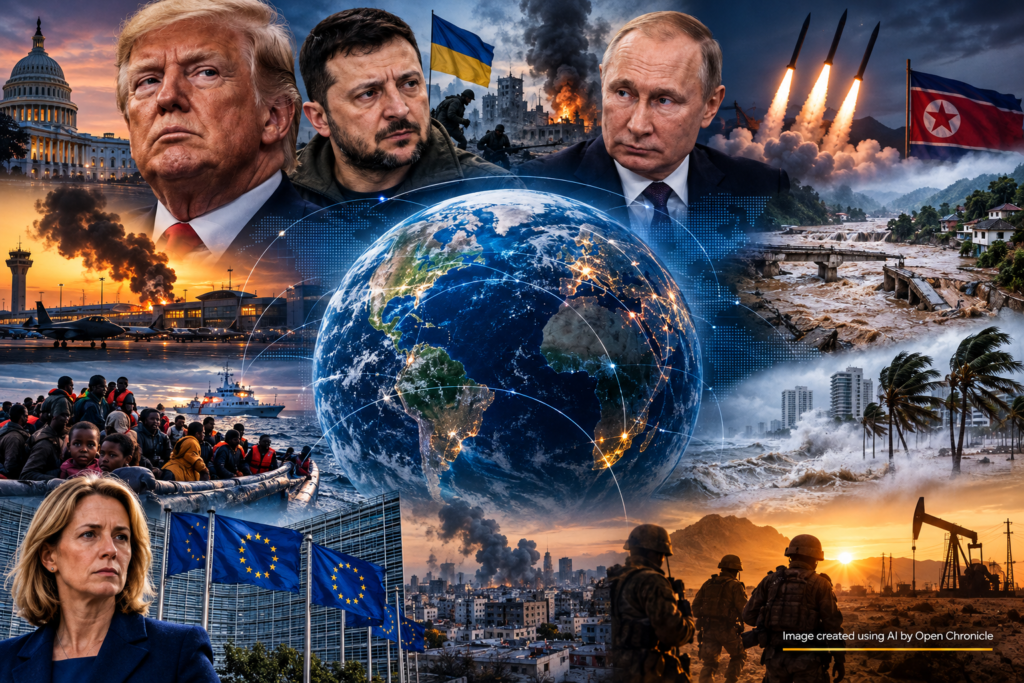
The international news agenda on Monday, October 12, is dominated by renewed attacks on Saudi Arabia, uncertainty surrounding a proposed Russia-Ukraine energy ceasefire, a dispute in Washington over Russian diesel imports and fresh North Korean missile launches.
Humanitarian emergencies are also intensifying, with severe flooding in Nepal, a deadly migrant boat disaster off Djibouti and a hurricane threatening communities along Mexico’s Pacific coast.
The following briefing brings together the principal developments in the supplied news feed. Several breaking reports contain conflicting casualty figures or claims that have not yet been independently established.
Russia and Ukraine: Trump’s Energy Ceasefire Announcement Raises Questions
US President Donald Trump’s declaration of an immediate energy ceasefire between Russia and Ukraine has created diplomatic uncertainty after Ukrainian President Volodymyr Zelenskyy said the announcement came as a surprise to Kyiv.
Trump stated that both sides had agreed to stop attacks on energy infrastructure and urged them to respect the arrangement.
Zelenskyy expressed support for a reciprocal halt to attacks but said Ukraine needed clarification about the terms. Subsequent Ukrainian statements indicated that military authorities had received instructions concerning the proposed arrangement.
However, Ukrainian officials continued to report Russian attacks against energy facilities, raising questions about whether a ceasefire had actually taken effect.
Russia had not publicly confirmed its participation in the agreement in the reporting available early Monday.
European leaders responded cautiously. French President Emmanuel Macron expressed support for a genuine energy truce, while EU foreign policy chief Kaja Kallas emphasised that any agreement would need to be respected by Moscow.
The Associated Press reported that attacks continued after Trump’s announcement, underlining the gap between the diplomatic declaration and conditions on the ground.
US-Russia Diesel Agreement Draws Bipartisan Opposition
A separate controversy has emerged over Trump’s announcement of an agreement to increase supplies of Russian diesel to international markets.
Republican and Democratic senators have challenged the proposed arrangement, arguing that allowing American purchases of Russian fuel could contradict legislation restricting energy imports from Moscow.
The administration has presented increased diesel supplies as a means of lowering fuel prices, while critics argue that additional Russian energy revenue could weaken economic pressure on President Vladimir Putin.
Senator Thom Tillis was among the Republicans questioning the legality of the proposed purchases.
The dispute has also complicated relations between Washington and European governments seeking tighter sanctions on Russia.
Kallas has urged the United States to align more closely with European restrictions, while the Czech Republic has criticised the proposed easing of pressure on Russian energy exports.
The Financial Times has separately reported that Washington threatened to restrict weapons procurement and intelligence cooperation with Ukraine unless Kyiv stopped striking Russian refineries. That reported threat has not been independently established.
Middle East: Saudi Airports Targeted in Renewed Houthi Attacks
Saudi Arabia is confronting a serious security escalation following consecutive days of reported Houthi attacks on aviation infrastructure.
Riyadh’s King Khalid International Airport was struck again on Sunday after an earlier attack on Saturday killed at least 12 people and injured more than 300, according to reports.
Saudi authorities reported one death and 11 injuries in the subsequent attack. The Houthis also claimed operations against Dammam and other Saudi targets.
The attacks have raised concerns about passenger safety, the resilience of Saudi air defences and the potential economic consequences for the kingdom.
Saudi-led coalition forces also reported intercepting a ballistic missile heading toward Khamis Mushait in southwestern Saudi Arabia.
International governments, including Britain and Bahrain, expressed support for Saudi security, while the Indian Embassy in Riyadh issued safety guidance to Indian nationals.
The escalation comes amid renewed fighting in Yemen and growing concern about threats to commercial shipping and energy infrastructure.
Financial Times reporting identified the attacks as a significant challenge to Saudi Arabia’s security and investment ambitions.
Maritime Security Concerns Spread Across the Gulf
The supplied news feed also describes an attack on an oil tanker near Oman’s Sohar port, with two Indian seafarers reportedly missing and nine others rescued.
Separate reports refer to a tanker incident in the Strait of Hormuz and competing allegations involving Iranian and American military activity.
These incidents have not been independently reconciled and should not be treated as a single confirmed sequence.
Nevertheless, the reports reflect mounting concern about maritime security in waters essential to international oil and gas transportation.
Any sustained disruption to the Gulf of Oman, Strait of Hormuz or Bab el-Mandeb could affect shipping costs, insurance premiums and global energy markets.
Gaza and Lebanon: Further Violence Reported
Reports from the Palestinian territories describe two Palestinians killed and three injured by Israeli forces in Gaza, with Palestinian sources characterising the incidents as violations of the ceasefire.
An Israeli artillery strike was also reported to have killed a retired Lebanese soldier.
The circumstances and competing accounts of these incidents require further confirmation.
The reports illustrate the fragility of regional security arrangements as renewed conflict in Yemen adds another source of instability.
Asia-Pacific: North Korea Launches Multiple Ballistic Missiles
North Korea fired several suspected ballistic missiles toward the waters east of the Korean Peninsula on Monday, according to reports citing South Korean and Japanese authorities.
The launches come amid heightened military tensions and recent South Korean weapons testing, including developments involving hypersonic technology.
Regional military authorities are assessing the launches and their implications for security.
The latest activity adds to concerns over North Korea’s continuing missile development and its ability to threaten neighbouring countries.
The supplied reporting also points to discussions in Washington over South Korea’s defence responsibilities and intelligence cooperation, while a Russian delegation has reportedly visited Pyongyang to discuss disaster-management cooperation.
China Imposes Sanctions Over Taiwan Relations
Beijing has reportedly imposed sanctions on ministers from Paraguay and Belize over their support for Taiwan.
The measures reflect China’s continuing efforts to discourage official international engagement with Taipei.
The diplomatic dispute comes as Taiwan faces growing concerns about military readiness, including reported shortages of personnel.
China’s relations with the European Union also remain under pressure from trade disagreements, while a group of 15 countries, including the United States, South Korea and Japan, has announced a coordinated response to Chinese industrial overcapacity, according to the supplied reports.
South Asia: Nepal Floods Destroy Bridges and Isolate Communities
Emergency teams are attempting to reach remote communities in Nepal after severe flash flooding damaged bridges, swept away buildings and disrupted transport routes.
The supplied reports indicate that at least six bridges collapsed, leaving more than 150 tourists stranded and isolating several settlements.
Flooding associated with the Budhi Gandaki River has prompted evacuations and emergency rescue operations.
Helicopters have reportedly been deployed to assist communities cut off by damaged roads and bridges.
Authorities face significant logistical challenges in mountainous areas where access can be difficult even under normal conditions.
The full extent of the damage, the number of displaced residents and any confirmed casualties remain subject to assessment.
India Faces Renewed Opposition Protests
India is experiencing another wave of political demonstrations, with opposition leaders and activists demanding the resignation of the country’s chief election official.
Reports describe plans for a march toward the Supreme Court, allegations of police abuses and heightened security in New Delhi.
Student activists have also become increasingly prominent in the protest movement.
The allegations against election authorities and police have not been independently established in this briefing.
The developments nevertheless indicate continuing political tensions surrounding electoral administration, civil liberties and public demonstrations.
Pakistan’s Emergency Rule Raises Political Tensions
Pakistan’s reported decision to impose emergency rule in Khyber Pakhtunkhwa has intensified tensions between the federal authorities and political forces associated with former Prime Minister Imran Khan.
The province has long been an important centre of support for Khan’s Pakistan Tehreek-e-Insaf movement.
The supplied reports describe the decision as part of a widening confrontation over provincial governance and national political authority.
Further clarification is needed regarding the legal provisions invoked and the practical extent of the emergency measures.
Africa: Djibouti Migrant Shipwreck Death Toll Rises to 139
One of the deadliest migration disasters reported this year has occurred off Djibouti, where an overcrowded boat carrying migrants toward Yemen capsized near Guhere, north of Obock.
The International Organization for Migration said at least 139 people died, including 15 children, while 84 remained missing.
The vessel was carrying approximately 305 people. Around 82 survived.
The disaster occurred during the night of October 8-9, according to survivor accounts.
The victims were travelling along the Eastern Route, a dangerous migration corridor connecting the Horn of Africa with Yemen and the wider Arabian Peninsula.
Many migrants undertake the journey in search of employment and economic security despite the risks of overcrowded vessels, trafficking networks and armed conflict.
The IOM has been assisting survivors while local authorities continue recovery operations.
The death toll was revised upward from an earlier figure of 109 as additional bodies were recovered.
Sudan Border Airstrikes and Humanitarian Concerns
A rights organisation has reported that airstrikes killed dozens of gold miners near the Egypt-Sudan border.
The identity of those responsible, the precise number of casualties and the circumstances of the attack have not been independently established in the supplied material.
Sudan’s military also reported shooting down a hostile drone near the Ethiopian border.
These developments come against the background of continuing conflict and instability in Sudan, where civilians face displacement, insecurity and severe humanitarian needs.
Separately, reports from Somalia describe worsening child malnutrition, highlighting the consequences of prolonged food insecurity and limited access to healthcare.
Americas: Hurricane Simon Strikes Mexico’s Pacific Coast
Hurricane Simon is bringing dangerous conditions to resort areas and vulnerable communities along Mexico’s Pacific coast, according to the supplied reports.
Heavy rainfall, strong winds and coastal flooding are creating risks for residents, tourists and emergency services.
Authorities are monitoring the storm as communities prepare for possible infrastructure damage, transport disruption and evacuations.
The reports available for this briefing do not establish a verified national casualty or damage total.
In the United States, attention is also turning toward the November congressional elections, with political disputes over energy prices, government advertising and foreign policy shaping the national debate.
Europe: Brexit Interference Claims and Defence Policy Debates
Britain is facing renewed discussion of foreign interference in the 2016 Brexit referendum after senior political figures reportedly said Russia had sought to influence the vote.
The supplied headlines attribute such remarks to Prime Minister Andy Burnham.
The precise statements, evidence cited and official conclusions require confirmation before they can be presented as established findings.
Across the European Union, governments are debating stronger defence coordination and proposals for a European Security Council.
NATO officials have also emphasised the alliance’s readiness to respond to potential threats.
In Germany, reports indicate that senior Social Democrat Bärbel Bas has resigned as labour minister, while Poland’s authorities are investigating an alleged threat against Prime Minister Donald Tusk.
European governments are simultaneously managing budget disagreements, climate-policy divisions and concerns over their ability to maintain long-term support for Ukraine.
Global Economy: Energy Markets React to Diplomatic Uncertainty
Oil prices declined in early trading following Trump’s announcement of an energy ceasefire between Russia and Ukraine, despite renewed attacks against Saudi infrastructure.
The prospect of fewer strikes on refineries and energy facilities encouraged expectations of improved supply conditions.
However, uncertainty surrounding the ceasefire’s implementation and the security situation in the Gulf continues to complicate market expectations.
European and Asian economies remain exposed to fluctuations in fuel prices, shipping costs and trade conditions.
The supplied reports also point to discussions at International Monetary Fund and World Bank meetings over rising debt and the economic consequences of an international energy shock.
Recent reporting indicates that crude prices fell more than 1% following the ceasefire announcement, even though Kyiv said attacks on Ukrainian infrastructure were continuing.
Humanitarian and Environmental Developments
Beyond the major geopolitical crises, the news agenda includes several developments affecting vulnerable populations and natural ecosystems.
A report on global multidimensional poverty warns that approximately 1.2 billion people experience acute deprivation, with children representing a substantial share of those affected.
In Indonesia, eight Borneo orangutans have reportedly been released into the wild following devastating forest fires.
In the Solomon Islands, authorities reportedly rescued all 73 passengers and crew members from a stranded ferry.
These stories reflect the breadth of challenges facing governments and humanitarian organisations, from disaster response and biodiversity protection to migration and poverty reduction.
The Global Outlook
The developments of October 12 reveal several interconnected pressures on international stability.
The proposed Russia-Ukraine energy ceasefire remains uncertain, while Washington’s Russian diesel initiative has exposed divisions over sanctions and the financing of Moscow’s war effort.
Saudi Arabia’s confrontation with the Houthis has widened regional security concerns, particularly around airports, oil infrastructure and strategic shipping routes.
North Korea’s missile activity is adding to tensions in East Asia, while disasters in Nepal, Mexico and Djibouti highlight the continuing vulnerability of civilian populations.
The immediate international focus will remain on whether the energy ceasefire becomes a verifiable agreement, whether attacks on Saudi infrastructure continue, and how governments respond to emerging humanitarian emergencies.