
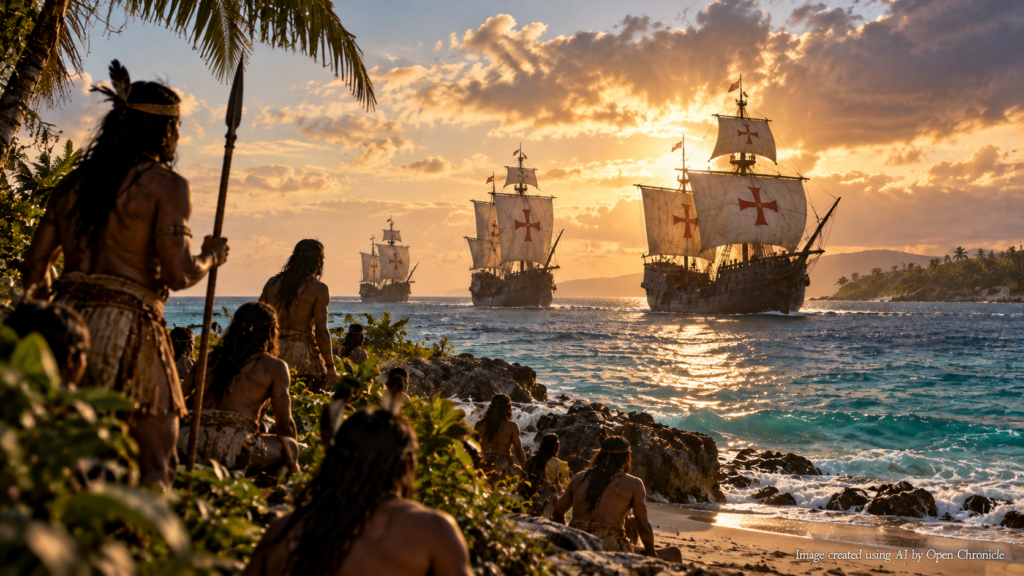
How a voyage across the Atlantic connected two worlds, transformed global trade and political power, and began centuries of conquest, colonization, cultural exchange and devastating consequences for Indigenous peoples.
By Open Chronicle History Desk
In the darkness before dawn on October 12, 1492, a lookout aboard a Spanish expedition saw land on the horizon.
After more than a month crossing the open Atlantic from the Canary Islands, three small ships were approaching an island in the Caribbean.
The men aboard had endured uncertainty, anxiety and the vast emptiness of an ocean that few Europeans of their generation had attempted to cross westward.
Their commander, Christopher Columbus, believed he had reached islands near Asia.
He was wrong.
The land before him was part of the Americas, continents inhabited by millions of people whose societies, languages, cultures and histories had developed over thousands of years.
For the Indigenous inhabitants of the Caribbean, the arrival of the ships was not the discovery of an unknown world.
It was the beginning of an encounter with outsiders whose presence would eventually transform their lives.
For the Spanish monarchy, the voyage opened possibilities of expansion, commerce, territorial claims and imperial ambition.
For Europe, it contributed to a profound reorientation of geography, economics and political power.
For the Americas, it marked the beginning of a long and often catastrophic era of colonization.
October 12, 1492 became one of the most consequential dates in world history.
But its significance cannot be understood through the familiar phrase that Columbus “discovered America.”
The Americas already existed.
Their peoples had built complex civilizations, developed agricultural systems, established trade networks and created political institutions long before Columbus arrived.
Nor was Columbus the first person from Europe to reach North America. Norse voyagers had established a settlement in Newfoundland centuries earlier.
What made the voyage of 1492 historically transformative was the sustained transatlantic connection that followed.
That connection would reshape the modern world.
1. Europe at the End of the Fifteenth Century
By the late fifteenth century, European kingdoms were increasingly interested in overseas commerce.
Luxury goods from Asia, including spices, silk and other valuable products, attracted merchants and rulers.
Established trade networks connected Europe with the Mediterranean, the Middle East, Africa and Asia.
But European powers sought additional maritime routes that might provide more direct access to Asian markets.
Portugal had taken a leading role in Atlantic exploration and voyages along the western coast of Africa.
Portuguese navigators gradually extended their knowledge of ocean currents, winds and navigation.
Spain, meanwhile, was emerging from a long period of political and military transformation.
The union of the crowns of Castile and Aragon under Isabella and Ferdinand strengthened the monarchy’s position.
In January 1492, the conquest of Granada brought the last Muslim-ruled kingdom on the Iberian Peninsula under Castilian control.
The same year, the Spanish monarchs supported an ambitious proposal to sail westward across the Atlantic.
2. Who Was Christopher Columbus?
Christopher Columbus was born in Genoa, probably in 1451.
He developed experience as a sailor and merchant in the Atlantic and Mediterranean worlds.
During his travels, he became interested in geography, navigation and the possibility of reaching Asia by sailing west.
Columbus was not the first person to imagine such a route.
Educated Europeans already understood that the Earth was spherical.
The central problem was not whether ships would eventually reach Asia by travelling westward.
It was the enormous distance involved.
Columbus underestimated the Earth’s circumference and overestimated the eastward extent of Asia.
These errors led him to believe that a westward voyage was more practical than it actually was.
He did not know that two vast continents stood between Europe and eastern Asia.
3. The Search for Royal Support
Columbus spent years seeking financial and political backing.
His proposal attracted skepticism.
Portuguese authorities did not accept his calculations.
He eventually gained the support of Isabella and Ferdinand.
The agreement known as the Capitulations of Santa Fe, signed in April 1492, established privileges and rewards connected with his proposed discoveries and claims.
Columbus was granted titles and promised a share of potential profits.
The expedition combined commercial ambition, royal prestige, religious objectives and the prospect of territorial expansion.
It was not simply a voyage of scientific curiosity.
It was an enterprise connected to the growing power of European monarchies.
4. The Three Ships
The expedition departed from Palos de la Frontera, Spain, on August 3, 1492.
Three vessels participated.
The largest vessel, a nao or merchant ship, served as Columbus’s flagship.
A smaller and faster caravel commanded by Martín Alonso Pinzón.
A caravel commanded by Vicente Yáñez Pinzón, later used by Columbus for his return voyage.
The ships were small by modern standards.
They carried supplies, equipment and crews into an ocean whose western reaches were poorly understood by European navigators.
5. The Atlantic Crossing
After leaving Spain, the expedition stopped in the Canary Islands.
The ships departed from the Canaries in early September.
Columbus used prevailing winds to carry the vessels westward.
As the days passed, the crews grew increasingly anxious.
They had no reliable knowledge of how far they would have to sail.
Columbus monitored their progress and recorded observations.
Floating vegetation, birds and changes in the sea became important signs in the search for land.
The voyage demonstrated the practical value of Atlantic wind systems.
But its outcome remained uncertain until land was sighted.
6. October 12, 1492: Land Appears
In the early hours of October 12, a sailor aboard the Pinta, traditionally identified as Rodrigo de Triana, sighted land.
The expedition approached an island in the Bahamas.
Columbus called it San Salvador.
Its Indigenous name was recorded as Guanahaní.
The precise modern island corresponding to Guanahaní remains debated among historians and geographers.
Columbus went ashore and claimed the territory for the Spanish monarchs.
He believed he had reached islands associated with Asia.
He had instead arrived in the Caribbean.
The encounter would become one of the defining moments of the early modern world.
7. The People Already Living There
The island was inhabited by Indigenous people commonly identified as Lucayans, part of the wider Taíno cultural world.
They possessed their own social organization, knowledge systems, agriculture, languages and maritime traditions.
They were not isolated from the rest of the Caribbean.
Island communities maintained networks of exchange, travel and cultural interaction.
For these inhabitants, the arrival of European ships represented an encounter with unfamiliar visitors.
They could not have anticipated the scale of the changes that would follow.
8. The First Encounters
Accounts of the initial meetings describe exchanges between the Europeans and Indigenous inhabitants.
Columbus observed local people, their appearance, possessions and customs.
His surviving voyage account, preserved through later transcription and summary, reflects European assumptions about wealth, religion, labor and political power.
He was interested in gold and the possibility of establishing Spanish authority.
He also considered the Indigenous inhabitants as potential subjects for conversion and exploitation.
The first encounters therefore contained the foundations of the unequal relationships that would characterize subsequent colonization.
9. A World Columbus Did Not Understand
Columbus believed he had reached the outer islands of Asia.
He continued searching for evidence of wealthy Asian kingdoms and trading centers.
His geographical assumptions shaped his interpretation of the lands and people he encountered.
He used the term Indios for Indigenous inhabitants because he believed he was in the Indies.
The terminology would have long-lasting consequences.
Even after Europeans recognized that the lands across the Atlantic were not eastern Asia, the language of the original mistake remained embedded in colonial administration and European writing.
10. The Caribbean Before European Arrival
The Caribbean was home to diverse Indigenous societies.
Communities cultivated cassava, maize, sweet potatoes and other crops.
They developed sophisticated knowledge of coastal environments, fishing and navigation.
Political organization varied across islands and regions.
Some communities were organized around hereditary leaders known as caciques.
Ceremonial practices, artistic traditions and spiritual beliefs formed important parts of social life.
The Caribbean was not an empty space awaiting European arrival.
It was a populated and interconnected world.
11. The First Voyage Continues
After the initial landing, Columbus explored other islands in the Bahamas.
He later reached Cuba and Hispaniola.
He continued to search for signs of Asian wealth and powerful kingdoms.
Relations with Indigenous communities varied.
Some encounters involved exchanges and hospitality.
Others involved coercion, captivity and violence.
The expedition gathered information about the islands while making claims on behalf of the Spanish Crown.
Columbus increasingly recognized the potential economic value of the region.
12. The Wreck of the Santa María
On Christmas Day 1492, the Santa María ran aground off Hispaniola.
The ship could not be saved.
Columbus used material from the wreck to establish a small settlement called La Navidad.
A group of men remained behind when he departed.
The settlement became one of the earliest Spanish footholds in the Caribbean following the voyage.
When Columbus returned during his second expedition, he found that La Navidad had been destroyed and its occupants killed.
The episode demonstrated how quickly relations between European newcomers and Indigenous communities could deteriorate.
13. The Return to Spain
Columbus began his return voyage in January 1493.
The Atlantic crossing was difficult.
Storms separated the ships.
Columbus eventually reached the Iberian Peninsula.
He returned to Spain with reports of islands, resources and people encountered across the ocean.
His account attracted enormous attention.
The Spanish monarchs regarded the expedition as a major achievement.
Plans for further voyages followed.
The initial crossing had been a small expedition.
Its consequences would be imperial in scale.
14. The Second Voyage and the Beginning of Colonization
Columbus returned to the Caribbean in 1493 with a much larger expedition.
The second voyage was not merely exploratory.
It carried settlers, animals, equipment and supplies intended to establish a more permanent Spanish presence.
Colonial settlements were created.
The Spanish sought gold, labor and territorial control.
The relationship between Europeans and Indigenous communities became increasingly coercive.
Resistance, violence, forced labor and the disruption of local societies intensified.
The era of sustained European colonization had begun.
15. The Treaty of Tordesillas
In 1494, Spain and Portugal concluded the Treaty of Tordesillas.
The agreement divided overseas spheres of expansion between the two monarchies along an agreed meridian.
It reflected the ambition of European rulers to claim authority over territories far beyond Europe.
The treaty did not recognize the sovereignty of the peoples already living in those lands.
Its significance extended well beyond the Caribbean.
It helped shape the later history of Portuguese expansion in Brazil and Spanish colonization across much of the Americas.
16. The Columbian Exchange
The voyages initiated a sustained exchange of plants, animals, diseases, technologies and populations between the Americas and Afro-Eurasia.
Historians commonly describe this process as the Columbian Exchange.
Maize, potatoes, tomatoes, cacao, tobacco and many varieties of beans and peppers spread to other parts of the world.
Horses, cattle, sheep, wheat, sugarcane and numerous other plants and animals arrived through European colonization.
The consequences were profound.
Food systems changed.
Agricultural production expanded into new environments.
Population growth in parts of the world was influenced by the spread of American crops.
But the exchange was not simply beneficial.
It also brought devastating diseases and transformed ecosystems.
17. Disease and Demographic Catastrophe
One of the most destructive consequences of sustained contact was the introduction of infectious diseases to Indigenous populations.
Smallpox, measles, influenza and other diseases contributed to severe mortality across the Americas.
Many Indigenous communities had no previous exposure to these pathogens.
The resulting epidemics were devastating.
But disease was not the only cause of population decline.
Warfare, enslavement, forced labor, displacement, hunger and the destruction of social systems also played major roles.
The scale and timing of demographic collapse varied across regions.
Historians continue to debate population estimates and the relative contribution of different causes.
What is not seriously disputed is that European colonization produced a demographic catastrophe for many Indigenous societies.
18. Conquest and Empire
The voyages of Columbus opened the way for Spanish imperial expansion.
During the sixteenth century, Spanish expeditions reached mainland regions of the Americas.
Hernán Cortés led the campaign that brought down the Aztec Empire in the early 1520s.
Francisco Pizarro and his associates conquered the Inca Empire during the 1530s.
These conquests were not achieved by Europeans acting alone.
They involved Indigenous allies, local political rivalries, military technology, disease and complex historical circumstances.
The resulting colonial order transformed political authority across enormous territories.
19. The Transformation of Global Trade
The Atlantic became a central arena of international commerce.
Spanish colonial expansion brought large quantities of American silver into global markets.
American agricultural products circulated across oceans.
European merchants, African trading networks and Asian markets became increasingly interconnected.
The development of Atlantic empires helped shift parts of Europe’s economic activity toward oceanic commerce.
Over time, these changes contributed to the emergence of a more integrated global economy.
The voyage of 1492 was not the beginning of all globalization.
Long-distance trade had existed for centuries.
But it greatly accelerated the sustained integration of the Americas into worldwide networks.
20. The Atlantic Slave Trade
European colonization also contributed to the expansion of the transatlantic slave trade.
Colonial economies demanded labor.
The destruction and exploitation of Indigenous populations, combined with the development of plantation agriculture, increased European demand for enslaved African workers.
Over the following centuries, millions of Africans were forcibly transported across the Atlantic.
They endured violence, captivity, family separation and exploitation.
The transatlantic slave trade became one of the central institutions of the Atlantic colonial world.
Its consequences continue to shape societies across the Americas, Africa and Europe.
21. Religion and Conversion
Religion played a major role in Spanish imperial expansion.
The monarchy supported missionary activity and the spread of Christianity.
Missionaries established churches, schools and religious institutions.
Conversion sometimes involved education and cultural exchange.
It also frequently occurred within systems of coercion and colonial authority.
Indigenous religious practices were suppressed in many regions.
Yet Indigenous communities did not simply abandon their identities.
They adapted, resisted and transformed religious traditions in ways that produced complex cultural forms.
The religious history of colonial America cannot be reduced to either peaceful conversion or uniform destruction.
It involved both coercion and Indigenous agency.
22. The Debate Over Indigenous Rights
European expansion produced debates within Spain about the moral and legal treatment of Indigenous peoples.
Some religious figures criticized colonial abuses.
Bartolomé de las Casas became one of the most prominent defenders of Indigenous communities against violent exploitation.
Other thinkers attempted to justify conquest and Spanish authority.
The Valladolid debate of 1550–1551 became an important episode in these arguments.
The debates did not end colonial domination.
But they reveal that the legitimacy of conquest and forced labor was contested even within European institutions.
23. Columbus as Colonial Governor
Columbus’s own career after 1492 was marked by conflict.
He attempted to govern Spanish settlements in the Caribbean.
His administration faced accusations of harsh punishment, mismanagement and abuses of authority.
In 1500, royal commissioner Francisco de Bobadilla arrested Columbus and sent him back to Spain in chains.
Columbus was later released.
He made a fourth Atlantic voyage, but his political position had been damaged.
The image of Columbus as a triumphant navigator obscures the controversies surrounding his conduct as a colonial administrator.
24. The Four Voyages
Columbus completed four voyages across the Atlantic between 1492 and 1504.
His expeditions explored parts of the Caribbean and reached sections of the Central American and northern South American coasts.
He never reached the Asian destinations he originally sought.
He also did not establish that he had encountered two previously unknown continents from the European geographical perspective.
His voyages nevertheless opened the way for sustained European expansion across the Atlantic.
He died in Valladolid, Spain, on May 20, 1506.
25. Why the Americas Were Not Named After Columbus
The name America is generally traced to Amerigo Vespucci.
Vespucci’s accounts helped persuade European geographers that the lands across the Atlantic were part of a previously unrecognized continental landmass.
In 1507, cartographer Martin Waldseemüller used the name America on a world map.
The designation gradually spread.
The naming process illustrates how European geographical knowledge changed after Columbus’s first voyage.
The initial belief that the Caribbean belonged to Asia was increasingly abandoned.
A new understanding of the world’s geography emerged.
26. The Norse Voyages Before Columbus
Columbus was not the first European to reach North America.
Around the year 1000, Norse voyagers crossed the North Atlantic.
Archaeological evidence confirms a Norse settlement at L’Anse aux Meadows in present-day Newfoundland, Canada.
The settlement demonstrates that Europeans reached North America centuries before 1492.
But Norse contact did not produce the same sustained transatlantic imperial and commercial system that followed Columbus’s voyages.
This distinction explains why 1492 remains a major historical turning point without requiring the inaccurate claim that Columbus was the first European in the Americas.
27. Indigenous Civilizations Before 1492
The Americas were home to an extraordinary diversity of civilizations.
The Maya had developed sophisticated writing, mathematics, astronomy and urban traditions.
The Aztec Empire dominated large parts of central Mexico.
The Inca Empire controlled extensive territories in the Andes.
Numerous other societies built cities, agricultural landscapes, trade systems and political institutions.
Across North America, Indigenous communities developed diverse forms of social organization and environmental knowledge.
The history of the Americas did not begin in 1492.
European arrival entered an already ancient and complex historical world.
28. Resistance and Survival
Indigenous peoples resisted European conquest and colonization in many ways.
Some fought military campaigns.
Others formed alliances to defend their communities.
Some preserved cultural practices through adaptation.
Others negotiated within colonial institutions or used legal systems to challenge abuses.
Indigenous resistance continued across centuries.
Despite enormous losses, Indigenous societies survived.
Their languages, cultures, political movements and identities remain central to the Americas today.
The history of colonization is therefore also a history of endurance.
29. October 12 and Historical Memory
October 12 has been commemorated in different ways.
In Spain, it is associated with the country’s national day.
In the United States, Columbus Day has traditionally celebrated the navigator’s voyage.
In parts of Latin America, the date has been associated with Hispanic heritage and the encounter between cultures.
But these commemorations have become increasingly contested.
For many Indigenous communities, October 12 represents the beginning of invasion, dispossession and colonial violence.
Some countries and communities have adopted alternative names and commemorations emphasizing Indigenous resistance, cultural diversity or historical reflection.
The disagreement is not simply about terminology.
It concerns whose experiences are placed at the center of historical memory.
30. Columbus: Explorer, Conqueror or Symbol?
Christopher Columbus remains one of the most debated figures in world history.
His voyages required maritime skill, determination and an ability to navigate the Atlantic.
They also served imperial ambitions and helped initiate systems of conquest and exploitation.
His historical significance is undeniable.
But significance is not the same as moral approval.
Understanding Columbus requires examining both his achievements as a navigator and the consequences of the colonial enterprises he helped establish.
The history is neither a simple story of heroic discovery nor a single event that explains every later development.
It is the beginning of a complex process with global consequences.
31. The Birth of an Atlantic World
After 1492, the Atlantic increasingly connected Europe, Africa and the Americas through commerce, migration, conquest, forced labor and cultural exchange.
Cities and ports grew.
New economic systems developed.
Empires competed for territory and resources.
Populations moved, voluntarily and involuntarily, across oceans.
Languages spread.
Religions changed.
Crops transformed diets.
The Atlantic became a major center of global history.
The world was not suddenly united on October 12.
But the voyage helped initiate a sustained transformation in the relationships between continents.
32. Why October 12 Matters
October 12, 1492 is important because it marks the beginning of sustained European contact with the Caribbean that led to the colonization of the Americas.
It transformed geographical knowledge.
It accelerated global commercial integration.
It reshaped political power.
It contributed to the exchange of crops, animals and diseases.
It initiated devastating processes of conquest, displacement and demographic collapse for Indigenous peoples.
And it remains a deeply contested date because its consequences were experienced so differently.
For European monarchies, it opened new imperial possibilities.
For many Indigenous communities, it began an era of profound upheaval.
For world history, it marked the emergence of a new and increasingly interconnected Atlantic system.
October 12, 1492: The Day Two Worlds Met
Before sunrise, three ships approached an island.
The men aboard believed they were nearing Asia.
The people watching from the shore knew nothing of the European kingdoms that had sent them.
Neither group could fully understand what the encounter would mean.
The ships carried sailors, weapons, religious beliefs and royal ambitions.
The island was home to people with their own histories, traditions and relationships with the surrounding Caribbean world.
The meeting did not immediately create a new global order.
But it opened the way for one.
In the centuries that followed, empires expanded, populations were displaced, millions of Africans were enslaved, Indigenous civilizations endured devastating upheaval and the movement of goods, people and ideas transformed societies across the world.
The familiar image of Columbus stepping onto a beach captures only a small part of the story.
The larger history belongs to everyone whose world changed after the encounter.
On October 12, 1492, Columbus reached the Caribbean. He did not discover an empty continent. His voyage began a sustained encounter that would transform the history of humanity.
Historical Sources and Further Reading
The following historical and educational resources
provide context for the 1492 Atlantic crossing,
the societies of the Americas before European
colonization, and the long-term consequences
of transatlantic contact.
1492: An Ongoing Voyage
Historical exhibition examining the world
of 1492, European exploration, the societies
of the Americas and the transformations
associated with transatlantic contact.
Explore the Historical Exhibition →
National Museum of the American Indian:
Native Knowledge 360°
Educational and historical resources
presenting Indigenous perspectives,
the diversity of Native American
societies and the consequences
of European colonization.
Explore Indigenous Historical Perspectives →
Christopher Columbus:
Voyages, Life and Historical Legacy
Historical overview of Columbus’s
background, Atlantic expeditions,
encounters in the Caribbean,
colonial administration and
long-term historical significance.
Read the Historical Biography →
L’Anse aux Meadows National Historic Site
Archaeological evidence of a Norse
settlement in Newfoundland around
the year 1000, demonstrating that
Europeans reached North America
centuries before Columbus’s
first Atlantic voyage.
Explore the UNESCO Historical Site →
Open Chronicle History uses October 12, 1492,
to identify the arrival of Christopher Columbus’s
expedition in the Caribbean, not the discovery
of an uninhabited continent. The Americas
were home to diverse Indigenous peoples
and civilizations long before European arrival.
The precise identification of Guanahani,
the island reached by Columbus, remains
a subject of historical and geographical
debate. Archaeological evidence also
establishes Norse contact with North
America centuries before 1492.
The historical significance of the voyage
lies in the sustained transatlantic contact
and colonization that followed. Its
consequences included cultural and
economic exchange, but also conquest,
forced labor, enslavement, epidemic
disease and widespread disruption
of Indigenous societies.