
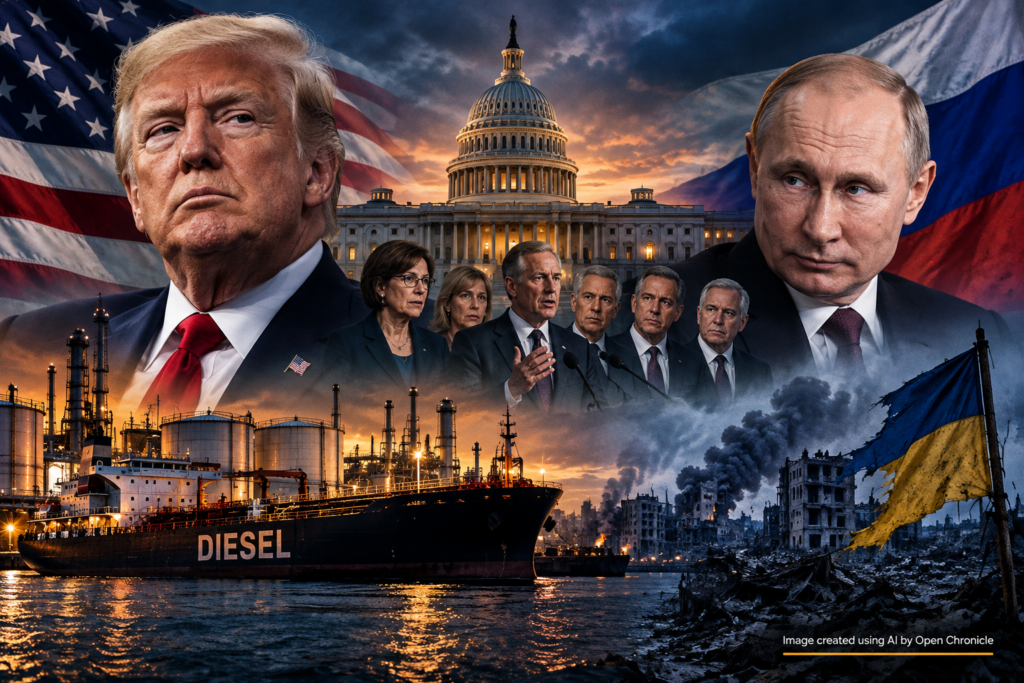
Six Republican and Democratic senators have called on President Donald Trump to reverse a proposed agreement to purchase Russian diesel, arguing that the arrangement could undermine US sanctions, contradict congressional legislation and provide Moscow with additional revenue as its war against Ukraine continues.
By Open Chronicle with agencies
WASHINGTON, October 11, 2026 — A bipartisan group of six United States senators called on President Donald Trump’s administration on Sunday to abandon a proposed agreement to purchase large quantities of diesel from Russia, warning that the arrangement could provide President Vladimir Putin with additional financial resources while Russian forces continue their war against Ukraine.
The lawmakers, including four Republicans and two Democrats, accused the administration of failing to consult Congress or provide a legal justification for the proposed purchases.
In a joint statement, they urged the White House to reverse its decision immediately.
“The United States should not provide Putin with a financial lifeline while Russia continues to kill Ukrainian civilians. The Administration must immediately reverse course,” the senators said.
Their intervention followed Trump’s announcement on Friday that he had reached an agreement with Putin during a telephone conversation to increase Russian diesel supplies to the American and international markets.
The president presented the arrangement as part of his administration’s efforts to reduce high fuel prices.
However, the announcement has prompted questions about its compatibility with existing restrictions on Russian energy imports and Washington’s broader strategy of limiting Moscow’s ability to finance its military operations.
Trump Announces Major Russian Diesel Supply Agreement
According to Trump’s announcement on social media, Russia would begin supplying more than 300,000 metric tons of diesel to the United States and global markets immediately.
The president said the arrangement would be followed by additional deliveries of 500,000 tons in November and another 1 million tons shortly afterward.
Russia would subsequently provide a further 3 million tons within what Trump described as a short period.
If implemented in full, the announced quantities would amount to more than 4.8 million metric tons of diesel.
The announcement did not establish how much of the fuel would be imported directly into the United States, how much would be sold elsewhere, or which companies would handle the transactions.
Those distinctions are significant because American restrictions on Russian energy imports may apply differently depending on the structure and destination of the transactions.
Trump’s proposal comes amid concerns about high fuel prices and their effects on American households, businesses and transportation costs.
The administration has presented increased energy supplies as a way to ease pressure on consumers.
Critics, however, argue that purchasing Russian petroleum products could undermine the economic restrictions imposed on Moscow following its full-scale invasion of Ukraine in February 2022.
Four Republicans Join Democrats in Opposing Deal
The six senators who signed Sunday’s statement represent both major American political parties.
The Republican signatories were Susan Collins of Maine, Lisa Murkowski of Alaska, Thom Tillis of North Carolina and John Curtis of Utah.
They were joined by Democratic senators Jeanne Shaheen of New Hampshire and Richard Blumenthal of Connecticut.
Their joint intervention reflects concern across party lines over the potential consequences of reopening American purchases of Russian energy products.
The lawmakers said the administration had neither consulted Congress nor submitted the explanation they believe is required under federal law.
They also argued that the proposed arrangement would contradict the purpose of legislation designed to restrict financial flows to Russia.
“Congress was clear: the U.S. should not import oil from Russia until it ends its aggression against Ukraine and ceases threats against our NATO Allies,” the senators said.
They added that Trump’s decision to permit Russian diesel imports would run directly counter to that legislation.
The lawmakers’ objections place the proposed agreement at the centre of a broader dispute over presidential authority, congressional restrictions and American policy toward Russia.
Senator Tillis Raises Questions About Legality
Republican Senator Thom Tillis went further in an interview broadcast Sunday on NBC’s Meet the Press, suggesting that implementation of the proposed purchases could raise serious questions about whether the administration was complying with federal law.
Tillis said there was a legitimate basis for arguing that the president would not be following the law if the administration proceeded with the diesel arrangement.
He also reiterated his position that Russia bears responsibility for the conflict in Ukraine.
“We were very clear that Russia is the aggressor. Russia is the one who can end this war by backing out of territory that they occupied,” Tillis said.
His remarks underline the tensions within the Republican Party over how Washington should balance domestic energy concerns against efforts to maintain economic pressure on Moscow.
While Trump has emphasised the importance of lowering fuel costs, several Republican lawmakers remain opposed to measures that could generate additional revenue for the Russian government.
The dispute could become more consequential if the administration takes formal steps to authorise purchases that lawmakers believe are prohibited under existing legislation.
Congressional Restrictions on Russian Energy Imports
The senators’ statement drew particular attention to the American ban on Russian energy imports introduced in 2022 following Moscow’s full-scale invasion of Ukraine.
The legislation was intended to prevent the United States from purchasing Russian energy products and thereby contributing revenue to the Russian economy during the war.
The lawmakers argued that permitting new diesel imports would undermine the purpose of those restrictions.
Their objections also come only weeks after Congress passed legislation directing the administration to impose substantial tariffs on major importers of Russian oil or natural gas.
According to the supplied account, the measure included an exception for certain countries that import less than 15 percent of Russia’s natural gas exports and have taken significant steps to reduce their dependence on Russian supplies.
The legislation was designed to increase economic pressure on countries purchasing Russian energy and limit Moscow’s access to revenue from international oil and gas sales.
Against that background, the proposed diesel agreement has raised questions about the consistency of American energy and sanctions policy.
The precise legal implications would depend on the structure of the proposed transactions, the statutory restrictions involved and any applicable presidential authorities or exceptions.
No court ruling or formal legal determination concerning the announced agreement was identified in the information available.
Republican Senator Defends Trump’s Energy Priorities
Not all Republican lawmakers have opposed the president’s approach.
Senator John Barrasso of Wyoming defended Trump’s broader energy objectives when questioned about the proposed arrangement during an appearance on CBS’s Face the Nation.
Barrasso said the president was focused on reducing energy costs and faced difficult decisions in balancing competing priorities.
“The president is balancing and has to make tough decisions,” Barrasso said.
His comments highlighted the administration’s argument that lowering fuel prices remains an important economic objective.
High diesel prices can affect transportation, agriculture, manufacturing and the movement of goods, potentially contributing to wider inflationary pressures.
Increasing available supplies could, depending on market conditions and the destination of the fuel, help ease some of those pressures.
However, the senators opposing the arrangement argue that the potential economic benefits must be weighed against the strategic consequences of providing Russia with additional export revenue.
The dispute illustrates the competing priorities facing Washington as it seeks to manage domestic energy prices while maintaining pressure on Moscow over the war in Ukraine.
Russian Energy Revenue Remains a Central Issue
Oil and petroleum exports remain an important source of revenue for the Russian economy.
Since the beginning of the full-scale invasion of Ukraine, Western governments have introduced restrictions intended to reduce Moscow’s ability to generate income from energy sales.
These measures have included import bans, financial sanctions and coordinated restrictions affecting Russian oil trade.
Ukraine and its international supporters have repeatedly argued that reducing Russia’s energy revenues is an essential component of the broader effort to constrain Moscow’s ability to sustain its military campaign.
The proposed diesel arrangement therefore carries implications beyond American fuel prices.
If implemented, purchases involving Russian suppliers could generate revenue for companies operating within Russia’s energy sector.
The scale and ultimate economic impact would depend on the commercial terms, transaction routes and volumes actually delivered.
Those details have not been fully established in the announced proposal.
A New Test for US Policy Toward Russia
The bipartisan opposition creates another challenge for Trump’s administration as it seeks to pursue its economic and diplomatic priorities.
For the six senators, the central issue is whether the United States should purchase Russian energy products while Moscow continues military operations in Ukraine.
For the White House, the proposed agreement has been presented as a measure intended to increase fuel supplies and ease prices.
The disagreement also raises questions about the relationship between executive authority and congressional legislation.
Lawmakers have indicated that they expect the administration to explain the legal basis for any arrangement that would permit imports otherwise restricted by federal law.
It remains unclear whether the White House will modify the proposed agreement, provide a formal legal justification or proceed despite the objections.
No completed diesel deliveries under the newly announced arrangement were established in the supplied reporting.
For now, the dispute underscores the continuing difficulty of reconciling domestic energy policy with Washington’s efforts to limit Russia’s financial resources during the war in Ukraine.