
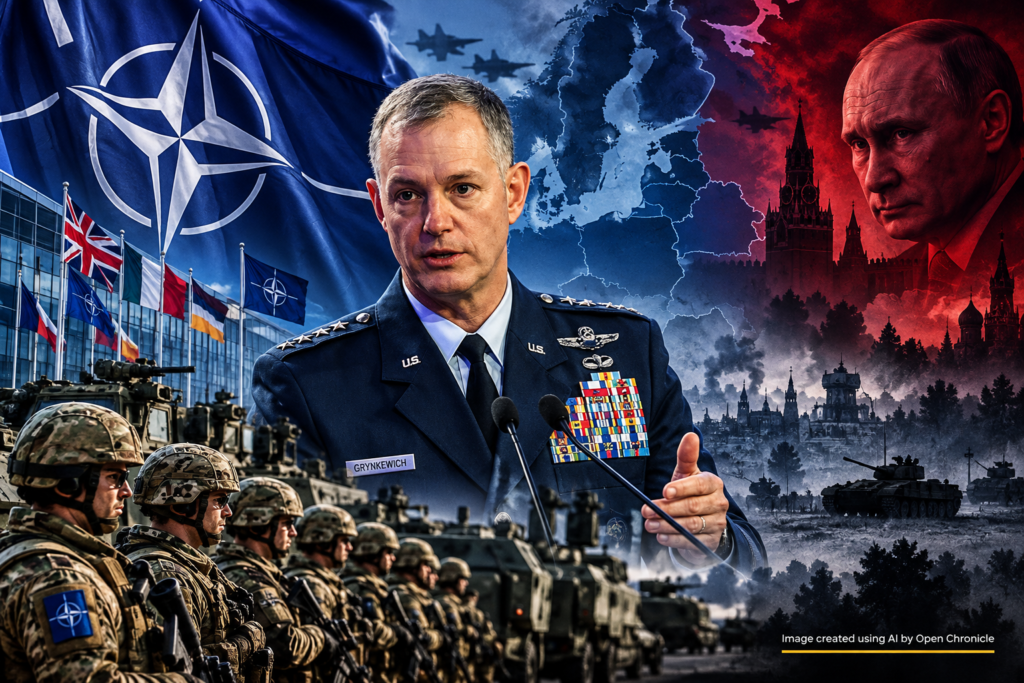
General Alexus Grynkewich says NATO is prepared to defeat any aggression against its members, while stressing that a direct military confrontation with Russia is neither imminent nor inevitable. The warning comes amid growing European concerns over sabotage, cyberattacks and the security of critical infrastructure.
By Open Chronicle with agencies
WARSAW, October 12, 2026 — NATO’s top American military commander in Europe delivered a warning to Russia on Monday, declaring that any attack against a member of the alliance would be defeated and that Moscow should not underestimate NATO’s collective military capabilities.
Speaking in Warsaw, US General Alexus Grynkewich, NATO’s Supreme Allied Commander Europe (SACEUR), outlined what he described as his “theory of victory”, explaining how the alliance would respond to an armed attack against its territory.
His remarks come at a time of heightened concern across Europe over Russian military activity, suspected sabotage operations, cyberattacks and other forms of hybrid warfare targeting NATO countries.
“If someone is foolish enough to attack us, we will fight. We will stop the attack and deny them the ability to achieve their objectives, whatever those may be,” Grynkewich said.
“We will, in short, ensure any attack against any ally proves utterly futile.”
Despite the forceful language, the American general emphasised that NATO does not consider a direct military confrontation with Russia inevitable.
“Let me make one point very clear: I do not assess that conflict is imminent or inevitable. It isn’t,” he said.
The speech sought to reinforce NATO’s deterrence posture while reassuring European governments that the alliance remains capable of defending its territory against conventional military threats and increasingly sophisticated forms of hostile activity.
NATO Outlines Its Strategy to Defeat an Armed Attack
Grynkewich described a military strategy designed to deny an aggressor any realistic prospect of achieving its objectives against NATO territory.
The approach would begin with stopping an initial assault, preventing hostile forces from advancing and, if necessary, destroying their ability to continue military operations.
“My theory of victory is simple: we will block the initial attack. If the attack persists, we will blunt it and prevent enemy advance,” he said.
“And if required, we will break the enemy’s forces and the operational warfighting system that is arrayed against us.”
The general’s remarks reflect NATO’s emphasis on credible deterrence, which depends on convincing potential adversaries that the military and political costs of aggression would outweigh any possible gains.
For the alliance, that means maintaining sufficient forces, readiness, intelligence capabilities and command structures to respond rapidly to a crisis.
NATO’s military planning has increasingly focused on reinforcing its eastern flank, improving logistical networks and ensuring that allied forces can operate together during a large-scale confrontation.
The war in Ukraine has reinforced European concerns about the possibility of conventional warfare on the continent, particularly in countries geographically close to Russia and Belarus.
However, Grynkewich’s comments also highlighted the importance of preventing a conflict rather than simply preparing to win one.
By communicating NATO’s defensive capabilities, the alliance hopes to discourage any potential attack before it begins.
Growing Concerns Over Russian Hybrid Warfare
The warning comes amid mounting allegations that Russia is conducting a campaign of hybrid operations across Europe.
Western officials have increasingly pointed to suspected sabotage, cyberattacks, disinformation, interference with communications systems and attempts to disrupt critical infrastructure.
Unlike conventional military operations, hybrid activities often take place below the threshold of open armed conflict.
They can involve attacks against energy networks, transportation systems, telecommunications infrastructure, military supply chains and public institutions.
Such operations present a particular challenge because responsibility can be difficult to establish quickly, while the consequences may extend across national borders.
European governments have also raised concerns about suspicious drone activity near airports and military installations.
One recent incident involved the discovery of a drone reportedly carrying explosives near a German airport, intensifying concerns about aviation security and potential threats to infrastructure.
The circumstances of individual incidents remain subject to investigation, and allegations of Russian involvement require evidence before responsibility can be established.
Nevertheless, NATO officials have warned that the cumulative effect of these activities could weaken public confidence, disrupt essential services and test the alliance’s ability to respond collectively.
NATO Must Clearly Communicate Its Red Lines
Grynkewich stressed that allied governments must respond to hostile activities through consultation, intelligence sharing and clear political communication.
He argued that when sufficient evidence identifies Russia as responsible for an incident, NATO countries should be prepared to attribute responsibility publicly and communicate the limits of acceptable behaviour.
“It’s important that allies continue to consult, think about how we might respond, and make sure that we message clearly and concisely to the Russians where our red lines are,” he said.
The general’s comments reflect a central challenge in modern deterrence: responding firmly to hostile actions without unintentionally triggering a broader military confrontation.
Hybrid operations are particularly difficult to address because they may involve criminal networks, covert agents, cyber capabilities or unidentified intermediaries.
Determining responsibility can require extensive intelligence cooperation between governments and security agencies.
NATO members must also decide whether an incident should be treated as a national security matter, a collective security concern or, in the most serious circumstances, an armed attack potentially engaging the alliance’s mutual defence commitments.
Grynkewich’s message was that ambiguity should not prevent NATO from preparing coordinated responses.
At the same time, the alliance must ensure that its decisions are based on reliable evidence and shared assessments.
France Strengthens Protection of Critical Infrastructure
Concerns about hybrid warfare have already prompted additional security measures in several European countries.
In September, French President Emmanuel Macron announced steps to strengthen protection for critical infrastructure and defence industry facilities against what he described as an intensifying threat from Russian hybrid operations.
The measures were intended to improve security around strategically important installations, including sites involved in defence production and essential national services.
France’s response reflects a wider European effort to protect infrastructure that could become a target during periods of geopolitical confrontation.
Energy facilities, ports, airports, rail networks, telecommunications systems and defence manufacturing sites are increasingly regarded as essential components of national resilience.
Disruptions to these systems could have consequences extending well beyond the immediate location of an attack.
European security officials have consequently placed greater emphasis on cooperation between military authorities, intelligence services, police forces and private infrastructure operators.
The growing attention to hybrid threats illustrates how the concept of national defence has expanded beyond traditional military installations and battlefield operations.
NATO Says Russia Would Bear Responsibility for Escalation
Another important element of Grynkewich’s speech concerned the danger of escalation during a military confrontation.
The commander said NATO’s response would be directed toward defeating aggression rather than deliberately expanding the conflict.
He argued that any subsequent decision to intensify hostilities would be the responsibility of the attacking state.
“The burden of escalation would rest squarely upon the aggressor; they and they alone would bear the full moral, political, and strategic weight of deciding whether to do so,” he said.
The statement comes against the background of continuing concern over nuclear risks in Europe.
Russia possesses one of the world’s largest nuclear arsenals, while NATO’s deterrence posture includes nuclear capabilities maintained by the United States, Britain and France.
Although Grynkewich did not explicitly refer to nuclear weapons in the quoted remarks, his comments addressed the broader issue of escalation management during a major conflict.
NATO has repeatedly maintained that it is a defensive alliance and does not seek military confrontation with Russia.
Its collective defence principle, established under Article 5 of the North Atlantic Treaty, provides that an armed attack against one member is considered an attack against all.
The alliance’s stated objective is to prevent aggression through credible military preparedness and political solidarity.
Uncertainty Over Future US Military Deployments in Europe
Grynkewich’s warning comes as European governments await the outcome of a review of American military deployments across the continent.
The Trump administration is assessing the distribution of US forces overseas, with decisions concerning the American presence in Europe expected toward the end of the year.
The review has generated concern among some European allies about the possibility of reductions in US troop numbers or changes to military commitments.
American forces remain a central component of NATO’s deterrence and defence posture, providing capabilities in areas including intelligence, strategic transport, air defence, logistics and command operations.
Any substantial changes to those deployments could require European countries to assume greater responsibility for capabilities currently supported by Washington.
The debate has intensified as European governments seek to strengthen their armed forces and reduce vulnerabilities exposed by Russia’s war against Ukraine.
Questions about the reliability and long-term direction of American security policy have also encouraged European leaders to pursue greater defence cooperation.
However, Grynkewich rejected suggestions that Washington’s commitment to NATO should be doubted.
“I think no one should question the commitment of the United States to this alliance,” he said.
His remarks were intended to reassure allied governments that American military leadership remains committed to NATO’s collective defence obligations.
European Defence Spending and Military Readiness Increase
European NATO members have accelerated efforts to expand defence capabilities in response to the changing security environment.
Governments are investing in ammunition production, air and missile defence systems, military mobility, intelligence capabilities and the modernisation of armed forces.
The conflict in Ukraine has demonstrated the importance of maintaining industrial capacity and sufficient stockpiles to sustain prolonged military operations.
European countries have also placed greater emphasis on interoperability, ensuring that national forces can operate effectively within NATO’s multinational command structure.
Grynkewich welcomed the shift toward greater European responsibility, arguing that the process was strengthening the alliance rather than weakening transatlantic cooperation.
“We’re in the implementation phase, and that is driving a stronger and more united alliance than I’ve seen in a long, long time,” he said.
His assessment suggests that increased European defence efforts are beginning to translate into operational improvements.
For NATO planners, the challenge is to ensure that political commitments and higher military budgets produce forces capable of deploying rapidly and operating effectively in a crisis.
That requires not only additional equipment but also trained personnel, secure communications, logistical support and coordinated military planning.
Poland’s Strategic Role on NATO’s Eastern Flank
The decision to deliver the warning in Warsaw carries particular strategic significance.
Poland has emerged as one of NATO’s most important military and logistical hubs since Russia launched its full-scale invasion of Ukraine in February 2022.
Its geographical position places it close to Ukraine, Belarus and Russia’s Kaliningrad exclave.
Poland has substantially increased its defence investments and expanded cooperation with the United States and other NATO allies.
The country also plays a central role in supporting military assistance to Ukraine and facilitating allied deployments across Eastern Europe.
For Warsaw and other governments along NATO’s eastern flank, the possibility of Russian aggression remains a major national security concern.
Grynkewich’s remarks therefore carried a message not only to Moscow but also to allied populations seeking reassurance about NATO’s readiness.
By emphasising that an attack would be defeated, the commander sought to reinforce confidence in the alliance’s defensive capabilities.
Deterrence, Unity and the Risk of Miscalculation
The speech illustrates NATO’s attempt to maintain a balance between military readiness and diplomatic restraint.
Alliance officials want to demonstrate that aggression would fail while avoiding rhetoric or actions that could make confrontation more likely.
That balance has become increasingly important as Europe faces a combination of conventional military threats, cyber operations, sabotage allegations and uncertainty over the future of American military deployments.
Grynkewich’s assertion that war is neither imminent nor inevitable was therefore as significant as his warning that NATO would defeat an attack.
The general presented military strength as an instrument of deterrence rather than an indication that the alliance expects conflict.
His message also reflected the importance of unity among NATO members, particularly when responding to incidents that fall short of conventional warfare.
For European governments, the coming months will test whether increased defence spending, stronger infrastructure protection and closer military coordination can translate into greater security.
For Russia, NATO’s senior military commander delivered a clear warning: any attempt to achieve military objectives through an attack on the alliance would face a coordinated response designed to ensure that aggression fails.
The central objective, Grynkewich insisted, remains preventing such a confrontation from occurring in the first place.