
From Oliver Solberg’s breakthrough in Monte-Carlo to the decisive showdown in Sardinia, the 2026 World Rally Championship delivered a season of emerging talent, fierce rivalries and a title battle decided by just five points.
By Open Chronicle Sports
World Rally Championship · 2026 Season Review · 12 October 2026
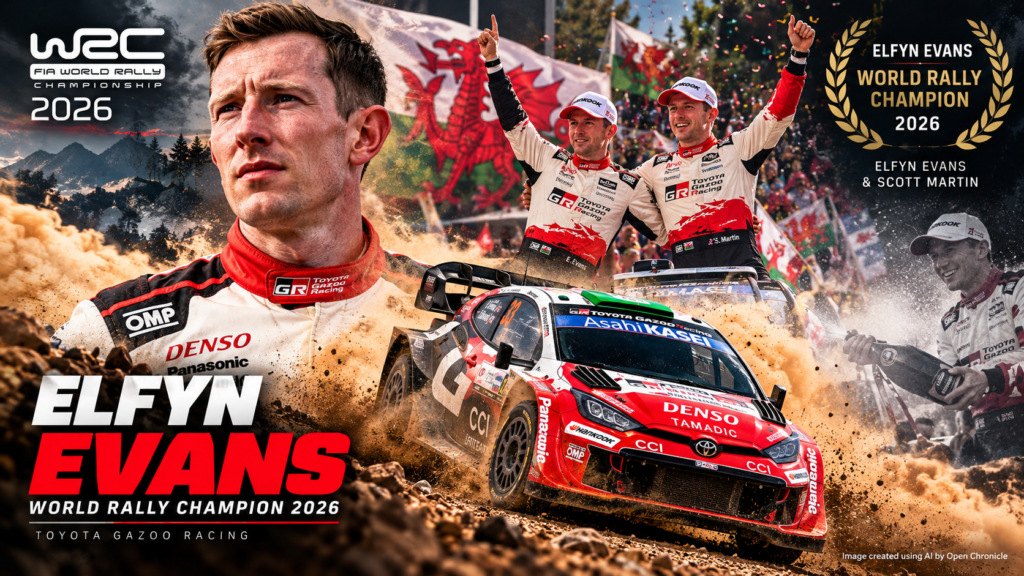
The 2026 FIA World Rally Championship will be remembered as the year Elfyn Evans finally reached the summit of world rallying, securing the drivers’ title alongside co-driver Scott Martin after a season-long struggle against two of Toyota’s most formidable challengers.
Across 13 completed rounds, the championship travelled from the snow-covered mountains of Monte-Carlo and Sweden to the gravel roads of Kenya, Portugal, Finland and South America. Every surface presented a different challenge, and the title contest remained open until the final event in Sardinia.
Evans emerged champion with 243 points, just five ahead of Oliver Solberg and six clear of Sami Pajari. Toyota also secured the manufacturers’ championship, completing a remarkable season for its Rally1 programme.
Yet the final standings tell only part of the story. The season also belonged to Solberg’s rise as a genuine title contender, Pajari’s breakthrough victories and a dramatic late campaign in which every stage carried championship consequences.
A championship decided by the narrowest margins
2026 FIA WORLD RALLY CHAMPIONSHIP · FINAL DRIVERS’ STANDINGS
1 · World Champion
243
Elfyn Evans
2 · Runner-up
238
Oliver Solberg
3 · Third place
237
Sami Pajari
Final championship standings following Rally Italia Sardegna, 4 October 2026.
For Evans, the championship represented the culmination of years spent competing at the highest level. Long regarded as one of rallying’s most accomplished and consistent drivers, the Welshman finally converted his experience into the sport’s ultimate prize.
His campaign was not built solely on outright speed. It required disciplined points collection, careful risk management and the ability to remain competitive on surfaces ranging from winter snow to punishing gravel.
Solberg and Pajari pushed him to the limit. Both emerged from the season with their reputations enhanced, demonstrating that a new generation of rally drivers was ready to challenge the established order.
Monte-Carlo: Solberg announces himself
The championship opened with a statement from Oliver Solberg.
At Rallye Monte-Carlo, where unpredictable weather and constantly changing road conditions have traditionally rewarded experience, Solberg claimed victory and immediately established himself as one of the season’s major contenders.
Monte-Carlo’s unique demands made the achievement particularly significant. Drivers faced combinations of dry asphalt, damp roads, ice and snow, often within the same competitive stage.
Solberg’s victory was an early indication that Toyota’s young Swedish driver possessed both the speed and composure required to compete for a world championship.
It also ensured that the title race began with an unexpected twist.
Evans responds in Sweden
The second round brought the championship to the frozen forests of Sweden, where studded tyres and high-speed snowbanks create one of the most distinctive challenges in motorsport.
Elfyn Evans responded with victory, demonstrating the consistency and technical precision that would become central to his title-winning campaign.
The result was important psychologically as well as competitively. Solberg had taken the opening victory, but Evans showed that the championship would not be dictated by a single early-season performance.
With both drivers immediately establishing themselves at the front, Toyota’s internal competition became one of the defining narratives of 2026.
Katsuta’s breakthrough in Africa and Croatia
Takamoto Katsuta delivered one of the season’s most memorable achievements with victory at Safari Rally Kenya.
The African classic remains among the toughest events in world rallying, with unpredictable weather, rocky roads, deep ruts and the constant possibility of mechanical damage.
Katsuta’s success demonstrated his growing maturity as a Rally1 driver and represented a major milestone for Japanese motorsport.
He followed that result with another victory in Croatia, underlining that his performance in Kenya was not an isolated achievement.
The two wins gave Toyota an exceptional start to the championship and highlighted the depth of its driver line-up.
Ogier remains a formidable force
Sébastien Ogier, competing on a partial programme, continued to demonstrate why he is one of the greatest drivers in WRC history.
The Frenchman secured victories at Rally Islas Canarias and the Acropolis Rally Greece, showing that experience, technical understanding and exceptional stage management remain powerful advantages in modern rallying.
His performances were especially important for Toyota’s manufacturers’ campaign.
Although Ogier was not contesting every round, his ability to deliver victories and strong results provided the team with another decisive weapon.
Portugal: Neuville strikes back
Thierry Neuville secured victory on the demanding Portuguese gravel stages, providing a welcome breakthrough against Toyota’s increasingly dominant operation.
Portugal’s combination of abrasive surfaces, high temperatures and passionate roadside crowds makes it one of the championship’s defining events.
Neuville’s success demonstrated that Hyundai remained capable of challenging for victories, even as Toyota controlled much of the championship narrative.
For Portuguese rally supporters, the result provided another memorable chapter in an event that remains central to the identity of the WRC.
Pajari’s remarkable summer
Few drivers made a greater impression during the middle of the season than Sami Pajari.
The Finnish driver claimed three consecutive victories across Estonia, Finland and Paraguay, transforming himself from an emerging talent into a genuine championship challenger.
His triumph in Finland carried particular significance. Winning on home soil, on some of the fastest gravel roads in the world, is one of the sport’s most prestigious achievements.
The success in Estonia demonstrated his ability to perform on high-speed gravel, while Paraguay confirmed that his competitiveness extended far beyond familiar European conditions.
By the time the championship reached South America, Pajari had established himself as a central figure in the title battle.
Chile: Solberg keeps the pressure on
Rally Chile Biobío became another important moment in Oliver Solberg’s campaign.
The Swedish driver delivered a commanding performance on the demanding South American gravel stages, defeating his rivals and collecting crucial championship points.
Chile’s roads reward confidence and commitment, but they also punish errors. Variable grip, changing weather and long technical sections require a careful balance between aggression and control.
Solberg’s victory confirmed that his Monte-Carlo success had been the beginning of a sustained title challenge rather than a one-off breakthrough.
With the season entering its final phase, the championship remained finely balanced.
Sardinia: The title is decided
The final chapter unfolded at Rally Italia Sardegna, which became the season finale following the cancellation of the Saudi Arabian round.
Solberg arrived determined to overturn Evans’ championship advantage and produced another winning performance.
But the title was decided by the accumulated points of an entire season rather than the outcome of the final rally alone.
Evans secured enough points to finish the championship with 243, preserving a five-point advantage over Solberg.
Pajari completed the final championship podium with 237 points, only one behind Solberg.
It was a remarkably close conclusion to a season in which three Toyota drivers had pushed one another to the limit.
For Evans and Scott Martin, Sardinia delivered the greatest achievement of their partnership: the World Rally Championship title.
Toyota’s dominance: a season for the history books
Beyond the drivers’ championship, Toyota produced one of the strongest manufacturer campaigns in recent WRC history.
The Japanese marque secured its sixth consecutive manufacturers’ title and its tenth overall, equalling Lancia’s historic record.
Toyota’s success was built on the collective performances of Evans, Solberg, Pajari, Katsuta and Ogier. The team’s depth allowed it to remain competitive across every major surface and almost every round.
Hyundai’s victory in Portugal offered a reminder of the competition’s strength, but Toyota’s consistency proved decisive over the full championship.
Every winner of the 2026 WRC season
| Round | Rally | Winner |
|---|---|---|
| 1 | Monte-Carlo | Oliver Solberg |
| 2 | Sweden | Elfyn Evans |
| 3 | Safari Rally Kenya | Takamoto Katsuta |
| 4 | Croatia | Takamoto Katsuta |
| 5 | Islas Canarias | Sébastien Ogier |
| 6 | Portugal | Thierry Neuville |
| 7 | Japan | Elfyn Evans |
| 8 | Acropolis Greece | Sébastien Ogier |
| 9 | Estonia | Sami Pajari |
| 10 | Finland | Sami Pajari |
| 11 | Paraguay | Sami Pajari |
| 12 | Chile Biobío | Oliver Solberg |
| 13 | Italia Sardegna | Oliver Solberg |
All 13 completed rounds, based on the official WRC results archive.
The moment that decided the world championship
The final rally deserves particular attention because the championship was not simply decided by Evans finishing ahead of his rivals.
In fact, Solberg won Sardinia.
Evans suffered a puncture on the penultimate stage and was forced to change a wheel, placing his title hopes under enormous pressure. The championship effectively came down to the final Wolf Power Stage.
Solberg was on course to secure the additional points he needed when he went off the road just two corners from the finish. He recovered to complete the stage and preserve his rally victory, but the lost time denied him the bonus points required to overturn Evans’ championship advantage.
That extraordinary final-stage incident confirmed Evans and Martin as world champions.
The legacy of WRC 2026
The 2026 season will be remembered for three contrasting achievements.
For Elfyn Evans, it was the fulfilment of a long-standing ambition, achieved through persistence, consistency and the support of Scott Martin.
For Oliver Solberg, it was the season that confirmed his arrival among the sport’s elite. Three victories and a championship challenge lasting until the final corners of the season marked a major step in his career.
For Sami Pajari, three consecutive victories demonstrated the emergence of another serious future title contender.
Above all, 2026 illustrated why the World Rally Championship remains one of motorsport’s most demanding competitions. Speed alone was never enough. Reliability, tyre strategy, co-driver communication and the ability to survive unpredictable conditions were equally important.
After thirteen rallies, the championship was decided by five points.
And when the dust finally settled in Sardinia, Elfyn Evans and Scott Martin stood at the summit of world rallying.