
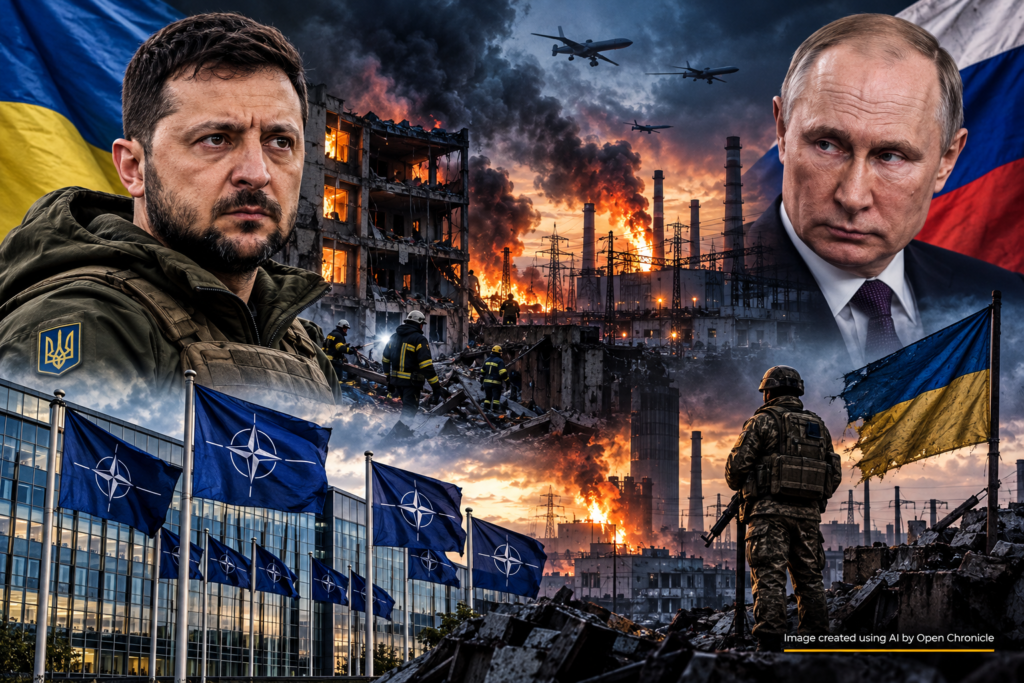
Ukrainian President Volodymyr Zelensky says Russian attacks on six energy facilities demonstrate Moscow’s unwillingness to accept a proposed halt to strikes on energy infrastructure. The renewed attacks have intensified tensions between Kyiv and Washington, while European governments insist that pressure on Russia must continue.
By Open Chronicle with agencies
KYIV, October 12, 2026 — Russia launched further attacks against Ukrainian energy infrastructure on Monday despite US President Donald Trump’s announcement of a proposed ceasefire covering energy targets, prompting Ukrainian President Volodymyr Zelensky to question whether Moscow has any intention of accepting the arrangement.
According to Ukrainian officials, six energy facilities were struck as Russian forces continued attacks across the country, including in the capital Kyiv and the eastern Donetsk region.
Zelensky said the latest operations demonstrated the difficulty of securing an agreement without clear commitments from Russia and credible guarantees that attacks would stop.
“It is increasingly evident that Russia is unwilling to accept an energy ceasefire proposed by the United States,” Zelensky wrote on social media.
The renewed strikes have added to confusion surrounding Trump’s announcement, which suggested that Russia and Ukraine had agreed to suspend attacks on energy infrastructure.
Ukrainian officials, however, have indicated that Kyiv was not informed of a completed bilateral agreement before the president’s public statement.
The developments have raised questions about the proposed ceasefire’s scope, implementation and prospects for success.
Six Ukrainian Energy Facilities Reportedly Hit
Zelensky said Russian forces had targeted six Ukrainian energy facilities despite the American proposal to suspend such attacks.
The strikes come as Ukraine continues to face pressure on its electricity generation, transmission and distribution networks.
Energy infrastructure has repeatedly been targeted during the war, causing disruptions to electricity supplies, heating and other essential services.
The consequences are particularly serious for civilian communities dependent on reliable power for hospitals, water systems, telecommunications and residential heating.
Ukraine has invested heavily in repairing damaged facilities, strengthening air defences and decentralising parts of its electricity network.
However, repeated attacks continue to complicate reconstruction and emergency planning.
Zelensky linked the latest strikes to concerns that renewed Russian energy revenues could help Moscow sustain its military operations.
“This is what happens when Russia sees the prospect of higher revenues for its war machine,” he wrote.
The Ukrainian president’s comments came amid controversy over Trump’s separate proposal to facilitate additional Russian diesel supplies to international markets.
Kyiv and several European governments have warned that measures increasing Russian energy revenue could undermine efforts to limit Moscow’s capacity to finance the war.
Russian Strike on Kyiv Residential Building Kills One
The attacks extended beyond energy infrastructure.
Ukrainian officials reported that a Russian strike on a residential building in Kyiv killed one person and injured four others.
The city’s military administration announced the death on Telegram, while Mayor Vitali Klitschko said a drone had struck a high-rise apartment building in an eastern suburb of the capital.
Images circulated on social media showed flames and smoke rising from sections of an apartment building.
The circumstances of the attack and the full extent of the damage were still being assessed.
The incident highlighted the continuing danger faced by civilians in Ukrainian cities, even as diplomatic discussions focus on reducing attacks against infrastructure.
Kyiv has repeatedly been targeted by drones and missiles since the beginning of Russia’s full-scale invasion in February 2022.
Air defence systems intercept many incoming weapons, but falling debris and direct impacts can still cause casualties and damage residential areas.
Three Killed Near Kramatorsk, Including 13-Year-Old Girl
In eastern Ukraine, regional authorities reported that three people were killed when Russian forces struck a house near the frontline city of Kramatorsk.
A 13-year-old girl was among the victims.
Vadym Filashkin, head of the Donetsk regional military administration, said the attack occurred in the Cherkaske area and involved cluster munitions.
He accused Russian forces of deliberately seeking to maximise civilian casualties.
The allegation concerning the weapon used and the intention behind the attack was made by Ukrainian authorities and has not been independently established in the supplied reporting.
The Donetsk region remains one of the most heavily contested areas of the conflict.
Communities near the front line continue to face artillery strikes, aerial attacks and repeated displacement.
The deaths underline the human consequences of the fighting at a time when diplomatic initiatives have raised expectations of possible de-escalation.
Kharkiv Attacks Leave at Least 12 Wounded
Russian attacks were also reported in Kharkiv, Ukraine’s second-largest city.
Local authorities said at least 12 people were wounded in strikes on the northeastern city.
Kharkiv’s proximity to the Russian border has made it particularly vulnerable to missile, drone and aerial bomb attacks throughout the conflict.
The city has experienced repeated damage to residential districts, industrial facilities and civilian infrastructure.
Emergency services continued assessing the consequences of the latest strikes.
The incidents in Kyiv, Donetsk and Kharkiv demonstrate that the wider conflict remains active despite discussions about a limited cessation of attacks against energy targets.
Zelensky Says Trump’s Ceasefire Announcement Came as a Surprise
The proposed energy ceasefire has become a source of diplomatic confusion.
Trump announced that Russia and Ukraine had agreed to halt attacks on energy infrastructure, presenting the development as an important step toward reducing hostilities.
Zelensky subsequently indicated that he had learned of the announcement through media reports rather than through a completed agreement communicated directly to Kyiv.
Ukrainian officials later said their armed forces had received relevant instructions concerning the American proposal.
However, Kyiv maintained that any meaningful arrangement would require reciprocal commitments and compliance by Russia.
An Axios report, citing an unnamed American source, suggested that the proposed understanding might apply specifically to oil refineries rather than all energy infrastructure.
That distinction could significantly affect the practical meaning of the initiative.
Oil refineries, electricity generation facilities, transmission networks and other energy installations serve different military and economic functions.
A limited agreement covering only refineries would not necessarily prevent attacks on electricity infrastructure or other civilian facilities.
The precise terms of the American proposal have not been fully established in the information available.
Zelensky has indicated that Ukraine would respond if Russia refused to accept or respect the proposed arrangement.
The Ukrainian government has consistently argued that ceasefires must be reciprocal, verifiable and accompanied by mechanisms capable of identifying violations.
Russian Diesel Deal Deepens Ukrainian Frustration With Washington
The ceasefire controversy has unfolded alongside growing criticism of Trump’s proposed agreement with Russian President Vladimir Putin concerning diesel supplies.
The American president announced plans for Russia to deliver substantial quantities of diesel to international markets as part of an effort to reduce fuel prices.
The arrangement has drawn opposition from American lawmakers and concern among Ukrainian officials.
A bipartisan group of six US senators has argued that allowing Russian diesel imports could contradict American legislation restricting purchases of Russian energy products.
The senators warned that additional revenue could provide Moscow with financial resources while Russian forces continue attacking Ukraine.
Reporting from central Ukraine, FRANCE 24 correspondent Gulliver Cragg described growing disappointment among Ukrainians over Washington’s changing approach.
According to Cragg, many Ukrainians feel betrayed by a country they previously regarded as a central ally and an important symbol of democratic values.
His observations reflect the concerns reported among some Ukrainians, rather than a measured assessment of public opinion across the country.
The dispute illustrates the tension between Trump’s stated objective of reducing energy prices and Ukraine’s efforts to restrict Russia’s export revenues.
EU Says Pressure on Moscow Must Continue
European Union foreign policy chief Kaja Kallas said Monday that the bloc should not relax its economic and diplomatic pressure on Russia.
Speaking after a meeting of EU foreign ministers in Luxembourg, Kallas argued that concessions would not provide the most effective route toward ending the war.
“Pressure on Moscow, not concessions, is the fastest way to end the war,” she said.
Her remarks came amid growing European concern that easing energy restrictions could provide Russia with additional resources without securing meaningful changes in its military conduct.
European governments have imposed successive rounds of sanctions against Russia since February 2022.
The measures have targeted financial institutions, technology transfers, energy exports and individuals connected to the Russian state.
However, the effectiveness of these restrictions continues to depend on enforcement, international cooperation and the ability to prevent circumvention.
Kallas’s comments indicated that European governments remain committed to maintaining pressure despite Washington’s recent energy diplomacy.
Russia Claims $320 Billion in Energy Sales to Europe Since 2022
Russian Deputy Prime Minister Alexander Novak said Moscow had supplied more than $320 billion worth of hydrocarbons to European Union countries since 2022.
Speaking on Russian television, Novak placed the value of deliveries at $320.7 billion.
The figure was presented by the Russian government and has not been independently verified in the supplied reporting.
The claim highlights the continuing importance of energy trade in relations between Russia and Europe.
Although European governments have reduced their dependence on Russian fossil fuels, some energy imports and commercial relationships have continued under changing regulatory and market conditions.
Russia has redirected significant portions of its energy exports toward markets outside Europe, while Western governments have sought to restrict revenues through sanctions and other measures.
The debate has become increasingly important as Washington considers policies that could affect the international supply of Russian petroleum products.
French Navy Boards Suspected Shadow Fleet Tanker
France announced a maritime operation targeting a vessel suspected of participating in the circumvention of sanctions on Russian oil.
President Emmanuel Macron said French naval personnel boarded the tanker DF Peak more than 450 nautical miles south of Réunion, the French island in the Indian Ocean.
Macron announced the operation on social media and published a video showing the boarding.
French authorities suspect the vessel of involvement in illicit oil transportation.
The allegations against the tanker remain subject to investigation.
The operation forms part of broader Western efforts to disrupt what is commonly described as Russia’s shadow fleet.
The term refers to networks of vessels suspected of helping transport Russian oil outside established shipping and sanctions frameworks.
Such ships may involve opaque ownership structures, complex insurance arrangements and changes in registration or operating practices.
Macron pledged to continue efforts against vessels suspected of circumventing international restrictions.
The operation demonstrates that European governments are pursuing enforcement measures even as diplomatic discussions continue over energy supplies and possible ceasefires.
Poland Reports Detentions Over Starlink Infrastructure Fire
Security concerns have also intensified in Poland.
Polish Interior Minister Marcin Kierwiński said two Turkish nationals had been detained in Germany in connection with a fire at a Starlink facility in Poland.
Poland’s Special Services Minister Tomasz Siemoniak alleged that Russia was responsible for the incident.
The accusation has not been independently verified in the supplied reporting, and the precise circumstances remain under investigation.
Starlink satellite communications have played an important role in maintaining connectivity in Ukraine during the war.
Western governments have repeatedly warned that communications infrastructure, transport networks and defence-related facilities could be targeted by hostile covert operations.
Russia has denied accusations that it is conducting a coordinated campaign of sabotage across Europe.
The Polish allegations come amid broader European efforts to improve the protection of critical infrastructure.
Germany Warns of a Growing ‘Shadow War’
German Interior Minister Alexander Dobrindt warned that Germany faces an increasingly complex security threat involving covert interference, cyber operations and suspected sabotage.
Speaking at a press conference concerning Germany’s domestic intelligence agency, the Federal Office for the Protection of the Constitution, Dobrindt described the situation as a shadow war extending beyond traditional Cold War threats.
“The shadow war we are witnessing today has an objective that extends far beyond anything seen during the Cold War,” he said.
German authorities have been strengthening intelligence capabilities and cooperation between security institutions in response to concerns about foreign interference.
The warnings reflect the growing importance of cyber defence, counterintelligence and infrastructure protection within European national security policy.
NATO officials have similarly argued that the alliance must be prepared to respond to both conventional military threats and activities designed to undermine member states without triggering open warfare.
EU Moves Toward Visa Restrictions for Russian Former Combatants
European Union governments have reached political agreement on the principle of restricting entry for Russian nationals who fought in Ukraine, according to Kallas.
Speaking after Monday’s meeting of EU foreign ministers, she said member states still needed to resolve the practical details.
“The political agreement is there. We just need to work out the technicalities,” Kallas said.
The proposed restrictions are intended to address security concerns surrounding individuals who participated in military operations against Ukraine.
Implementation would require agreement on identification procedures, legal safeguards and the scope of any entry prohibition.
EU governments are also discussing tighter conditions for Russian tourist visas and possible restrictions on the movement of Russian diplomats.
The measures reflect broader efforts to strengthen internal security while maintaining pressure on Moscow.
Ukraine Advances EU Membership Ambitions With Minority Rights Law
Amid the continuing conflict, Ukraine has taken a step toward advancing its European Union membership negotiations.
Ukrainian lawmakers approved legislation expanding protections for national minorities, including the right of Hungarian-speaking communities to receive education in their native language.
The measure was designed to address concerns raised by Hungary, which had previously blocked progress on parts of Ukraine’s EU accession negotiations.
Ukrainian Foreign Minister Andrii Sybiha said Kyiv expected the European Union to approve the opening of additional negotiation stages following the legislative development.
He met Hungarian Foreign Minister Anita Orbán on the sidelines of the EU Foreign Affairs Council meeting in Luxembourg.
Both officials welcomed progress in implementing bilateral understandings.
The legislation still requires Zelensky’s signature before becoming law.
For Ukraine, advancing EU membership negotiations remains a major strategic objective alongside military resistance to Russia.
The accession process requires extensive legal, institutional and economic reforms, with minority rights among the issues examined by European institutions.
Lithuania Calls for Stronger Response to Russian Interference
Lithuanian Prime Minister Mindaugas Sinkevicius urged Ukraine’s allies to consider stronger measures against Russian infrastructure allegedly used in hostile cyber and information operations.
Speaking at the Warsaw Security Forum, he suggested that attacks against Russian data centres could weaken Moscow’s capacity to conduct interference.
“I believe that we should ask Mr Zelensky to hit more data centres in Russia, and that might help,” he said.
He also called for substantial investment in countering disinformation.
The remarks reflect concern among Baltic governments about cyber threats, foreign interference and the security of democratic institutions.
However, proposals involving attacks against civilian or dual-use infrastructure raise significant legal and strategic questions, including the need to distinguish legitimate military objectives from protected civilian facilities.
Such operations could also carry risks of escalation.
The comments were made in the context of broader discussions about how European countries should respond to suspected Russian hybrid activities.
Diplomacy Continues as Fighting Intensifies
The latest developments illustrate the widening gap between diplomatic efforts to reduce hostilities and the continuing military reality in Ukraine.
Trump’s proposed energy ceasefire has generated expectations of a possible limited reduction in attacks, but the absence of clearly established terms and reciprocal commitments has undermined confidence in its implementation.
For Zelensky, the strikes against Ukrainian energy facilities demonstrate why Kyiv remains sceptical of Russian intentions.
For European governments, the priority remains maintaining sanctions, strengthening security and ensuring that any diplomatic initiative does not weaken Ukraine’s position.
Russia’s reported attacks on Kyiv, Kharkiv and the Donetsk region have reinforced the urgency of protecting civilians and essential infrastructure.
At the same time, developments involving Russian energy exports, maritime sanctions enforcement and alleged sabotage operations demonstrate that the consequences of the war extend far beyond Ukraine’s borders.
Whether Washington can transform its ceasefire proposal into a credible agreement will depend on the willingness of both sides to accept clear obligations and on the ability of international partners to verify compliance.
For now, the conflict continues, and the prospects for a sustained reduction in attacks remain uncertain.