
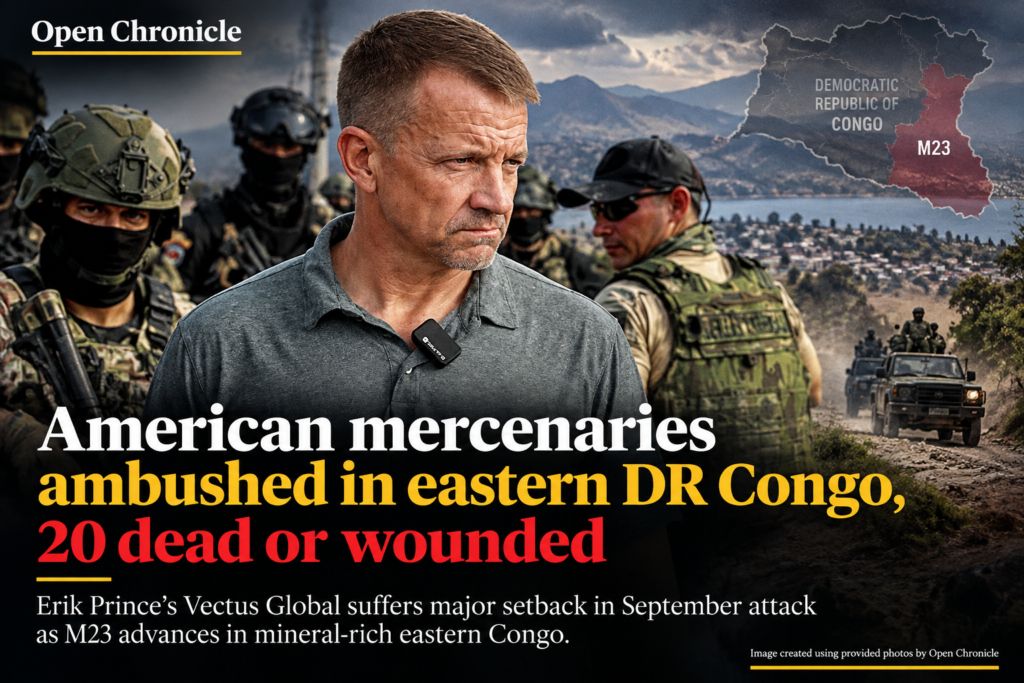
A deadly ambush against personnel linked to Erik Prince’s private security company, Vectus Global, has exposed the growing risks facing foreign contractors in eastern Democratic Republic of Congo. Reuters reports that approximately 20 people were killed or wounded in the September attack, amid continuing fighting between Congolese forces and the M23 rebel movement.
By Open Chronicle with agencies
KINSHASA, Democratic Republic of Congo, October 13, 2026 — A team associated with Vectus Global, the private security and consulting company linked to Blackwater founder Erik Prince, suffered heavy casualties in an ambush in eastern Democratic Republic of Congo, according to a report attributed to Reuters.
Approximately 20 members of the team were reportedly killed or wounded in the September attack, which targeted personnel operating in one of Africa’s most volatile conflict zones.
The casualties reportedly included foreign security specialists and Congolese nationals.
Among those wounded was Tim Kennedy, a former United States Army Green Beret, mixed martial arts fighter and podcast host. According to the report, Kennedy sustained three gunshot wounds to the leg and was receiving medical treatment at Walter Reed National Military Medical Center in Maryland.
Those reported killed included a former member of New Zealand’s special forces and at least seven Congolese nationals.
Sources cited by Reuters alleged that fighters from the M23 rebel movement carried out the ambush. However, responsibility for the attack has not been independently established in the information available.
The incident represents a significant setback for Prince’s security operations in the country and raises questions about the role of private security contractors in a conflict increasingly shaped by territorial competition, mineral resources and regional military involvement.
A Deadly Ambush in Eastern Congo
The September attack occurred as foreign security personnel were operating in eastern DR Congo, where government forces and their allies continue to confront the M23 rebel movement.
The precise location of the ambush, the number of people killed as opposed to wounded, and the circumstances immediately preceding the attack were not specified in the supplied account.
Nevertheless, the reported scale of the casualties suggests a serious security failure involving a team operating in contested territory.
Eastern Congo has become an especially dangerous environment for military personnel, civilians, humanitarian workers and foreign contractors.
Armed groups operate across difficult terrain, while shifting front lines and competing territorial claims complicate movement and security planning.
For private security companies, the risks can be substantial when assignments bring personnel into areas affected by active fighting.
The reported casualties also underline that the dangers extend beyond foreign contractors to the Congolese nationals working alongside them.
Former Green Beret Tim Kennedy Among the Wounded
One of the most prominent names associated with the incident is Tim Kennedy, a former US Army Special Forces soldier who later became known for his career in mixed martial arts and his media activities.
Kennedy reportedly suffered three gunshot wounds to his leg during the ambush.
According to the supplied Reuters account, he was subsequently receiving treatment at Walter Reed National Military Medical Center in Maryland, a major US military medical institution.
His reported involvement has drawn particular attention because of his military background and public profile.
However, the information provided does not establish his precise contractual role, operational responsibilities or employment status at the time of the attack.
It also does not specify his current medical condition beyond the reported injuries and treatment.
The involvement of former special forces personnel illustrates how private security companies can draw on individuals with extensive military experience for assignments in unstable environments.
Such experience, however, does not eliminate the dangers associated with operations in areas where armed groups possess substantial combat capabilities.
Erik Prince’s Growing Security Role in Congo
Erik Prince is best known as the founder of Blackwater, the private military company that became a prominent contractor during the US-led war in Iraq.
In recent years, Prince has pursued security and consulting opportunities through other business ventures, including Vectus Global.
According to the supplied reporting, the Congolese government initially contracted Prince’s company in October 2024 to help improve security and revenue collection.
The arrangement was particularly relevant to the country’s mineral sector, which generates significant economic value but has long faced challenges involving insecurity, illicit trade and weak state oversight.
The company’s activities subsequently expanded.
Personnel associated with Vectus Global were deployed to Uvira, in South Kivu province, amid increasing military pressure and continuing instability.
The reported September ambush demonstrates the risks that can emerge when commercial security assignments intersect with an active armed conflict.
The exact terms of the company’s contracts with Kinshasa, including the division between advisory, security and operational responsibilities, were not detailed in the supplied account.
M23’s Territorial Advances Changed the Conflict
The attack occurred against the backdrop of major territorial changes in eastern Congo.
In January 2025, M23 fighters captured Goma, the capital of North Kivu province and one of the region’s most important urban and commercial centres.
The following month, the movement captured Bukavu, the capital of South Kivu.
These advances significantly weakened the Congolese government’s authority in parts of the east and transformed the military and political landscape.
By March 2025, M23 had consolidated control over extensive areas of both provinces.
Congolese government forces and allied armed groups continued to contest territory elsewhere, leaving the region divided by competing military and political authorities.
The loss of major provincial capitals also complicated efforts to restore government services, protect trade routes and maintain state control over strategic infrastructure.
For Kinshasa, the territorial advances represented more than a battlefield setback.
They challenged the government’s ability to exercise sovereignty over a region central to the country’s economic interests and national security.
M23 Establishes a Parallel Administration
Beyond its military operations, M23 has sought to consolidate political and administrative authority in territory under its control.
According to the supplied account, the movement established a parallel administration centred on Goma.
Its governing structures include appointed officials, security arrangements and tax collection mechanisms.
Such institutions allow the movement to exercise authority beyond the immediate presence of its fighters.
They also create additional obstacles for the Congolese government, which must confront both an armed insurgency and an alternative system of territorial administration.
The existence of competing authorities can complicate commercial activity, civilian movement, access to public services and the collection of government revenue.
It can also make the restoration of state control more difficult, even if military conditions change.
The development illustrates how armed conflicts can evolve into prolonged struggles over governance, resources and political legitimacy.
Rwanda’s Alleged Support for M23 Fuels Regional Tensions
The conflict has also become a major source of tension between the Democratic Republic of Congo and neighbouring Rwanda.
The United Nations and several Western governments have accused Rwanda of providing military support to M23.
Kigali denies those allegations.
The dispute has added an international dimension to the fighting and complicated diplomatic efforts to reduce hostilities.
For Kinshasa, allegations of external support for the rebel movement reinforce concerns about national sovereignty and regional security.
For Rwanda, the conflict is connected to longstanding security disputes involving armed groups and instability near its western border.
The competing positions have contributed to a difficult diplomatic environment in which military developments on the ground can affect relations between neighbouring states.
The reported ambush against personnel linked to Vectus Global occurred within this wider atmosphere of regional confrontation.
However, the supplied information does not independently establish which armed group carried out the attack.
Congo’s Mineral Wealth at the Centre of the Security Crisis
Eastern DR Congo contains substantial deposits of strategically important minerals.
These include gold, coltan, tin and other resources used in industrial production and international supply chains.
The region’s mineral wealth creates major economic opportunities, but insecurity has repeatedly undermined the government’s ability to regulate extraction, protect transport routes and collect revenue.
Armed groups have also been associated with efforts to control territory, commercial routes and economic activity.
For the Congolese government, strengthening oversight of the mineral sector is therefore both an economic and a security priority.
The reported agreement with Prince’s company reflects this intersection between commercial interests and national security.
Improving revenue collection can help the state capture a greater share of economic activity.
Protecting strategic sites and transport corridors may also be important for maintaining commercial operations.
However, when security contractors operate in areas affected by armed conflict, their activities can expose them to military threats that extend well beyond conventional commercial security risks.
The September ambush illustrates those dangers.
The Controversial Legacy of Blackwater
Erik Prince’s involvement in Congo has attracted attention partly because of his history with Blackwater.
Founded in the United States, Blackwater became one of the most recognisable private military contractors during the Iraq War.
Its personnel provided security services in an environment marked by insurgency, political instability and intense scrutiny of private military operations.
The company became embroiled in international controversy following the 2007 killing of Iraqi civilians by Blackwater personnel in Baghdad’s Nisour Square.
The incident raised major questions about accountability, the use of armed contractors in conflict zones and the responsibilities of governments that employ private security companies.
The Blackwater controversy remains an important reference point in debates about the private military industry.
Prince’s subsequent activities through other companies have therefore attracted attention whenever they involve security operations in unstable countries.
His company’s work in Congo is distinct from Blackwater’s former operations in Iraq, but the historical connection shapes public scrutiny of his business activities.
Security Operations Beyond Congo
Vectus Global has also been associated with security activities in Haiti, where armed gangs have severely undermined public order and state authority.
The company’s reported involvement in efforts against armed gangs reflects the wider international demand for private security expertise in countries facing serious security challenges.
Such assignments can vary considerably.
Some companies provide training, advice, logistical support or protection of facilities.
Others may operate closer to active security operations.
The legal and political implications depend on the contractual arrangements, national laws and the precise nature of the work being performed.
In Congo, the reported casualties raise renewed questions about the extent to which private security personnel may become exposed to direct hostilities.
The information supplied does not establish whether the ambushed team was conducting an offensive military mission, providing protection or carrying out another assignment when it was attacked.
That distinction is important when assessing the incident.
The Risks of Private Security Contractors in Active Conflict Zones
Private security companies can provide governments with specialised personnel and technical expertise.
They may offer capabilities that states cannot easily deploy through their own institutions.
However, their involvement in unstable regions raises difficult operational and political questions.
One concerns accountability.
The responsibilities of private contractors can differ from those of regular military personnel, depending on national legislation and the terms of their contracts.
Another concerns the risk of escalation.
When armed contractors operate near active front lines, their presence can become entangled with wider military confrontations.
A third issue is transparency.
Governments and companies do not always disclose the full scope of security agreements, making independent assessment difficult.
The reported ambush involving Vectus Global personnel brings these concerns into focus.
It also demonstrates that even experienced security professionals can face severe risks when operating in territory contested by well-organised armed groups.
Kinshasa Faces a Difficult Security Calculation
President Félix Tshisekedi’s government continues to confront the challenge of restoring authority across eastern Congo.
The conflict involves multiple armed actors, regional tensions, economic interests and longstanding grievances.
The M23 movement’s territorial advances have placed additional pressure on the government.
At the same time, Kinshasa must protect strategic economic activities and maintain public revenue in areas affected by insecurity.
Private security arrangements may offer specialised support, but they cannot by themselves resolve the underlying political and military causes of the conflict.
The reported losses suffered by the Vectus Global-linked team illustrate the limits of relying on outside expertise in an environment where armed groups can carry out deadly attacks.
They may also prompt renewed examination of how foreign contractors are deployed, protected and supervised.
The supplied reporting does not indicate whether the Congolese government or Vectus Global intends to change its operations following the incident.
The Human Cost of Eastern Congo’s Conflict
The reported deaths and injuries among security contractors form part of a much wider conflict affecting communities across eastern DR Congo.
Years of violence have disrupted livelihoods, displaced civilians and weakened essential services.
The capture of major cities and the emergence of competing administrations have further complicated everyday life.
Civilians often face insecurity regardless of which armed group controls a particular area.
The conflict also affects regional commerce, access to healthcare and the ability of humanitarian organisations to reach vulnerable populations.
Although the involvement of internationally known figures such as Erik Prince and Tim Kennedy attracts attention, the wider humanitarian consequences remain central to understanding the crisis.
The reported deaths of at least seven Congolese nationals in the ambush are a reminder that local personnel also bear substantial risks in security operations involving foreign companies.
The Big Picture: Foreign Contractors Confront Congo’s Deepening Security Crisis
The reported September ambush against personnel linked to Erik Prince’s Vectus Global underscores the complexity of eastern Congo’s conflict.
The incident combines several major developments: the expanding role of private security companies, the territorial strength of M23, the economic importance of mineral resources and continuing tensions between Congo and Rwanda.
For Kinshasa, the challenge is not simply to regain territory.
It must also restore effective administration, protect civilians, secure economic infrastructure and rebuild confidence in state institutions.
For private security contractors, the incident highlights the dangers of operating in areas where military front lines and commercial security responsibilities may overlap.
For regional governments and international partners, it reinforces the difficulty of achieving lasting stability through military measures alone.
The precise circumstances of the ambush, including responsibility for the attack and the final casualty figures, remain important unanswered questions in the supplied reporting.
What is clear is that eastern DR Congo continues to present an exceptionally challenging environment for government forces, civilians and foreign personnel alike.
The reported casualties among Vectus Global-linked personnel demonstrate that international security expertise does not provide immunity from the risks of a conflict rooted in territorial competition, regional rivalries and the struggle for control of valuable resources.
Open Chronicle | World News & Security
Sources and Further Reading
Investigative reporting, official United Nations documentation and independent human rights research providing context on the conflict in eastern Democratic Republic of Congo.
Source 01 · Investigative Journalism
Reuters
Erik Prince’s Forces Suffer Battlefield Loss in Congo
Reporting on the September ambush involving personnel linked to Vectus Global, including casualty figures, injuries sustained by former US Special Forces soldier Tim Kennedy and allegations concerning the forces responsible for the attack.
Source 02 · United Nations Peacekeeping
United Nations Organization Stabilization Mission in the Democratic Republic of the Congo (MONUSCO)
Official information on United Nations peacekeeping activities, civilian protection, armed groups and security developments in the Democratic Republic of Congo.
Source 03 · Humanitarian Assessment
United Nations Office for the Coordination of Humanitarian Affairs (OCHA)
Humanitarian reporting and assessments of population displacement, civilian needs, access to essential services and the consequences of armed conflict in eastern Congo.
Source 04 · International Security
United Nations Security Council
Official documentation, resolutions, sanctions-related materials and reports concerning the situation in the Democratic Republic of Congo, regional security and armed groups operating in the Great Lakes region.
Source 05 · Human Rights Research
Human Rights Watch
Independent reporting on armed conflict, civilian protection, human rights conditions, abuses by armed groups and the wider humanitarian consequences of violence in eastern Congo.
Editorial Transparency
Editorial Note
This article is based on the supplied account of Reuters reporting concerning an ambush involving personnel associated with Erik Prince’s Vectus Global in eastern Democratic Republic of Congo.
The figure of approximately 20 killed or wounded is a combined casualty estimate, not a confirmed death toll. The available material does not establish the exact number of fatalities.
The reported injuries to Tim Kennedy, the deaths of a former New Zealand special forces member and at least seven Congolese nationals, and the allegation of M23 responsibility are attributed to the supplied reporting.
Responsibility for the attack has not been independently established. The precise circumstances of the ambush, the full contractual roles of those involved and any subsequent operational changes remain unclear.
The wider historical and geopolitical discussion provides context for the incident and should not be interpreted as independent confirmation of the attack’s disputed details.
Open Chronicle
Independent. Global. Trusted.