
OPEN CHRONICLE MAGAZINE | MYSTERIES AND THE UNKNOWN
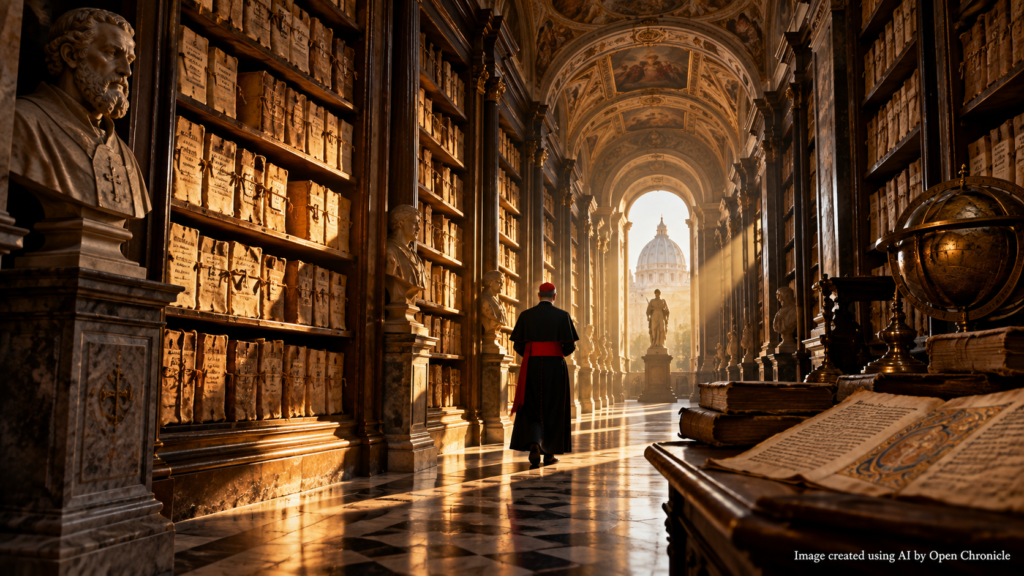
Behind the walls of Vatican City lies an extraordinary documentary record of papal power, diplomatic intrigue, religious conflict and forgotten history. But how much of its legendary secrecy is real?
By Open Chronicle Magazine | The Vatican Files
Special Investigation Series | Episode 001 | Historical Mysteries
For centuries, the Vatican Archives have occupied a peculiar place in the popular imagination. They are often described as a labyrinth of forbidden knowledge, a repository of suppressed manuscripts, ancient prophecies and documents capable of rewriting history.
The reality is both less sensational and considerably more interesting.
Within the Vatican’s archival collections are records of political negotiations, religious controversies, royal correspondence, judicial proceedings and diplomatic encounters that shaped the history of Europe and the wider world. These documents reveal how the papacy interacted with kings, emperors, scientists, revolutionaries and governments across centuries.
Yet the institution’s reputation for secrecy has survived changes in its name, its administration and its accessibility.
To understand why, it is necessary to separate three different things: the archives that actually exist, the historical information they preserve and the extraordinary stories that have grown around them.
1. The Meaning of a Secret
The first mystery begins with a word.
Until October 2019, the institution was officially known as the Vatican Secret Archives, a name that seemed to invite speculation. In modern English, the word secret suggests something deliberately concealed, perhaps even dangerous if revealed.
But the original Latin terminology carried a different meaning.
The word secretum referred to something separate, reserved or private. In this context, it described an archive belonging to the pope and administered for the purposes of the Holy See.
The distinction is significant.
The archives were not originally named to suggest the existence of forbidden truths. Their title reflected their institutional status within the government of the Catholic Church.
The origins of the present archival institution lie in the early seventeenth century, under Pope Paul V, when documentary collections associated with different papal offices were brought together.
Over time, the institution accumulated records from successive pontificates, diplomatic missions, ecclesiastical courts and administrative departments.
In October 2019, Pope Francis formally restored the name Vatican Apostolic Archive, explaining that the modern interpretation of the word secret had become misleading.
The change did not transform the archive into a public library. Access remained regulated, and the institution continued to serve both the papacy and qualified historical researchers.
It did, however, remove a name that had helped inspire generations of conspiracy theories.
2. Eighty Five Kilometres of History
85 km
Approximately, of archival shelving
600+
Archival collections
12
Centuries of documentary heritage
Few archival institutions possess a documentary heritage comparable in scale to that of the Vatican.
According to the Vatican Apostolic Archive’s official description, its holdings extend across more than 85 linear kilometres of shelving, encompassing over 600 archival fonds and material spanning approximately twelve centuries, from the eighth to the twentieth century.
The sheer quantity of material makes the archives difficult to imagine.
A single register might preserve years of administrative decisions. A diplomatic correspondence series might illuminate relations between the Holy See and a foreign government. A judicial record might contain testimony that has survived nowhere else.
Taken together, these collections provide an unusually extensive record of how a major religious institution interacted with the political and social world.
They are also a reminder that history is not preserved in a perfectly organized narrative.
Archives contain gaps, damaged documents, incomplete correspondence and records whose meaning becomes clear only when compared with material held elsewhere.
Even when a document survives, historians must establish who wrote it, why it was produced, who received it and whether its contents were accurate.
The existence of a document is not automatically proof that every claim recorded within it was true.
3. Beneath the Vatican: The Real Underground Archive
Among the most persistent images associated with the Vatican Archives is that of a hidden underground repository.
In this case, there is a real architectural foundation for the story.
Beneath the Cortile della Pigna, within the Vatican Museums complex, stands a purpose-built underground archival facility.
Inaugurated by Pope John Paul II on 18 October 1980, the bunker consists of two levels of reinforced concrete storage space designed to protect large quantities of documents.
It incorporates specialized shelving, climate control, fire protection and environmental monitoring systems.
Its storage capacity is approximately 31,000 cubic metres, with around 43 kilometres of shelving inside the facility alone.
The bunker is not evidence of an underground chamber constructed to conceal supernatural revelations. Its principal purpose is archival preservation.
Yet the physical reality is impressive enough without embellishment.
Thousands of boxes and volumes, accumulated over centuries, are maintained in carefully controlled conditions beneath one of the world’s most visited religious and cultural sites.
Some of the institution’s most valuable parchment documents are stored separately under specialized conditions.
Among the treasures identified by the archive itself are papal and imperial documents, historical registers and the proceedings of the trial of Galileo Galilei.
These are not merely objects of antiquarian curiosity.
They are original witnesses to moments when religion, science, monarchy and political authority collided.
4. Galileo: A Trial Preserved in the Archives
In 1633, Galileo Galilei stood before the Roman Inquisition.
His support for the Copernican model, in which Earth moves around the Sun, had brought him into conflict with ecclesiastical authorities who regarded aspects of his position as incompatible with the accepted interpretation of Scripture.
The proceedings became one of the most famous episodes in the history of science.
Galileo was condemned, required to abjure the positions judged heretical and sentenced to imprisonment, subsequently commuted to house arrest.
The Vatican Apostolic Archive preserves a volume of proceedings relating to his trial, an extraordinary documentary witness to the case.
For generations, Galileo’s story has often been presented as a simple confrontation between scientific truth and religious dogma.
The surviving records allow historians to investigate a more complicated sequence of theological arguments, institutional decisions, personal relationships and political circumstances.
They also demonstrate the importance of primary documents.
Without archival evidence, historical controversies can easily become reduced to legends.
With it, researchers can reconstruct the decisions, language and procedures of the institutions involved.
The Galileo case is therefore a particularly revealing example of what the Vatican Archives actually contain: not a magical secret, but evidence of an episode that profoundly influenced intellectual history.
5. Napoleon and the Documents That Never Returned
One of the most remarkable episodes in the archive’s history occurred not inside the Vatican but in Napoleonic France.
During Napoleon Bonaparte’s domination of Rome, large quantities of papal archival material were removed and transferred to Paris.
The project reflected the emperor’s ambition to concentrate important documentary collections within the French imperial capital.
After Napoleon’s downfall, efforts began to return the archives to Rome.
But the restitution was incomplete.
The official historical account of the Vatican Apostolic Archive records that the return operations of 1815 to 1817 involved substantial losses.
Some documents disappeared in transit. Others were delivered to incorrect destinations. Particularly strikingly, the high cost of transporting the material led papal commissioners to destroy hundreds of records judged useless and sell thousands of others as wastepaper.
This is a genuine historical mystery.
What information was lost? Which documents survived outside their original collections? Could unidentified records still exist in private collections or other archives?
The answers are not necessarily recoverable.
The destruction and dispersal of documents create permanent gaps in the historical record.
It is tempting to imagine that every missing document contained a sensational revelation. There is no reason to assume that.
But the loss of archival material can deprive historians of evidence about diplomatic negotiations, administrative decisions, financial affairs and personal correspondence.
Sometimes the most important mystery is not what an institution deliberately concealed, but what history has irretrievably lost.
6. The Vatican and the Second World War
Few areas of Vatican archival research have attracted as much international attention as the pontificate of Pope Pius XII.
Eugenio Pacelli became pope in March 1939, shortly before the outbreak of the Second World War.
His pontificate encompassed Nazi persecution, the Holocaust, the destruction of European cities, the collapse of fascist regimes and the emergence of the Cold War.
For decades, historians debated the Holy See’s wartime diplomacy and the pope’s public response to the persecution of European Jews.
Some scholars have emphasized diplomatic intervention, humanitarian assistance and efforts to protect vulnerable populations.
Others have questioned whether the pope could or should have condemned Nazi crimes more explicitly and whether Vatican officials possessed information that should have prompted stronger action.
The controversy has been sustained partly by disagreements over the interpretation of the available evidence.
On 2 March 2020, the Vatican opened the archival documentation relating to the pontificate of Pius XII, covering the period from 1939 to October 1958.
The material made available included approximately 120 archival collections and series comprising some 20,000 archival units within the Vatican Apostolic Archive, alongside records held by other institutions of the Holy See.
The opening was a major development for historical research.
It allowed scholars to examine additional correspondence, diplomatic reports, administrative records and communications that had previously been inaccessible.
Yet opening an archive does not instantly resolve every controversy.
Historical interpretation requires time, comparison with other collections and careful consideration of the context in which documents were produced.
A diplomatic message may reveal what an official reported, but not necessarily everything the recipient believed or subsequently did.
A record of humanitarian assistance may demonstrate an intervention without resolving broader questions about institutional policy.
The Pius XII collections illustrate why access to original documents matters, especially when the historical questions are morally and politically consequential.
7. Why Are Some Documents Still Closed?
A frequent question concerns the limits of public access.
If the Vatican Archives exist to preserve history, why can researchers not examine every document?
The answer involves archival policy, conservation, privacy and the institutional authority of the Holy See.
The archive is not generally open to casual tourism. Researchers must satisfy admission requirements and work within established consultation procedures.
Historically, documents have been opened progressively according to pontificates, with the decision resting with the pope.
The general chronological boundary currently extends through the pontificate of Pius XII, which ended in October 1958, although particular collections from later periods have also been made accessible.
Restrictions can be frustrating for historians seeking to investigate more recent events.
But it is important to distinguish between restricted access and evidence of wrongdoing.
Many government, diplomatic, institutional and personal archives operate under access rules.
Restrictions may protect sensitive information, preserve fragile materials or reflect decisions about when historical records should become available.
That does not mean such policies are beyond criticism.
Researchers can legitimately question whether restrictions are justified, whether access decisions are sufficiently transparent and whether historically important records should be opened sooner.
The central issue is one of accountability and evidence.
The fact that a document is unavailable cannot establish what it contains.
8. The Vatican Library Is Not the Vatican Archive
Another source of confusion concerns the distinction between the Vatican Apostolic Archive and the Vatican Apostolic Library.
The two institutions have different historical missions.
The archive primarily preserves records generated by the administration and government of the Holy See.
The library preserves manuscripts, books, printed works and other materials of scholarly and cultural importance.
Both institutions possess exceptional historical collections, but they should not be treated as interchangeable.
This matters particularly when discussing ancient biblical manuscripts, apocryphal writings and allegedly forbidden religious texts.
Popular accounts sometimes suggest that every controversial manuscript in the Vatican belongs to the Secret Archives.
In reality, many such discussions concern library holdings, documents preserved elsewhere or texts known through published scholarly editions.
A claim about a hidden gospel should therefore begin with basic questions.
Does the manuscript exist? Where is it catalogued? Has it been examined by scholars? Is the text actually suppressed, or is it simply unfamiliar to the wider public?
Without answers, a dramatic story remains a claim rather than a historical discovery.
9. The Legends: Prophecies, Forbidden Knowledge and Extraterrestrial Files
The Vatican’s reputation has generated an extensive mythology.
Stories circulate about lost biblical revelations, prophecies concerning the end of the world, secret histories of Christianity and even alleged evidence of extraterrestrial encounters.
These narratives frequently combine real historical details with unsupported conclusions.
A genuine archival restriction becomes proof of an extraordinary conspiracy. A missing document becomes a suppressed revelation. A medieval text becomes evidence of knowledge supposedly hidden from humanity.
The logical problem is straightforward.
An absence of publicly available evidence does not establish the existence of a hidden secret.
There is no credible publicly established archival evidence demonstrating that the Vatican Apostolic Archive holds authenticated records proving extraterrestrial contact or conceals a discovery that fundamentally overturns established human history.
This does not mean every question about the Vatican’s collections has been answered.
It means that historical investigation must distinguish possibilities from documented facts.
For a magazine dedicated to mysteries, that distinction is essential.
The most compelling investigations do not begin by deciding what the answer must be.
They begin by identifying what can actually be verified.
10. The Real Mystery of the Vatican Archives
Perhaps the greatest misconception about the Vatican Archives is that their historical importance depends on the existence of a single spectacular secret.
It does not.
Their significance lies in the extraordinary continuity of an institution that has accumulated records across centuries of European and global history.
Within those collections are traces of diplomacy, religious authority, scientific controversy, warfare, political transformation and individual lives.
Some documents confirm familiar historical narratives.
Others complicate them.
Still others may eventually challenge interpretations that scholars have accepted for generations.
The opening of previously restricted material can change what historians know, not because it necessarily reveals a conspiracy, but because it introduces evidence that was previously unavailable.
And there are genuine mysteries that may never be solved.
Records destroyed during wars, documents lost during the Napoleonic transfers, correspondence never preserved and decisions taken without surviving written explanations all leave unanswered questions.
These gaps remind us that historical knowledge is always incomplete.
The Vatican Archives are therefore neither an imaginary vault of supernatural secrets nor a collection whose contents have been exhaustively understood.
They are a vast, complex and continually studied historical resource.
Their most important revelations may not concern hidden prophecies or extraordinary civilizations.
They may concern something far more consequential: the decisions people made, the information they possessed and the ways institutions exercised power.
The mystery is not simply what lies behind the Vatican’s doors. It is how much of the past remains to be understood, even when the documents are finally opened.
Open Chronicle | The Vatican Files
Historical Sources and Further Reading
Explore the primary institutional records and historical documentation supporting this investigation into the Vatican Apostolic Archive.
01 | Official Archive
Vatican Apostolic Archive
The Archives: History, Mission and Documentary Heritage
Official institutional overview describing the archive’s origins, collections, preservation mission and research access.
02 | Historical Documentation
Vatican Apostolic Archive
Historical Background
Official chronology covering the archive’s development, the Napoleonic transfers, documentary losses and its gradual opening to researchers.
03 | Archival Preservation
Vatican Apostolic Archive
Bunker and Storerooms
Official information about the underground storage facilities, conservation systems and historically significant documents, including Galileo’s trial proceedings.
04 | Contemporary Reporting
Vatican News
Vatican Opens Archives on Pope Pius XII, 2 March 2020
Contemporary reporting on the opening of the wartime pontificate’s archival records and the scale of the documentation made available.
Editorial Note
This investigation draws on official archival documentation, historical institutional records and published material concerning the Vatican Apostolic Archive. It distinguishes documented historical facts from unresolved questions and unverified claims. References to restricted documents do not imply that those documents contain evidence of conspiracies or supernatural phenomena.
OPEN CHRONICLE MAGAZINE | THE VATICAN FILES
Open Chronicle Magazine
Explore More Mysteries
Discover historical enigmas, unexplained phenomena, secret operations and investigations into the mysteries that continue to challenge our understanding of the world.
← Return to Mysteries and the Unknown