
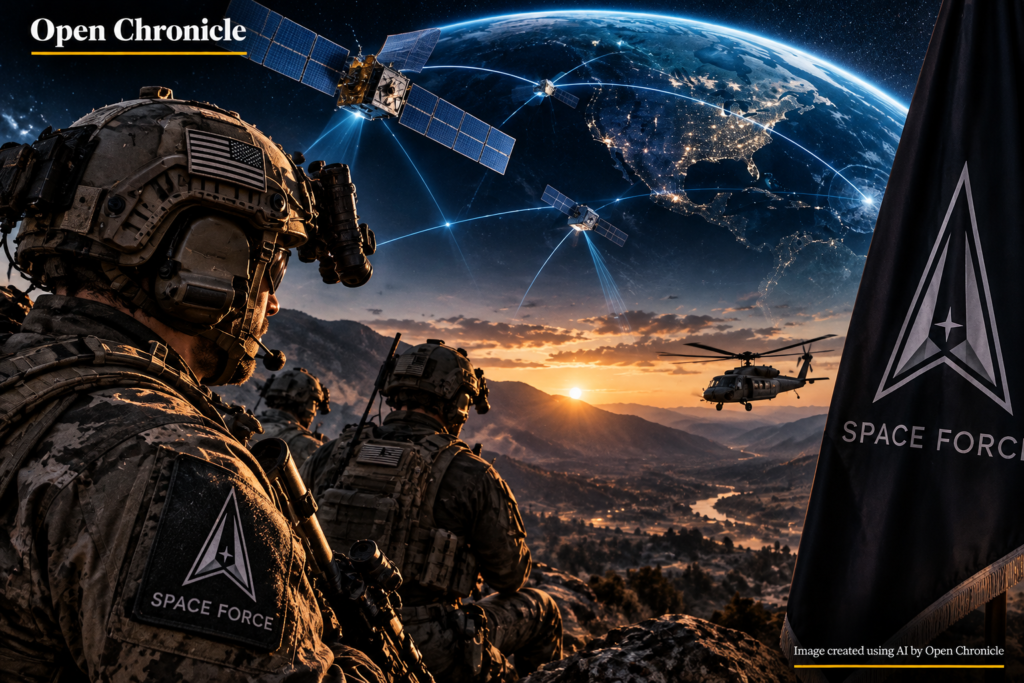
The United States Space Force has activated a unit dedicated to supporting American special operations, highlighting the growing importance of satellite communications, intelligence, navigation and space-based capabilities in modern military missions.
By Open Chronicle with agencies
WASHINGTON, October 13, 2026 — The United States Space Force has activated a unit to support US special operations, reflecting the increasingly close relationship between military activities on Earth and the space-based systems that enable them.
The development highlights the importance of integrating space expertise into missions conducted by American special operations forces, which frequently operate in complex, geographically dispersed and high-risk environments.
Satellite communications, positioning and navigation services, missile warning systems and space-derived intelligence have become essential components of modern military operations.
For special operations forces, reliable access to these capabilities can be particularly important when conducting missions far from established military bases or in environments where conventional communications networks are unavailable.
The activation also reflects a broader transformation in American military planning, as the Pentagon places increasing emphasis on protecting access to space and maintaining operational effectiveness in environments where satellites and supporting infrastructure could be disrupted.
A Closer Connection Between Space and Special Operations
The US Space Force was established in December 2019 as the newest branch of the American armed forces.
Its responsibilities include organising, training and equipping personnel to conduct military space operations and protect American interests in space.
Although its activities are often associated with satellites and orbital systems, the service’s capabilities directly support military forces operating on land, at sea and in the air.
Special operations forces are among the military organisations that depend heavily on these systems.
They may require secure communications over long distances, precise navigation in unfamiliar terrain and timely information about developments in operational areas.
Dedicated space support can help military planners understand the availability, limitations and vulnerabilities of these capabilities.
It can also improve coordination between specialists responsible for space systems and the forces that rely on them during missions.
The newly announced activation points toward a more integrated approach to those requirements.
Why Space Capabilities Matter to Special Operations
Special operations missions often differ from conventional military campaigns.
They may involve small teams operating in remote areas, rapidly changing conditions or locations where communication with higher headquarters is difficult.
Such missions place considerable demands on information systems.
Satellite communications can allow personnel to maintain contact across substantial distances without relying entirely on local infrastructure.
Space-based positioning, navigation and timing services can support movement, coordination and the synchronisation of military activities.
Satellite-derived information can also contribute to broader intelligence assessments and situational awareness.
These functions are not exclusive to special operations, but the circumstances in which specialised forces operate can make their reliability especially important.
The loss or degradation of a critical space-enabled service could complicate communications, navigation and coordination.
As a result, military organisations increasingly emphasise resilience, redundancy and the ability to continue operating when individual systems become unavailable.
Responding to a More Contested Space Environment
The activation comes against the backdrop of growing concern about the vulnerability of military space systems.
The United States and other major military powers depend on satellites for communications, navigation, intelligence collection and warning of potential threats.
At the same time, military planners increasingly recognise that space-based infrastructure may be exposed to interference, cyberattacks and other forms of disruption.
Electronic interference can affect satellite navigation or communications signals.
Cyber operations may target supporting ground infrastructure or information systems.
Physical threats to satellites and the growing complexity of orbital operations also influence military planning.
These risks have encouraged the Pentagon to consider how military forces can maintain operational effectiveness when access to space-enabled services is contested.
For special operations forces, this may involve closer coordination with space specialists, alternative communications arrangements and improved understanding of potential disruptions.
The activation of a dedicated support unit is consistent with that broader emphasis on integration and resilience.
A Growing Role for the Space Force
Since its establishment, the Space Force has sought to develop its own operational structures while supporting the wider US military.
The service works closely with other branches of the armed forces and with joint military organisations.
Its role extends beyond operating satellites.
Space professionals also contribute technical expertise, operational planning and assessments of how space-related developments may affect military activities.
As the United States adapts to technological competition and increasingly complex security challenges, the demand for specialised space knowledge across the armed forces is likely to grow.
Support for special operations represents one area in which that expertise can have direct operational relevance.
The relationship also illustrates a wider shift in military thinking: space is no longer treated solely as a distant technical domain but as an integral part of military command, communications and decision-making.
The Importance of Joint Military Integration
American military operations frequently require cooperation between different services and combatant commands.
The Space Force contributes capabilities and expertise that other military organisations use to carry out their missions.
Effective integration requires more than access to technology.
Military personnel must understand how systems function, what limitations they face and how to respond when capabilities are disrupted.
Closer institutional relationships can support that process.
For special operations, dedicated space support may help planners incorporate space-related considerations earlier in mission preparation.
It may also strengthen coordination when rapidly changing operational conditions require adjustments to communications, navigation or other supporting systems.
The precise responsibilities of the newly activated unit, however, have not been established in the information supplied for this report.
What the Activation Means for US Military Strategy
The decision to activate a Space Force unit supporting special operations is significant because it reflects the expanding role of space capabilities in American military strategy.
Modern military effectiveness increasingly depends on the ability to connect personnel, sensors, communications networks and command structures.
Space systems contribute to that connectivity.
Their importance becomes particularly apparent when forces operate across large distances or in areas with limited conventional infrastructure.
The development also reinforces the Pentagon’s emphasis on cooperation between military services and operational commands.
As technological threats evolve, the United States faces the challenge of ensuring that forces can use advanced capabilities without becoming excessively dependent on systems that adversaries might attempt to disrupt.
Integrating space specialists more closely with operational forces is one way to address that challenge.
The Big Picture: Space Is Becoming Central to Modern Warfare
The activation of a Space Force unit supporting US special operations reflects a broader change in the nature of military power.
Space capabilities are deeply connected to operations conducted across traditional military domains.
Satellites support communications, navigation, intelligence and warning systems that influence decisions on the ground and in other operational environments.
For special operations forces, those services can be particularly valuable because missions may involve limited personnel, challenging geography and rapidly changing conditions.
The increasing importance of space also creates new vulnerabilities.
Protecting military systems, preparing for interference and developing resilient operational procedures have therefore become central concerns for defence planners.
The latest activation illustrates how the United States is adapting its military organisation to these realities.
Although the specific structure and responsibilities of the new unit require further official confirmation, its reported creation underscores a clear strategic trend.
In modern warfare, the ability to operate effectively in space is increasingly inseparable from the ability to conduct successful operations on Earth.
Open Chronicle | Defense & Security
Sources and Further Reading
Official institutions and reference materials for understanding the United States Space Force, special operations and joint military capabilities.
SOURCE 01 · OFFICIAL MILITARY
United States Space Force
Official information about the service’s mission, organisation and operational activities.
SOURCE 02 · SPECIAL OPERATIONS
United States Special Operations Command
Official information about US special operations forces and their organisational responsibilities.
SOURCE 03 · SPACE OPERATIONS
United States Space Command
Information about US military space operations and the integration of space capabilities with joint forces.
SOURCE 04 · DEFENSE POLICY
United States Department of Defense
Official defence policy, military announcements and information about joint operations.
Editorial Note
This article was prepared from the supplied headline announcing the activation of a Space Force unit to support US special operations.
The source material did not identify the unit’s official name, activation date, location, leadership, organisational structure or specific operational responsibilities. Accordingly, those details have not been invented.
The discussion of satellite communications, navigation, intelligence, resilience and military integration provides general explanatory context rather than a confirmed description of the new unit’s assigned missions.
OPEN CHRONICLE
Independent. Global. Trusted.