
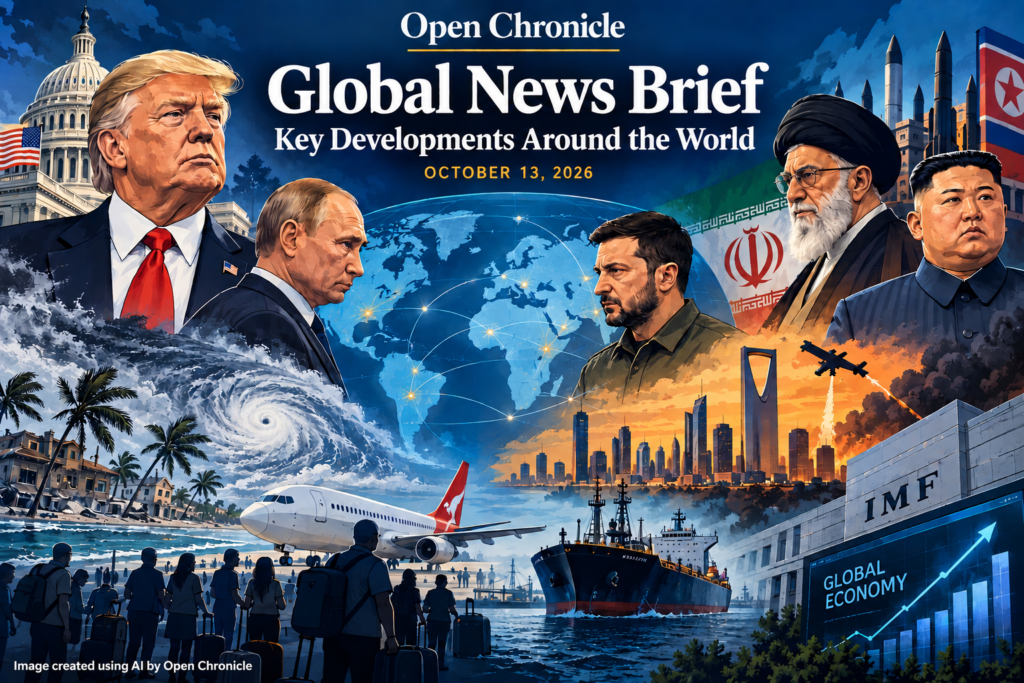
Trump’s disputed Ukraine energy ceasefire, mounting tensions with Iran, fresh North Korean missile activity and warnings about the global economy dominate international headlines. From deadly storms in Mexico to security concerns in Europe and political instability in Africa, governments face a growing number of interconnected challenges.
By Open Chronicle with agencies
WORLD NEWS DESK | October 13, 2026
International attention remains focused on the wars in Ukraine and the Middle East as diplomatic uncertainty, military escalation and economic disruption continue to shape global affairs.
US President Donald Trump has insisted that Russia and Ukraine agreed to suspend attacks on energy infrastructure, despite continued Russian strikes and the absence of a publicly confirmed agreement between the two countries. Washington has also warned Russia and China against assisting Iran, while Houthi attacks on Saudi Arabia have heightened concerns about regional security.
Elsewhere, North Korea has showcased advanced military technology, the International Monetary Fund has warned about the economic consequences of war, and severe weather has caused deaths and disruption across parts of the Americas and Asia.
This edition of the Open Chronicle Global News Brief examines the principal developments by region, distinguishing official statements from reports that remain subject to independent confirmation.
AMERICAS
United States: Trump Defends His Diplomatic Approach to Russia and Iran
President Donald Trump has continued to defend his approach to the wars in Ukraine and the Middle East, arguing that diplomatic pressure can produce agreements even as questions remain about their implementation.
Trump has insisted that Russia and Ukraine accepted an energy ceasefire, despite the absence of public confirmation from either government that a comprehensive agreement has taken effect.
The president has also suggested that Russian President Vladimir Putin is more interested in reaching a peace agreement than Ukrainian President Volodymyr Zelenskyy.
The assessment contrasts with Kyiv’s position that Russian military operations remain the principal obstacle to a negotiated settlement.
The disagreement has intensified scrutiny of Washington’s relationship with Moscow, particularly following reports of an arrangement involving Russian diesel supplies.
Trump has accused European governments of inconsistency over their continued energy purchases from Russia while criticising American policy.
European and Ukrainian officials have warned that additional revenue from Russian energy exports could undermine sanctions intended to limit Moscow’s ability to finance its military campaign.
Elon Musk’s Political Spending Draws Attention Ahead of Midterms
Technology billionaire Elon Musk has emerged as a major financial supporter of Republican candidates and political organisations ahead of the November congressional elections.
Reports in the supplied news feed place his political contributions at approximately $276 million, although other headlines cite a higher figure of $366 million.
The discrepancy may reflect different reporting periods or methods of calculating direct contributions and other political spending.
Without a reconciled accounting of campaign finance records, neither figure should be treated as a definitive total.
Musk’s financial involvement highlights the growing influence of wealthy donors and technology executives in American electoral politics.
The midterm elections will determine control of Congress and shape the political environment for the remainder of Trump’s presidential term.
Federal Investigation Involving Ilhan Omar Raises Political Questions
Federal agents have reportedly searched the Washington residence of Democratic Representative Ilhan Omar as part of a criminal investigation.
Omar has condemned the operation as political intimidation and denied wrongdoing.
The available reports do not establish that criminal charges have been filed against the congresswoman.
The investigation has nevertheless raised questions about federal law enforcement independence and the treatment of political opponents.
The precise legal basis for the search and the evidence under examination remain matters for further official clarification.
Deadly Roller-Coaster Incident Prompts Safety Closures
A fatal incident at a Six Flags amusement park in Georgia has reportedly led to the closure of nine rides.
According to preliminary reports, a man died after falling from a roller coaster and striking parts of the ride.
Several other people were reportedly injured.
Authorities are investigating the circumstances of the incident, while the operator faces questions about ride safety and inspection procedures.
The cause of the accident has not been established in the information provided.
Mexico: Deadly Storms Trigger Flooding and Emergency Evacuations
Hurricane Simon and Tropical Storm Rachel have caused deaths and widespread disruption along parts of Mexico’s Pacific coast.
Initial reports indicated two fatalities, while subsequent headlines raised the death toll to five.
Heavy rainfall has damaged roads, flooded communities and complicated rescue operations.
Foreign tourists were reportedly among those evacuated from affected areas.
Emergency services continue to assess damage and assist residents.
The changing casualty figures reflect the developing nature of the emergency.
Panama and Bolivia Report Separate Disasters
A magnitude 6.1 earthquake has reportedly struck Panama, prompting renewed concern following an earlier powerful tremor.
The extent of any damage or injuries has not been established in the supplied reports.
In Bolivia, a minibus reportedly plunged down a cliff, killing ten people and injuring four.
Authorities are expected to investigate the circumstances of the accident.
Brazil Faces Renewed Political Mobilisation
Supporters of Brazilian President Luiz Inácio Lula da Silva have reportedly rallied in Rio de Janeiro as former President Jair Bolsonaro campaigns ahead of a runoff election.
The demonstrations reflect continuing political polarisation.
The electoral timetable, candidates’ formal status and reported campaign activities require confirmation from Brazilian electoral authorities.
EUROPE
Ukraine: Russian Strikes Continue Despite Trump’s Ceasefire Claims
Ukraine has reported continued Russian attacks on its territory and energy infrastructure despite Trump’s announcement of an energy ceasefire.
Ukrainian authorities say Russian forces have targeted electricity and other critical facilities.
A strike on Kharkiv reportedly killed three people, according to the latest headlines.
Zelenskyy has questioned the credibility of the proposed truce, arguing that Russian military activity contradicts the American president’s statements.
European governments have responded cautiously, emphasising the need for an agreement that both parties acknowledge and can be independently monitored.
Germany’s foreign minister, Johann Wadephul, has called for increased pressure on Putin, while Chancellor Friedrich Merz has urged Moscow to accept restrictions on attacks against energy facilities.
The disagreement illustrates the difficulty of translating diplomatic announcements into enforceable arrangements.
Ukraine’s Drone Campaign Extends Into Russian Territory
Russian authorities have reported a large Ukrainian drone operation directed toward Moscow and surrounding regions.
Some reports claim that more than 400 drones were involved.
Damage was reportedly recorded at a school building in the Kaluga region, while drone activity disrupted operations at Moscow airports.
The reported number of drones and the full extent of the damage have not been independently established.
Ukraine has also discussed attacks on Russian data centres and energy facilities as part of its broader military strategy.
Zelenskyy reportedly said strikes against Yandex infrastructure had reduced activity associated with pro-Russian online influence operations.
That assessment remains a Ukrainian government claim.
Germany: Nord Stream Proceedings Renew Debate Over Pipeline Explosions
German judicial proceedings connected to the destruction of the Nord Stream gas pipelines are attracting renewed attention.
The explosions damaged major Baltic Sea energy infrastructure in September 2022 and became a central issue in European security.
According to the supplied reports, German prosecutors are pursuing allegations involving Ukrainian individuals and possible connections to state authorities.
Those allegations must be distinguished from conclusions established by a court.
The proceedings could have important diplomatic implications for Germany, Ukraine and European energy security.
Suspected Sabotage Raises European Security Concerns
German authorities have reportedly arrested two suspects in connection with an arson attack on a Starlink communications facility near Warsaw.
The incident has prompted concerns about sabotage targeting infrastructure associated with Ukraine’s communications and military support networks.
Reports have suggested possible foreign involvement, although responsibility has not been established by a public judicial finding.
European governments are increasingly examining vulnerabilities involving telecommunications, energy networks, transportation and digital infrastructure.
France Intercepts Tanker Suspected of Links to Russia’s Shadow Fleet
French authorities have reportedly intercepted the tanker DF Peak in the Indian Ocean.
The vessel is suspected of being connected to Russia’s so-called shadow fleet, a network of tankers associated with efforts to maintain oil exports despite Western sanctions.
The operation forms part of broader European efforts to monitor maritime activity and enforce restrictions on Russian energy trade.
The vessel’s ownership, cargo and any alleged sanctions violations require confirmation through official maritime and legal records.
Germany’s Inflation Reaches 3.3 Percent
Germany’s inflation rate reportedly reached 3.3 percent in September, its highest level since 2023.
The increase has renewed concerns about household purchasing power and the economic consequences of higher energy costs.
European governments are struggling to balance inflation control with the need to protect industries and consumers from geopolitical disruption.
Italian Prime Minister Giorgia Meloni has called for a longer-term European response to elevated energy prices.
The broader challenge is likely to feature prominently in European Union economic discussions.
European Union Confronts Trade and Security Challenges
The European Union is reportedly considering a cap on imports of Chinese hybrid vehicles, with one headline citing an annual limit of 350,000 units.
Such a measure would have implications for European carmakers, Chinese manufacturers and the wider EU-China trade relationship.
The reported proposal requires confirmation from official EU documentation.
Meanwhile, Lithuania has called for faster progress on Ukraine’s accession to the European Union.
The debate reflects the growing importance of enlargement as a geopolitical and security instrument.
Spain: Ceuta Migration Crisis Remains Politically Sensitive
Spain’s King Felipe VI is expected to visit Ceuta following a summer marked by migration pressures.
The Spanish enclave in North Africa remains an important point of contact between Europe and Morocco.
Public concern over border security and migration has intensified political debate ahead of Spain’s elections.
Some reports suggest growing anxiety about the possibility of a diplomatic or security confrontation with Morocco.
Those concerns do not establish that an armed conflict is imminent.
France Faces Protests, Cyberattacks and Political Uncertainty
France is confronting several domestic challenges.
Reports indicate that cybercriminals manipulated refrigeration systems at major supermarket chains, causing temperature increases, food losses and possible fires.
The incident has raised concerns about cybersecurity in food distribution and other essential commercial infrastructure.
Separately, youth demonstrations have renewed debate about education, employment opportunities and economic prospects.
French political parties are also preparing for electoral competition, with reports highlighting the emergence of Raphaël Glucksmann as a prominent figure in the presidential debate.
Maritime Security: Drone Attacks Reported in the Black Sea
Two vessels were reportedly struck by drones off Bulgaria’s Black Sea coast, with one ship said to have sunk.
The incident raises concerns about the spread of maritime risks associated with the Russia-Ukraine war.
The vessels’ identities, ownership and the origin of the drones have not been established in the supplied material.
Further confirmation from Bulgarian maritime authorities is necessary.
MIDDLE EAST
Trump Warns Russia and China Against Supporting Iran
President Trump has warned Moscow and Beijing against providing military or strategic assistance to Tehran.
The American president suggested that both countries have too much to lose by becoming involved.
However, he also said he did not believe Russia or China was currently helping Iran.
The distinction is significant because the warning does not establish that either country has supplied military assistance.
Washington remains concerned about Iran’s missile capabilities, regional alliances and ability to threaten American interests.
Reports also suggest that Tehran is attempting to rebuild military capabilities damaged during the conflict.
The extent of those efforts has not been independently established.
Saudi Arabia Investigates Houthi Attacks on Riyadh Airport
Saudi authorities are investigating how Houthi missiles and drones were able to threaten Riyadh’s international airport despite the kingdom’s air defence systems.
The attacks reportedly caused casualties and forced the airport to suspend or restrict operations.
Saudi officials are examining the effectiveness of defensive systems and considering possible responses.
The Houthis have warned of further attacks if the United States becomes involved in Saudi military operations against them.
The confrontation has increased concerns about the safety of civilian aviation and the possibility of a broader regional escalation.
Strait of Hormuz Shipping Security Deteriorates
Reports indicate an increase in attacks on vessels operating near the Strait of Hormuz.
The strategically important waterway connects the Persian Gulf with the Gulf of Oman and is a major route for international energy shipments.
Any sustained disruption could increase transportation costs, insurance premiums and pressure on oil prices.
The United States and regional governments are monitoring threats to commercial shipping.
A separate diplomatic initiative reportedly involving 60 countries opposes the introduction of tolls or restrictions affecting navigation through the strait.
The details and legal status of that declaration require official confirmation.
International Coalition Condemns Alleged Iranian Threats
A group of 32 countries has reportedly condemned Iranian state-backed threats following an alleged incident involving RAF Fairford, a British air base used by American forces.
The United Kingdom has expressed concern about possible Iranian involvement.
Any allegation of responsibility remains subject to investigation and the evidence disclosed by the relevant authorities.
The reports underscore growing concerns about the geographical reach of the Middle East conflict.
Iraq Warns of Economic Pressure From Regional Conflict
Iraqi officials have reportedly accused both Washington and Tehran of placing severe pressure on the country’s economy.
The war has complicated energy supplies, trade and regional financial arrangements.
Baghdad is seeking to strengthen energy cooperation with Saudi Arabia, including measures intended to improve electricity supply stability.
Iraq’s position between competing regional powers continues to create significant diplomatic and economic challenges.
Syria and Israel Remain in Dispute Over Security Operations
Syrian authorities have reportedly established a new Capital Security Service to strengthen security in Damascus.
Separately, reports indicate continued Israeli military activity in southern Syria.
The United Nations has called for respect for Syrian sovereignty and compliance with the 1974 Disengagement Agreement.
The situation illustrates the continuing instability of the Syrian-Israeli frontier.
Palestinian Displacement Concerns Continue
Reports indicate that 47 Palestinian families face possible forced displacement amid restrictions associated with the Israeli blockade.
Humanitarian organisations continue to raise concerns about civilian protection, access to essential supplies and compliance with international humanitarian law.
The precise circumstances of the reported displacement require additional verification.
ASIA-PACIFIC
North Korea Unveils Defence Museum and Conducts Missile Tests
North Korean leader Kim Jong Un has reportedly inaugurated a defence museum displaying intercontinental ballistic missiles, drones and other advanced weapons.
The exhibition appears intended to highlight Pyongyang’s military development and technological ambitions.
North Korea has also confirmed a tactical ballistic missile test, according to the supplied reports.
The latest developments come amid speculation that Trump could meet Kim during a forthcoming visit to Asia.
No new summit agreement has been established in the available information.
The Korean Peninsula remains a major source of regional security tension.
China Expands Diplomatic and Economic Pressure
China has reportedly imposed sanctions on officials from Paraguay and Belize over their governments’ diplomatic relations with Taiwan.
The measures reflect Beijing’s continued efforts to limit Taiwan’s international recognition.
China is also expanding maritime and Arctic logistics cooperation with Russia, particularly in areas associated with energy transportation.
Separately, concerns have emerged about China’s growing technological influence in Latin America and its expanding role in global artificial intelligence markets.
Fiji Investigates Alleged China-Linked Cyber Intrusion
The US Embassy has reportedly warned of a cyberattack affecting an organisation in Fiji.
The intrusion has been attributed in some reports to hackers linked to China.
Cyber attribution is technically complex and often depends on intelligence that is not publicly available.
The available information does not independently establish the identity of the attackers.
The incident nevertheless highlights growing cybersecurity concerns across Pacific island states.
Philippines Moves to Restrict Children’s Social Media Access
The Philippine House of Representatives has reportedly approved legislation restricting social media access for children under 13.
The proposal reflects growing concern about online safety, harmful content and the influence of digital platforms on young users.
Further legislative approval would be required before the measure could become law.
The debate forms part of a wider international movement toward stronger regulation of children’s digital activities.
Pakistan Train Derailment Leaves Several Dead
A passenger train travelling between Karachi and Peshawar has reportedly derailed in Pakistan’s Punjab province.
Preliminary reports indicate between four and five deaths and approximately 30 injuries.
Emergency services have been deployed to assist passengers.
Authorities are expected to investigate the cause of the accident.
The conflicting death tolls reflect the preliminary nature of the available information.
Pakistan and Afghanistan Face Renewed Humanitarian Concerns
The United Nations has reportedly called for accountability following civilian deaths associated with Pakistani military operations in Afghanistan.
The allegations highlight continuing tensions along the border.
Separately, political uncertainty is growing in Pakistan’s Khyber Pakhtunkhwa province, where supporters of former Prime Minister Imran Khan are preparing to oppose possible federal intervention.
India Sees New Opposition Demonstrations
Indian opposition groups have organised demonstrations over electoral procedures and allegations concerning voter registration.
Police have reportedly detained several political activists after protesters entered a restricted area.
The demonstrations reflect wider concerns about political representation, electoral administration and relations between the government and opposition parties.
Nepal Flooding Strands Foreign Trekkers
More than 100 foreign trekkers have reportedly been stranded by flooding in Nepal’s Gorkha region.
Heavy rainfall has disrupted roads and access routes in mountainous areas.
Rescue services face difficult terrain and potentially unstable weather conditions.
The number of stranded travellers and the progress of evacuation operations remain subject to official updates.
Australia: Qantas Flight Grounded After Bedbug Reports
A Qantas aircraft has reportedly been withdrawn from service after passengers complained of bedbug bites during a long-haul flight.
Affected travellers were rebooked, according to the supplied reports.
The incident has raised questions about aircraft sanitation and passenger welfare.
The airline’s final assessment of the incident has not been established in the available information.
Australian Prime Minister Condemns Proposed US Execution Broadcast
Australian Prime Minister Anthony Albanese has criticised a reported proposal to livestream an execution in the United States.
The prime minister described the idea as abhorrent and indicated that Australia would seek to prevent such a broadcast.
The legal status of the proposed broadcast and whether American authorities have formally authorised it remain unclear.
Malaysia Faces Aviation Disruption From Indonesian Haze
Malaysia’s Firefly airline has reportedly cancelled flights to Singapore because of haze associated with fires in Indonesia.
Air pollution from regional fires has repeatedly affected aviation and public health across Southeast Asia.
Authorities are monitoring visibility and air quality conditions.
AFRICA
Sudan Orders Investigation Into Deadly Gold Mine Airstrike
Sudan’s military leader Abdel Fattah al-Burhan has reportedly ordered an investigation into an airstrike on a gold mine that caused civilian casualties.
The incident adds to concerns about the humanitarian consequences of Sudan’s continuing conflict.
Independent confirmation of the casualty figures and responsibility for the attack remains necessary.
The war has devastated infrastructure, displaced large numbers of civilians and severely weakened the country’s economy.
Democratic Republic of the Congo: Kabila Announces Opposition Alliance
Former Congolese President Joseph Kabila has reportedly announced a new political front opposing the government.
The initiative is said to involve the M23 rebel movement.
If confirmed, such an alliance would represent a significant development in the country’s political and security crisis.
The Democratic Republic of the Congo continues to face armed conflict in its eastern provinces, where M23 and other groups have contributed to instability and displacement.
The exact membership and political objectives of the reported alliance require further verification.
Morocco: Parties Reach Coalition Agreement
Reports indicate that four Moroccan political parties have reached an agreement to form a governing coalition.
The arrangement is reportedly led by El Mansouri following an electoral victory by the Authenticity and Modernity Party.
The composition of the coalition and the formal appointment of government leaders require confirmation from Moroccan institutions.
The negotiations come amid economic and social challenges, including employment, public services and regional development.
South Sudan: Deadly Clashes Between Rival Groups
Reports indicate that clashes between rival groups in central South Sudan have caused numerous deaths.
The country continues to struggle with localised violence, political instability and humanitarian pressures.
The latest casualty figures have not been independently confirmed.
Niger: Major Oil and Gas Leak Raises Environmental Concerns
A significant oil and gas leak has reportedly caused environmental damage in Niger.
The incident raises concerns about pollution, water resources and the safety of communities near energy infrastructure.
The scale of the damage and the responsible operator have not been established in the supplied information.
GLOBAL ECONOMY & INTERNATIONAL INSTITUTIONS
IMF Raises Global Growth Outlook but Warns of Risks in 2027
The International Monetary Fund has reportedly raised its forecast for global economic growth, supported partly by investment in artificial intelligence and economic activity in India and China.
However, the institution has warned that geopolitical conflict, rising energy prices and financial instability could weaken growth in 2027.
The Middle East and Central Asia face particularly severe risks because of the continuing regional war.
The IMF’s assessment highlights the contrasting forces shaping the world economy: rapid technological investment on one side and military conflict, inflation and fiscal pressure on the other.
The precise forecast figures should be checked against the latest official IMF World Economic Outlook before publication.
Artificial Intelligence Creates Opportunities and New Financial Risks
The rapid expansion of artificial intelligence is supporting investment in computing infrastructure, semiconductors and digital services.
However, regulators are increasingly concerned about the risks associated with AI deployment in banking and financial markets.
Potential vulnerabilities include cyberattacks, operational failures, market disruption and inadequate oversight of automated decision-making.
Financial institutions face growing pressure to strengthen internal safeguards.
Global Energy Security Remains Under Pressure
The wars in Ukraine and the Middle East continue to affect international energy markets.
Russian oil exports, sanctions enforcement, maritime security and disruptions near the Strait of Hormuz are creating uncertainty for producers, traders and consumers.
European governments remain concerned about energy dependence and price volatility.
Asian economies are also exposed to changes in fuel costs and shipping conditions.
The resulting pressures could influence inflation, industrial production and monetary policy across several regions.
IMF and World Bank Meetings Focus on Debt and Conflict
The IMF and World Bank annual meetings have reportedly opened in Bangkok, with the Middle East conflict, debt sustainability and global economic uncertainty among the main issues.
International financial institutions face growing demands to support countries experiencing the consequences of war, climate disasters and high borrowing costs.
The meetings provide an opportunity for governments to discuss coordinated responses to financial instability.
International Law and Accountability Remain Central Concerns
Human rights advocates and international legal experts continue to call for stronger protection of civilians and greater accountability for violations of international law.
Nobel Peace Prize laureate Navi Pillay has reportedly urged governments to defend the international legal system.
Debates over the International Criminal Court, humanitarian protections and the conduct of armed conflicts remain prominent.
These questions are particularly relevant as multiple regional wars place pressure on international institutions.
THE BIG PICTURE
A World Confronting Simultaneous Security and Economic Crises
The international developments reported on October 13 reveal a global environment marked by overlapping crises.
The war in Ukraine remains active despite renewed diplomatic initiatives from Washington.
In the Middle East, military operations and attacks on energy infrastructure are threatening regional stability and international trade.
European governments are strengthening their responses to suspected sabotage, cyber threats and economic disruption.
North Korea continues to develop and display advanced military systems, while China is expanding its diplomatic and strategic influence.
Across Africa, armed conflicts and political uncertainty are creating additional humanitarian challenges.
Meanwhile, severe storms, transport accidents and natural disasters are placing pressure on emergency services in several countries.
The IMF’s latest warnings underline the economic consequences of this instability.
Although technological investment and artificial intelligence are creating new opportunities, the benefits remain vulnerable to conflict, inflation and financial disruption.
For governments, the central challenge is not simply managing individual crises but understanding how developments in one region can quickly affect security, energy supplies and economic conditions elsewhere.
The coming days will be important for assessing whether diplomatic initiatives in Ukraine and the Middle East produce measurable results, whether military tensions continue to escalate and how financial markets respond to the latest economic outlook.
For now, uncertainty remains a defining feature of the international landscape.