
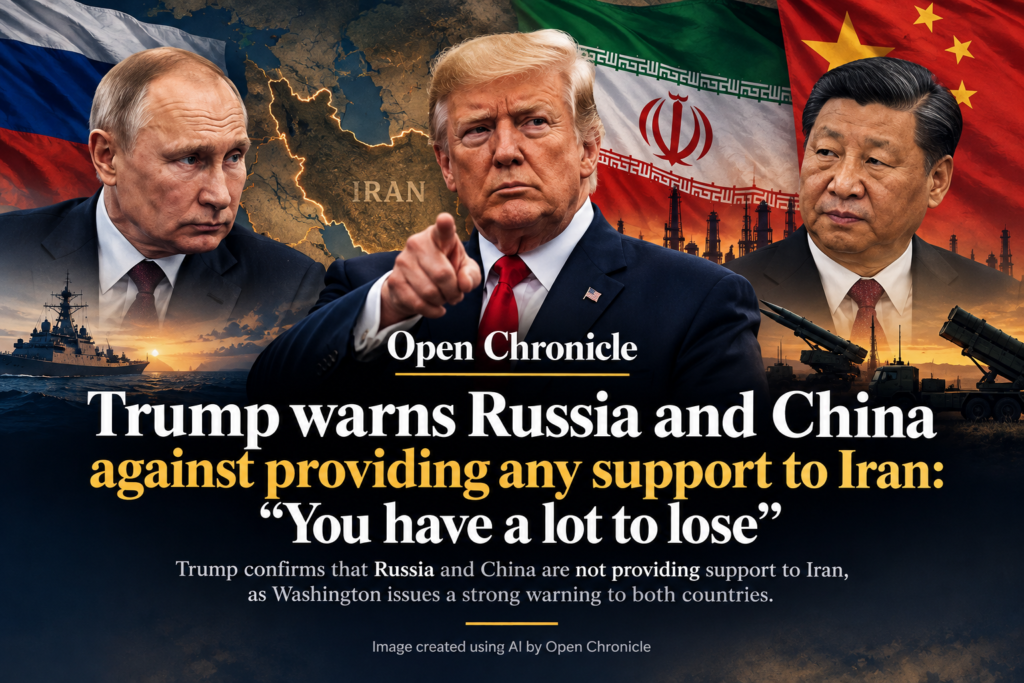
The US president says he does not believe Moscow or Beijing is providing significant military assistance to Tehran, despite Western intelligence reports alleging Russian intelligence-sharing and concerns over Chinese involvement. His remarks highlight growing uncertainty over the extent of cooperation between Iran and its two powerful international partners.
By Open Chronicle with agencies
WASHINGTON, October 13, 2026 — US President Donald Trump has warned Russia and China against providing military or intelligence assistance to Iran, declaring that both countries have substantial interests at stake if they become more directly involved in the Middle East conflict.
At the same time, Trump played down suggestions that Moscow and Beijing are already offering significant support to Tehran, saying he believes any assistance is either nonexistent or extremely limited.
The president’s comments come amid growing scrutiny of Iran’s military relationships with Russia and China, as Washington seeks to prevent the regional confrontation from developing into a wider geopolitical crisis involving major powers.
Western intelligence reports have raised concerns about possible Russian assistance involving satellite imagery, military intelligence and missile-related technology. Separate allegations have focused on the potential transfer of Chinese military equipment and assistance in circumventing sanctions.
However, the precise extent of any current support remains disputed, and the allegations have not all been independently substantiated.
Trump Says Moscow and Beijing Have Too Much to Lose
In comments published on his Truth Social platform, Trump rejected suggestions that Russia and China are providing extensive assistance to Iran.
He argued that the United States possesses the intelligence capabilities necessary to detect significant transfers of military equipment or operational information.
According to the president, any assistance that might be reaching Tehran is occurring at a very limited level.
Trump also criticised political opponents whom he accused of exaggerating the relationship between Iran and the two powers.
His central message was both a warning and an assessment: Russia and China should avoid becoming involved in the conflict, and he does not believe either government currently intends to take that risk.
The president suggested that Moscow and Beijing understand the potential economic, diplomatic and strategic consequences of supporting Iran against American forces.
His remarks reflect an effort to discourage further military cooperation while avoiding a public declaration that either country has already crossed a threshold requiring a direct American response.
Nevertheless, Trump’s assessment does not settle questions about the intelligence reports cited by Western officials and media organisations.
Washington Seeks to Prevent a Wider Conflict
The warnings come as the United States continues to confront Iran over its military activities, regional alliances and threats to American interests.
The possibility of assistance from Russia or China has become an important consideration for US policymakers.
Both countries maintain diplomatic and economic relationships with Tehran, although their strategic priorities differ.
Russia has developed extensive military and technical cooperation with Iran, particularly in connection with unmanned aerial systems and defence technology.
China, meanwhile, is a major economic partner of Iran and has consistently opposed the use of unilateral sanctions and military pressure as instruments of foreign policy.
For Washington, the principal concern is whether those relationships could evolve into more direct support for Iranian military operations.
Such assistance could potentially include intelligence-sharing, advanced air-defence equipment, missile components or technology designed to improve the effectiveness of Iranian weapons.
The United States is particularly sensitive to the possibility that foreign governments could provide Tehran with information about American military deployments.
Even limited intelligence assistance could have significant consequences during a regional conflict.
Western Reports Allege Russian Intelligence Assistance
One of the most sensitive questions concerns allegations that Russia has shared intelligence with Iran about American military movements in the Middle East.
According to Western intelligence reporting cited in the supplied information, Russian assistance has allegedly included satellite imagery and information concerning the movements of US naval vessels, aircraft and other military assets.
Such information could potentially help Iranian forces identify targets or improve their understanding of American operations.
Reports have also alleged Russian transfers of components and equipment associated with missile and drone systems.
The allegations, if substantiated, would suggest that Moscow’s cooperation with Tehran extends beyond diplomatic support and commercial relationships.
However, the full extent of the reported intelligence-sharing remains unclear.
Publicly available information does not establish whether Russian intelligence has directly contributed to particular Iranian attacks or whether Moscow has authorised operational assistance during specific engagements.
There is also an important distinction between longstanding military cooperation, the transfer of dual-use technology and direct participation in military operations.
Russia has not been shown in the information provided to have deployed its own forces to fight alongside Iran.
Trump’s comments suggest that the White House is either questioning the scale of the alleged assistance or distinguishing limited cooperation from more substantial military involvement.
Russia’s Strategic Relationship With Iran
Moscow and Tehran have strengthened their relationship in recent years, driven partly by shared opposition to Western sanctions and American influence.
The two countries have expanded cooperation in defence technology, energy and international diplomacy.
Iranian-designed drones have played an important role in Russia’s military campaign in Ukraine, bringing the relationship under intense scrutiny from Western governments.
Russia, in turn, has an interest in maintaining Iran as a regional partner without becoming directly involved in a broader war with the United States.
That calculation helps explain why Moscow may seek to preserve cooperation while avoiding actions that could trigger a direct confrontation.
Russian officials have also warned that continued military escalation in the Middle East could increase the risk of nuclear proliferation.
Such warnings reflect Moscow’s stated concerns about regional stability, although Western governments remain critical of Russia’s own military conduct and international security policies.
The relationship therefore presents a complicated challenge for Washington.
Russia can provide diplomatic and potentially technical assistance to Iran while simultaneously seeking to avoid a wider conflict that could damage its own strategic interests.
China Denounces US Military Action but Faces Questions Over Its Role
China’s position is different in several important respects.
Beijing maintains significant economic interests in the Middle East and has repeatedly called for respect for national sovereignty and the resolution of disputes through diplomacy.
Chinese officials have condemned American military strikes against Iran, describing them as violations of Iranian sovereignty.
At the same time, China has strong incentives to prevent a prolonged regional war.
The Middle East is a major source of energy supplies for the Chinese economy, and disruption to maritime trade routes could increase costs for Chinese manufacturers and consumers.
Beijing also has an interest in maintaining commercial relationships with countries across the Gulf, including governments whose security partnerships are closely connected to the United States.
Those considerations make direct military involvement in support of Iran a potentially costly decision.
Trump has indicated that he discussed the issue with Chinese President Xi Jinping and received assurances that Beijing would not provide assistance to Tehran.
According to the supplied reporting, the US ambassador in Beijing also referred to assurances obtained from Chinese officials.
The precise wording, timing and scope of those assurances have not been independently established in the information available.
Allegations Involving Air-Defence Systems and Sanctions
Western reports have also raised concerns about possible efforts to supply Iran with portable air-defence weapons and other military equipment.
Man-portable air-defence systems, commonly known as MANPADS, are shoulder-fired missiles designed to engage aircraft operating at relatively low altitudes.
Such systems could create additional risks for helicopters, transport aircraft and certain other military platforms.
However, the presence of allegations concerning possible transfers does not establish that the weapons have been delivered.
The supplied information does not identify confirmed shipments, independently verified delivery records or publicly disclosed evidence demonstrating that China has transferred such systems to Iran during the current conflict.
Separately, Western governments have accused networks operating across several countries of helping Iran evade restrictions on oil exports and access sensitive technology.
China’s commercial relationship with Iran has frequently been examined in connection with those sanctions.
Nevertheless, economic trade, alleged sanctions evasion and direct military support are separate issues that require different forms of evidence.
The Importance of Intelligence in Modern Warfare
The controversy illustrates the growing importance of intelligence cooperation in contemporary military conflicts.
Satellite imagery, electronic surveillance and information about troop movements can provide a significant operational advantage without requiring a foreign government to deploy combat forces.
For example, intelligence about naval movements could help a military organisation identify potential targets or adjust its surveillance activities.
Similarly, technical information about aircraft operations or defensive systems could influence tactical planning.
However, the actual military value of such information depends on its accuracy, timeliness and how it is used.
It is therefore not possible to conclude that alleged intelligence-sharing has improved the effectiveness of Iranian attacks without evidence connecting particular information transfers to operational outcomes.
For Washington, the challenge is to distinguish routine intelligence activity from assistance that directly contributes to attacks against American personnel or assets.
That distinction may become increasingly important if the regional confrontation continues.
Trump’s Warning Reflects a Broader Strategic Calculation
Trump’s public position appears designed to serve several objectives.
First, it communicates that Washington is monitoring possible foreign assistance to Iran.
Second, it warns Moscow and Beijing that more extensive involvement could carry consequences.
Third, it avoids publicly accusing either government of direct participation in military operations without establishing the basis for such a conclusion.
The approach also reflects the president’s wider diplomatic relationships with Russia and China.
Washington is simultaneously managing disputes involving Ukraine, international trade, technological competition and global security.
An escalation involving Iran could complicate those relationships considerably.
For Russia, the risks include additional sanctions, diplomatic confrontation and possible consequences for its wider strategic interests.
For China, the risks include disruption to trade, financial restrictions and further deterioration in relations with Washington.
Both governments must weigh their relationships with Tehran against those potential costs.
A Growing Test for International Diplomacy
The dispute comes at a moment when the Middle East conflict is already affecting international energy markets, aviation and maritime security.
Attacks on regional infrastructure and threats to shipping have increased concerns about the stability of the Strait of Hormuz and other strategically important routes.
The possibility of outside military assistance introduces another layer of uncertainty.
A wider conflict involving additional powers could have consequences far beyond the Middle East, particularly for global energy supplies and international financial markets.
Diplomatic communication between Washington, Moscow and Beijing may therefore play an important role in preventing further escalation.
The United States is likely to continue monitoring military transfers, financial networks and intelligence activity associated with Iran.
At the same time, public claims about foreign involvement will require careful scrutiny.
What Remains Unclear
Several important questions remain unanswered.
The first concerns the actual scale of Russian intelligence and technical assistance to Iran during the current conflict.
The second is whether Chinese entities have supplied military equipment or technology that could materially improve Iranian capabilities.
The third concerns the distinction between cooperation undertaken before the latest hostilities and assistance provided specifically to support ongoing operations.
Finally, it remains unclear what measures Washington would consider if it concluded that either country had significantly expanded its involvement.
Trump has publicly expressed confidence that Russia and China are not providing substantial support.
Western intelligence allegations, however, indicate that the issue remains under examination.
For now, the president’s warning highlights a central concern in Washington: preventing the conflict with Iran from expanding into a confrontation involving other major powers.
The next stage will depend on the evidence gathered by intelligence agencies, the decisions made in Moscow and Beijing, and the ability of diplomatic channels to contain the crisis.