
OPEN CHRONICLE | CULTURE & IDEAS MAGAZINE
Before Animal Farm and Nineteen Eighty-Four, Orwell witnessed a revolution divided against itself, a war fought on competing versions of reality, and the political destruction of people who believed they were fighting for the same cause.
By Open Chronicle Culture & Ideas
Books & Thought · Literary History · Political Ideas · Historical Essay
Introduction — Before the Dystopia, There Was Spain
In December 1936, a young English writer arrived in Barcelona expecting to fight fascism.
He was thirty-three years old, relatively unknown, and carrying convictions that were about to be tested more severely than anything he had previously experienced. His name was Eric Arthur Blair, although readers were beginning to know him as George Orwell.
Spain was in the midst of a civil war. General Francisco Franco’s military rebellion against the Spanish Republic had plunged the country into a conflict that rapidly became an international struggle over fascism, democracy, socialism and revolution.
For Orwell, the moral question initially appeared straightforward. Fascism had to be resisted. The Spanish Republic, whatever its imperfections, represented a cause worth defending.
What he discovered was considerably more complicated.
In Barcelona, he encountered a revolutionary society in which traditional class distinctions seemed briefly suspended. On the Aragon front, he experienced the discomfort, boredom and vulnerability of ordinary soldiers. Back in Barcelona, he witnessed armed conflict between factions ostensibly fighting on the same side.
He would eventually leave Spain not only wounded by an enemy bullet but also profoundly shaken by the political persecution of former comrades and by newspaper accounts that, in his judgment, bore little resemblance to events he had personally observed.
The experience did not turn Orwell against socialism. It changed his understanding of what political loyalty could demand, how revolutionary ideals could be corrupted, and how easily the historical record could become a battlefield.
Long before he imagined the Ministry of Truth, Orwell had encountered a world in which competing political organisations struggled to determine what the public would believe had happened.
Spain did not provide him with a complete theory of totalitarianism. But it gave him something perhaps more important: direct experience of the distance between political language and political reality.
To understand the later Orwell, we must return to the streets of revolutionary Barcelona, the freezing trenches of Aragon, and the dangerous weeks of May and June 1937.
I. Barcelona, December 1936: A Revolution in Progress
Orwell reached Barcelona approximately five months after the military uprising of July 1936.
By then, the city had become one of the most remarkable political experiments in Europe.
The attempted military rebellion had been defeated in Barcelona by forces loyal to the Republic, including armed workers’ organisations. In its aftermath, anarchist and socialist groups exercised considerable influence over factories, transport, workplaces and militias.
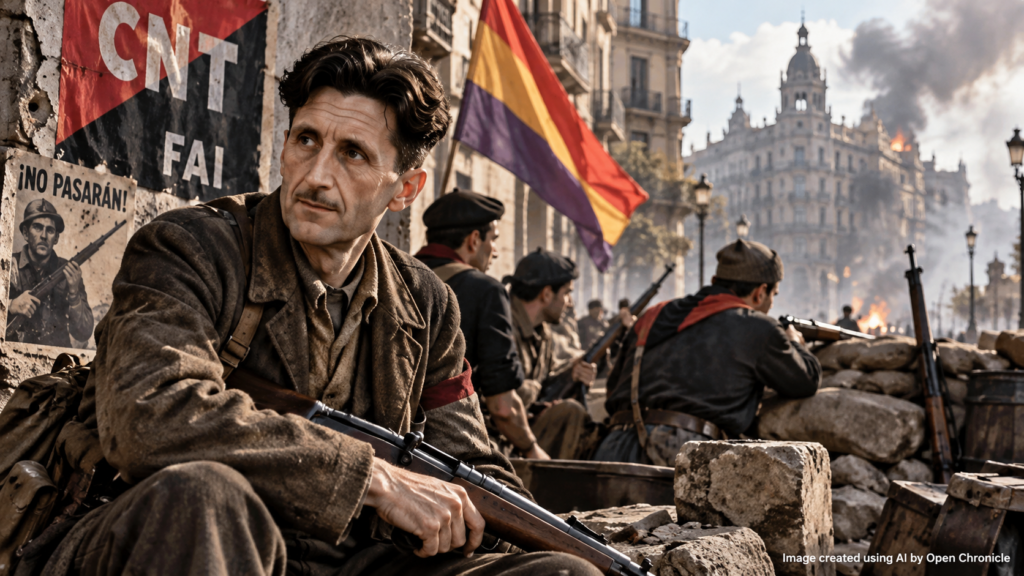
Red-and-black banners were visible across the city. Revolutionary slogans appeared on buildings. Many businesses had been collectivised, and the public display of traditional social hierarchy had diminished.
In Homage to Catalonia, Orwell described the powerful impression made by a city in which working-class people appeared to have acquired a new public dignity.
He was particularly struck by changes in everyday forms of address and social behaviour. The atmosphere suggested that the old divisions between employers and workers, officers and ordinary soldiers, and privileged and subordinate citizens had temporarily weakened.
Yet his account was also shaped by the limited perspective of a newcomer. Barcelona’s revolutionary transformation was real, but neither universal nor uncontested. The city remained politically divided, economically strained and increasingly affected by the demands of war.
The forces supporting the Republic were not a single political movement.
They included anarchists, socialists, communists, liberal republicans, regional nationalists and other organisations whose visions of Spain’s future differed substantially.
Some believed that defeating Franco required the continuation and deepening of social revolution.
Others argued that revolutionary measures should be restrained so that a disciplined Republican state could concentrate on military victory and maintain international support.
This disagreement would become central to Orwell’s experience.
For the moment, however, he encountered a society that seemed to offer an alternative to the hierarchies he had known in Britain and colonial Burma.
He had arrived intending to oppose fascism. He found himself, at least temporarily, inside a social revolution.
II. The POUM: Fighting Fascism Outside Stalinist Orthodoxy
Orwell did not initially arrive in Spain with a sophisticated understanding of the divisions among the Republican factions.
His connections in Britain led him to the Independent Labour Party, whose Spanish contacts were associated with the Partido Obrero de Unificación Marxista, or POUM.
The POUM was a revolutionary Marxist organisation formed in 1935 through the merger of two groups. Its leading figures included Andrés Nin and Joaquín Maurín.
Although often described by its enemies as Trotskyist, the POUM was not simply a Spanish branch of Leon Trotsky’s movement. Its political position was more complicated, and Trotsky himself sharply criticised its leadership.
The distinction matters because accusations of Trotskyism became a political weapon during the war.
In the increasingly polarised language of the period, the label could suggest disloyalty, conspiracy or even collaboration with fascism.
Orwell joined a POUM militia largely because it was the organisation through which he could most readily reach the front.
He would later acknowledge that, had circumstances been different, he might initially have joined another anti-fascist formation.
His affiliation was therefore not the result of a long-standing commitment to the POUM’s particular political programme.
But his experiences within its militia and his subsequent observation of its persecution would give the organisation a lasting place in his understanding of revolutionary politics.
The POUM believed that the war against fascism could not be separated from the struggle for socialist transformation.
By contrast, the Spanish Communist Party and its Catalan allies increasingly supported a strategy of centralising Republican authority, restoring military discipline and postponing revolutionary changes that might undermine the broader anti-fascist coalition.
These divisions were shaped by domestic politics, but also by international power.
The Soviet Union became an important supplier of military assistance to the Republic, while Nazi Germany and Fascist Italy provided substantial support to Franco’s forces.
Soviet influence strengthened Communist organisations and intensified tensions with revolutionary groups that resisted Stalinist political control.
Orwell entered this conflict as an inexperienced volunteer.
He would leave with a much clearer understanding of the dangers posed when one faction claims exclusive authority to define the meaning of political loyalty.
III. The Aragon Front: The Reality Behind Revolutionary Language
After joining the militia, Orwell travelled to the Aragon front, where Republican forces faced Nationalist positions across a relatively static line.
The experience was far removed from the romantic image of revolutionary warfare.
Weapons were often inadequate. Ammunition could be scarce. Training was inconsistent, and the men endured cold, poor sanitation, lice, hunger and prolonged inactivity.
Orwell’s account is particularly memorable because of its attention to such details.
Instead of presenting the front as a continuous sequence of heroic engagements, he described a soldier’s life dominated by discomfort, waiting and the practical difficulties of surviving in the trenches.
His writing challenged the tendency of political narratives to transform warfare into an abstraction.
The men around him were not simply representatives of historical forces. They were individuals struggling with exhaustion, fear, inadequate equipment and uncertainty.
Orwell also encountered the distinctive structure of the revolutionary militias.
Officers and ordinary soldiers often shared living conditions, and conventional displays of military hierarchy were limited. Discipline relied partly on political commitment and collective agreement rather than the formal authority familiar in traditional armies.
Orwell recognised the weaknesses of this arrangement, particularly in the conditions of modern warfare.
But he also found something morally significant in the attempt to establish equality within military life.
The experience strengthened his conviction that socialist ideals could be expressed through ordinary human relationships rather than merely through political programmes.
It also sharpened his distrust of those who judged events exclusively through ideological categories.
War, he learned, was not made more comprehensible by turning soldiers into symbols.
It became more comprehensible through attention to what they actually endured.
IV. May 1937: When the Anti-Fascist Coalition Turned Against Itself
The decisive political rupture in Orwell’s Spanish experience came during the Barcelona May Days of 1937.
Tensions within the Republican camp had been mounting for months.
The Catalan government and Communist-aligned forces sought to consolidate public authority, while anarchist organisations and the POUM resisted measures they regarded as attacks on the revolutionary gains of July 1936.
The immediate confrontation began on 3 May, when security forces attempted to take control of the central telephone exchange, which had been operated under the influence of the anarchist-led CNT.
The incident triggered armed clashes across Barcelona.
Barricades appeared in the streets. Rival groups occupied strategic buildings. Gunfire broke out between forces that were, in principle, united against Franco.
Orwell had returned to Barcelona on leave from the front.
He found himself drawn into the crisis alongside members of the POUM, although he was increasingly troubled by the political confusion surrounding the confrontation.
For several days, the city became a landscape of suspicion, improvised defensive positions and contradictory reports.
The fighting ended following negotiations and the arrival of government forces, but the political consequences were profound.
The events strengthened the position of those demanding centralised Republican authority and accelerated the marginalisation of revolutionary organisations considered politically unreliable.
For Orwell, the most disturbing aspect was not simply that anti-fascist factions had fought one another.
It was the way those events were subsequently represented.
Accounts circulated that portrayed the POUM and other revolutionary elements as participants in a conspiracy against the Republic. Accusations of collaboration with Franco’s forces became increasingly prominent.
Orwell regarded many of these claims as distortions or outright fabrications.
His personal experience did not give him complete knowledge of every confrontation or political decision. Yet he had seen enough to believe that influential narratives were being constructed in disregard of important facts.
The consequences were not merely rhetorical.
In a civil war, an accusation of treason could lead to imprisonment, disappearance or death.
The struggle over information had become inseparable from the struggle over political power.
V. Andrés Nin and the Destruction of the POUM
In June 1937, the Republican authorities moved decisively against the POUM.
The organisation was suppressed, its offices were raided, and leading members were arrested.
Andrés Nin, one of its principal figures, was detained on 16 June.
He subsequently disappeared while in the custody of security personnel connected to the Soviet-directed repression of anti-Stalinist forces.
Historical research has established that Nin was tortured and murdered, although details of his final days remain the subject of investigation and historical debate.
His fate became one of the most notorious episodes of repression within the Republican camp.
The campaign against the POUM was justified through allegations that the organisation had engaged in treasonous activity and maintained connections with Franco’s intelligence services.
These accusations served a political purpose: they presented the elimination of an independent revolutionary organisation as an act necessary to defend the Republic.
Orwell had already returned to the front when he was wounded in the throat by a sniper’s bullet on 20 May 1937.
The injury narrowly missed vital structures and could easily have killed him.
After medical treatment, he returned to Barcelona, where the political environment had become increasingly dangerous for members of the POUM.
The organisation to which he belonged was now being treated as an enemy by authorities on the same side of the civil war.
Orwell and his wife, Eileen, who had been working in Barcelona, faced the risk of arrest.
They eventually escaped Spain in June 1937.
The sequence of events left Orwell with a deeply unsettling conclusion.
Political movements did not need to abandon the language of justice or liberation in order to practise repression.
They could employ that language to justify it.
A government could claim to defend democracy while suppressing political opponents within its own coalition. A revolutionary movement could denounce oppression while reproducing its methods.
For Orwell, these were not abstract paradoxes.
They were lessons learned in a country where he had risked his life for a cause he continued to regard as fundamentally just.
VI. Homage to Catalonia: A Book Against Convenient History
Published in 1938, Homage to Catalonia transformed Orwell’s Spanish experiences into one of the most distinctive political memoirs of the twentieth century.
The book is unusual in its combination of personal testimony, military observation and political argument.
It is often humorous, sometimes bitter, and consistently concerned with the gap between official narratives and lived experience.
Orwell did not pretend to possess a complete understanding of the Spanish Civil War.
Indeed, one of the book’s strengths is its acknowledgment of confusion, incomplete knowledge and the difficulty of reconstructing events amid competing claims.
His account is partisan in the sense that he sympathised with the revolutionary aspirations of the workers and opposed the persecution of the POUM.
But he also criticised weaknesses within the militia system and recognised the limitations of his own perspective.
The book’s significance lies partly in its resistance to the demand that political writing should always serve a single convenient narrative.
For many supporters of the Republic abroad, publicising internal repression risked weakening the anti-fascist cause.
Orwell understood that concern.
He nevertheless believed that suppressing inconvenient facts would ultimately damage the moral foundations of the movement itself.
This created a difficult question that would recur throughout his career.
When a political cause is threatened by powerful enemies, should its supporters conceal internal wrongdoing for the sake of unity?
Orwell’s answer was shaped by Spain.
A cause worth defending could not be made stronger by the systematic falsification of its own history.
His commitment to socialism survived the war.
His willingness to accept socialist propaganda did not.
VII. From Spain to the Politics of Truth
The connection between Orwell’s Spanish experiences and his later work is substantial, but it should not be simplified into a single explanation.
Orwell’s political imagination was also shaped by British imperialism, poverty, class divisions, the rise of fascism, Stalinist repression and the experience of the Second World War.
Nevertheless, Spain gave him a particularly vivid understanding of how political systems could attack independent judgment.
In the 1943 essay Looking Back on the Spanish War, he reflected on the disturbing possibility that historical events could be transformed through propaganda until the public record no longer corresponded to what had actually occurred.
He was especially concerned that the modern political world seemed increasingly willing to treat historical truth as subordinate to organised power.
This was not a new problem in human history.
Rulers had long commissioned flattering chronicles, destroyed hostile records and controlled public narratives.
What disturbed Orwell was the apparent scale, ideological ambition and institutional organisation of modern political falsification.
The twentieth century had developed mass political parties, centralised propaganda systems, modern communication technologies and forms of repression capable of enforcing official narratives across entire societies.
The experience of Spain helped Orwell recognise that political domination could operate not only by controlling what people did, but also by influencing what they believed had happened.
The implications extended beyond the Spanish conflict.
If an institution could systematically rewrite the record of yesterday, it might also reshape the possibilities of tomorrow.
Political freedom therefore depended, in part, on the survival of evidence independent of the authorities interpreting it.
That conviction would become central to Orwell’s mature work.
VIII. The Road from Catalonia to Animal Farm
Orwell began writing Animal Farm in 1943, several years after his return from Spain.
The novella was published in Britain in August 1945.
Its immediate historical subject was the Russian Revolution and the corruption of its ideals under Stalinism.
Yet the Spanish experience helped give its political allegory an urgent personal dimension.
Orwell had seen how revolutionary organisations could invoke collective emancipation while demanding obedience to a narrowing circle of political authorities.
He had encountered propaganda that represented dissenting socialists as enemies of socialism.
He had witnessed the transformation of ideological disagreement into accusations of treason.
These experiences illuminate the moral structure of Animal Farm.
The novel’s central tragedy is not simply the emergence of a new dictatorship.
It is the gradual appropriation of revolutionary language by a ruling group that claims to embody the very ideals it has abandoned.
The pigs do not openly announce that equality is finished.
They progressively redefine equality, altering principles and memories until the revolution’s original promises can no longer be used to judge its leaders.
The animals’ vulnerability is intensified by their limited access to independent information.
They depend on official explanations, imperfect memories and a political vocabulary increasingly controlled by those in power.
The parallels with Orwell’s Spanish experiences are not exact, and Animal Farm should not be read as a disguised history of the POUM.
Its allegory is primarily directed at Soviet communism and Stalinist political development.
But the underlying problem—how revolutionary authority can corrupt both institutions and language—had acquired a personal reality for Orwell in Spain.
He knew that political betrayal was not only a theoretical possibility.
He had watched it unfold among people who claimed to share a common struggle.
IX. The Spanish Shadow Behind Nineteen Eighty-Four
Published in June 1949, Nineteen Eighty-Four presented Orwell’s most elaborate fictional investigation of totalitarian power.
The novel’s political universe was shaped by several historical forces, including Nazi Germany, Stalinist Soviet society, wartime propaganda and the development of increasingly centralised modern states.
Spain was one important part of this intellectual background.
The connection is especially clear in the novel’s treatment of historical records.
Winston Smith works at the Ministry of Truth, where documents are altered to make the past conform to the Party’s current position.
What distinguishes this fictional system is not merely that it circulates falsehoods.
It attempts to eliminate the possibility of proving that a falsehood has occurred.
Once contradictory records disappear, the official version becomes increasingly difficult to challenge.
In Spain, Orwell had encountered political accusations that seemed to him radically disconnected from events he had witnessed.
In Nineteen Eighty-Four, he imagined a state that possessed the institutional machinery to make such disconnections permanent.
The difference is crucial.
The confusion and factional propaganda of the Spanish Civil War did not amount to the fully developed totalitarian system portrayed in the novel.
But the experience offered Orwell a practical example of the relationship between political power, public language and historical memory.
His fiction expanded that relationship into a systematic nightmare.
The Ministry of Truth was not simply a prediction of a future bureaucracy.
It was the literary expression of a question that had troubled Orwell since Spain: what becomes of political freedom when people can no longer appeal to an independently verifiable account of events?
X. Orwell’s Uncomfortable Position on the Left
One of the most important consequences of Spain was Orwell’s increasingly distinctive position within the British left.
He remained committed to democratic socialism, opposing economic inequality and the concentration of privilege.
At the same time, he became deeply hostile to Stalinist political methods and to intellectual cultures that excused authoritarianism when it appeared to serve a preferred ideological cause.
This placed him in an uncomfortable position.
His criticism of the Soviet Union could be welcomed by conservatives who rejected socialism altogether.
His socialist commitments, meanwhile, made him difficult to assimilate into a straightforward anti-left political tradition.
Orwell resisted both simplifications.
He did not believe that exposing Stalinist repression required abandoning the aspiration to a more equal society.
Nor did he believe that the pursuit of equality justified suppressing dissent, manufacturing accusations or rewriting history.
The Spanish Civil War made the tension between these positions unavoidable.
For Orwell, political principles were meaningful only if they remained applicable when they became inconvenient.
A movement could not credibly oppose fascist repression while treating the repression of its own internal opponents as morally irrelevant.
A writer could not defend freedom of expression while insisting that uncomfortable evidence be withheld to protect a political alliance.
These convictions did not make Orwell politically neutral.
They made him a partisan who believed that allegiance imposed obligations of criticism rather than exemptions from it.
That distinction is central to his intellectual legacy.
XI. The Limits of Orwell’s Spanish Perspective
Orwell’s account remains indispensable, but it is not the complete history of the Spanish Civil War.
He spent a relatively short period in Spain and experienced the conflict from a particular political and geographical position.
His military service was concentrated on the Aragon front. His account of the Barcelona May Days reflected what he could observe directly and what he subsequently learned from others.
He was not present at every significant political negotiation, military confrontation or act of repression.
Historians have therefore approached Homage to Catalonia as both an important eyewitness document and a politically situated interpretation.
This distinction does not diminish the book’s value.
It makes it possible to appreciate Orwell’s testimony without turning him into an infallible observer.
The Spanish Republic faced genuine military threats, severe internal divisions, shortages of resources and intense international pressure.
The argument for military centralisation was not inherently fraudulent. Republican leaders had legitimate reasons to seek greater coordination against Franco’s armies.
At the same time, those practical concerns did not justify fabricated accusations or political persecution.
The difficulty lies in distinguishing genuine strategic disagreements from efforts to suppress independent political organisations.
Orwell’s experience is most illuminating when placed within that broader historical complexity.
His account captures the moral experience of someone who discovered that an anti-fascist struggle could contain its own authoritarian practices.
But understanding the entire conflict requires engagement with other witnesses, archival evidence and the work of historians examining the Republic’s political, military and international circumstances.
Orwell’s greatest achievement was not that he resolved every historical controversy.
It was that he refused to allow the urgency of the anti-fascist cause to erase the need for factual scrutiny.
XII. The Writer Who Returned from Spain Changed
Orwell left Spain in June 1937.
He had survived the front, a near-fatal wound and the threat of arrest. He had also experienced a profound disillusionment with the conduct of political organisations that claimed to be fighting for liberation.
But the transformation was not a simple journey from idealism to cynicism.
He did not conclude that all political movements were equally corrupt, that collective action was futile or that socialism had been disproved.
Instead, he became more determined to distinguish political ideals from the institutions claiming to represent them.
This was the intellectual consequence of Spain.
Orwell’s later writing would return repeatedly to the corruption of language, the fragility of historical evidence and the danger of surrendering personal judgment to political authority.
These themes did not emerge from detached philosophical speculation alone.
They were shaped by the experience of watching real people become targets of accusations that could destroy their lives.
His understanding of truth was therefore inseparable from questions of power and responsibility.
Truth mattered not because it was politically convenient, but precisely because it could become politically inconvenient.
The writer’s responsibility was not to guarantee that every judgment would be correct.
It was to resist the temptation to make reality conform to a predetermined conclusion.
That principle gave Orwell’s work a distinctive moral intensity.
And it remains one of the strongest reasons to read his Spanish writing today.
Conclusion — The War That Changed the Meaning of Truth
The Spanish Civil War is often remembered as a prelude to the wider European catastrophe that followed.
It was a conflict in which fascism, revolution, democracy and international ideological rivalry converged with devastating consequences.
For George Orwell, it was also an education in the political uses of truth.
He arrived believing that the central task was to resist fascism.
He left convinced that the defence of political freedom also required confronting deception and repression within movements that claimed to oppose fascism.
That conviction would inform his most celebrated books, but its clearest expression may still be found in Homage to Catalonia.
There, the reader encounters not the architect of a fictional dystopia, but a wounded volunteer struggling to understand why people who had fought on the same side could become enemies—and why the public accounts of their conflict could be so different from the events he remembered.
Spain taught Orwell that the historical record was never politically innocent.
But it also taught him that abandoning the effort to establish what happened would leave the field entirely to those with the power to impose their preferred version.
The most enduring lesson of his Spanish experience is therefore neither despair nor political withdrawal.
It is the necessity of maintaining intellectual independence even when the pressure to conform comes from one’s own side.
Before Orwell wrote about a world in which truth could be erased, he had witnessed how easily it could be endangered.
And before he imagined a system that demanded absolute loyalty, he had learned why loyalty without independent judgment could become a form of surrender.