
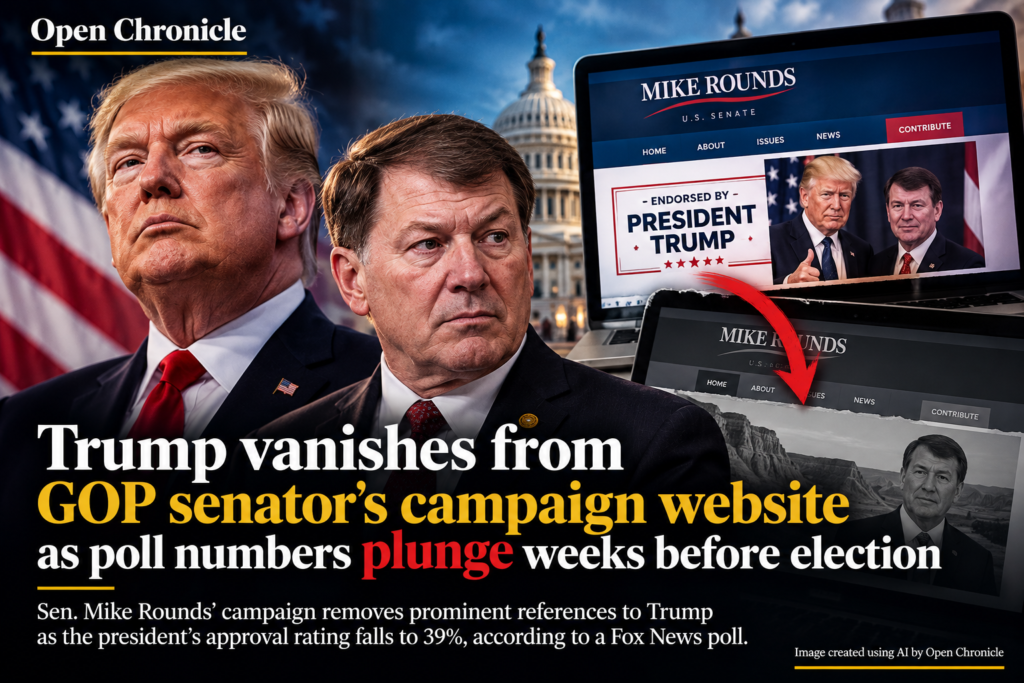
Republican Senator Mike Rounds has removed prominent references to President Donald Trump from his re-election campaign website in South Dakota, raising questions about the president’s political influence as the November midterm elections approach. The campaign insists it remains proud of Trump’s endorsement and describes the changes as a routine shift toward general election messaging.
By Open Chronicle with agencies
WASHINGTON, October 13, 2026 — Republican Senator Mike Rounds of South Dakota has removed several prominent references to President Donald Trump from his campaign website, becoming the latest Republican candidate to adjust his political messaging as the president faces declining approval ratings ahead of the November midterm elections.
The changes, first reported by Fox News Digital, come as Republicans confront growing voter dissatisfaction over the cost of living, rising fuel and grocery prices, and the continuing war involving Iran.
Rounds, who is seeking a third term in the US Senate, previously featured Trump’s endorsement prominently on his campaign homepage. However, comparisons with an earlier version of the website show that several references to the president have disappeared.
The senator’s campaign rejects suggestions that the changes represent an attempt to distance Rounds from Trump, insisting that the president’s endorsement remains visible in his campaign announcement video.
“The president’s endorsement is still front and center on the website in Mike’s announcement video,” campaign adviser Rob Skjonsberg told Fox News Digital.
“But, generally speaking, it’s not abnormal to hone in on general election messaging.”
The episode illustrates a growing political dilemma for Republican candidates who want to retain support from Trump’s conservative base while appealing to voters increasingly concerned about the administration’s economic and foreign policy decisions.
Trump’s Endorsement Removed From Prominent Website Sections
According to Fox News Digital, Rounds’ campaign website previously displayed two prominent references to Trump on its homepage.
One declared that the senator was “Endorsed by President Trump.”
Another appeared alongside a photograph of Rounds and stated that the senator had Trump’s backing while working for South Dakota residents.
Both references have since been removed from the homepage.
The campaign also deleted Trump’s name from two sections of its policy platform.
The president had previously been mentioned in the website’s “Put America First” and “Education” sections.
The changes do not mean that Rounds has formally rejected Trump’s endorsement or withdrawn his support for the president.
His campaign maintains that the endorsement remains available through the senator’s announcement video.
Nevertheless, the removal of prominent references has attracted attention because of the broader political environment facing Republicans.
With the midterm elections approaching, candidates must decide how closely to associate their campaigns with a president whose approval ratings have weakened.
Trump Previously Gave Rounds His Full Endorsement
Trump endorsed Rounds for re-election last year, praising the South Dakota senator as a strong advocate for his constituents.
The president described Rounds as an “incredibly strong advocate for the wonderful people of South Dakota.”
Trump also emphasised his own electoral success in the state, noting his victories there in the 2016, 2020 and 2024 presidential elections.
“Mike Rounds has my Complete and Total Endorsement for Re-Election — HE WILL NEVER LET YOU DOWN,” Trump wrote on Truth Social.
The endorsement was politically significant because Trump remains an influential figure within the Republican Party.
His support can help candidates consolidate conservative voters, attract campaign contributions and strengthen their position within the party.
However, the political value of presidential endorsements can change during a general election.
Candidates competing for independent and moderate voters may place greater emphasis on local issues, their legislative records and their personal political identities.
Rounds’ campaign argues that its website adjustments reflect precisely that kind of electoral strategy.
Trump’s Approval Rating Falls to 39%
The changes come amid declining public approval of Trump’s performance.
A Fox News poll released in September found that 39% of voters approved of the president’s handling of his job.
The result reflects a difficult political environment for the White House as Republicans attempt to preserve their congressional majorities.
The survey identified several major sources of voter dissatisfaction.
The cost of living remained a central concern, particularly grocery prices, fuel expenses and the broader financial pressures affecting American households.
The continuing war involving Iran also emerged as a significant issue.
These concerns have created challenges for Republican candidates seeking to defend their records while maintaining support for the administration.
Although Trump’s approval rating is a national measure, individual Senate and House races are shaped by state-level political conditions.
A candidate in a strongly Republican state may face different pressures from one competing in a closely divided electorate.
Nevertheless, national dissatisfaction can influence voter turnout, campaign messaging and the overall political environment.
South Dakota Remains a Republican Stronghold
Despite the attention surrounding Rounds’ website, South Dakota remains one of the Republican Party’s strongest electoral states.
The Cook Political Report continues to classify the Senate contest as “Solidly Republican.”
Rounds has an extensive political history in the state.
Before entering the US Senate, he served as governor of South Dakota and as a member of the state Senate.
His long record in state politics provides him with established name recognition and a strong Republican political base.
Trump also won South Dakota comfortably in each of his three presidential campaigns.
These factors suggest that Rounds enters the general election with significant structural advantages.
The removal of presidential references from his website does not, by itself, establish that the senator is in danger of losing re-election.
Nor does the supplied reporting provide independent polling showing that Rounds’ own support has declined.
The broader significance of the changes lies in what they may reveal about Republican campaign strategy rather than evidence of an imminent electoral upset.
Independent Brian Bengs Challenges Rounds
Rounds is facing independent candidate Brian Bengs in the November election.
Bengs previously ran as a Democrat against Republican Senator John Thune in 2022.
Thune won that election decisively, securing more than 70% of the vote.
For the 2026 contest, Bengs is running as an independent, presenting himself as an alternative to the Republican incumbent.
He has criticised Rounds over the changes to his campaign website, arguing that they reflect political calculations rather than disagreements over policy.
“I’m not running against the President,” Bengs told Fox News Digital.
He suggested that Rounds had changed his campaign messaging only after becoming concerned about his electoral position.
Bengs also criticised the administration’s policies concerning Iran and international trade.
According to the challenger, the war has contributed to rising costs, while tariffs have placed additional pressure on American households and businesses.
He argued that Rounds should publicly debate him so voters can examine the senator’s positions.
“I hope Mike finds the courage to debate me, so we can talk about it,” Bengs said.
His comments seek to connect the website changes to broader concerns about political accountability and the economic consequences of federal policy.
Rounds Campaign Rejects Bengs’ Criticism
Rounds’ campaign responded forcefully to Bengs’ accusations.
Skjonsberg rejected the suggestion that the senator was attempting to conceal his relationship with Trump.
“We’re proud of the president’s endorsement. It’s still front and center,” he said.
The adviser also attacked Bengs’ political positions, portraying the independent candidate as aligned with liberal policies.
He accused Bengs of supporting higher taxes, restrictions on gun ownership and the expansion of the Affordable Care Act, commonly known as Obamacare.
These allegations were presented as campaign criticism and were not independently established in the supplied reporting.
Skjonsberg further argued that Bengs was attempting to distract voters from his own policy positions by focusing on Rounds’ relationship with the president.
The exchange reflects the increasingly confrontational tone of the Senate race.
For Bengs, the website changes offer an opportunity to question the incumbent’s political independence.
For Rounds, the priority is to present himself as a senator focused on South Dakota while maintaining his standing within the Republican Party.
The Iran War Becomes a Growing Political Liability
The conflict involving Iran has become an increasingly important issue in the 2026 midterm campaign.
According to the supplied reporting, some Republican candidates have publicly expressed reservations about aspects of the administration’s military and foreign policy decisions.
The war has also become part of the wider debate over energy prices and household expenses.
Disruptions affecting international energy markets can increase the cost of oil and fuel, creating additional pressure on consumers and businesses.
For voters already concerned about inflation and affordability, these developments may influence perceptions of the administration.
Republican candidates therefore face difficult choices.
Supporting the president’s foreign policy may strengthen their standing among voters who approve of his leadership.
However, association with an unpopular conflict could create challenges among independent voters and Republicans concerned about the economic consequences.
The debate is particularly sensitive because the administration’s foreign policy decisions have implications for national security, energy markets and government spending.
Other Republicans Adjust Their Positions
Rounds is not the only Republican candidate facing questions about his relationship with Trump.
According to the supplied reporting, Representative Ashley Hinson of Iowa and former Representative Mike Rogers of Michigan have publicly expressed opposition to certain administration policies.
Their positions have included criticism of aspects of the Iran war and concerns surrounding the expansion of data centres.
These issues have different implications depending on the state.
The development of large data centres, for example, can generate investment and employment but may also raise concerns about electricity demand, infrastructure and local resources.
Candidates in competitive races may seek to distinguish themselves from the administration on particular issues while continuing to support the broader Republican agenda.
Such disagreements do not necessarily represent a complete political break with Trump.
Instead, they may reflect efforts to respond to local concerns and establish an independent political identity.
The growing visibility of these differences suggests that the midterm campaign is creating new pressures within the Republican Party.
The Political Challenge of Presidential Endorsements
Presidential endorsements can be powerful tools in American politics.
They can provide candidates with national attention, fundraising opportunities and access to established networks of political supporters.
However, their effectiveness depends on the popularity of the president and the political characteristics of the electorate.
In Republican primary elections, Trump’s endorsement has often been treated as an important indicator of support from the party’s conservative base.
General elections present a different challenge.
Candidates may need to attract independents, moderate voters and individuals who do not strongly identify with either major party.
When presidential approval ratings decline, candidates may place greater emphasis on their own records and local priorities.
That does not necessarily mean rejecting the president.
It can instead involve changing the prominence of presidential references in campaign advertising, websites and public appearances.
Rounds’ campaign explicitly describes its changes as a shift toward general election messaging.
The distinction is important because the removal of website references is not equivalent to a formal political disagreement.
Midterm Elections Test Republican Control of Congress
The November elections will determine whether Republicans can retain their majorities in Congress.
Historically, midterm elections have often been difficult for the party controlling the White House.
Voters may use the elections to express dissatisfaction with national leadership, economic conditions or government policy.
The current political environment includes several potentially significant challenges for Republicans.
Public concern about household finances remains high.
The war with Iran has generated controversy.
And Trump’s national approval rating, according to the cited Fox News poll, has fallen below 40%.
Republicans nevertheless retain important advantages in some states, including established political organisations, strong partisan support and substantial campaign resources.
South Dakota remains a particularly favourable state for the party.
The challenge for Republican candidates is to maintain enthusiasm among their core supporters while avoiding unnecessary political vulnerabilities.
For some candidates, that may mean placing greater emphasis on local priorities rather than national political figures.
Campaign Websites Reveal Shifting Political Priorities
Campaign websites are an important part of modern electoral communication.
They allow candidates to present their biographies, policy positions, endorsements and campaign priorities directly to voters.
Changes to a website can therefore offer clues about how a campaign wishes to position itself.
However, those changes must be interpreted carefully.
Removing an endorsement from a prominent section does not necessarily mean that the candidate no longer values or supports it.
Campaigns frequently reorganise their websites as elections move from primary contests to general elections.
Messaging that appeals to a party’s core supporters may be replaced with material intended to reach a broader electorate.
Rounds’ campaign says this is the explanation for its recent changes.
Critics, including Bengs, argue that the timing suggests a desire to reduce the senator’s public association with Trump.
Without additional evidence of the campaign’s internal decision-making, the changes alone cannot conclusively establish either interpretation.
The Big Picture: Trump’s Influence Faces a Midterm Test
The controversy surrounding Mike Rounds’ campaign website illustrates the increasingly complicated relationship between Republican candidates and President Donald Trump ahead of the 2026 midterm elections.
Trump remains an important political figure within the Republican Party.
His endorsement continues to carry significance, particularly among conservative voters.
At the same time, declining national approval ratings and public dissatisfaction over economic and foreign policy issues are creating challenges for candidates seeking broader electoral support.
Rounds’ decision to remove prominent references to Trump from his campaign website has attracted attention precisely because South Dakota is such a strongly Republican state.
The senator’s campaign insists that the president’s endorsement remains part of its political message and that the changes are routine.
His independent challenger argues that they reveal a growing concern about the political consequences of association with the White House.
Both interpretations reflect the wider tensions shaping the election.
For Republicans, the central challenge is balancing loyalty to the president with the need to respond to voters’ concerns about affordability, foreign policy and government performance.
For Democrats and independent challengers, declining presidential approval offers an opportunity to challenge Republican incumbents over their relationship with the administration.
The outcome in South Dakota is still expected to favour Rounds, according to the Cook Political Report’s current classification.
But the debate over his campaign website points to a larger question facing the Republican Party nationwide.
As November approaches, will Donald Trump’s endorsement remain an electoral advantage, or will some Republican candidates increasingly seek to define themselves independently of the president?
The answer may help determine not only the outcome of individual Senate races but also the balance of power in Washington after the midterm elections.