
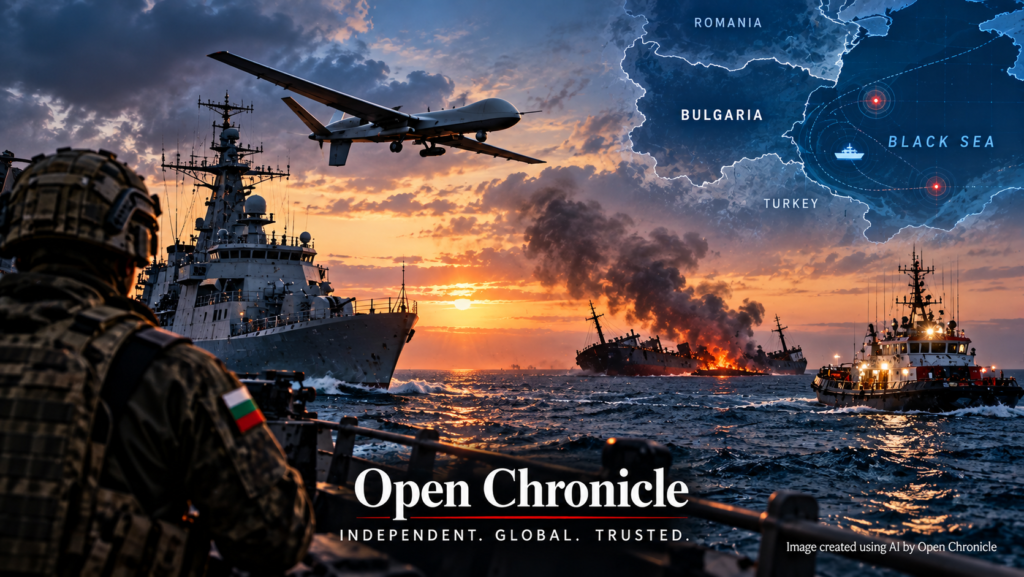
Bulgaria is preparing to strengthen maritime surveillance and deploy two additional unmanned systems after reported drone attacks on two commercial vessels near its Black Sea coast. The incidents have prompted emergency rescue operations, closer coordination with Romania and Turkey, and renewed debate over NATO’s response to security threats spreading beyond Ukraine’s borders.
By Open Chronicle with agencies
SOFIA, Bulgaria — October 14, 2026
Bulgaria will deploy two additional unmanned systems and reinforce surveillance of its Black Sea coastline following attacks on two commercial vessels that have raised concerns about the growing proximity of the Russia-Ukraine war to NATO territory.
Speaking to journalists at the National Assembly, Defence Minister Dimitar Stoyanov warned that the security situation in the Black Sea was deteriorating and that military incidents were moving closer to Bulgarian territorial waters.
“Escalation is already underway and continues to rise. We see this conflict drawing ever closer to our territorial waters,” Stoyanov said.
The minister expressed concern that the conflict could cross a dangerous threshold, while acknowledging that the circumstances surrounding the latest incidents remained under investigation.
The attacks reportedly involved two merchant vessels, the HS Dignity and the Chelsea-3, both of which issued distress calls during the early hours of the morning.
One vessel sank near Bulgaria’s northern Black Sea coast, triggering a search-and-rescue operation for missing crew members.
The second ship was evacuated after reporting multiple drone strikes.
Bulgarian authorities have not established the type of drones involved or definitively identified those responsible.
The incidents have prompted Sofia to reinforce its coastal monitoring capabilities and accelerate discussions with neighbouring NATO allies over maritime security.
Commercial Vessel Sinks Near Krapets After Reported Drone Attack
The first emergency was reported shortly after 1 a.m., when Bulgarian authorities received a distress signal from the HS Dignity, a commercial vessel sailing under the flag of Guinea-Bissau.
According to Stoyanov, the crew reported a fire aboard the ship following what was described as a drone attack.
The vessel subsequently sank off Krapets, a coastal settlement near Bulgaria’s northern border with Romania.
Six of the ship’s 16 crew members were located and rescued.
Search operations continued for the remaining ten sailors, whose whereabouts had not been established at the time of the minister’s statement.
The sinking prompted an immediate response from Bulgaria’s armed forces.
A Bulgarian Navy frigate was dispatched to the area, while two military helicopters were sent toward the location of the incident.
The operation focused on locating survivors, assessing the maritime threat and establishing the circumstances of the reported attack.
The available information does not establish the ship’s cargo, the extent of any environmental damage or whether the vessel was carrying hazardous materials.
Those questions may become important as authorities investigate the sinking and assess possible risks to navigation and the surrounding marine environment.
Second Vessel Attacked Southeast of Varna
A second distress call was received at approximately 1:28 a.m. from the Chelsea-3, located around 17 nautical miles southeast of Varna.
The vessel, described as Ukrainian-owned and sailing under the Maltese flag, reportedly came under repeated drone attack.
Its crew included Ukrainian and Azerbaijani nationals.
According to the Bulgarian defence minister, the sailors were evacuated with assistance from a Greek patrol boat operating in the area.
One crew member reported that the ship had been struck three times by a drone he identified as Russian.
However, Bulgarian authorities have not independently confirmed the weapon’s origin or the identity of the attacker.
The reported location of the Chelsea-3 places the incident in a maritime area where questions of jurisdiction, navigation rights and military response can be particularly complex.
The ship’s ownership and flag registration also illustrate the international nature of commercial shipping in the Black Sea.
A vessel may be owned by interests in one country, registered in another and operated by a multinational crew.
Attacks on such ships can therefore affect several governments simultaneously, even when the incidents occur outside their territorial waters.
Russia Suspected, but Responsibility Remains Unconfirmed
Stoyanov suggested that Russian drones were a possible explanation for the attacks.
He argued that Ukraine would have little apparent reason to target vessels owned by Ukrainian interests.
However, the minister acknowledged that investigators had not established the type of unmanned aircraft involved or conclusively determined who launched them.
The Bulgarian military’s initial aerial surveillance reportedly detected no unmanned aerial vehicles in the area following the incidents.
The absence of detected drones does not establish that no drone attack occurred.
Unmanned aircraft may have left the area, crashed or otherwise disappeared before surveillance assets arrived.
Nevertheless, the available information remains insufficient to attribute responsibility with confidence.
The allegations concerning Russian involvement should therefore be treated as preliminary assessments rather than confirmed findings.
Determining responsibility would require additional evidence, potentially including recovered fragments, radar data, electronic records, vessel damage assessments and witness testimony.
For Bulgaria and its NATO partners, reliable attribution is particularly important because the incidents could influence diplomatic and military responses.
Bulgaria Orders Additional Unmanned Surveillance Systems
The Bulgarian government plans to deploy two additional unmanned systems as part of its response to the deteriorating security environment.
Stoyanov said the country would also strengthen monitoring of the Black Sea and reinforce its ability to identify threats approaching Bulgarian territory.
The minister did not provide detailed technical specifications for the new systems.
It was therefore unclear whether they would be used primarily for aerial surveillance, maritime monitoring or other military purposes.
The announcement follows broader efforts to strengthen Bulgaria’s coastal defence and air surveillance capabilities.
Stoyanov said Sofia had already requested a stronger allied military presence and increased air patrols.
Further requests for assistance were prepared following discussions within Bulgaria’s Consultative Council for National Security.
The minister declined to disclose specific operational measures during the public parliamentary session.
The decision reflects the growing importance of persistent surveillance in the Black Sea, where drones, missiles and other weapons can pose risks to civilian shipping.
Early detection can provide authorities with more time to issue warnings, coordinate rescue operations and prepare defensive responses.
However, surveillance systems alone cannot eliminate the threat of attacks in international waters.
Bulgaria, Romania and Turkey Move to Strengthen Coordination
Following the maritime incidents, Stoyanov held discussions with his Romanian and Turkish counterparts.
The three countries agreed to improve coordination, accelerate the exchange of security information and conduct joint assessments of developments in the Black Sea.
A meeting involving their defence ministers and chiefs of defence is being arranged.
According to Stoyanov, the gathering could take place before the end of October, although a date had not yet been finalised.
The proposed consultations reflect the shared security interests of the three NATO members bordering the western and southern Black Sea.
Romania and Bulgaria are particularly exposed to the consequences of military activity near Ukraine’s maritime approaches.
Turkey, meanwhile, occupies a central position in regional security because it controls access between the Black Sea and the Mediterranean through the Turkish Straits.
Closer cooperation could improve maritime situational awareness and coordination during emergencies.
It may also help the three countries develop more consistent responses to threats affecting commercial shipping.
For Bulgaria, the objective is to strengthen regional security without becoming directly involved in the Russia-Ukraine conflict.
Legal Limits on Protecting Merchant Shipping
Stoyanov emphasised that Bulgaria’s ability to protect commercial vessels depends on their location and the applicable legal framework.
He said Bulgarian armed forces could respond to specific threats within the country’s territorial waters and airspace.
However, he ruled out providing routine military escorts to merchant vessels in international waters without an appropriate legal basis.
“We have no commitment, obligation, or right to do so,” the minister said when questioned about escort operations beyond Bulgarian territorial waters.
He added that naval escorts could be provided within Bulgaria’s territorial sea.
The minister’s remarks underline the distinction between different maritime zones recognised under international law.
A coastal state exercises sovereignty over its territorial sea, subject to applicable navigation rights.
Beyond that area, its powers become more limited and depend on the legal status of the waters and the activity concerned.
In an exclusive economic zone, for example, a coastal state possesses important rights relating to natural resources and certain economic activities, but it does not exercise the same general sovereignty as it does within its territorial sea.
Foreign vessels retain navigation rights under international maritime law.
These distinctions can complicate decisions about how and when a state may use military force to protect shipping.
They do not, however, mean that naval operations outside territorial waters are categorically prohibited. Their legality depends on the circumstances and the applicable international legal framework.
NATO Article 4: Bulgaria Urges Caution
The incidents have renewed discussion about whether Bulgaria should seek formal consultations under Article 4 of the North Atlantic Treaty.
Article 4 allows NATO members to consult whenever any ally considers its territorial integrity, political independence or security to be threatened.
Stoyanov argued that the mechanism should not be invoked automatically after every security incident.
He said NATO allies needed to evaluate the seriousness and circumstances of individual events before deciding whether formal consultations were necessary.
The minister referred to previous incidents involving Russian military aircraft, missiles and drones affecting NATO countries.
He also noted that Bulgaria had informed its allies about the latest Black Sea incidents through its permanent representative to NATO in Brussels, Ambassador Nikolay Milkov.
According to Stoyanov, the matter had been raised within the North Atlantic Council and remained under discussion.
He said allied governments generally favoured assessing incidents individually rather than treating every episode as an automatic trigger for Article 4.
The minister also linked Article 4 discussions to the possibility of Article 5, NATO’s collective-defence provision.
However, the two mechanisms are legally distinct.
Article 4 consultations do not automatically lead to Article 5 action.
Article 5 concerns collective defence in response to an armed attack, while Article 4 provides a mechanism for consultation about perceived threats.
The distinction is particularly important when incidents involve unidentified weapons or occur outside the territorial jurisdiction of an alliance member.
NATO’s Black Sea Security Challenge
The reported attacks demonstrate the difficulties NATO faces in protecting its southeastern maritime approaches.
The Black Sea is simultaneously an area of commercial navigation, strategic military activity and direct confrontation between Russia and Ukraine.
Bulgaria, Romania and Turkey must manage the risks associated with the conflict while preserving maritime commerce and avoiding unnecessary escalation.
The challenge is especially acute when attacks involve unmanned systems.
Drones can be difficult to identify, and their origins may remain uncertain even when damage has occurred.
The resulting ambiguity complicates decisions about attribution and proportional responses.
For NATO, the priority is to maintain credible defensive capabilities while ensuring that individual incidents do not produce uncontrolled escalation.
Information sharing and regional coordination are therefore likely to become increasingly important.
Bulgaria’s decision to strengthen surveillance is consistent with that approach.
More Than 600 Maritime Incidents Reported Since the War Began
Stoyanov said more than 600 incidents involving ships had been recorded across the Black Sea since Russia’s full-scale invasion of Ukraine in February 2022.
The figure reportedly covers the wider region rather than only Bulgaria’s exclusive economic zone.
The minister did not provide a detailed breakdown of the incidents.
Consequently, the total should not be interpreted as representing 600 confirmed military attacks on commercial vessels.
The incidents may encompass different categories of maritime emergencies and security events.
Nevertheless, the reported number illustrates the prolonged disruption affecting navigation and maritime safety.
Commercial shipping has faced risks associated with military operations, sea mines, damaged infrastructure and restrictions on access to certain maritime areas.
The security environment has also created challenges for insurers, shipping companies and port operators.
Stoyanov warned that similar incidents were likely to continue.
He argued that no single institution in Bulgaria, Ukraine or Russia possessed the ability to prevent every maritime security incident in the region.
The assessment reflects the limitations of national surveillance and defensive systems in a large maritime environment affected by an ongoing war.
The Montreux Convention and Turkey’s Strategic Role
The Bulgarian defence minister also addressed questions concerning the Montreux Convention, which governs the passage of warships through the Turkish Straits.
The convention gives Turkey an important role in regulating naval access between the Mediterranean and the Black Sea.
Its provisions distinguish between different categories of vessels and establish specific rules applicable during wartime.
Turkey’s implementation of the convention has become a major factor in Black Sea security since Russia launched its full-scale invasion of Ukraine.
Stoyanov said he had not discussed the convention with his Turkish counterpart during their latest exchange.
He argued that the existing restrictions were clearly defined and that the issue did not require separate discussion at the level of the two defence ministers.
The minister’s remarks should not be interpreted as granting Turkey unrestricted discretion over warship passage.
Turkey’s powers and obligations depend on the provisions of the convention and the circumstances of the conflict.
The wider importance of the treaty lies in its influence over the composition and movement of naval forces in the Black Sea.
For NATO countries in the region, the convention remains a central element of maritime security planning.
Questions Raised Over a Classified Facility Near Sofia
During the parliamentary discussions, Stoyanov was also questioned about the reported destruction of Starlink communications antennas at a classified facility near Sofia.
The minister said the Defence Ministry was not responsible for security or other activities at the site.
He did not provide additional information about the incident.
The supplied reporting does not establish the circumstances of the alleged destruction, the identity of those responsible or any connection with the attacks on commercial shipping.
The matter therefore remains separate from the confirmed elements of Bulgaria’s announced maritime security response.
The Economic Importance of Black Sea Shipping
The security of commercial navigation is a major concern for Bulgaria and neighbouring countries.
Black Sea ports support international trade involving agricultural products, industrial goods, energy supplies and other commodities.
Varna and Burgas are important components of Bulgaria’s transport and logistics infrastructure.
Disruptions to maritime navigation can affect trade flows, increase transport costs and create uncertainty for shipping operators.
The reported sinking of the HS Dignity and evacuation of the Chelsea-3 underline the human consequences of the conflict’s maritime dimension.
Merchant sailors are not combatants merely because their vessels operate in waters affected by war.
Their protection is therefore a major concern under applicable international law.
Repeated attacks or unexplained incidents can also influence shipping routes, insurance premiums and decisions about whether particular ports or maritime corridors remain commercially viable.
For Bulgaria, maintaining confidence in the safety of its maritime approaches is both a national security priority and an economic necessity.
The Big Picture: The Black Sea Becomes an Increasingly Dangerous NATO Frontier
Bulgaria’s decision to deploy additional unmanned systems reflects a wider transformation in the Black Sea security environment.
The region is no longer simply a theatre of confrontation between Russia and Ukraine.
The consequences of the war increasingly affect neighbouring NATO members, international shipping and civilian maritime activity.
The reported attacks on the HS Dignity and Chelsea-3 demonstrate how quickly an incident involving commercial vessels can become a matter of regional security.
They also expose the difficulty of responding when responsibility has not been established.
Bulgaria faces several simultaneous challenges: protecting its coastline, assisting vessels in distress, maintaining freedom of navigation and coordinating with NATO partners.
The planned deployment of additional surveillance systems represents one element of that response.
Closer cooperation with Romania and Turkey could also strengthen regional monitoring and improve the speed of emergency coordination.
Yet the broader problem remains unresolved.
As long as the Russia-Ukraine war continues to affect the Black Sea, civilian shipping will remain exposed to military risks, and neighbouring states will face difficult decisions about deterrence, jurisdiction and escalation.
The immediate priority is the search for the missing crew members of the HS Dignity and a credible investigation into the reported attacks.
Beyond those urgent concerns, the incidents raise a wider strategic question: how can NATO’s Black Sea members strengthen maritime security without allowing individual confrontations to draw the alliance into a larger conflict?
Bulgaria’s response suggests that Sofia is seeking to combine stronger surveillance and allied coordination with a cautious approach to military escalation.
Whether those measures will be sufficient depends on the evolution of the war and the ability of regional governments to manage an increasingly unpredictable maritime security environment.
Open Chronicle | Editorial Transparency
Editorial Note
This article is based on the supplied reporting of statements attributed to Bulgarian Defence Minister Dimitar Stoyanov concerning reported attacks on two commercial vessels in the Black Sea.
The sinking of the HS Dignity, the reported attacks on the Chelsea-3, the rescue operations and Bulgaria’s planned security measures are presented according to the supplied account. These specific October 2026 incidents have not been independently verified for this article.
Responsibility for the reported drone attacks remains unconfirmed. Suggestions of Russian involvement are attributed to the minister and witness accounts and should not be treated as established findings.
The reported total of more than 600 maritime incidents has not been independently reconciled with a publicly identified incident database.
Additional explanations of NATO procedures, maritime jurisdiction and the Montreux Convention are provided as legal and strategic context. The institutional websites listed above are background resources and should not be interpreted as independent confirmation of the reported incidents.
Open Chronicle
Independent. Global. Trusted.