
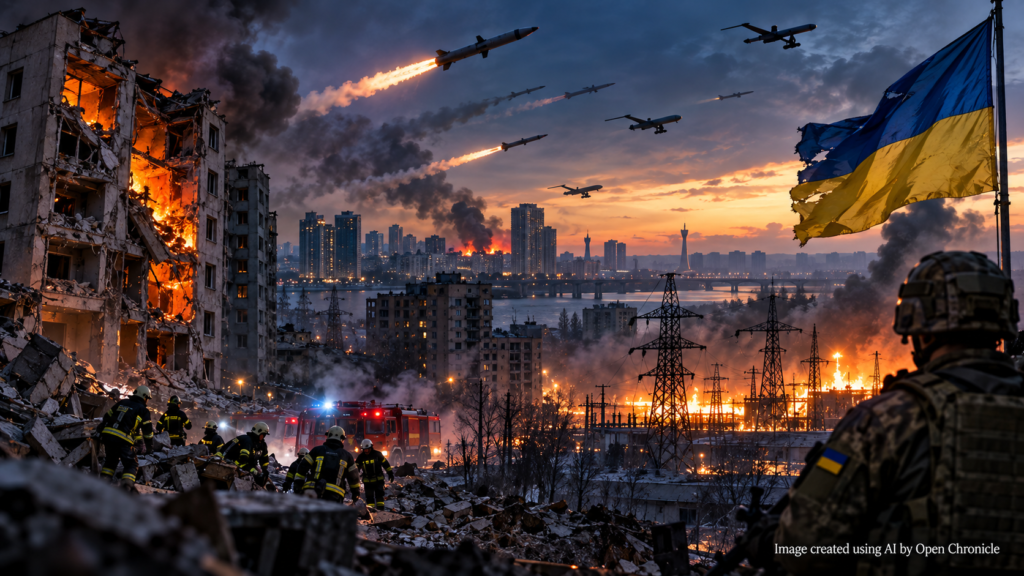
A major Russian missile and drone assault has struck Kyiv and other Ukrainian regions, killing civilians, damaging power stations and leaving hundreds of thousands without electricity. The attacks have intensified tensions over a proposed US-brokered energy ceasefire, while Ukrainian forces report unexpected restrictions affecting satellite communications used in military operations.
By Open Chronicle with agencies
KYIV, Ukraine — October 14, 2026
Russia launched a large-scale missile and drone attack against Ukraine overnight on October 13–14, striking residential areas and critical energy infrastructure in Kyiv and other regions, according to Ukrainian officials.
President Volodymyr Zelenskyy said Russian forces deployed 39 ballistic missiles and more than 120 attack drones and loitering munitions, targeting electricity generation and distribution facilities as well as civilian infrastructure.
The attacks reportedly left at least 600,000 people without electricity, damaged dozens of energy facilities and caused significant casualties in the Ukrainian capital.
Ukrainian authorities reported at least three deaths and more than 20 injuries during the initial assessments, with subsequent reports indicating additional casualties.
The strikes came just days after US President Donald Trump announced what he described as an agreement between Russia and Ukraine to suspend attacks against each other’s energy infrastructure.
Kyiv accused Moscow of deliberately violating the proposed arrangement.
The overnight assault has also intensified questions about American intelligence-sharing arrangements, after Ukrainian officials reported receiving no advance warning of Russian ballistic missile launches.
Separately, Ukrainian military personnel reported unexpected restrictions affecting SpaceX’s Starlink and StarShield satellite communications services, disrupting several military operations.
The combination of Russian attacks, uncertainty surrounding US military assistance and communications disruptions has created a particularly difficult moment for Ukraine as it prepares for another winter of war.
Kyiv’s Energy Infrastructure Comes Under Heavy Attack
Ukrainian officials described the overnight operation as a coordinated assault against the country’s energy system.
According to Zelenskyy, Russian forces targeted power generation facilities, electricity distribution infrastructure and other strategically important installations.
Prime Minister Serhii Koretskyi said all three of Kyiv’s combined heat and power plants had been attacked.
These facilities play an important role in supplying electricity and heating to the capital.
Additional strikes reportedly targeted infrastructure in Kyiv Oblast that supports electricity distribution to the capital and central Ukraine.
Kharkiv and surrounding areas were also among the reported targets.
Zelenskyy said the attacks damaged 26 power facilities and four oil and gas installations.
The full extent of the damage had not been established at the time of the initial reports.
Emergency crews were working to assess affected sites, restore electricity and address damage to essential services.
The reported disruption to electricity supplies affected approximately 600,000 people, according to the Ukrainian president.
The scale of the attack illustrates the continuing vulnerability of Ukraine’s energy network to ballistic missiles and long-range drones.
Residential Building Hit as Civilians Take Shelter
The assault began late on October 13, when explosions were reported across Kyiv.
Mayor Vitalii Klitschko said a Russian missile struck a nine-storey residential building in the Desnyanskyi district, causing a major fire.
The Kyiv City Prosecutor’s Office reported that three women had been killed and 24 people injured, including a seven-year-old girl.
Sixteen injured people were hospitalised, with four reported to be in serious condition.
Subsequent attacks affected additional districts of the capital.
Klitschko reported that another person had been hospitalised in Darnytskyi and that a fatality had been recorded in Holosiivskyi.
These figures were released during an evolving emergency response, and authorities had not yet provided a fully reconciled casualty total.
Ukraine’s State Emergency Service reported damage to several other buildings, including a private house, a non-residential property and an unoccupied structure.
Residents described the attacks as sudden and frightening.
A Kyiv resident identified as Maksym told the Kyiv Independent that he and his partner initially sheltered in their building’s corridor before moving to a designated shelter after a nearby explosion shattered windows.
“Everything was very fast. We didn’t even understand anything,” he said.
The testimony reflects the difficulty civilians face when ballistic missiles approach with limited warning.
More Than a Dozen Explosions Reported Before Dawn
The overnight attack continued into the early hours of October 14.
Journalists in Kyiv reported hearing more than a dozen explosions between approximately 4:45 a.m. and 6:45 a.m. local time.
Power interruptions and flickering lights were observed in parts of the capital.
The Kyiv City State Administration said a water pumping station had lost electricity, reducing water pressure in the Pechersk district.
The disruption demonstrated how attacks on electrical infrastructure can affect other essential services.
Water distribution, public transport, telecommunications and heating systems all depend on reliable power supplies.
Air raid alerts were also issued in western Ukrainian regions, including Lviv, Volyn and Ivano-Frankivsk, highlighting the geographical reach of the Russian missile threat.
Ukraine’s Air Force reported intercepting four ballistic missiles and 115 drones during the overnight operation.
Those figures indicate substantial defensive activity but also underline the challenge posed by coordinated attacks involving different types of weapons.
Zelenskyy Accuses Russia of Disregarding Trump’s Energy Ceasefire
The timing of the strikes has become a central issue in the diplomatic confrontation surrounding the war.
On October 11, Trump announced that Russia and Ukraine had agreed to stop attacking each other’s energy infrastructure.
However, the precise terms, verification arrangements and implementation procedures of the proposed ceasefire have not been fully established in the supplied reporting.
Zelenskyy said Ukraine had refrained from striking Russian oil refineries following the announcement.
He accused Moscow of continuing its attacks against Ukrainian energy facilities.
The Ukrainian president described the latest assault as a deliberate challenge to Washington.
“This was a targeted Russian ballistic strike specifically against the energy sector,” Zelenskyy said, referring to the infrastructure covered by the proposed ceasefire.
He characterised the attack as a demonstration of disrespect toward the United States.
For Kyiv, the issue is not only the destruction of infrastructure but also the credibility of American efforts to secure limited agreements with Moscow.
A ceasefire restricted to energy facilities would potentially reduce civilian hardship and damage to economically important infrastructure.
However, its effectiveness would depend on both sides accepting clearly defined obligations and on mechanisms capable of identifying and addressing violations.
The latest attacks have raised serious doubts about whether such an arrangement can operate under current conditions.
Ukraine Questions the Absence of Advance Missile Warnings
A separate controversy has emerged over Ukraine’s access to advance intelligence concerning Russian missile launches.
Ukrainian officials said the country had received no advance warning from international partners before ballistic missile attacks on two consecutive nights.
Presidential adviser Dmytro Lytvyn told reporters that Ukraine’s partners had not provided alerts concerning the launches.
The Ukrainian Air Force also confirmed that it had not received information about missile launches from Russian territory on October 12 or 13.
Zelenskyy said Ukrainian detection systems identified the incoming weapons only shortly before they approached Kyiv.
The absence of advance warning is particularly important because ballistic missiles can reach their targets within minutes.
Early detection can help Ukrainian air defence units prepare interception attempts and provide additional time for civilians to seek shelter.
However, the failure to receive a warning does not by itself establish that Washington deliberately suspended intelligence cooperation.
It may also reflect technical, operational or information-sharing limitations.
Ukraine’s foreign minister, Andrii Sybiha, said cooperation with the United States was continuing.
Speaking in Warsaw, he attributed the lack of warning to a particular type of Russian weaponry.
The explanation leaves unresolved questions about the specific circumstances surrounding the latest launches.
Trump Denies Intelligence Sharing Has Been Suspended
Trump has rejected suggestions that Washington stopped providing intelligence to Ukraine.
“We are helping them, and we are sharing intel,” he told reporters.
The president said his administration remained engaged with both Ukraine and Russia in efforts to bring the war to an end.
His comments followed reports that American officials had threatened to suspend intelligence sharing and military assistance unless Kyiv stopped attacking Russian oil refineries.
A Ukrainian official cited by the Kyiv Independent alleged that senior military personnel had received warnings concerning possible restrictions.
The official also referred to the potential suspension of the Prioritised Ukraine Requirements List, or PURL, a mechanism through which European partners finance purchases of American military equipment for Ukraine.
These allegations have not been independently established in the supplied material.
Ukrainian and American sources cited in the reporting indicated that intelligence cooperation had not yet been formally suspended.
Nevertheless, the controversy has highlighted Ukraine’s dependence on Western assistance in several critical areas.
Why American Intelligence Matters to Ukraine
Intelligence cooperation between Ukraine and its partners covers several different military requirements.
These include identifying potential targets, monitoring Russian military movements and detecting preparations for missile and aircraft attacks.
Ukrainian commanders have argued that American intelligence is not essential for locating fixed infrastructure such as oil refineries, which can be identified using commercially available geographical information.
However, advance warnings of ballistic missile launches and long-range bomber operations are a different matter.
Such information can provide Ukrainian forces with valuable time to activate defensive systems and protect personnel and infrastructure.
The distinction has become increasingly important as Russia intensifies attacks involving ballistic missiles and advanced drones.
For Ukraine, continued access to timely intelligence is closely connected to the effectiveness of its air defence network.
Any sustained reduction in warning capabilities could increase the risks faced by both military personnel and civilians.
Russian Diesel Agreement Adds to Diplomatic Tensions
The dispute over energy infrastructure has unfolded alongside a controversial agreement involving Russian diesel exports.
According to the supplied reporting, Trump announced an arrangement with Russian President Vladimir Putin concerning Russian diesel entering international markets.
The move reportedly involved easing previous American restrictions.
Trump defended the agreement by arguing that the diesel was intended for global markets rather than direct importation into the United States.
He also rejected suggestions that the arrangement necessarily undermined his administration’s broader diplomatic objectives.
The issue has attracted criticism because energy exports remain an important source of revenue for Russia.
Critics argue that relaxing restrictions on Russian petroleum products could provide Moscow with additional economic resources while it continues military operations against Ukraine.
The actual financial implications depend on the agreement’s terms, the volume of permitted trade and the sanctions measures involved.
Those details were not fully established in the supplied reporting.
The controversy illustrates the difficulty of balancing energy market considerations, sanctions policy and diplomatic pressure during an ongoing war.
Ukraine Calls for More Patriot Missiles and Stronger Sanctions
Zelenskyy has urged Washington to respond to the latest Russian attacks with stronger measures.
His requests include additional Patriot air defence interceptors and expanded economic pressure on Moscow.
Patriot systems are among the most important weapons available to Ukraine for intercepting certain types of ballistic missiles.
However, the effectiveness of these systems depends on the availability of interceptors, radar coverage and the number of incoming threats.
Large-scale attacks involving dozens of missiles and drones can place significant pressure on defensive resources.
Zelenskyy has repeatedly warned that Ukraine requires a sustained supply of advanced air defence ammunition.
He also called for additional sanctions against Russia.
The Ukrainian president referred to proposed American legislation associated with Senator Lindsey Graham, arguing that Washington possessed the necessary tools to increase pressure on Moscow.
Ukraine’s appeal reflects a broader concern that diplomatic statements alone may be insufficient to prevent further attacks.
For Kyiv, the credibility of international security commitments increasingly depends on practical military assistance and economic measures.
Starlink Restrictions Disrupt Ukrainian Military Operations
Alongside the missile attacks, Ukrainian forces reported a separate problem affecting satellite communications.
According to presidential adviser Serhii Beskrestnov, known by the call sign “Flash”, SpaceX introduced restrictions affecting the use of StarShield terminals while moving at high speed.
StarShield is a military-oriented service associated with SpaceX’s satellite communications technology.
Beskrestnov said the restrictions appeared to limit connectivity when terminals travelled faster than approximately 160 kilometres per hour, equivalent to 100 miles per hour.
He stated that Ukrainian forces had not received advance notice of the change.
According to his account, the unexpected restrictions disrupted several military missions.
Ukrainian activist and volunteer Serhii Sternenko also reported the connectivity limitations.
The claims have attracted attention because Ukrainian military operations increasingly rely on satellite communications for coordination and the operation of certain unmanned systems.
The precise technical scope of the restrictions, the number of affected units and the duration of the disruption have not been independently established.
Allegations of Political Pressure Remain Unproven
The reported StarShield restrictions have prompted speculation about possible political motives.
Beskrestnov suggested that the changes might be connected to the current diplomatic environment.
Sternenko went further, suggesting that SpaceX may have acted at the request of the Trump administration.
However, neither account provided evidence establishing that Washington ordered the restrictions.
The White House had not commented on the allegations in the supplied reporting.
No independent evidence has established a direct connection between the technical changes and American pressure on Ukraine over attacks against Russian energy facilities.
The distinction is important because communications restrictions may result from technical, operational, security or commercial decisions.
Without additional information from SpaceX or the relevant authorities, their underlying purpose cannot be determined.
The incident nevertheless demonstrates the risks associated with military dependence on privately operated communications infrastructure.
The Strategic Importance of Satellite Communications
Satellite connectivity has become an important component of Ukraine’s military operations.
Systems such as Starlink can support communications in areas where terrestrial networks have been damaged or disrupted.
They can also provide connectivity for mobile units and certain unmanned platforms.
For Ukrainian forces, the reliability of these systems can directly affect operational planning.
Restrictions on terminals operating at particular speeds may have consequences for equipment mounted on fast-moving vehicles or unmanned systems.
However, the operational effects depend on the type of terminal, its configuration and the mission involved.
The supplied reporting does not establish that all Ukrainian Starlink services were affected.
It specifically describes restrictions associated with high-speed use of StarShield terminals.
The incident highlights a broader challenge facing modern armed forces: commercially developed technology can become essential to military operations without being entirely controlled by the governments or forces that depend on it.
Russia Intensifies Pressure Ahead of Winter
The latest strikes form part of Russia’s continuing campaign against Ukrainian energy infrastructure.
Electricity generation, transmission systems and heating facilities are especially important during the colder months.
Damage to these installations can create serious humanitarian consequences.
Prolonged outages may affect hospitals, water distribution, transport and residential heating.
Repair work is also complicated by the possibility of repeated attacks on the same facilities.
Ukraine has sought international assistance to obtain replacement equipment, strengthen infrastructure protection and expand its air defence capabilities.
The latest assault demonstrates that the country’s energy system remains exposed despite years of emergency repairs and adaptation.
The reported damage to Kyiv’s combined heat and power plants is particularly concerning because such facilities provide both electricity and heating.
Their restoration may require specialised equipment and extensive technical work.
Kharkiv Also Suffers Deadly Attacks
The violence has not been confined to Kyiv.
Ukrainian officials reported another Russian attack on Kharkiv earlier in the week.
According to Zelenskyy, a residential building was destroyed, killing four people and injuring 41 others.
Emergency personnel reportedly searched the wreckage throughout the night for people trapped beneath the debris.
Kharkiv, located near the Russian border, has experienced repeated missile, drone and aerial bomb attacks during the war.
Its proximity to Russian territory can significantly reduce the warning time available to residents.
The continued attacks on residential areas have reinforced Ukrainian demands for stronger air defence protection.
They have also increased pressure on local emergency services, hospitals and municipal authorities.
The Big Picture: Ukraine Faces a Converging Military and Diplomatic Crisis
The October 13–14 attacks have exposed several vulnerabilities facing Ukraine.
Russia continues to demonstrate its ability to launch large-scale attacks against energy infrastructure and civilian areas.
Ukraine’s air defence network remains heavily dependent on advanced Western weapons and a reliable supply of interceptors.
At the same time, questions surrounding intelligence sharing have raised concerns about the consistency of American support.
The reported StarShield restrictions add another layer of uncertainty by highlighting the importance of privately operated communications systems to modern warfare.
These developments are unfolding against a difficult diplomatic backdrop.
Trump has sought to reduce attacks on energy infrastructure while also pursuing arrangements involving Russian petroleum exports.
Kyiv argues that Moscow’s continued strikes undermine the credibility of the proposed ceasefire and demonstrate the need for stronger pressure.
The coming days will be important in determining whether Washington responds with additional sanctions, military assistance or renewed diplomatic efforts.
For Ukraine, the immediate priority remains protecting civilians, restoring electricity and strengthening air defences.
For the wider international community, the latest escalation raises a fundamental question about the effectiveness of limited ceasefire arrangements when the parties disagree over implementation and enforcement.
As winter approaches, the consequences of attacks on Ukraine’s energy network could become increasingly severe.
The country’s ability to withstand those attacks will depend not only on its own resilience but also on the reliability of international military, technological and diplomatic support.
Open Chronicle | Editorial Transparency
Editorial Note
The article draws on Ukrainian official statements and reporting published on October 14, 2026. Casualty figures and infrastructure damage assessments remain subject to revision.
President Trump’s announcement of an energy ceasefire has not been independently established as a fully implemented, mutually verified agreement. Ukrainian allegations concerning Russian violations are attributed accordingly.
The reported StarShield restrictions are supported by Ukrainian military accounts and independent news reporting. However, allegations that the Trump administration directed SpaceX to impose the restrictions remain unsubstantiated. The absence of advance missile warnings does not, by itself, establish a suspension of US intelligence sharing.
Open Chronicle
Independent. Global. Trusted.