
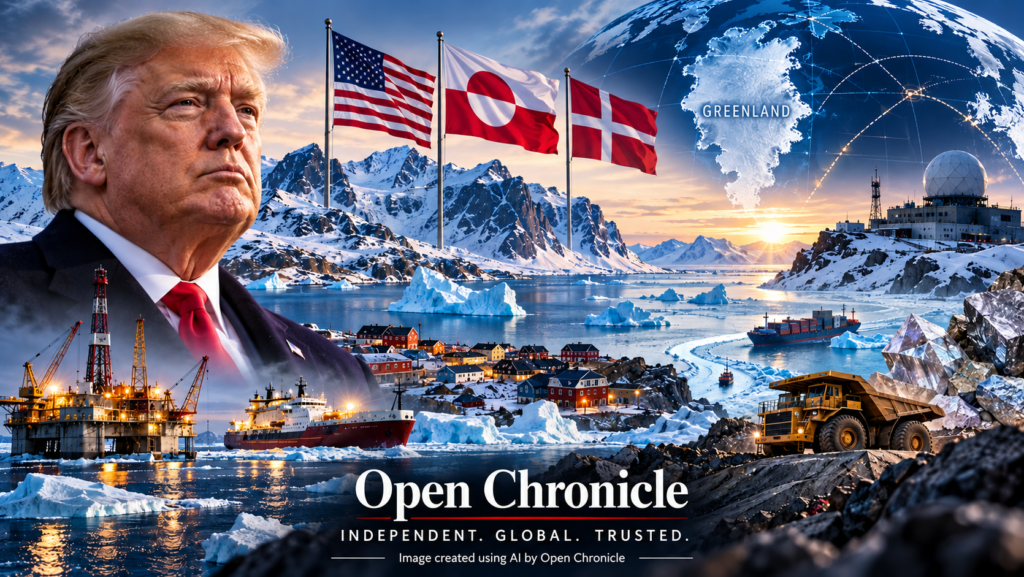
US President Donald Trump says large-scale exploration of Greenland’s natural resources is preparing to begin, linking the Arctic island’s economic potential to American national security and his proposed Golden Dome missile defence system. The announcement follows a security agreement with Denmark and Greenland that expands US military cooperation while reaffirming Danish sovereignty and Greenlandic self-determination.
By Open Chronicle with agencies
WASHINGTON / NUUK — October 14, 2026
US President Donald Trump announced on Wednesday that extensive oil, natural gas and mineral exploration was preparing to begin in Greenland, describing the Arctic island as a strategic asset for the United States and Europe.
The announcement comes weeks after Washington reached a security agreement with Denmark and Greenland, following months of tensions caused by Trump’s repeated threats to take control of the Danish autonomous territory.
In a statement published on his Truth Social platform, Trump said that major resource exploration activities were approaching their initial stages.
“Massive Oil, Gas, and Mineral Exploration is getting ready to begin in our new and beautiful Greenland!” the president declared.
He also claimed that Greenland possessed exceptionally large quantities of accessible petroleum resources, suggesting that its oil potential could exceed that of many other regions.
However, Trump provided no technical assessments, investment figures, operational timetable or details concerning the companies expected to participate.
The announcement immediately renewed attention on Greenland’s natural resources, its strategic geographical position and the growing competition for influence in the Arctic.
Greenland at the Centre of America’s Arctic Strategy
Greenland occupies a critical position in the North Atlantic and Arctic regions, between North America and Europe.
Its location has long made it important to American defence planning, particularly for monitoring potential missile threats approaching the United States from northern trajectories.
During the Cold War, Greenland became a significant component of the American early-warning network.
That strategic importance has increased as Washington considers new generations of missile defence technology and as Russia and China expand their Arctic interests.
Trump described Greenland’s geographical position as essential to the security of both the United States and Europe.
According to the president, the island is “second to none” in its importance to American and European defence.
He argued that Greenland would play a decisive role in detecting and intercepting potential threats, including missiles, drones and future weapons systems.
The statements reinforce the administration’s view that Greenland should occupy a central position in Washington’s long-term security strategy.
They also illustrate how the president continues to connect military considerations with economic and territorial ambitions.
The US-Denmark-Greenland Security Agreement
The announcement follows a trilateral security agreement reached in September between the United States, Denmark and Greenland.
The agreement emerged after a period of diplomatic confrontation during which Trump repeatedly suggested that Washington should acquire control of Greenland.
His earlier statements, including threats involving the possible use of force, generated strong opposition in Denmark and Greenland and raised concerns among European governments.
The September agreement was presented as a framework for expanded American defence cooperation without transferring sovereignty over the island.
Under its reported provisions, the United States would be permitted to expand its military presence, including the development of two additional military bases.
The arrangement also establishes a framework for integrating Greenland into the proposed Golden Dome missile defence system.
Importantly, the agreement reaffirms Danish sovereignty and recognises the Greenlandic population’s right to self-determination.
The distinction is significant.
Greenland remains an autonomous territory within the Kingdom of Denmark, with its own government and parliament.
The new agreement does not constitute a transfer of ownership or sovereignty to the United States.
Although Trump referred to Greenland as “our new and beautiful Greenland”, that language does not reflect a change in the island’s legal or constitutional status.
The agreement is also not yet fully implemented.
According to the supplied reporting, it remains subject to a second reading and parliamentary vote in Greenland.
Lawmakers are expected to approve the legislation, but the final decision has not yet been completed.
Golden Dome: A New Dimension of Arctic Defence
A central element of Washington’s interest in Greenland is the proposed Golden Dome missile defence system.
The initiative is intended to strengthen American capabilities to detect, track and intercept potential missile threats.
Greenland’s position along northern approaches to North America makes it particularly relevant to early-warning and surveillance operations.
The island already hosts the US-operated Pituffik Space Base, formerly known as Thule Air Base.
The installation has historically supported missile warning, space surveillance and other defence activities.
Additional facilities could strengthen the integration of Arctic monitoring infrastructure into a wider missile defence network.
Trump suggested that Greenland could provide a crucial defensive position against future attacks on the United States.
He said potential threats could be intercepted over the Arctic before reaching American territory.
However, the operational effectiveness of such a system would depend on technology, deployment decisions, funding and the nature of the weapons involved.
Greenland’s strategic location offers important advantages, but it does not mean that every potential attack against the United States would necessarily pass over the island.
Missile trajectories vary according to launch location, weapon type and intended target.
The administration’s statements therefore reflect its strategic objectives rather than a complete description of the technical realities of missile defence.
Oil, Gas and Rare Earth Minerals: Greenland’s Economic Potential
Beyond security, Greenland possesses significant geological resources that have attracted international attention.
The island is known to contain mineral deposits that may include rare earth elements and other materials important to advanced manufacturing, renewable energy technologies and defence industries.
Rare earth elements are used in products ranging from electric vehicles and wind turbines to communications equipment and military systems.
Their strategic importance has increased as governments seek to diversify supply chains and reduce dependence on concentrated international production networks.
Greenland has consequently become a potential destination for mineral exploration and investment.
However, the existence of geological resources does not automatically mean that they can be extracted commercially.
Mining projects require detailed assessments of deposit size, quality, accessibility, infrastructure requirements and environmental impact.
Greenland’s remote terrain, severe weather conditions and limited transport infrastructure can make development particularly expensive.
Oil and gas exploration presents additional challenges.
Much of Greenland’s territory is covered by an extensive ice sheet, while offshore operations face demanding Arctic conditions.
Previous exploration activities have not established that Greenland possesses commercially recoverable petroleum reserves on the scale suggested by Trump’s announcement.
The president’s claim about exceptionally large quantities of easily accessible oil should therefore be understood as a political assertion rather than a verified geological assessment.
A Controversial Return to Petroleum Exploration
Greenland’s potential petroleum resources have been the subject of debate for decades.
The island’s authorities have previously examined opportunities for offshore oil and gas exploration.
However, environmental concerns, economic uncertainty and climate policy have complicated the development of the sector.
In 2021, Greenland’s government announced that it would stop issuing new licences for oil and gas exploration.
That decision reflected concerns about the environmental consequences of fossil fuel development and the economic viability of new projects.
Any major expansion of petroleum exploration would therefore raise questions about the relationship between the new US security agreement and Greenland’s existing regulatory framework.
The supplied reporting does not establish whether Greenland’s government has changed its petroleum licensing policy.
Nor does it identify the legal arrangements through which American companies could begin new exploration activities.
These details will be central to determining whether Trump’s announcement leads to actual operations.
American Corporate Interest Raises Local Concerns
The prospect of expanded American resource exploration has already generated unease among some Greenlandic communities.
In August, media reports concerning preparatory activities by a US oil company in a remote part of eastern Greenland prompted concern among local residents and authorities.
The episode highlighted the sensitivity of foreign commercial activity in a territory where questions of political autonomy, environmental protection and economic development are closely connected.
For Greenland’s government, attracting investment must be balanced against the need to maintain control over natural resources and protect local interests.
The island’s population is relatively small, and major industrial projects can have significant consequences for communities, infrastructure and the environment.
New exploration proposals are therefore likely to face scrutiny concerning consultation, licensing, environmental assessments and economic benefits.
The extent of public support for the projects announced by Trump remains unclear.
The Arctic’s Growing Strategic Importance
Greenland’s significance extends beyond its individual mineral deposits or military installations.
The wider Arctic is undergoing substantial environmental and geopolitical change.
Rising temperatures and declining sea ice are altering access to some northern maritime routes.
These changes have encouraged governments and commercial operators to examine new opportunities for shipping, resource extraction and infrastructure development.
However, Arctic navigation remains difficult and subject to significant seasonal and operational risks.
Reduced ice coverage does not automatically create safe or commercially reliable transport routes.
At the same time, the region is becoming increasingly important to national defence strategies.
Russia maintains extensive military infrastructure across its Arctic territory.
China has also expressed interest in Arctic shipping, scientific research and economic opportunities.
The United States, Canada and European Arctic countries are consequently paying greater attention to regional surveillance, maritime security and infrastructure.
Greenland sits at the intersection of these developments.
Its geographical position gives it significance for transatlantic security, while its natural resources create potential economic opportunities.
The combination explains why the island has become an increasingly prominent subject in American strategic discussions.
Denmark and Greenland Face a Delicate Political Balance
The security agreement creates opportunities for expanded cooperation with Washington, but it also presents political challenges for Copenhagen and Nuuk.
Denmark remains responsible for important aspects of Greenland’s defence and foreign affairs, while Greenland exercises substantial autonomy over domestic matters.
The island’s political future has long been shaped by debates about independence and the extent of its relationship with Denmark.
Trump’s earlier statements about acquiring Greenland intensified those discussions and provoked opposition to any suggestion that the island could be transferred without the consent of its population.
The September agreement attempts to establish a framework in which American security interests can be addressed while preserving the existing constitutional relationship.
Its explicit recognition of Greenlandic self-determination is therefore an important element.
Nevertheless, expanded US military activity and potential large-scale resource development may generate further debate about the balance between security cooperation, economic opportunity and political autonomy.
The forthcoming parliamentary vote will provide an important indication of how Greenland’s elected representatives assess that balance.
Europe and the Transatlantic Security Dimension
Trump has presented Greenland’s strategic importance as extending beyond the defence of the United States.
He argues that the island is equally relevant to European security.
That assessment reflects Greenland’s geographical position between North America and Europe and its potential role in monitoring northern approaches to the Atlantic.
Denmark is a member of NATO, and Greenland’s defence has long been connected to the broader transatlantic security architecture.
Expanded American facilities could strengthen surveillance and early-warning capabilities relevant to allied defence planning.
However, the precise relationship between the proposed Golden Dome system and existing NATO arrangements has not been fully explained in the supplied announcement.
Questions remain about command structures, information sharing, infrastructure financing and the involvement of European partners.
Those issues may become increasingly important as the agreement moves toward implementation.
Economic Opportunities and Environmental Questions
The possibility of extensive resource exploration could attract international investment to Greenland.
Mineral extraction projects can generate employment, infrastructure development and public revenue.
They may also support efforts to diversify an economy in which fishing remains a major industry.
However, the potential benefits depend on whether commercially viable deposits can be identified and developed.
Large-scale projects would require substantial spending on transport, energy, communications and industrial facilities.
Environmental considerations are particularly important in Greenland because of the sensitivity of Arctic ecosystems.
Mining and petroleum operations can create risks involving waste management, habitat disruption, emissions and marine pollution.
The island’s changing climate adds another dimension to those challenges.
Infrastructure must be designed for demanding conditions, including permafrost changes, severe weather and limited emergency-response capacity in remote areas.
The economic and environmental consequences of the proposed exploration programme cannot be reliably assessed until specific projects, locations and regulatory arrangements are announced.
What Happens Next?
Several developments will determine whether Trump’s announcement produces substantial changes on the ground.
The first is the completion of Greenland’s parliamentary approval process for the September security agreement.
The second is clarification of the military infrastructure projects associated with the agreement.
The proposed additional bases and their relationship to Golden Dome will require detailed planning and implementation.
The third is the announcement of concrete resource exploration proposals.
At present, the administration has not identified the companies involved, the precise areas targeted, the expected investment or the timetable for operations.
It also remains unclear how new petroleum exploration would be reconciled with Greenland’s existing policy restrictions.
Until those questions are answered, the announcement should be regarded as a statement of political and strategic intent rather than confirmation that large-scale extraction is imminent.
The Big Picture: Greenland Becomes a Test of Arctic Power and Sovereignty
Trump’s announcement illustrates the growing importance of Greenland in the competition for Arctic security, natural resources and geopolitical influence.
The island combines a strategically significant location with geological potential and an increasingly important role in northern defence planning.
For Washington, Greenland offers opportunities to strengthen surveillance, expand military infrastructure and investigate new sources of critical minerals.
For Denmark, the challenge is to maintain a stable security partnership with the United States while protecting the sovereignty of the Kingdom.
For Greenland, the central issue is whether international interest can translate into sustainable economic development without compromising political autonomy or environmental priorities.
The September security agreement provides a framework for cooperation, but its implementation remains incomplete.
Likewise, Trump’s promise of massive oil, gas and mineral exploration has not yet been accompanied by the technical and commercial details necessary to establish its feasibility.
The coming months will reveal whether the announcement marks the beginning of a significant new phase in Greenland’s development or remains primarily an expression of Washington’s expanding Arctic ambitions.
What is already clear is that Greenland has moved closer to the centre of American strategic thinking.
Its future will be shaped not only by decisions in Washington and Copenhagen, but also by the political choices of Greenland’s own institutions and people.
Open Chronicle | Politics & Geopolitics
Sources and Further Reading
Official government institutions, scientific authorities and Arctic policy organisations providing context on Greenland’s sovereignty, natural resources, security cooperation and strategic importance.
Source 01 · Greenland Government
Government of Greenland — Naalakkersuisut
Official information concerning Greenland’s government, natural resources, political autonomy and development policies.
Source 02 · Danish Government
Government of Denmark
Official information concerning Danish foreign policy, defence and the Kingdom of Denmark.
Source 03 · Defence & Security
United States Department of Defense
Official information concerning American defence policy, Arctic security and military installations.
Source 04 · Geological Research
United States Geological Survey
Scientific information concerning mineral resources, geological assessments and resource potential.
Source 05 · Arctic Cooperation
Arctic Council
Information concerning Arctic cooperation, environmental issues, sustainable development and regional research.
Editorial Transparency
Editorial Note
This article is based primarily on the supplied agency’s report concerning President Donald Trump’s statements on October 14, 2026, and the September security agreement involving the United States, Denmark and Greenland.
The president’s assertions about Greenland’s oil resources, the expected scale of exploration and the defensive capabilities of the proposed Golden Dome system are presented as political claims rather than independently verified technical conclusions.
The supplied reporting does not identify specific exploration licences, participating companies, investment amounts, confirmed petroleum reserves or operational schedules.
The security agreement is described as awaiting further parliamentary consideration in Greenland. It does not transfer Danish sovereignty or override Greenland’s right to self-determination.
Historical, environmental and strategic context has been included to explain the significance of the announcement and should not be interpreted as confirmation of future commercial or military outcomes.
Open Chronicle
Independent. Global. Trusted.