
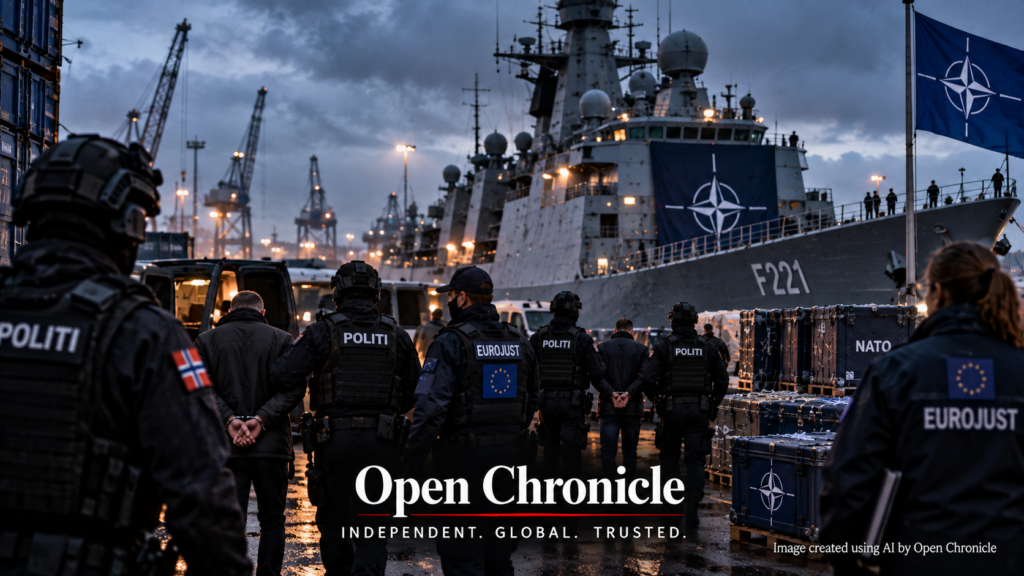
Norwegian authorities have arrested five suspects in a multinational investigation into alleged fraudulent invoices submitted for services provided to NATO military vessels. Coordinated searches in Norway, Romania and Germany form part of an inquiry into suspected procurement fraud and possible bribery of foreign public officials.
By Open Chronicle with agencies
THE HAGUE / OSLO — October 14, 2026
Five people have been arrested in Norway as part of a cross-border investigation into suspected fraud involving more than €1 million ($1.1 million) in services supplied to NATO military vessels, according to the European Union Agency for Criminal Justice Cooperation, Eurojust.
The investigation, involving authorities in Norway, Romania and Germany, centres on allegations that a company and its subcontractors submitted fraudulent invoices to the NATO Support and Procurement Agency (NSPA) for services provided to military vessels visiting ports in northwestern Europe.
Investigators are also examining allegations that foreign public officials were bribed through an intermediary in exchange for favourable treatment in contractual dealings with the NATO procurement agency.
The coordinated operation included arrests in Norway and searches of residential and commercial properties in all three countries.
Eurojust said the estimated financial losses to NATO member countries exceed €1 million, although the exact amount remains under investigation.
The agency declined to provide further details because the criminal proceedings remain ongoing.
Alleged Fraud Involving NATO Naval Support Services
At the centre of the investigation are contracts for so-called husbandry services, a specialised category of logistical and administrative support provided to vessels during port visits.
For military ships operating far from their home bases, these services can be essential to maintaining operational readiness.
They may include port arrangements, local transportation, accommodation coordination, supply deliveries, waste management and other logistical requirements.
Such services are frequently arranged through local contractors and subcontractors, creating commercial relationships that can extend across several jurisdictions.
According to Eurojust, investigators suspect that a company and its subcontractors submitted fraudulent invoices for services associated with NATO vessels visiting ports in northwestern Europe.
The agency has not publicly identified the company, the subcontractors or the specific vessels involved in the information supplied for this report.
It has also not disclosed whether the suspected irregularities involved inflated prices, services that were not delivered, duplicate billing or another form of invoice manipulation.
Those details remain matters for the ongoing investigation.
The case nevertheless illustrates the financial oversight challenges associated with complex international defence procurement arrangements.
NATO Procurement Agency Identified Suspected Irregularities
The investigation originated after the NATO Support and Procurement Agency identified suspected irregularities in invoices submitted for maritime support services.
The NSPA is responsible for providing multinational logistics, procurement and support services to NATO allies and partner nations.
Its activities include facilitating the acquisition of equipment, supplies and services required by participating governments and military organisations.
In this case, the agency’s examination of the relevant invoices raised concerns about possible financial misconduct.
Eurojust began supporting the investigation in April 2025.
The involvement of the European judicial cooperation agency enabled authorities to coordinate inquiries involving different national legal systems.
The NSPA also provided information and assistance to the investigators.
Its cooperation was particularly important because the suspected fraudulent transactions concerned contracts administered through the NATO procurement framework.
The precise internal procedures through which the irregularities were initially detected have not been disclosed.
However, the case demonstrates the role that procurement monitoring and financial controls can play in identifying potential misconduct involving public defence expenditure.
Investigators Examine Alleged Bribery of Foreign Officials
The investigation extends beyond suspected invoice fraud.
Authorities are also examining allegations that the company involved used an intermediary to bribe foreign public officials.
According to Eurojust, the suspected payments were allegedly intended to secure favourable treatment in contractual dealings with the NSPA.
The identities and nationalities of the officials concerned have not been disclosed.
Investigators have also not specified the amount of the alleged payments or the precise contractual decisions that may have been influenced.
The involvement of an intermediary is a significant element of the allegations.
In corruption investigations, intermediaries may be examined to determine whether they facilitated improper payments or concealed relationships between commercial entities and public officials.
However, the existence of an intermediary does not itself establish criminal conduct.
Investigators must determine whether unlawful payments occurred, who authorised them and whether they were connected to particular official decisions.
The allegations remain unproven, and the individuals under investigation are entitled to the presumption of innocence.
Five Arrested in Norway During Coordinated Operation
The multinational operation resulted in the arrest of five individuals in Norway.
Authorities also conducted searches at residential and business addresses as part of efforts to gather evidence.
Eurojust did not disclose the identities of those arrested or specify their roles within the suspected scheme.
It also did not indicate whether formal charges had been filed or whether the individuals would remain in custody.
The searches were conducted as part of a coordinated investigative operation involving several national authorities.
Such operations can be used to obtain financial records, contractual documents, electronic communications and other material relevant to allegations of procurement fraud and corruption.
The available information does not establish what evidence was recovered during the Norwegian searches.
Nor does it indicate whether additional arrests are expected.
Searches Conducted in Romania and Germany
The coordinated operation extended to Romania and Germany, reflecting the cross-border nature of the suspected offences.
In Romania, investigators searched company premises and several residential properties.
In Germany, authorities searched two business locations and one residence.
The German searches were conducted under a European Investigation Order, a legal mechanism designed to facilitate the gathering and transfer of evidence between participating European countries.
Eurojust did not provide details about the businesses or individuals connected to the searched properties.
It also did not specify whether the searches in Romania and Germany targeted suspected participants, witnesses or locations believed to contain relevant evidence.
The operation illustrates the practical challenges faced by investigators when suspected financial misconduct involves companies, contractors and transactions operating across national borders.
Relevant documents and financial information may be distributed among several countries, requiring judicial cooperation to obtain evidence lawfully and efficiently.
Eurojust Has Supported the Investigation Since April 2025
Eurojust became involved in the case in April 2025 after the NSPA identified the suspected billing irregularities.
The agency assists national judicial authorities in investigating and prosecuting serious cross-border crime.
Its role can include facilitating information exchanges, resolving jurisdictional issues and coordinating investigative measures.
In July 2025, Eurojust supported the establishment of a joint investigation team.
The arrangement allowed participating authorities to cooperate under a common legal framework and exchange relevant evidence directly.
Joint investigation teams are particularly useful in cases where alleged criminal activity spans several jurisdictions.
They can reduce procedural delays and improve coordination between investigators and prosecutors.
Eurojust also hosted meetings to prepare the coordinated operation that resulted in the five arrests.
The agency’s involvement demonstrates how European judicial cooperation mechanisms can support investigations affecting international organisations such as NATO.
Although Norway is not a member of the European Union, it participates in European judicial cooperation arrangements, making collaboration with EU member states possible in appropriate cases.
Understanding the NATO Support and Procurement Agency
The NATO Support and Procurement Agency is an important component of the alliance’s logistics and procurement structure.
It supports participating nations by coordinating the acquisition and delivery of goods and services needed for military operations and readiness.
These activities can include equipment procurement, maintenance support, logistics arrangements and other operational requirements.
By consolidating certain services, multinational procurement arrangements can provide efficiencies and reduce duplication among participating countries.
However, complex contracting structures can also create oversight challenges.
Contracts may involve multiple companies, subcontractors, local service providers and public institutions.
Ensuring that invoices accurately reflect delivered services is therefore an important element of financial accountability.
The present investigation concerns alleged misconduct within a specific contractual context.
It does not establish wrongdoing by the NSPA itself.
According to the supplied information, the agency identified the suspected irregularities and cooperated with the authorities investigating them.
That distinction is important when assessing the institutional implications of the case.
Why Maritime Support Contracts Require Oversight
Military vessels depend on reliable support services when operating in foreign ports.
Port visits can involve logistical requirements that must be arranged rapidly and in coordination with local authorities.
The services may vary according to the vessel, the port and the operational circumstances.
Unlike large equipment procurement contracts, some maritime support arrangements involve numerous smaller transactions.
These can include services provided by different contractors during individual port visits.
Such arrangements require clear documentation and effective verification to ensure that charges correspond to authorised services.
When several subcontractors are involved, identifying responsibility for particular transactions can become more complicated.
The suspected fraud involving NATO vessels highlights the importance of transparent procurement procedures and effective auditing.
It also demonstrates why financial irregularities in defence contracts can become matters of international criminal investigation.
Estimated Losses Exceed €1 Million
Eurojust said the suspected financial losses to NATO member countries exceed €1 million.
The figure represents an initial estimate rather than a final calculation.
Investigators are continuing to determine the amount of money potentially affected by the alleged scheme.
The final financial assessment may depend on the examination of invoices, contracts, payment records and supporting documentation.
Authorities will also need to distinguish between legitimate contractual payments and transactions suspected of being fraudulent.
The investigation has not established how the alleged losses were distributed among participating NATO countries.
Nor has Eurojust identified the total value of the contracts under examination.
Those details may become clearer as the investigation progresses.
Although the suspected losses are relatively limited compared with the overall scale of NATO defence expenditure, the case raises wider questions about procurement integrity and accountability.
Defence Procurement and the Risk of Cross-Border Corruption
International defence procurement involves significant public expenditure and complex relationships between governments and commercial suppliers.
These arrangements can create opportunities for legitimate cooperation and economic efficiency.
They also require safeguards against fraud, conflicts of interest and corruption.
Potential vulnerabilities may arise when contract administration involves multiple jurisdictions or when services are difficult to verify independently.
Allegations of bribery can be particularly serious because they raise questions about whether procurement decisions were influenced by improper financial incentives.
In the present case, investigators are examining both the accuracy of invoices and the possibility that foreign officials received unlawful benefits.
The combination of alleged billing fraud and bribery suggests that authorities are considering whether financial misconduct was accompanied by attempts to influence contractual decisions.
However, the supplied information does not establish that either allegation has been proven.
The investigation remains at a stage where evidence is being collected and assessed.
International Cooperation Becomes Central to the Case
The participation of Norway, Romania and Germany demonstrates the international dimensions of the inquiry.
Each country has its own criminal justice system, investigative procedures and legal requirements.
Cross-border investigations must therefore coordinate evidence collection while respecting national legal safeguards.
Eurojust’s involvement provides a framework for that cooperation.
The joint investigation team established in July 2025 enables participating authorities to share information and coordinate investigative activity more efficiently.
The European Investigation Order used for searches in Germany provides an additional mechanism for obtaining evidence across borders.
These arrangements are important in cases involving financial transactions and corporate structures that may extend beyond a single country.
The coordinated searches and arrests indicate that investigators have moved beyond preliminary assessments to active evidence-gathering measures.
However, they do not establish the guilt of any individual or company.
What Happens Next?
Eurojust has declined to comment further while the investigation continues.
The next stages may involve examining evidence collected during the searches, reviewing financial transactions and determining whether criminal charges are warranted.
Authorities may also seek additional information from companies, subcontractors or public institutions connected to the relevant contracts.
The exact timetable remains unknown.
It is also unclear whether the investigation will expand to additional jurisdictions or individuals.
Any eventual prosecution would depend on the evidence obtained and the decisions of the competent national judicial authorities.
The five individuals arrested in Norway remain presumed innocent unless proven guilty in accordance with the law.
The same principle applies to companies, officials and other individuals whose activities may be examined during the investigation.
The Big Picture: Procurement Integrity and NATO’s Financial Accountability
The investigation into alleged fraud involving NATO vessel support services highlights an important dimension of European security: the integrity of the systems that sustain military operations.
Defence readiness depends not only on ships, aircraft and weapons but also on the logistical networks that support them.
Those networks involve public funding, commercial contracts and cooperation between institutions across national borders.
When suspected financial misconduct emerges, it can raise questions about oversight, supplier accountability and the protection of public resources.
In this case, the NATO Support and Procurement Agency identified suspected irregularities and provided information to investigators.
Eurojust then facilitated cooperation between national authorities, leading to the establishment of a joint investigation team and a coordinated operation across three countries.
The arrests and searches represent significant investigative developments, but the allegations remain unproven.
The case will ultimately be judged by the evidence collected and the outcome of any judicial proceedings.
Its broader significance lies in the importance of maintaining confidence in multinational defence procurement.
As European countries increase defence spending and strengthen military cooperation, transparent contracting and effective financial oversight will remain essential to ensuring that public resources are used for their intended purposes.
Open Chronicle | Editorial Transparency
Editorial Note
This article is based on the supplied October 14, 2026, report concerning an investigation coordinated with the support of Eurojust into suspected fraud involving NATO maritime support services.
The arrests, searches, estimated financial losses and allegations of fraudulent invoicing and bribery are presented according to the supplied account. The specific October 2026 operation has not been independently verified against a Eurojust press release for this article.
The suspected financial losses exceed €1 million, but the final amount remains under investigation. The companies and individuals involved have not been identified in the supplied reporting.
Allegations of fraud and bribery are not findings of guilt. All suspects are presumed innocent unless and until proven guilty by a competent court.
Descriptions of NATO procurement arrangements, maritime husbandry services and European judicial cooperation mechanisms are provided as explanatory background. The institutional websites listed above do not, by themselves, independently confirm the reported arrests or allegations.
Open Chronicle
Independent. Global. Trusted.