
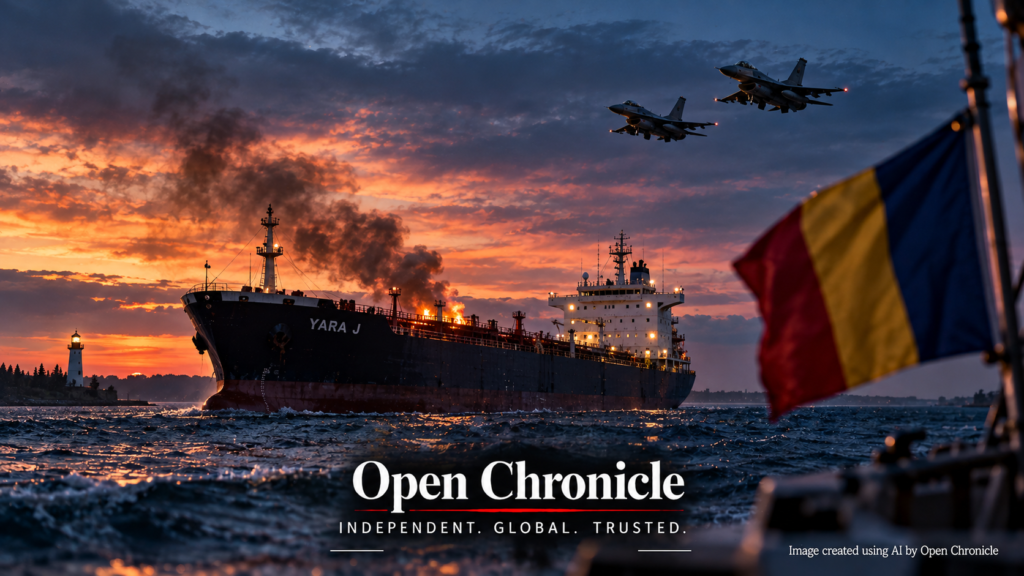
A Comoros-flagged tanker was reportedly struck by a drone near the Romanian port of Sulina on Wednesday evening, while Romanian and allied fighter jets responded to aerial threats over the Black Sea. The crew was reported safe, but the origin of the alleged strike remains unconfirmed.
By Open Chronicle with agencies
BUCHAREST / SULINA — October 15, 2026
A Comoros-flagged tanker was reportedly hit by a drone near Romania’s Black Sea coast on Wednesday evening, October 14, triggering an emergency maritime response as Romanian authorities monitored multiple aerial threats near the border with Ukraine.
The vessel, identified in Romanian media reports as YARA J, was approximately eight to ten nautical miles east or southeast of Sulina, near the Danube Delta, when an explosion was reported and a fire broke out on board.
The crew subsequently reported that the fire had been extinguished and that everyone aboard was safe.
Romanian maritime rescue authorities dispatched a vessel to the area after receiving a request for assistance, while the country’s Ministry of National Defense separately reported detecting aerial targets over the Black Sea and scrambling Romanian and Spanish fighter aircraft.
The incidents occurred against the background of Russian attacks on Ukrainian infrastructure near the Danube, a region where the proximity of Ukrainian and Romanian territory has repeatedly generated concerns about the possibility of drones crossing into NATO airspace.
However, the available information does not establish who launched the drone allegedly responsible for the tanker incident, whether the vessel was deliberately targeted or whether the reported maritime explosion was connected to the aerial activity detected by Romanian radar.
The incident has nevertheless generated political concern in the region, with a Bulgarian opposition politician describing it as an attack on NATO territory.
That characterisation has not been independently established.
Explosion Reported Near Sulina
According to Romanian media reports, the tanker was waiting for permission to enter the Sulina Channel when the incident occurred.
The vessel had reportedly anchored because of adverse weather conditions.
The Sulina Channel is an important maritime route connecting the Danube River with the Black Sea and providing access to river ports and commercial transport networks serving southeastern Europe.
The tanker was positioned near the Romanian coast when its captain reportedly notified the authorities following an explosion and a subsequent fire.
Initial accounts placed the incident at approximately 8 p.m. local time.
Romanian authorities said a maritime assistance request was received at approximately 8:25 p.m.
The circumstances of the explosion have not been independently established.
Although several reports described the event as a drone strike, the information supplied does not include forensic evidence identifying the weapon, its origin or the party responsible.
The incident was reported by Romanian media outlets including Adevărul, Evenimentul Zilei, Sibiu 100% and Ziua de Constanța.
Crew Reported Safe After Fire Extinguished
Romanian maritime and border authorities subsequently reported that the fire aboard the tanker had been extinguished.
Adrian Mihălcioiu, head of Romania’s Free Seafarers’ Union and a representative of the International Transport Workers’ Federation in Romania, told Adevărul that the reported incident had occurred in Romanian territorial waters.
He said the crew was out of danger, remained aboard and that the vessel’s engines appeared operational.
Early reports contained conflicting information about whether the crew had been evacuated.
Subsequent statements attributed to Romanian authorities indicated that those aboard were safe and that the crew had not requested further assistance after the fire was brought under control.
Reports also differed on the composition of the crew.
The Bulgarian broadcaster bTV reported that 17 people were aboard, while Romanian journalist Iulia Stanciu, cited in reporting by Digi24, described the crew as consisting of 17 Syrian sailors.
Other accounts referred to Syrian and Indian crew members.
The precise crew composition has not been independently confirmed.
No fatalities or injuries were reported in the information supplied.
Romanian Rescue Vessel Dispatched
Romania’s maritime rescue agency responded to the reported incident through the Maritime Rescue Coordination Centre.
The rescue vessel SAR Apollo was dispatched toward the tanker.
According to information attributed to the Romanian Border Police, the assistance request was received at approximately 8:25 p.m., and SAR Apollo departed at 8:31 p.m.
The response was intended to assess the situation and provide assistance if necessary.
Romanian authorities later reported that the fire had been extinguished and that the people aboard were safe.
At the time covered by the supplied reports, the rescue operation and assessment of the vessel’s condition were still developing.
The extent of any structural damage, the precise cause of the explosion and whether the tanker could continue its voyage had not been established.
Conflicting Reports About the Tanker’s Cargo
Early reporting also contained contradictory information about the vessel’s cargo and intended destination.
Some accounts suggested that YARA J was transporting petroleum products or coal destined for Ukraine.
An account identified as GeoInsider on X reported that the vessel was carrying coal bound for Ukraine.
However, Romania’s Coast Guard subsequently stated that the tanker was in ballast.
A vessel operating in ballast is not carrying commercial cargo and may instead use ballast water to maintain stability, trim and safe operating conditions.
The Coast Guard’s account therefore contradicted reports that the tanker was transporting a commercial shipment at the time of the incident.
The discrepancy is important because speculation about a cargo destined for Ukraine could influence interpretations of the vessel’s possible military or strategic significance.
No verified evidence in the supplied information establishes that the tanker was carrying goods intended for Ukraine.
Its exact voyage details and intended destination remain to be independently confirmed.
Romanian Radar Detects Aerial Threats
The maritime incident coincided with a series of aerial alerts reported by Romania’s Ministry of National Defense.
According to the ministry’s account, Romanian radar detected two aerial targets over the Black Sea on Wednesday evening.
The detections prompted the scrambling of two Romanian F-16 fighter jets.
The RO-ALERT public warning system was activated at approximately 8 p.m. to notify residents in northern Tulcea County of the possible entry of drones into Romanian airspace.
The alerts were associated with Russian attacks on Ukrainian territory near the Romanian border.
Romanian defence authorities reported that radar contact with one aerial target was lost over the sea.
The second target reportedly exited Romanian airspace at 8:13 p.m., heading toward the Ukrainian city of Vylkove.
The ministry also reported the subsequent entry of two additional aerial targets into Romanian airspace.
Two Spanish F-18 fighter jets operating from Mihail Kogălniceanu Air Base were scrambled in response.
The Spanish aircraft were deployed as part of allied air-security arrangements.
Romanian public radio also reported a drone entering Romanian airspace earlier that day.
According to the supplied account, the evening alert was the fourth drone warning issued in Romania on October 14.
The available information does not establish whether any of the aerial targets detected by Romanian radar was responsible for the explosion aboard YARA J.
Why the Sulina Area Is Strategically Sensitive
Sulina lies near the mouth of the Danube, close to the border between Romania and Ukraine.
The surrounding waterways form part of an important regional transport network linking the Black Sea to inland European markets.
Across the border, Ukrainian Danube ports have become strategically significant for trade and logistics during the war with Russia.
Russian strikes on Ukrainian port infrastructure have repeatedly created security concerns for Romania because of the short distances separating the two countries.
Drone activity near the border can present risks even when the intended targets are located entirely within Ukrainian territory.
Aircraft or drones may cross borders, lose navigation capability or fall into neighbouring areas.
Explosions and falling debris can also endanger civilian populations, shipping and infrastructure.
Romania has previously issued public warnings and deployed military aircraft in response to aerial threats near the Ukrainian border.
The latest reports underline the continuing difficulty of protecting civilian maritime traffic and national airspace in a region adjacent to an active conflict.
Bulgarian Politician Says Russia Struck NATO Territory
The reported tanker incident also prompted a political response in neighbouring Bulgaria.
Ivaylo Mirchev, co-chairman of the Bulgarian political party Yes, Bulgaria!, described the event as an attack on NATO territory.
In a Facebook statement cited in the supplied reporting, Mirchev accused Russia of striking territory belonging to the alliance and called for a stronger response from the Bulgarian authorities.
He also criticised what he characterised as hesitation by the country’s political leadership.
His comments reflect concern among some political figures that military activity around the Black Sea is creating increasingly direct risks for NATO member states.
However, Mirchev’s assertion about Russian responsibility remains a political allegation rather than an independently verified finding.
Neither the reported explosion aboard YARA J nor the Romanian radar detections, as described in the supplied material, conclusively establishes that Russia deliberately attacked the tanker.
The distinction is central to assessing the incident’s implications for NATO.
Was NATO Territory Attacked?
Romania is a member of the North Atlantic Treaty Organization, and its territorial waters form part of its sovereign territory.
Under international law, a coastal state’s territorial sea can extend up to 12 nautical miles from its baselines, subject to applicable maritime boundaries and legal rules.
The reported location of YARA J, approximately eight to ten nautical miles from Sulina, could therefore be consistent with the vessel being inside Romanian territorial waters.
However, a precise legal determination would require verified coordinates and the relevant maritime baselines.
Even if the vessel was inside Romanian territorial waters, several separate questions would remain.
Investigators would need to establish whether the explosion was caused by a drone, who operated it and whether the vessel was deliberately targeted.
An incident involving a weapon or drone within NATO territory does not automatically establish a deliberate attack by a particular state.
Nor does every security incident within a NATO member state’s territory automatically trigger the alliance’s collective-defence mechanism.
Article 5 of the North Atlantic Treaty concerns collective defence following an armed attack, with the relevant circumstances subject to political and legal assessment by the alliance and its members.
Article 4 provides a framework for consultations when an ally considers its territorial integrity, political independence or security to be threatened.
The supplied reports do not establish that Romania requested Article 4 consultations or that NATO determined the tanker incident constituted an armed attack.
NATO’s Black Sea Security Challenge
The Black Sea has become an increasingly sensitive security environment since Russia launched its full-scale invasion of Ukraine in February 2022.
Romania, Bulgaria and Türkiye are NATO members with coastlines on the Black Sea.
Their maritime and air-security responsibilities intersect with the conflict involving Russia and Ukraine.
Commercial shipping, naval activity, mines, unmanned systems and aerial threats all contribute to the complexity of the regional security environment.
Romania’s proximity to Ukrainian ports along the Danube makes it particularly exposed to the consequences of attacks near the border.
The deployment of Romanian F-16s and Spanish F-18s illustrates the role of national and allied aircraft in responding to possible airspace violations.
Such missions can help identify, monitor and respond to aerial threats.
They also demonstrate the importance of coordination between national defence authorities and NATO allies.
The presence of allied aircraft, however, does not by itself establish that NATO has entered into direct military confrontation with Russia.
Maritime Security and Civilian Shipping
The reported incident involving YARA J raises broader concerns about the safety of commercial vessels operating near areas affected by military activity.
Civilian ships depend on predictable navigation conditions and reliable access to ports.
Drone activity, unexploded ordnance, maritime mines and military operations can create risks even for vessels that are not participating in a conflict.
Ships waiting at anchor may be especially vulnerable because they have limited room to manoeuvre and may be exposed for extended periods.
An explosion aboard a tanker can also create environmental and safety risks, depending on the vessel’s cargo, fuel and structural condition.
In this case, Romanian authorities reportedly said the tanker was in ballast, reducing the relevance of early claims about commercial cargo.
Nevertheless, any damage to a commercial vessel requires careful assessment to establish whether it can remain safely afloat and continue operating.
Maritime investigators may also need to examine radar data, communications, vessel-tracking records and physical damage.
Such evidence could help determine what happened aboard YARA J.
What Remains Unconfirmed
Despite the seriousness of the reported incident, several important questions remain unresolved.
The exact coordinates of the tanker at the time of the explosion have not been independently verified.
The cause of the explosion has not been conclusively established.
No publicly verified evidence supplied for this report identifies the drone’s operator or demonstrates that the tanker was deliberately targeted.
The vessel’s cargo status was disputed in early reports, although the Romanian Coast Guard reportedly described it as operating in ballast.
The crew’s precise nationalities and the extent of any damage also remain unclear.
Most importantly, the relationship between the reported tanker incident and the aerial targets detected by Romanian defence radar has not been established.
The two developments occurred in the same general region and time period, but temporal and geographic proximity alone cannot demonstrate a direct connection.
Further information from Romanian maritime authorities, defence officials and investigators will be necessary to clarify the circumstances.
The Big Picture: The Risk of Conflict Spillover
The incident near Sulina highlights the vulnerability of the Black Sea’s maritime and border-security environment.
Russia’s continuing military operations against Ukraine have created risks extending beyond the immediate locations of intended targets.
For Romania and other NATO members bordering the conflict zone, the challenge is to protect national territory and civilian infrastructure while avoiding unsupported conclusions about incidents whose circumstances remain uncertain.
The alleged strike on YARA J is particularly sensitive because it involves a civilian vessel reportedly operating close to, or within, Romanian territorial waters.
If investigators establish that a drone struck the vessel inside Romania’s territorial sea, the findings would raise significant questions about the safety of commercial shipping and the circumstances of the airspace or maritime intrusion.
If responsibility were attributed to a state actor, further diplomatic and security consequences could follow.
But those possibilities remain conditional on evidence that has not yet been established.
The appropriate immediate distinction is between confirmed emergency responses, reported maritime damage and unresolved questions of responsibility.
Conclusion: A Serious Incident, but Attribution Remains Open
The reported explosion aboard the Comoros-flagged tanker YARA J comes at a moment of heightened security concern along Romania’s Black Sea coast.
Romanian authorities responded to the maritime emergency while military aircraft monitored aerial threats near the Ukrainian border.
The vessel’s crew was reported safe, and the onboard fire was extinguished.
Those developments are reassuring, but they do not resolve the central questions surrounding the incident.
Investigators must still establish the cause of the explosion, the vessel’s exact location and whether the reported drone strike was connected to the wider aerial activity detected that evening.
Political claims that Russia attacked NATO territory should be assessed against those findings rather than treated as established fact.
For Romania and its allies, the episode is another reminder of the security risks created by the proximity of the war in Ukraine to NATO territory.
The immediate emergency appears to have ended without reported casualties. The investigation into what happened — and who, if anyone, was responsible — remains the decisive next step.
Open Chronicle | Research & Documentation
Sources and Further Reading
Official institutional resources, Romanian reporting and international maritime-security references relevant to the reported YARA J tanker incident near Sulina and the wider Black Sea security environment.
01 | Official Defence Information
Romanian Ministry of National Defense
Official defence announcements and information concerning aerial monitoring, fighter aircraft responses and national security alerts.
02 | Border & Maritime Security
Romanian Border Police
Official information concerning border security, maritime surveillance and operational responses.
03 | Emergency Response
Romanian General Inspectorate for Emergency Situations
Institutional information on emergency response and public safety procedures.
04 | Romanian News Reporting
Adevărul
Romanian news reporting on the reported tanker incident and statements attributed to maritime union representative Adrian Mihălcioiu.
05 | National Security Reporting
Digi24
Romanian television news coverage of national security alerts, maritime incidents and developments near the Ukrainian border.
06 | Black Sea Regional Reporting
Ziua de Constanța
Regional reporting concerning maritime activity, port operations and security developments along Romania’s Black Sea coast.
07 | Romanian Political & Security News
Evenimentul Zilei
Romanian news coverage of national and regional security developments.
08 | NATO Security & Collective Defence
NATO — North Atlantic Treaty Organization
Official information concerning collective defence, Article 4 consultations, Article 5 and allied security arrangements.
09 | International Maritime Safety
International Maritime Organization
International regulatory and safety information concerning commercial shipping, maritime incidents and navigational security.
Open Chronicle | Editorial Transparency
Editorial Note
This article is based on reports supplied for October 14–15, 2026, concerning an alleged drone strike on the Comoros-flagged tanker YARA J near Sulina, Romania, and separate aerial-security alerts reported by Romanian authorities.
The incident was described by Romanian media outlets, with statements attributed to maritime union representatives, rescue authorities, the Romanian Border Police, the Coast Guard and the Ministry of National Defense.
The exact circumstances of the reported explosion, the vessel’s verified coordinates, the origin of any drone involved and the identity of any responsible party have not been independently established for this article.
Initial reports contained conflicting information concerning the tanker’s cargo, intended destination, crew composition and possible evacuation. Subsequent statements attributed to the Romanian Coast Guard indicated that the vessel was in ballast, the fire had been extinguished and the crew was safe.
Statements alleging that Russia deliberately struck NATO territory are attributed to the individuals who made them. They are not presented as independently verified conclusions.
The reported detection of aerial targets and the scrambling of Romanian and Spanish fighter aircraft do not, by themselves, establish a connection between those targets and the maritime incident.
The institutional sources listed above provide official background and avenues for further verification. Their inclusion does not imply that each institution has confirmed the reported tanker strike.
Open Chronicle
Independent. Global. Trusted.