
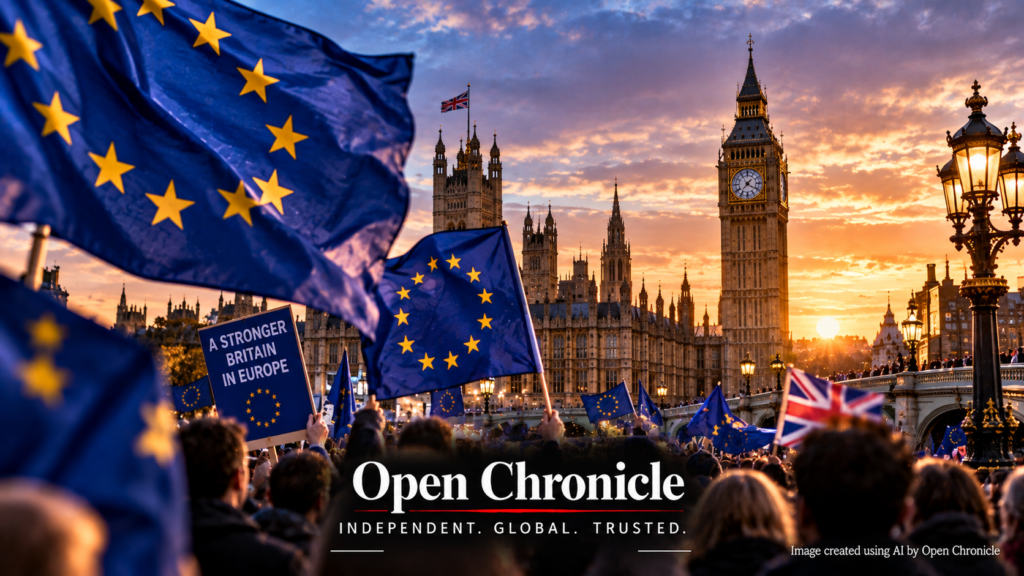
A new YouGov survey suggests 67% of Londoners would vote for Britain to rejoin the European Union, reinforcing Mayor Sadiq Khan’s calls for a fundamental reassessment of Brexit and exposing a widening political divide between the capital and other English regions.
By Open Chronicle with agencies
LONDON — October 14, 2026
Nearly seven in ten Londoners would vote for the United Kingdom to rejoin the European Union, according to a new YouGov survey that highlights the strength of pro-European sentiment in the British capital a decade after the historic Brexit referendum.
The poll suggests that 67% of adults in London would support returning to EU membership, substantially higher than the figures recorded in other English regions.
Only 15% of London respondents said they would vote to remain outside the European Union, while the remaining respondents expressed other preferences or did not give a definitive answer.
The findings provide fresh political momentum for London Mayor Sadiq Khan, who has argued that Britain should begin preparing for the possibility of returning to the European bloc after years of economic disruption and political disagreement following Brexit.
They also come amid renewed debate within the Labour Party over whether the government should pursue closer economic integration with Europe, including possible participation in the EU customs union, the single market or, eventually, full membership.
Although the survey points to strong support for rejoining the EU in London, the regional figures are based on smaller samples within a nationwide poll of more than 2,300 respondents and should be interpreted with appropriate caution.
Nevertheless, the results reinforce a longstanding political reality: London remains considerably more favourable toward European integration than many other parts of England.
London Emerges as Britain’s Strongest Pro-EU Region
The YouGov findings reveal substantial regional differences in attitudes toward reversing Brexit.
According to the survey, support for rejoining the European Union stands at 67% in London, compared with 44% in the Midlands, 48% in the rest of southern England and 50% in northern England.
The contrast is particularly significant because it suggests that London’s pro-European orientation has endured despite a decade of political change.
<text strong>Regional support for rejoining the EU</text>
| Region | Would vote to rejoin |
|---|---|
| London | 67% |
| North of England | 50% |
| Rest of southern England | 48% |
| Midlands | 44% |
London’s result is consistent with its voting behaviour during the 2016 referendum, when approximately 60% of voters in the capital supported remaining in the European Union.
At the time, London was one of the strongest centres of opposition to Brexit, alongside Scotland and Northern Ireland.
The new figures suggest that the capital’s preference for European integration has strengthened further among those surveyed.
Anthony Wells, YouGov’s Global Head of Politics, Elections and Public Data, told the Evening Standard that Londoners were more likely than respondents elsewhere in England and Wales to support rejoining the EU.
He also cautioned that the regional findings were based on smaller samples.
The distinction matters because regional subsamples carry greater statistical uncertainty than the overall national survey.
The poll therefore provides evidence of London’s strong pro-EU sentiment without establishing that precisely 67% of every segment of the capital’s population supports membership.
Sadiq Khan’s Campaign to Reconsider Brexit
London Mayor Sadiq Khan has become one of the most prominent political voices calling for Britain to reconsider its relationship with the European Union.
Khan has repeatedly argued that Brexit has imposed significant economic costs on London and the wider United Kingdom, particularly through additional trade barriers, reduced labour mobility and greater administrative complexity for businesses.
The mayor has also highlighted the importance of international talent, investment and access to European markets for the capital’s economy.
London is home to one of the world’s leading financial centres, major universities, technology companies, creative industries and international professional services businesses.
These sectors maintain extensive relationships with European institutions, investors, clients and workers.
For many London businesses, the UK’s withdrawal from the EU single market introduced new regulatory and operational challenges.
Khan’s position reflects the argument that Britain’s long-term economic competitiveness would benefit from restoring closer ties with its largest neighbouring trading bloc.
However, rejoining the EU would require more than a change in political rhetoric.
It would involve a formal accession process, negotiations with European institutions and unanimous agreement among existing EU member states.
Britain would also need to confront difficult questions concerning sovereignty, budget contributions, regulatory alignment and the terms of any future membership.
Brexit’s Economic Legacy Remains Contested
The debate over EU membership continues to be shaped by disagreements about Brexit’s economic consequences.
Critics argue that leaving the European single market and customs union created additional barriers to trade, investment and labour mobility.
Businesses exporting goods to the EU have faced customs requirements, regulatory checks and additional administrative procedures.
Some sectors have experienced difficulties associated with recruitment, professional mobility and the recognition of qualifications.
Financial services companies have also had to adjust to changes in market access and regulatory arrangements.
Supporters of Brexit, by contrast, emphasise the restoration of national control over immigration policy, legislation and international trade agreements.
They argue that the United Kingdom can pursue economic opportunities independently and develop policies better suited to domestic priorities.
The economic effects of Brexit are difficult to isolate completely from other major developments, including the COVID-19 pandemic, energy price shocks, inflation and wider changes in international trade.
Nevertheless, Britain’s long-term economic relationship with the EU remains central to debates about productivity, investment and growth.
For London, whose economy is deeply connected to international commerce, the issue carries particular significance.
Andy Burnham Pushes Debate Toward Closer European Integration
The latest polling comes as senior Labour figures increasingly discuss options for rebuilding economic ties with the European Union.
Greater Manchester Mayor Andy Burnham has been associated with calls for a more ambitious reassessment of Britain’s post-Brexit arrangements.
The options under discussion include closer cooperation with the EU customs union, participation in the single market and the possibility of returning to full membership.
These alternatives would carry different legal and economic consequences.
Rejoining the customs union could reduce some trade barriers for goods but would constrain Britain’s ability to pursue an entirely independent tariff policy.
Participation in the single market would involve a much broader set of obligations concerning regulatory alignment and market access.
Full EU membership would restore Britain’s role within the bloc’s institutions but would also require agreement on the terms of accession.
The distinctions are politically important.
Support for reducing trade barriers does not necessarily translate into support for full membership, and voters may hold different preferences depending on the economic and institutional arrangements being proposed.
The debate therefore extends beyond the simple question of whether Brexit should be reversed.
It concerns the type of relationship Britain should seek with Europe in the years ahead.
A Second Referendum or a General Election Mandate?
The YouGov survey also reveals disagreement over how any future decision to rejoin the European Union should be made.
According to the poll, 57% of Londoners believe another referendum should be held if the government proposes returning to EU membership.
Twenty-nine percent disagree.
The findings suggest that many Londoners who support closer European integration also believe the decision should receive a direct democratic mandate.
Elsewhere in the country, approximately two-thirds of respondents reportedly favour holding a referendum before rejoining.
This creates a political challenge for those advocating a return to the EU.
Even if public opinion shifts decisively toward membership, there may still be disagreement over whether the government should act through parliamentary authority, an electoral manifesto or another nationwide referendum.
The issue has already generated controversy within Labour.
Emily Thornberry Questions the Need for Another Brexit Referendum
Dame Emily Thornberry, the Labour MP for Islington South and Finsbury and chair of the House of Commons Foreign Affairs Committee, has argued that Britain could pursue rejoining the European Union without holding a second referendum.
Her position centres on the possibility of seeking an explicit mandate through a general election.
Under such an approach, a political party could include EU membership in its election manifesto and argue that an electoral victory would provide democratic authority to begin the accession process.
The next UK general election is expected by 2029 unless an earlier election is called.
Supporters of the manifesto approach could argue that representative democracy allows governments to make major international policy decisions through parliamentary and electoral mandates.
Critics would likely contend that reversing the outcome of the 2016 referendum requires another direct public vote.
The question is not merely procedural.
It touches on the continuing political significance of the original Brexit referendum and the competing interpretations of democratic legitimacy that emerged from it.
Any attempt to restore EU membership without another referendum would almost certainly become a major political controversy.
Reform UK and Conservatives Oppose Rejoining
The renewed debate has drawn opposition from political figures committed to maintaining Britain’s departure from the European Union.
Nigel Farage and Reform UK continue to defend Brexit and oppose returning to EU membership.
Conservative leader Kemi Badenoch has also positioned her party against reversing Brexit.
For opponents of rejoining, the question concerns sovereignty as well as economics.
They argue that Brexit restored powers over immigration, legislation, trade policy and other areas previously governed or influenced by EU institutions.
Returning to membership would require Britain to accept the obligations associated with the European legal and political framework.
The debate therefore involves competing visions of Britain’s international role.
One emphasises national autonomy and the freedom to establish independent policies.
The other places greater weight on economic integration, institutional cooperation and influence within European decision-making.
The YouGov findings suggest that these arguments continue to resonate differently across the country’s regions.
Why London Views Europe Differently
London’s distinctive political and economic character helps explain its comparatively strong support for EU membership.
The capital has a large international population, extensive commercial links with Europe and a substantial concentration of industries dependent on cross-border activity.
Its universities attract students and researchers from around the world.
Its financial institutions serve international markets.
Its technology, media, cultural and professional services sectors operate within global networks.
These characteristics can make international mobility and market access particularly important to the city’s economic outlook.
London also has a younger and more ethnically diverse population than many other parts of England, although attitudes toward EU membership cannot be explained by demographics alone.
Political preferences are shaped by education, occupation, income, geography, personal experience and broader views about national identity.
The city’s voting patterns have consistently differed from those in many areas that supported Brexit in 2016.
The latest survey indicates that those differences remain significant.
However, London is not politically uniform.
The poll’s finding that 15% of respondents would vote to remain outside the EU demonstrates that opposition to rejoining persists within the capital.
What Would Britain Need to Do to Rejoin the European Union?
Rejoining the European Union would require a formal political and legal process.
The United Kingdom could not simply reverse Brexit by repealing domestic legislation or announcing a change of policy.
Under Article 49 of the Treaty on European Union, a European state seeking membership must submit an application and satisfy the conditions required for accession.
The process involves negotiations and agreement among the existing member states.
The European Parliament must also give its consent, and an accession treaty would require ratification under the applicable constitutional procedures.
For Britain, negotiations could raise complex questions.
These might include its future financial contributions, participation in EU institutions, regulatory commitments and the treatment of arrangements previously negotiated during its decades of membership.
There would also be questions about whether the United Kingdom could recover any of its former special arrangements.
Those terms could not be assumed in advance.
The EU itself has changed since Britain left, and existing member states would have their own priorities and negotiating positions.
Consequently, even a decisive political shift in favour of rejoining would not guarantee a rapid return.
A Political Challenge for Labour
The polling places renewed attention on Labour’s European policy.
The party faces pressure from politicians and voters who favour closer economic integration, while also needing to consider constituencies where Brexit remains politically sensitive.
A proposal to rejoin the customs union or single market would represent a substantial policy shift.
A commitment to seek full EU membership would be more consequential still.
Such decisions would affect Britain’s trade relationships, regulatory framework and political positioning.
They could also reshape electoral competition by bringing Brexit back to the centre of national politics.
For Labour, the challenge is balancing economic arguments for closer cooperation with the political consequences of reopening a deeply divisive constitutional question.
London’s strong pro-European sentiment may increase pressure for change, but national electoral calculations remain more complicated.
The regional figures from YouGov illustrate that difficulty.
While London shows a substantial majority in favour of rejoining, support elsewhere is more evenly divided.
A national political strategy would therefore need to address concerns extending well beyond the capital.
The Big Picture: Brexit Remains an Unfinished Political Argument
Ten years after the 2016 referendum, Britain’s relationship with the European Union remains one of the country’s defining political questions.
Brexit formally ended the UK’s EU membership, but it did not settle the broader debate over Britain’s economic, political and strategic relationship with Europe.
The new YouGov findings suggest that support for reversing Brexit is particularly strong in London.
They also indicate that many voters want a direct say before any government attempts to restore membership.
The two findings are not contradictory.
A voter may favour rejoining the EU while also believing that such a major decision requires another referendum.
For politicians advocating closer European integration, that distinction will be important.
The debate is also taking place in a changing international environment.
European security, economic competitiveness, trade relationships and geopolitical cooperation have become increasingly important policy concerns.
Britain remains closely connected to its European neighbours through commerce, diplomacy and defence, regardless of its institutional relationship with the EU.
The question is how those connections should evolve.
Conclusion: London Signals a Shift, but Britain Remains Divided
The YouGov survey provides evidence of a strong pro-European majority among London respondents and renewed political pressure to reconsider Britain’s post-Brexit direction.
With 67% of Londoners surveyed saying they would vote to rejoin the European Union, the capital stands well ahead of other English regions.
The findings strengthen the political argument advanced by Sadiq Khan and other figures calling for a closer relationship with Europe.
Yet the survey does not establish that Britain as a whole has reached a consensus on reversing Brexit.
Regional differences remain substantial, and the question of whether another referendum would be required is itself politically contested.
Any future attempt to rejoin would also depend on negotiations with the European Union and agreement on the conditions of membership.
For now, the polling demonstrates that Brexit remains an active political issue rather than a settled chapter of British history.
A decade after the referendum that took Britain out of the European Union, London is signalling that it would prefer a different future. Whether the rest of the country will follow remains an open question.
Open Chronicle | Research & Documentation
Sources and Further Reading
Polling research, political reporting and institutional references on Brexit, public opinion and the United Kingdom’s relationship with the European Union.
01 | Public Opinion Research
YouGov — Public Opinion and Brexit Research
Polling analysis on British attitudes toward rejoining the European Union and whether another referendum should be required.
02 | London Political Reporting
Evening Standard — London and Brexit
Reporting on the YouGov survey, Sadiq Khan’s position and the political debate surrounding Britain’s relationship with the European Union.
03 | London Mayoral Policy
Evening Standard — Sadiq Khan and EU Membership
Coverage of the London mayor’s calls for the British government to prepare for the possibility of returning to the European Union.
04 | UK-EU Economic Relations
Evening Standard — Andy Burnham and Brexit
Reporting on proposals for closer economic integration between the United Kingdom and the European Union.
05 | Constitutional Debate
Evening Standard — Emily Thornberry and a Second Referendum
Reporting on the debate over whether a general election mandate could provide a route toward renewed EU membership.
06 | UK Parliament
UK Parliament — Dame Emily Thornberry
Official parliamentary information concerning the MP for Islington South and Finsbury.
07 | European Union Institutions
European Union — EU Membership and Enlargement
Institutional information on the legal requirements and accession process for countries seeking European Union membership.
08 | Electoral History
UK Electoral Commission — EU Referendum 2016
Official information and historical results concerning the referendum on Britain’s membership of the European Union.
Open Chronicle | Editorial Transparency
Editorial Note
This article is based on the supplied reporting concerning a YouGov survey of more than 2,300 respondents examining British attitudes toward rejoining the European Union.
The figures cited for London and other English regions are drawn from the supplied account. Regional subsamples are smaller than the overall survey population and should be interpreted with appropriate statistical caution.
Statements and political positions attributed to Sadiq Khan, Andy Burnham, Emily Thornberry and other public figures are presented according to the supplied reporting. The article does not independently establish that these positions constitute formal policy commitments by the Labour government.
Descriptions of Brexit’s economic consequences, the UK’s relationship with the European Union and the legal requirements for renewed membership are provided as explanatory context.
The article distinguishes public support for rejoining the EU from support for holding another referendum. These represent separate questions and should not be treated as interchangeable.
The sources listed above provide reporting, polling information and institutional background. The article’s broader political analysis is an editorial interpretation of the supplied material.
Open Chronicle
Independent. Global. Trusted.