
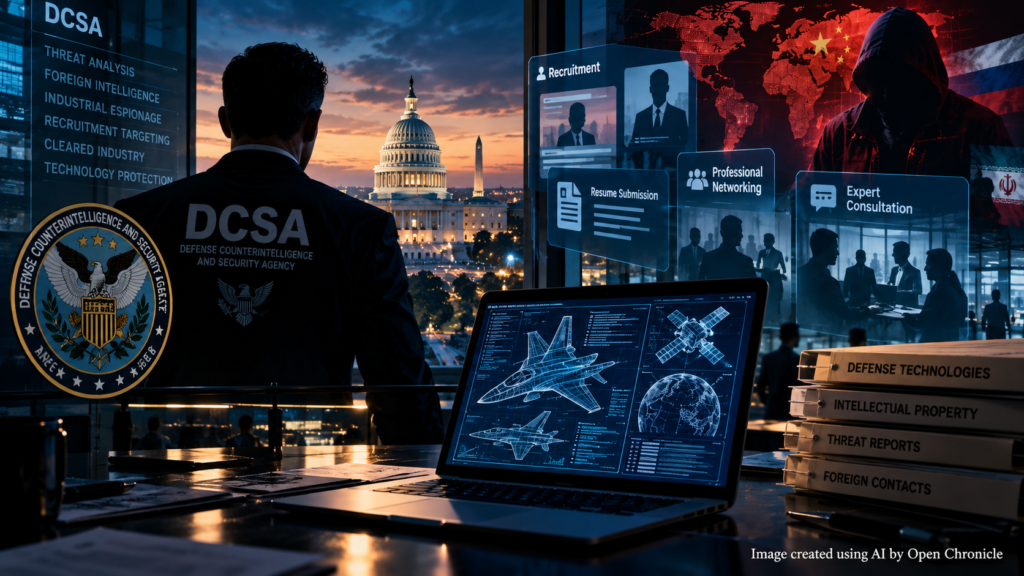
A US counterintelligence report highlights how foreign entities may seek access to sensitive technologies and information before prospective employees undergo formal security vetting. The Defense Counterintelligence and Security Agency recorded approximately 2,900 incidents involving foreign attempts to obtain sensitive information or technology during fiscal 2025, alongside more than 22,000 suspicious contact reports.
By Open Chronicle News Desk with Agencies
WASHINGTON | October 15, 2026
Foreign intelligence services are exploiting recruitment processes, professional networking platforms and expert consultations to pursue sensitive information about American defence technologies, according to findings highlighted in a report by the US Defense Counterintelligence and Security Agency (DCSA).
The warning points to a potential weakness in the way government agencies and defence contractors approach personnel security: considerable attention is devoted to determining whether individuals can be trusted once they enter formal vetting procedures, but foreign intelligence collection efforts may begin much earlier.
Activities that appear to be routine parts of professional life — submitting a résumé, responding to a recruiter, discussing technical experience or participating in an expert consultation — can also create opportunities for attempts to obtain information.
The DCSA report, Targeting U.S. Technologies: A Report of Threats to Cleared Industry, describes the broader threat facing US organisations working with sensitive technologies and national security programmes.
During fiscal 2025, the agency identified approximately 2,900 incidents involving foreign entities seeking sensitive information or technology. It also received more than 22,000 suspicious contact reports.
Those figures underline the scale of the counterintelligence challenge facing the American defence industrial base, although suspicious contacts should not automatically be interpreted as confirmed espionage operations.
The Security Threat Begins Before Clearance Screening
The federal government’s personnel security system is designed to assess whether individuals should be entrusted with access to classified information.
Background investigations, security assessments and ongoing monitoring are intended to reduce the risk that sensitive information will be compromised.
However, the DCSA findings suggest that focusing exclusively on the formal vetting process may overlook an earlier stage of potential exposure.
Recruitment and professional networking often require individuals to describe their previous work, technical skills, institutional affiliations and areas of expertise.
For professionals employed in defence-related industries, even apparently ordinary descriptions of their experience may reveal information about the technologies, programmes or capabilities in which they have participated.
A foreign intelligence collector may not need to obtain classified documents to acquire useful knowledge.
Information about technical specialisations, organisational relationships, research priorities or personnel movements can help identify individuals and institutions of interest.
The concern is particularly relevant to defence contractors, whose employees frequently combine highly specialised technical expertise with access to sensitive projects.
Recruitment as a Potential Intelligence Collection Channel
Recruitment is a normal and necessary part of the defence industry’s operations.
Companies must attract engineers, scientists, cybersecurity specialists and other professionals capable of working on increasingly complex technologies.
Yet the same processes that connect employers with qualified candidates can create opportunities for deceptive approaches.
A recruitment message may appear to offer a legitimate employment opportunity while seeking detailed information about an individual’s responsibilities, experience or technical knowledge.
Similarly, a request for a résumé may encourage an applicant to provide information that goes beyond what is appropriate to disclose publicly.
The DCSA warning draws attention to the potential exploitation of these interactions.
It does not establish that recruitment activity is inherently suspicious. Rather, it highlights the importance of recognising when a seemingly professional request may be designed to collect sensitive information.
For employers and employees alike, the challenge is distinguishing legitimate career opportunities from approaches that may conceal an intelligence-gathering purpose.
Professional Networking and Expert Consultations
The threat extends beyond conventional hiring.
Professional networking platforms allow specialists to establish contacts, exchange ideas and explore commercial opportunities across national borders.
Those benefits can also make such platforms attractive environments for intelligence collection.
A professional profile may reveal an individual’s employer, technical background, former positions and connections to particular industries.
Even without access to restricted systems, a collector could use publicly available information to identify people whose expertise may be valuable.
Expert consultations present another potential point of exposure.
Companies, research organisations and advisory services routinely seek specialist insights into technological developments and industrial trends.
Such exchanges can be entirely legitimate.
However, when discussions concern defence-related technologies, participants may face questions that approach the boundaries of confidential or otherwise sensitive information.
The DCSA findings indicate that these routine professional activities deserve attention within the broader counterintelligence environment.
Thousands of Reports Highlight the Scale of the Problem
Two figures from the DCSA report illustrate the extent of reported foreign interest in sensitive US technologies.
The agency identified approximately 2,900 incidents involving foreign entities seeking sensitive information or technology during fiscal 2025.
Separately, it received more than 22,000 suspicious contact reports over the same period.
These figures describe different categories of information and should not be treated as interchangeable.
The larger number represents suspicious contacts reported to the agency, while the smaller figure concerns incidents identified in connection with foreign efforts to obtain sensitive information or technology.
The supplied summary does not establish how many contacts resulted in successful information collection, criminal investigations, prosecutions or confirmed compromises.
Nevertheless, the volume of reporting suggests that attempted access to defence-related information is a persistent concern rather than an isolated phenomenon.
It also demonstrates why counterintelligence agencies depend on reporting from organisations and individuals who encounter unusual approaches.
Why the Defence Industrial Base Matters
The United States relies on a broad network of private contractors, research institutions and specialist suppliers to develop and maintain military capabilities.
This network encompasses far more than the largest defence manufacturers.
Smaller technology companies, engineering firms, research laboratories and subcontractors can possess expertise or components essential to major national security programmes.
Their personnel may therefore become targets of interest even when their employers are not widely known.
Foreign intelligence collection can seek information about technologies, research directions, manufacturing capabilities or organisational relationships.
Such information may have value independently or become more useful when combined with material obtained from other sources.
The potential vulnerability is not limited to classified information.
Proprietary research, sensitive technical data and certain forms of unclassified information can also carry national security or commercial significance.
The DCSA findings reinforce the importance of understanding personnel security as part of a wider system of technology protection.
The Limits of Traditional Vetting
Formal personnel vetting remains a central component of protecting classified information.
But vetting is principally concerned with determining whether a person meets the requirements for access to sensitive material.
It does not, by itself, eliminate the possibility that foreign entities will approach employees or prospective employees outside controlled environments.
A person may encounter a suspicious recruiter before joining a defence contractor.
An established engineer may receive an unsolicited request for technical advice.
A former employee may be contacted because of expertise acquired during previous work.
These situations demonstrate why security awareness cannot be confined to the moment a clearance is granted.
The broader challenge is to help personnel recognise inappropriate requests without discouraging legitimate employment opportunities, scientific exchange or professional collaboration.
Counterintelligence Awareness Without Excessive Suspicion
The DCSA findings raise practical questions for both government agencies and private-sector employers.
Recruitment procedures may need to account for the possibility that professional approaches can be used to gather information.
Employees working with sensitive technologies may also benefit from guidance about the kinds of information they can appropriately share in résumés, interviews and external consultations.
At the same time, security policies must avoid treating ordinary international professional contact as evidence of wrongdoing.
The existence of a foreign recruiter, overseas company or international professional relationship is not sufficient to establish an intelligence threat.
Effective counterintelligence depends on assessing behaviour, context and evidence rather than relying on nationality or other broad assumptions.
The objective is to protect sensitive information while preserving the legitimate exchange of skills and ideas on which technological innovation depends.
The Big Picture: Protecting Technology Before Access Is Granted
The central message emerging from the DCSA report is that the protection of sensitive US technologies cannot begin only when a prospective employee enters the security clearance process.
Foreign entities may seek valuable information through routine professional interactions that occur long before an individual is formally evaluated for access to classified material.
Recruitment, networking and expert consultations are essential activities in a modern technology economy. They can also create opportunities for information collection when participants are unaware of the sensitivity of what they disclose.
The approximately 2,900 incidents and more than 22,000 suspicious contact reports highlighted for fiscal 2025 illustrate the scale of the issue facing cleared industry.
They do not establish that every reported approach involved espionage or that every attempt succeeded.
They do, however, reinforce a broader national security lesson: safeguarding advanced technology requires attention not only to secure facilities, computer networks and clearance procedures, but also to the everyday professional interactions through which information can be exposed.
For the American defence industrial base, the counterintelligence challenge increasingly begins before the first day of employment.
Open Chronicle | News Desk
Sources and Further Reading
Official United States government resources concerning counterintelligence threats, foreign intelligence collection, personnel security and the protection of sensitive technologies within the American defense industrial base.
01 | Official Counterintelligence Report
Defense Counterintelligence and Security Agency
Targeting U.S. Technologies: A Report of Threats to Cleared Industry
The DCSA report identified in the supplied material, including figures for fiscal 2025 and the threat posed by foreign attempts to obtain sensitive information and technology.
02 | Government Institution
Defense Counterintelligence and Security Agency
Official Website
Institutional information concerning the agency’s personnel vetting, counterintelligence and security responsibilities.
Open Chronicle | Editorial Transparency
Editorial Note
This article is an original Open Chronicle news synthesis based on the supplied summary of the Defense Counterintelligence and Security Agency report Targeting U.S. Technologies: A Report of Threats to Cleared Industry.
The figures of approximately 2,900 incidents involving foreign entities seeking sensitive information or technology and more than 22,000 suspicious contact reports are attributed to the DCSA information provided for fiscal 2025.
The article distinguishes suspicious contacts from confirmed espionage, successful information theft and criminal findings. These categories should not be treated as equivalent.
Discussion of recruitment vulnerabilities, professional networking, personnel vetting and information protection provides explanatory editorial context. It should not be interpreted as a claim that every recruitment approach or international professional contact represents a security threat.