
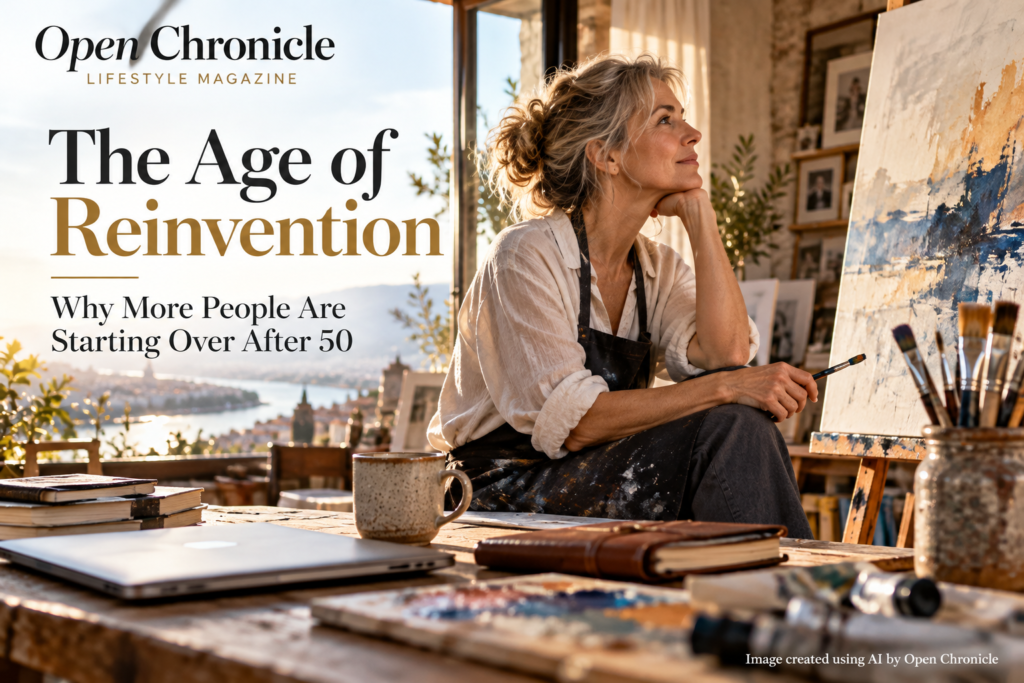
The Age of Reinvention: Why More People Are Starting Over After 50
New careers, unexpected relationships, creative ambitions and the freedom to question old expectations. For a growing number of people, turning 50 is not simply about getting older. It is about discovering what the next chapter of life could become.
By Open Chronicle Lifestyle Magazine
There is a moment in life when the question changes.
For years, we ask ourselves what we want to become.
A successful professional. A parent. A homeowner. A respected colleague. Someone who has built something meaningful.
We spend decades answering that question through work, family, relationships and responsibility.
Then, somewhere around the age of 50, another question begins to emerge.
What if I want something different now?
It may arrive quietly.
During an ordinary commute. At a birthday dinner. After the children leave home. Following the end of a relationship. While looking at a career that once seemed exciting but has gradually become predictable.
Sometimes it follows a personal crisis.
Sometimes it arrives without any crisis at all.
A person may have a good job, a comfortable home and a life that appears successful from the outside, yet feel an unexpected desire to begin again.
To study something new.
To move somewhere unfamiliar.
To start a business.
To return to a forgotten creative ambition.
To build a different kind of relationship.
Or simply to stop living according to expectations that no longer feel like their own.
For much of modern history, middle age was presented as a period of consolidation. By 50, we were supposed to know who we were, what we wanted and where our lives were going.
But longer working lives, changing family structures and evolving attitudes toward ageing are challenging that assumption.
The second half of adulthood is no longer necessarily a long conclusion to the first.
For some, it is becoming another beginning.
And perhaps the most interesting question is not why people are starting over after 50.
It is why we ever believed they should stop.
1. The Age When Life Was Supposed to Be Settled
There was once a relatively predictable cultural script for adulthood.
Education came first.
Then work.
Marriage, perhaps.
Children.
A home.
Professional advancement.
Retirement.
The details varied across countries, generations and social classes, but the underlying expectation was familiar.
Youth was for discovery.
Middle age was for responsibility.
Older age was for withdrawal from professional life.
The structure offered stability, but it also established an invisible deadline for personal transformation.
By 50, we were expected to have made the important decisions.
A person changing careers at 25 was ambitious.
At 35, adaptable.
At 55, they might be asked whether something had gone wrong.
The same double standard could shape attitudes toward education, relationships, appearance and personal ambitions.
Yet experience does not necessarily eliminate curiosity.
Nor does maturity make change less meaningful.
A person can spend thirty years becoming exceptionally good at something and still discover that they want to do something else.
The first life does not have to be a failure for the next one to be worthwhile.
2. Why Fifty No Longer Means What It Once Did
Age is a biological reality, but its social meaning is constantly changing.
People are living longer than previous generations in many parts of the world, although life expectancy, health and economic security remain deeply unequal.
More adults are also spending additional years in employment.
The OECD’s Employment Outlook 2025 describes rising employment rates among older workers across many member countries, alongside substantial differences in opportunity, health and access to training.
These changes matter.
When working lives extend beyond traditional expectations, the idea of one uninterrupted career becomes less convincing.
Someone aged 52 may have many years of professional activity ahead.
Someone aged 60 may want to work differently rather than stop altogether.
Someone approaching retirement may be considering education, volunteering, entrepreneurship or a completely new personal project.
But longevity alone does not explain reinvention.
There is also a cultural change.
People increasingly encounter examples of adulthood that do not follow a single timetable.
Marriage can happen later.
Education can resume.
Careers can change.
New relationships can begin.
Creative ambitions can return.
The milestones that once appeared fixed have become more flexible for some people.
And that flexibility opens a remarkable possibility.
Perhaps adulthood is not a journey toward becoming one permanent version of ourselves. Perhaps it is a series of opportunities to become someone new.
3. The Career That No Longer Fits
Professional reinvention is one of the most visible forms of starting over.
Consider someone who has spent twenty-five years working in finance.
They understand the industry.
They have experience, professional contacts and a reliable income.
But the work no longer feels meaningful.
They have always been interested in architecture, teaching or photography.
At 30, changing direction might have seemed relatively straightforward.
At 55, the decision carries additional weight.
There may be a mortgage.
Children in education.
Retirement savings to protect.
A professional identity built over decades.
And an understandable fear of becoming a beginner again.
Nevertheless, career change is not merely a theoretical possibility.
A 2025 AARP survey of American workers aged 50 and over found that 24% planned a job change that year, compared with 14% in its comparable survey a year earlier.
Among those considering change, some were seeking different employment, while others were interested in entrepreneurship or reduced working hours.
The findings reflect intentions among surveyed US workers, not proof of a universal international trend.
They also reveal something important.
Financial concerns remain a major motivation.
Reinvention is not always about pursuing a dream.
Sometimes it is about finding a way to remain economically secure in a changing labour market.
Sometimes it is about escaping exhausting working conditions.
And sometimes it is about finally asking whether the work we do still reflects the person we have become.
4. The Courage to Become a Beginner Again
One of the greatest barriers to reinvention is not age itself.
It is the discomfort of losing expertise.
By middle age, many people have spent decades developing competence.
They know how to solve problems.
They understand professional expectations.
They have accumulated experience that gives them confidence.
Starting something new can threaten that confidence.
A successful manager becomes a novice language student.
An experienced accountant struggles with a digital design program.
A respected professional attends a class alongside people half their age.
The experience can be humbling.
But it can also be liberating.
Learning reminds us that identity is not limited to what we already know.
It creates opportunities to meet different people, explore unfamiliar ideas and develop capabilities that were never part of our original plans.
Of course, access to education is unequal.
Time, money, digital access, health and caregiving responsibilities all influence who can return to learning.
Employers may also underestimate older workers’ willingness or ability to acquire new skills.
The OECD has identified substantial age-related gaps in participation in training, making lifelong learning an important policy challenge rather than merely a matter of individual motivation.
The solution cannot simply be telling people to reinvent themselves.
Societies must make reinvention possible.
5. The Second Career May Be the First One We Choose Freely
Many careers begin before we fully understand ourselves.
At 18 or 22, decisions about education and employment may be shaped by family expectations, financial necessity, social prestige or the opportunities available nearby.
Those choices can lead to rewarding lives.
But they are often made with limited experience.
By 50, a person may understand their strengths, limitations and priorities much more clearly.
They may know what kind of working environment suits them.
Which responsibilities they enjoy.
Which compromises they no longer wish to make.
Which ambitions were inherited from others.
This does not mean later career decisions are automatically wiser.
Experience can bring confidence, but also caution.
Financial obligations can restrict freedom.
Age discrimination can make changing jobs difficult.
Nevertheless, there is something compelling about the possibility that a second career may reflect a more deliberate choice.
Not the occupation someone thought they should pursue.
But the work they now believe is worth doing.
For some, that may involve a complete professional transition.
For others, it may mean mentoring younger colleagues, consulting independently or reducing hours to make space for another part of life.
Reinvention does not always require abandoning everything we have built.
Sometimes it means using what we have built differently.
6. Love, Relationships and the Unexpected Second Chapter
Starting over after 50 is not limited to professional life.
Relationships change too.
Long marriages can end.
Partners can die.
Children become independent.
Friendships evolve.
Some people find themselves living alone for the first time in decades.
Others discover that a relationship they once considered permanent no longer reflects their needs.
These transitions can be painful.
Divorce, bereavement and separation are not lifestyle trends.
They are profound experiences that may involve grief, financial insecurity, loneliness and major changes in identity.
But they can also create space for new forms of connection.
A person may discover companionship after years of living alone.
Begin dating again.
Develop friendships outside established social circles.
Or decide that living independently offers a kind of freedom they had never previously experienced.
The most important shift may be the recognition that emotional life does not expire at a particular age.
Affection, intimacy, curiosity and the desire to be understood remain meaningful throughout adulthood.
There is no age at which someone becomes too old to fall in love.
And there is no obligation to seek a new relationship in order to have a fulfilling life.
The freedom lies in being able to choose.
7. When the Children Leave, Who Are We?
For many parents, family life shapes identity over several decades.
Daily routines revolve around school, meals, activities, homework, transport and care.
Then the household begins to change.
Children leave for university.
Start careers.
Move to other cities.
Establish homes of their own.
The transition can bring mixed emotions.
Pride.
Relief.
Sadness.
Uncertainty.
A parent who has spent years organising life around other people may suddenly find unfamiliar space in the calendar.
The experience is often described as the empty nest, but that phrase can oversimplify a complicated transition.
Some parents welcome greater independence.
Others struggle with a loss of daily purpose.
Many experience both.
And not every household follows the same pattern. Adult children may remain at home or return because of housing costs, employment insecurity or family circumstances.
For those who do gain more personal time, the change can provoke an important question.
What interests have been waiting quietly in the background?
A forgotten instrument.
A language never learned.
A professional ambition set aside.
A desire to travel.
A friendship that needs attention.
The answer need not involve a dramatic transformation.
Sometimes reinvention begins when people rediscover parts of themselves that responsibility had temporarily pushed aside.
8. Women and the Freedom to Redefine Success
The experience of reinvention can be particularly complex for women.
Many have spent substantial parts of adulthood balancing paid employment, family responsibilities and unpaid care.
Some interrupted careers to raise children.
Others cared for ageing parents.
Some navigated workplaces in which professional advancement required sacrifices that were not equally expected of male colleagues.
By their fifties, women may find themselves reconsidering the roles they have occupied for decades.
For some, this creates an opportunity to pursue ambitions previously deferred.
For others, financial inequality makes reinvention difficult.
Career interruptions can affect pensions.
Age and gender discrimination may intersect.
Caregiving responsibilities can continue or intensify.
Menopause may also influence health, comfort and workplace experiences, although its effects vary widely and should not be treated as a universal explanation for midlife change.
The important point is that reinvention should not be presented as a fashionable obligation.
Not every woman wants to start a business, change her appearance, travel alone or transform her personal life.
Freedom means having the opportunity to make choices without being confined by expectations about age or gender.
For some, the boldest decision will be to begin something new.
For others, it will be to stop doing something that no longer serves them.
9. The Entrepreneur Who Starts at Fifty-Five
Entrepreneurship is frequently associated with youth.
Popular culture celebrates the young founder with a laptop, a revolutionary idea and an ambition to disrupt an industry.
But business creation does not belong exclusively to the young.
Experience can provide valuable advantages.
Industry knowledge.
Professional networks.
Understanding of customers.
Awareness of common mistakes.
Practical judgement.
A person who has spent thirty years working in hospitality may understand the realities of running a small business better than someone encountering the industry for the first time.
A former teacher may identify an educational need.
An engineer may develop a consulting practice.
A designer may turn a long-standing creative interest into a commercial project.
Yet later-life entrepreneurship also involves significant risk.
Savings may be harder to replace.
Borrowing conditions can be restrictive.
Business failure can threaten retirement security.
The romantic image of leaving a corporate job to open a café rarely includes the difficult financial calculations involved.
A responsible account of reinvention must include both possibility and risk.
The objective is not to encourage everyone over 50 to become an entrepreneur.
It is to challenge the assumption that entrepreneurial ambition has an expiry date.
10. Ageism: The Invisible Barrier to Starting Again
One of the greatest contradictions in contemporary society is that we celebrate experience while sometimes discriminating against those who possess it.
Older workers may be described as dependable, knowledgeable and committed.
Yet they can also encounter assumptions that they are less adaptable, less technologically capable or less interested in professional development.
These stereotypes can influence hiring, promotion and access to training.
The World Health Organization defines ageism through stereotypes, prejudice and discrimination associated with age.
Its Global Report on Ageism documents the consequences for health, wellbeing and participation in society.
Ageism is not merely an interpersonal problem.
It can be embedded in institutions, policies and cultural expectations.
When someone in their fifties is repeatedly told that changing careers is unrealistic, the message can eventually become internalised.
They may stop applying.
Stop learning.
Stop imagining alternatives.
Not because they lack ability.
But because they have begun to accept the limits imposed upon them.
A society serious about longer, healthier lives must also be serious about opportunity.
There is little value in celebrating longevity while denying people meaningful ways to participate.
11. The Reinvention Industry
There is another side to this cultural shift.
Reinvention has become an attractive commercial narrative.
Books promise a new beginning.
Coaches offer transformation programs.
Retreats encourage people to discover their authentic selves.
Social media presents dramatic before-and-after stories.
Someone leaves a demanding career and opens a guesthouse in the countryside.
Another moves abroad.
Another transforms their appearance, lifestyle and relationships.
These stories can be inspiring.
But they can also create unrealistic expectations.
A successful second chapter does not have to be spectacular.
It does not require a business, a new country, a dramatic physical transformation or a carefully curated social media presence.
Nor does it require rejecting everything that came before.
A person who chooses to remain in a familiar job, cultivate friendships and enjoy a quieter life has not failed to reinvent themselves.
The danger is turning reinvention into another standard of achievement.
After decades of being told to build successful careers and families, people should not now be told that they must also produce an extraordinary second act.
The purpose of reinvention is freedom.
Not another form of pressure.
12. The Financial Reality of Beginning Again
Money changes the meaning of reinvention.
Someone with substantial savings may be able to take a year away from work.
Someone living from one salary to the next may have no such option.
A person with a secure pension can consider risks that would be impossible for someone facing retirement insecurity.
Housing costs, debt, health expenses and family responsibilities all influence what change is realistic.
This is particularly important after 50 because the time available to recover from major financial setbacks may be shorter.
A career transition can reduce income.
A new business may require capital.
Returning to education can involve fees and lost earnings.
Relocation can bring unexpected costs.
These considerations do not invalidate the desire for change.
They make planning essential.
Sometimes the most sustainable form of reinvention is gradual.
Studying while remaining employed.
Testing a business idea before investing heavily.
Reducing working hours rather than leaving employment entirely.
Building new skills before applying for a different role.
Change does not become less meaningful because it happens carefully.
Indeed, the ability to distinguish between courage and unnecessary risk may be one of the advantages of experience.
13. Reinvention Does Not Always Mean Becoming Someone Else
There is a common misunderstanding about personal transformation.
We imagine that starting over means rejecting our previous identity.
The executive becomes an artist.
The city resident moves to the countryside.
The cautious person becomes adventurous.
The familiar life disappears.
A completely different person emerges.
But identities are rarely so simple.
We carry our histories with us.
Our experiences shape how we interpret new situations.
Our relationships influence our decisions.
Our skills often remain useful in unexpected contexts.
Someone who becomes a teacher after working in business does not abandon everything learned in their first career.
A person who starts painting at 60 brings decades of observation and experience to the canvas.
A parent who returns to education carries practical knowledge acquired outside the classroom.
Reinvention may be less about replacing the past than allowing it to develop in a new direction.
The person we become after 50 is not necessarily a stranger.
Sometimes it is someone we have been gradually becoming all along.
14. The Quiet Reinventions Nobody Sees
Not every transformation is visible.
Some of the most important changes happen without a new job title, relationship status or address.
A person learns to establish boundaries.
Stops apologising for needing rest.
Becomes more comfortable spending time alone.
Rebuilds a friendship.
Begins exercising regularly.
Finds the confidence to express an opinion.
Returns to reading.
Learns to ask for help.
Decides that constant professional ambition is no longer necessary.
These changes may appear modest.
But they can fundamentally alter the experience of everyday life.
There is also a kind of reinvention that comes from accepting rather than changing.
Accepting that some ambitions no longer matter.
That a relationship has changed.
That the body requires different care.
That success now means something different from what it meant at 30.
Maturity can involve the courage to pursue new possibilities.
It can also involve the wisdom to release old expectations.
Both deserve recognition.
15. What If the Best Years Are Not Behind Us?
There is a familiar expression that describes youth as the best years of life.
It is usually intended affectionately.
But it carries an unfortunate implication.
That the most interesting experiences belong to the beginning.
That adventure, discovery and transformation gradually disappear as we age.
Yet life does not follow a single emotional trajectory.
Some people remember their twenties as a period of extraordinary happiness.
Others remember uncertainty, insecurity or loneliness.
Some discover greater confidence in middle age.
Others experience difficult transitions.
Later adulthood can bring freedom and opportunity, but also illness, loss and financial challenges.
There is no universal best age.
And perhaps that is precisely the point.
A life does not have to peak according to a timetable.
The years after 50 may contain experiences that were impossible at 25.
Not because they are necessarily better.
But because we encounter them with different knowledge, priorities and expectations.
We may become less interested in impressing people.
More attentive to relationships.
More selective about obligations.
More aware that time is finite.
And sometimes, more willing to act.
16. The Freedom to Begin Again
Imagine someone turning 55.
They have lived more than five decades.
They have made mistakes.
Built relationships.
Experienced disappointment.
Achieved things they once considered impossible.
Lost opportunities.
Changed opinions.
Perhaps raised children.
Perhaps lived alone.
Perhaps followed a conventional path.
Perhaps never had the opportunity to do so.
Now they stand at another threshold.
The future is uncertain.
But it is not empty.
There may be another career.
Another friendship.
Another home.
Another love.
Another language.
Another journey.
Another version of daily life that feels more closely aligned with who they are today.
There may also be no dramatic change at all.
Perhaps the next chapter will simply involve enjoying what has already been built.
That, too, can be a deliberate choice.
The significance of reinvention after 50 is not that everyone must transform their lives.
It is that age should not automatically remove the possibility.
We are allowed to change our minds.
To discover new interests.
To revise old ambitions.
To begin something without knowing whether we will become exceptional at it.
To pursue happiness without pretending that the past was wasted.
And to recognise that experience is not merely a record of what has happened.
It can also be a resource for what comes next.
Perhaps the most liberating discovery of growing older is that we do not have to remain the person we once believed we were supposed to become.
We can honour the life we have lived and still be curious about the life ahead.
Sources and Further Reading
Selected research, institutional reports and further reading informing this feature on reinvention, employment and wellbeing after 50.
OECD Employment Outlook 2025: Can We Get Through the Demographic Crunch?
Organisation for Economic Co-operation and Development
Research on older workers, labour market participation, career mobility, age discrimination and lifelong learning. The report provides important context for understanding the opportunities and barriers facing people who want or need to continue working later in life.
Money Is Still a Driver of Job Change Among Older Workers
AARP Research
A January 2025 survey examining employment intentions among American workers aged 50 and older, including career transitions, financial motivations, entrepreneurship and flexible working arrangements.
Global Report on Ageism
World Health Organization
International research examining age-related stereotypes, discrimination and their consequences for health, wellbeing and social participation, together with strategies for reducing ageism.
World Report on Ageing and Health
World Health Organization
A foundational report presenting a broader understanding of healthy ageing, functional ability and the importance of environments that support participation and wellbeing throughout later life.
UN Decade of Healthy Ageing (2021–2030)
World Health Organization
An international framework for improving the lives of older people, their families and communities through age-friendly environments, integrated care, long-term care and efforts to combat ageism.
EDITORIAL NOTE
This feature combines demographic and labour market research, public health evidence and original lifestyle commentary. Reinvention after 50 is presented as an important contemporary possibility, not as a universal experience or a statistically established trend across every aspect of life. The opportunities to change careers, pursue education, develop relationships or adopt a different lifestyle vary significantly according to income, health, disability, gender, employment conditions, family responsibilities and national context. Examples of personal transitions in this article are illustrative rather than documented individual case studies. Reinvention should not be understood as an obligation, nor should it replace responsible financial planning or recognition of structural barriers to opportunity.
Discover More Lifestyle Stories
Explore inspiring stories about contemporary living, remarkable people, travel, style, wellbeing and the experiences that shape our everyday lives.
← Back to Open Chronicle Lifestyle