
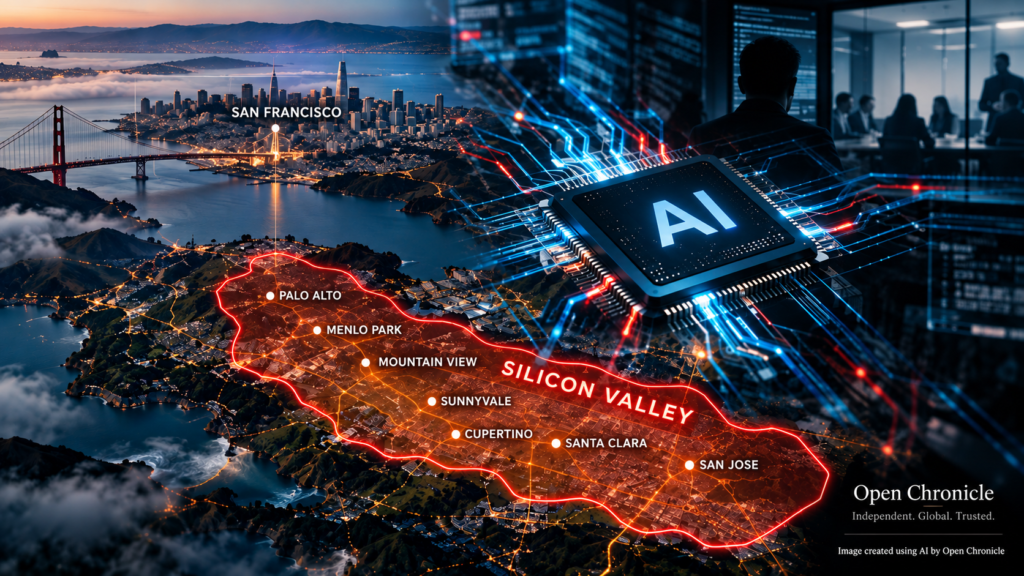
An alleged recording device at OpenAI, disputes over confidential research and a growing wave of trade-secret lawsuits are exposing a new security crisis in the artificial intelligence industry. As competition intensifies, companies are increasingly concerned about corporate espionage, foreign infiltration and the use of AI-generated identities to penetrate their workforces.
By Open Chronicle News Desk with Agencies
SAN FRANCISCO | October 15, 2026
Silicon Valley’s artificial intelligence industry is confronting an increasingly uncomfortable reality: the technology companies competing to build the world’s most powerful AI systems are becoming targets of the very surveillance, deception and information-theft techniques that their technologies can help enable.
A reported espionage investigation involving an OpenAI engineer, allegations of confidential information being shared outside the company, and a growing number of lawsuits over proprietary technology have intensified concerns about the security of America’s leading AI laboratories.
The latest developments come as artificial intelligence companies compete for highly specialised researchers, proprietary algorithms, training techniques and commercial advantages that can be worth billions of dollars.
In an industry where technical leadership can change within months, confidential information has become a strategic asset.
The resulting competition is creating an environment in which employee mobility, corporate intelligence gathering, cybercrime and national security concerns increasingly overlap.
An Alleged Recording Device at OpenAI
The latest controversy emerged after the FBI arrested an OpenAI engineer suspected of placing a recording device inside an executive conference room at the company’s San Francisco headquarters.
According to reporting published by The San Francisco Standard on October 13, the employee, identified in the reporting as a Saudi national, was suspected of secretly recording conversations within the company.
The allegations have not been established in court, and the existence of a suspected recording device does not, by itself, establish who may have received information or whether any foreign government was involved.
Nevertheless, the case has attracted attention because of the potentially sensitive discussions that take place inside executive meeting rooms at major AI laboratories.
Such conversations may concern future products, model capabilities, security vulnerabilities, research priorities, commercial partnerships and strategic decisions.
The reported incident illustrates how traditional physical surveillance methods remain relevant even within an industry primarily associated with advanced digital technology.
It also raises questions about internal access controls and the difficulty of protecting confidential discussions in organisations employing large numbers of researchers, engineers and contractors.
OpenAI Faces Internal Disputes Over Confidential Information
The reported surveillance case comes amid separate tensions over information security inside OpenAI.
Earlier this month, the company dismissed three safety researchers following allegations of misconduct, including reported disclosures of confidential information to the external AI evaluation organisation METR.
According to reporting by ABC News and The Wall Street Journal, OpenAI maintained that it could no longer trust the employees involved.
The researchers have disputed aspects of the allegations and their characterisation.
The controversy highlights a particularly sensitive issue within the artificial intelligence industry: the boundary between legitimate external safety evaluation and the protection of proprietary research.
AI developers increasingly face demands for independent scrutiny of powerful systems, particularly when those systems may introduce significant cybersecurity, societal or operational risks.
External evaluators can play an important role in assessing whether AI models behave as intended and whether developers have adequately identified potential dangers.
At the same time, companies regard certain model details, research methods and internal evaluations as commercially sensitive.
The dispute demonstrates how disagreements over transparency and confidentiality can become especially contentious when they involve employees working on AI safety.
It is important to distinguish these allegations from the separate FBI investigation. The supplied reporting does not establish any connection between the cases.
The AI Industry’s Expanding Trade-Secret Battles
OpenAI is not alone in confronting allegations involving confidential information.
In July, Apple accused OpenAI of misappropriating trade secrets in a dispute involving an employee who had previously worked for the iPhone maker.
Reporting on the litigation described allegations concerning files associated with an unreleased Apple device.
The accusations form part of a broader pattern of legal confrontations involving technology companies and former employees.
Tesla, Meta and Scale AI have pursued lawsuits alleging that departing workers or competitors improperly obtained proprietary business information.
Elon Musk’s xAI also accused a former engineer of taking confidential information concerning its Grok chatbot after accepting employment at OpenAI.
In a separate case, a judge dismissed xAI’s lawsuit against OpenAI over allegations that the company had recruited employees to obtain trade secrets.
The dismissal of that case should not be confused with a judicial determination concerning every separate allegation involving individual employees.
The broader pattern reflects the growing commercial importance of technical knowledge in artificial intelligence.
Unlike traditional industries, where competitive advantages may depend on physical factories or established distribution networks, AI companies can derive substantial value from specialised knowledge held by relatively small groups of researchers.
Information concerning model architectures, optimisation techniques, training procedures, infrastructure, datasets and product road maps can offer competitors a significant advantage.
As a result, disputes involving employee departures have become increasingly consequential.
A Second California Gold Rush
Dylan Wiseman, a lawyer at Buchalter specialising in trade-secret litigation, described the current environment as a new period of intense competition.
“This is the second gold rush for California,” he said.
Wiseman, who said he was working on five trade-secret lawsuits involving technology companies, expects litigation to remain a defining feature of the industry.
His comparison reflects the extraordinary amounts of investment flowing into artificial intelligence and the commercial pressure on companies to establish technological leadership.
The industry has experienced rapid growth, with startups founded only a few years ago attracting substantial financing and recruiting researchers from established competitors.
Many of those early employees are now beginning to move between companies.
That mobility creates opportunities for innovation, but it also raises difficult questions about the distinction between an employee’s professional expertise and information legally belonging to a former employer.
California’s employment laws add another dimension to the problem.
The state generally prohibits most post-employment noncompete agreements, allowing workers to leave one company and join a direct competitor.
That legal framework has long supported Silicon Valley’s culture of innovation and entrepreneurial mobility.
However, it also means companies seeking to protect confidential information frequently rely on trade-secret law rather than contractual restrictions preventing employees from changing jobs.
Trade-secret protections generally apply to information that derives economic value from remaining confidential and is subject to reasonable efforts to preserve its secrecy.
The challenge is proving that protected information was improperly acquired, used or disclosed, rather than merely demonstrating that an employee moved to a rival company.
For AI businesses, where expertise and proprietary knowledge can be closely intertwined, that distinction is becoming increasingly important.
Corporate Espionage Beyond the Major AI Laboratories
The growing concern about espionage is not limited to the largest artificial intelligence developers.
Human resources technology companies Rippling and Deel have been involved in a high-profile legal dispute over allegations that a competitor recruited an insider to obtain confidential information.
The controversy, which emerged in 2025, demonstrated how allegations of corporate infiltration can arise in sectors far removed from frontier AI research.
Meanwhile, AI insurance startup Corgi has pursued lawsuits against competitors and former employees, alleging the theft of proprietary technology and attempts to obtain confidential business information.
These cases illustrate the increasingly varied forms that alleged corporate espionage can take.
Some disputes involve employees accused of downloading confidential documents before leaving a company.
Others concern allegations of deliberate recruitment, internal access to proprietary systems or attempts to obtain customer information.
Not every trade-secret lawsuit establishes wrongdoing. Allegations must be assessed through the legal process, and defendants may dispute both the facts and whether the information involved qualifies for legal protection.
Nevertheless, the number and prominence of these disputes indicate that information security has become a central business concern across the technology sector.
From Coffee Shops to Conference Rooms: A New Security Culture
The growing anxiety has reportedly prompted technology companies to warn employees about unconventional intelligence-gathering techniques.
According to The Wall Street Journal, OpenAI executives have cautioned staff about people attempting to establish relationships with employees in social settings, overhear conversations in coffee shops or obtain sensitive information through personal interactions.
Similar warnings have reportedly circulated at Anthropic and Google.
The concern is that valuable information may be obtained without sophisticated cyberattacks.
A conversation about an unreleased model, a confidential technical challenge or an internal product decision could provide a competitor with useful intelligence.
This has encouraged greater attention to operational security: the everyday practices used to prevent sensitive information from being exposed.
For AI laboratories, those practices may include limiting access to confidential discussions, controlling the sharing of research materials and training employees to recognise suspicious approaches.
However, the expansion of internal security measures also creates potential tensions.
Companies must balance legitimate confidentiality requirements against employee privacy, professional collaboration, academic exchange and the ability of researchers to raise safety concerns.
Excessive suspicion could undermine the open exchange of ideas that has historically contributed to Silicon Valley’s success.
Deepfakes Open a New Front in Corporate Infiltration
Perhaps the most technologically significant development is the increasing use of AI-generated identities in recruitment.
Security companies warn that malicious applicants are using deepfake video and audio technologies to conceal their identities during remote job interviews.
Deepfakes can generate realistic faces, imitate voices and alter live video appearances, potentially allowing applicants to present themselves as entirely different people.
Although synthetic media technology has existed for years, recent improvements in openly available AI models have made it substantially cheaper and easier to deploy.
Some models can now run locally on personal computers, reducing the need for expensive cloud infrastructure.
Ben Colman, chief executive of deepfake detection company Reality Defender, said this shift dramatically expanded access to the technology.
“That singlehandedly opened the floodgates,” he said.
According to Colman, many of the Fortune 500 companies using Reality Defender’s services believe they have been targeted by espionage attempts associated with foreign adversaries.
These assessments are based on the company’s reported experience and should not be interpreted as independently verified evidence that every suspicious applicant was engaged in espionage.
Nevertheless, the claims highlight a growing concern among employers: a convincing video interview and an apparently valid professional identity may no longer provide sufficient assurance about an applicant’s authenticity.
When Job Applicants May Not Be Who They Claim
One case described by Reality Defender illustrates the scale of the problem.
According to Colman, a financial services company using the firm’s technology identified potential espionage indicators involving three of four finalists for a senior technology position.
Two candidates allegedly used fabricated identities that had nevertheless passed background checks.
A third application appeared to involve a real individual whose identity had been used without authorisation.
When the employer contacted that person directly with a job offer, the individual reportedly said they had never applied.
Colman declined to identify the financial services company.
The account has not been independently verified, but it illustrates the potential limitations of conventional recruitment screening.
Employers have traditionally relied on identity documents, background checks, references and interviews to establish whether candidates are legitimate.
Synthetic identities and AI-assisted impersonation can complicate each of those processes.
A fabricated applicant might combine genuine personal information with false employment records, altered video appearances and artificial speech.
If such a candidate obtained employment, they could potentially gain access to internal systems, confidential documents and sensitive communications.
The risks are particularly serious in positions involving software engineering, cybersecurity, cloud infrastructure or advanced AI research.
North Korean Remote-Worker Schemes Raise National Security Concerns
The problem also intersects with concerns about overseas networks attempting to obtain employment at American companies through fraudulent identities.
US authorities have previously investigated schemes involving North Korean information technology workers who allegedly secured remote positions using false identities or assistance from intermediaries.
Such operations have been linked to efforts to generate revenue for North Korea, and some investigations have also involved allegations of data theft.
The distinction matters: not every fraudulent employment application is necessarily an espionage operation, and the presence of a foreign applicant does not establish illicit intent.
However, access to sensitive systems through a fraudulent identity can create significant security risks regardless of the applicant’s immediate objective.
Pindrop Security, another company specialising in detecting manipulated audio and synthetic identities, reported encountering a suspected North Korean-linked applicant during recruitment for a senior software engineering position in the United States.
According to Pindrop chief executive Vijay Balasubramaniyan, the individual appeared well prepared during a virtual interview and answered technical questions confidently.
The company later identified an internet connection that it associated with North Korea.
That technical indicator raised concerns but does not, by itself, conclusively establish the applicant’s nationality, identity or relationship with a government intelligence service.
Pindrop also reported identifying indicators of possible North Korean connections in approximately one out of every 47 applicants reviewed across its clients during 2026.
The company described the rate as seven times higher than the previous year.
These figures represent Pindrop’s own detection results, rather than an independently established prevalence rate across the wider US employment market.
Even with those limitations, the findings suggest that identity verification is becoming a significant cybersecurity challenge.
Human Resources Becomes a Cybersecurity Front Line
The emergence of deepfake recruitment schemes is changing the role of human resources departments.
Traditionally, corporate cybersecurity teams have focused on networks, software vulnerabilities, employee credentials and external attacks.
Recruitment was often treated primarily as an administrative and personnel-management function.
That division is becoming increasingly difficult to maintain.
A fraudulent employee who successfully completes the hiring process may receive legitimate access credentials, company equipment and permission to work inside protected systems.
From a security perspective, the organisation may have inadvertently granted an attacker authorised access.
This can make recruitment-based infiltration particularly difficult to detect.
Unlike an external hacker attempting to bypass security controls, a malicious employee may initially appear to be a legitimate user performing ordinary job-related tasks.
Colman said human resources departments are now becoming part of cybersecurity discussions in ways that would have been unusual only a few years ago.
The change reflects a broader recognition that identity verification, employee screening and internal access management are interconnected security functions.
It also creates a need for proportionate safeguards that protect companies without subjecting legitimate applicants to unjustified suspicion or discriminatory screening.
The Strategic Stakes of AI Espionage
The consequences of alleged espionage in artificial intelligence extend beyond individual companies.
Advanced AI systems are increasingly relevant to economic productivity, scientific research, cybersecurity, defence applications and national technological competitiveness.
Governments regard leadership in AI as a strategic priority, while companies invest heavily in research infrastructure and specialised talent.
Confidential information about a leading AI model could therefore have value not only to commercial competitors but potentially to foreign intelligence services.
That does not mean every trade-secret dispute is connected to state-sponsored espionage.
The distinction between commercial misconduct, ordinary employment disputes, criminal information theft and foreign intelligence activity remains essential.
Yet the growing overlap between commercial AI development and national security is making those distinctions more consequential.
A company developing advanced models may simultaneously face ordinary business competition, insider threats, cyberattacks and attempts at foreign intelligence collection.
Protecting proprietary technology increasingly requires organisations to consider all four risks.
The Big Picture: AI Companies Face a Security Paradox
Silicon Valley’s growing espionage fears expose a fundamental paradox at the centre of the artificial intelligence boom.
The industry depends on the rapid movement of ideas, research collaboration and competition for highly skilled workers.
Those same characteristics can make it difficult to protect commercially valuable information.
At the same time, advances in generative AI are making some forms of deception cheaper, more convincing and more accessible.
Deepfake interviews, synthetic identities and AI-assisted impersonation are transforming risks that once required extensive resources into threats that may be attempted by smaller groups or individual actors.
The result is a new security environment in which traditional corporate confidentiality, physical surveillance, digital identity verification and national security concerns increasingly converge.
For leading AI laboratories, the challenge will be to protect sensitive research without creating cultures of excessive secrecy that undermine scientific collaboration or legitimate scrutiny.
For employers across the wider economy, the challenge is ensuring that remote recruitment and identity verification remain trustworthy in an era of increasingly realistic synthetic media.
For policymakers, the task is to distinguish genuine espionage and criminal activity from ordinary competition, lawful employee mobility and contested allegations.
The current wave of investigations and lawsuits may ultimately shape how the next generation of AI companies approaches security, employment and intellectual property.
Silicon Valley’s technological race is no longer simply about who can build the most powerful model.
It is also about who can protect the knowledge, people and systems behind it.
Open Chronicle | News Desk
Sources and Further Reading
News reporting, legal developments, firsthand accounts and institutional records concerning alleged corporate espionage, trade-secret disputes and security threats across the artificial intelligence industry.
01 | Investigative Reporting
The San Francisco Standard
OpenAI Engineer Arrested Over Alleged Conference-Room Bugging, October 13, 2026
Reporting on the FBI investigation involving an OpenAI employee suspected of concealing a recording device inside an executive conference room.
02 | Technology News
ABC News
OpenAI Dismisses Three Safety Researchers Amid Dispute Over AI Risks
Reporting on the dismissal of three OpenAI safety researchers and the company’s stated concerns regarding employee conduct and trust.
03 | Corporate Information Security
The Wall Street Journal
OpenAI Parts Ways With Researchers Allegedly Involved in Confidential Information Disclosures
Coverage of allegations involving confidential information reportedly shared with external AI safety evaluators.
04 | Firsthand Account
Mikita Balesni
Public Letter Concerning the OpenAI Researcher Dispute
A first-person response contesting aspects of the allegations surrounding the researchers’ departures. Included to represent the disputed account.
05 | Legal Reporting
Reuters
Litigation Involving Apple, OpenAI and Alleged Trade Secrets, October 14, 2026
Reporting on legal allegations involving confidential Apple information and an employee who subsequently joined OpenAI.
06 | Trade-Secret Litigation
Reuters
xAI Lawsuit Against Former Engineer, August 29, 2025
Reporting on allegations that a former xAI engineer took confidential information relating to the Grok chatbot.
07 | Judicial Developments
Reuters
Dismissal of xAI Trade-Secret Lawsuit Against OpenAI, June 15, 2026
Coverage of a court decision concerning xAI’s separate allegations against OpenAI.
08 | Corporate Espionage Allegations
The San Francisco Standard
Corporate Espionage Allegations in the Rippling–Deel Dispute
Reporting on the legal confrontation between the two human resources technology companies.
09 | Technology Industry Litigation
TechCrunch
Scale AI and Alleged Theft of Customer Information
Coverage of trade-secret litigation involving Scale AI, a former employee and competitor Mercor.
10 | Official Government Records
United States Department of Justice
Fraudulent Remote IT Worker Schemes
Official information concerning criminal proceedings related to fraudulent remote employment arrangements associated with North Korean workers.
Open Chronicle | Editorial Transparency
Editorial Note
This article is an original Open Chronicle news synthesis based on the supplied reporting concerning alleged corporate espionage, trade-secret disputes, employee misconduct investigations and AI-enabled recruitment fraud in the technology industry.
The reported FBI arrest involving an OpenAI employee is attributed to The San Francisco Standard. The allegations remain subject to the applicable legal process and should not be interpreted as proof of guilt or evidence of involvement by any foreign government.
The allegations concerning the dismissal of three OpenAI safety researchers are presented alongside the fact that the researchers have disputed aspects of the company’s account. The article does not establish that the reported disclosure of information constituted criminal espionage.
References to trade-secret lawsuits involving Apple, OpenAI, xAI and other technology companies distinguish legal allegations from judicial findings.