
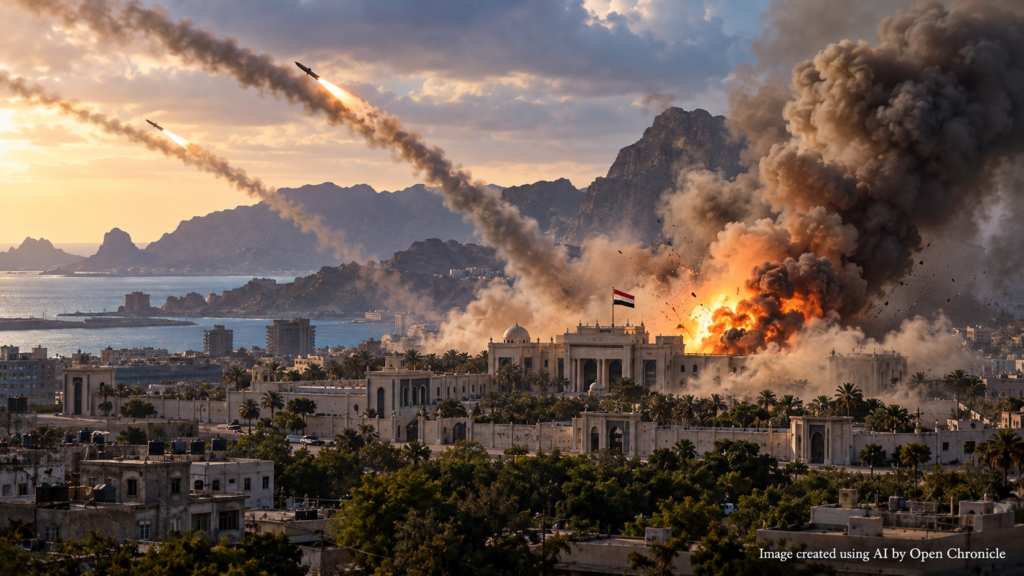
Multiple explosions were reported near Yemen’s presidential palace complex in Aden, while Saudi authorities accused the Iran-aligned Houthi movement of launching repeated attacks against airports, ports and energy infrastructure. The latest developments raise fears of a wider regional escalation.
By Open Chronicle News Desk with Agencies
ADEN / RIYADH | October 15, 2026
Houthi forces launched several missiles towards Yemen’s presidential palace complex in the southern city of Aden on Thursday, according to two Yemeni government officials cited by Reuters, marking another significant escalation in the country’s renewed conflict.
Witnesses reported hearing multiple loud explosions near the palace, a politically sensitive location associated with Yemen’s internationally recognised government.
The immediate extent of the damage, whether the missiles struck the complex directly, and whether there were casualties remained unclear. There was no independently confirmed assessment of the impact in the initial reporting.
The reported attack comes amid an intensifying confrontation between the Houthis and Saudi Arabia, with the Saudi-led military coalition accusing the movement of conducting repeated missile and drone operations against civilian and strategic infrastructure across the kingdom.
The escalation threatens to undermine years of fragile efforts to prevent Yemen’s civil war from returning to sustained large-scale hostilities.
Presidential Palace Reportedly Targeted in Aden
Aden has served as a principal seat of Yemen’s internationally recognised authorities since the Houthi movement took control of the capital, Sanaa, in 2014.
The presidential palace complex carries considerable political and symbolic importance, making any attack against it a potentially significant development in the struggle for control of Yemen.
According to the two government officials cited by Reuters, several missiles were directed towards the complex on Thursday.
Residents and other witnesses described hearing powerful explosions in the surrounding area.
The initial reports did not establish how many missiles reached their intended targets or whether air-defence systems intercepted any of them.
There was also no immediate independent confirmation of casualties or structural damage.
If confirmed as a direct strike against the presidential compound, the attack would represent an attempt to threaten one of the internationally recognised government’s most prominent institutional locations.
The reported operation also highlights the Houthis’ continuing ability to project military force beyond the territory under their control.
Saudi Coalition Reports Extensive Attacks on Civilian Infrastructure
The confrontation has also intensified across the Saudi border.
The Saudi-led military coalition said the Houthis had attempted to strike dozens of airports, ports and oil facilities in Saudi Arabia during the latest phase of fighting.
Coalition spokesperson Turki al-Maliki presented figures indicating a substantial campaign against Saudi infrastructure, particularly aviation facilities.
According to Maliki, the Houthis launched 20 attacks against King Khalid International Airport in Riyadh during October.
He said those attacks had killed 17 people and wounded 333 others.
The casualty figures were presented by the Saudi-led coalition and could not be independently verified from the information available.
King Khalid International Airport is one of Saudi Arabia’s principal international aviation gateways, serving the capital and connecting the kingdom with destinations across the Middle East, Europe, Asia and beyond.
Repeated attacks against such infrastructure could have consequences extending beyond the immediate conflict, potentially affecting civilian aviation, commercial activity and international travel.
The coalition also reported attacks against Abha International Airport, near the Yemeni border in southwestern Saudi Arabia.
According to Maliki, those operations had killed three people and wounded 28 others.
The allegations underline the growing importance of civilian infrastructure in the confrontation between the Houthis and the Saudi-led coalition.
Ballistic Missiles, Drones and Maritime Threats
The Saudi coalition accused the Houthis of deploying an increasingly sophisticated arsenal that includes ballistic missiles, unmanned aerial vehicles and explosive-laden fast boats.
Maliki said the movement had obtained advanced military technology with assistance from what he described as regional actors.
Although the Houthis are widely regarded as aligned with Iran, the coalition’s latest allegations concerning external military assistance were not accompanied in the supplied reporting by independently verifiable evidence identifying specific transfers or suppliers.
The coalition spokesperson also claimed that Saudi-led forces had destroyed 127 Houthi weapons storage facilities and launch platforms in Yemen’s mountainous regions.
Those figures likewise remain claims by a party to the conflict.
The use of missiles and drones has become a defining feature of the regional security environment, allowing armed groups to threaten targets far beyond conventional front lines.
In Yemen, the country’s mountainous geography and fragmented territorial control complicate efforts to locate launch sites, secure transport routes and prevent renewed attacks.
The reported use of explosive-laden boats adds a maritime dimension to the threat, particularly given Yemen’s proximity to the Red Sea and the Bab el-Mandeb Strait, a strategically important passage for international shipping.
Houthis Renew Warning to International Airlines
Shortly after the Saudi coalition released its latest assessment, a Houthi military spokesperson renewed a warning that Saudi airspace and airports should be considered unsafe.
The warning was directed at airlines operating in or near the kingdom.
The Houthi spokesperson made an exception for airspace over the Islamic holy cities of Mecca and Medina.
The announcement followed a week of reported ballistic missile and drone launches against Saudi targets, which the Houthis have presented as retaliation for Riyadh’s support of government forces in Yemen.
The warning is significant because of its potential implications for civilian aviation.
Airlines operating in conflict-affected regions must evaluate security information, airspace restrictions and guidance issued by relevant aviation authorities.
However, a warning issued by an armed group does not, by itself, establish that all Saudi airspace is unsafe or constitute an official aviation restriction.
Any operational consequences would depend on the evolving security situation and decisions by airlines, national regulators and air-traffic authorities.
The renewed threat nevertheless illustrates how the conflict is increasingly extending into areas with direct implications for civilian populations and international transport.
Saudi Arabia Warns of Further Consequences
In his remarks, Maliki called on the Houthis to stop attacks targeting civilians and civilian infrastructure.
He also urged the movement to examine the coalition’s statement carefully and read what he described as the message “between the lines.”
The remarks appeared intended to convey a warning about possible further military or political consequences, although the coalition did not specify a new operation in the supplied account.
The exchange of warnings highlights the deteriorating relationship between the Saudi-led coalition and the Houthis after a prolonged period of relative military restraint.
For Saudi Arabia, protecting airports, oil installations and other essential infrastructure remains a major national security priority.
For the Houthis, the ability to launch long-range attacks offers a means of exerting pressure on Riyadh despite the substantial differences in conventional military capabilities.
The danger is that successive rounds of retaliation could make de-escalation increasingly difficult.
Yemen’s Fragile Truce Under Pressure
Yemen’s present crisis is rooted in more than a decade of conflict.
The Houthis seized control of Sanaa in 2014, triggering a political and military confrontation with the internationally recognised government.
A Saudi-led coalition intervened militarily in March 2015 in support of the government.
The conflict subsequently developed into a prolonged war involving competing Yemeni factions, regional powers and an extensive humanitarian emergency.
A United Nations-brokered truce in April 2022 significantly reduced major hostilities.
Although the formal agreement expired six months later, a degree of relative calm continued, creating opportunities for diplomatic engagement and discussions about a broader political settlement.
Those negotiations, however, failed to produce a comprehensive and durable peace agreement.
The latest reported missile attacks in Aden and Saudi Arabia illustrate how vulnerable that period of relative stability has become.
Renewed hostilities risk further weakening Yemen’s already fragile institutions, infrastructure and economy.
They could also complicate humanitarian operations in a country where years of war have left large sections of the population dependent on assistance.
The Regional Dimension: Iran, Saudi Arabia and Strategic Infrastructure
The Houthis’ relationship with Iran has long been a major concern for Saudi Arabia and its regional partners.
Tehran’s political alignment with the movement and longstanding allegations of Iranian military support have made the Yemeni conflict part of the wider struggle for influence in the Middle East.
Nevertheless, the Houthis retain their own political leadership, territorial interests and military objectives within Yemen.
The renewed attacks must therefore be understood both as developments in Yemen’s domestic war and as potential sources of wider regional instability.
Saudi airports, energy facilities and ports are particularly sensitive targets because of their importance to international commerce and the kingdom’s economic infrastructure.
Escalation affecting these facilities could create uncertainty for aviation, investment and energy markets.
At the same time, attacks against government institutions in Aden could deepen Yemen’s internal political fragmentation.
The simultaneous pressure on Saudi infrastructure and Yemeni government positions suggests that the confrontation is unfolding across multiple fronts.
International Humanitarian Law and Civilian Protection
The reported attacks also raise questions about the protection of civilians during armed conflict.
International humanitarian law requires parties to distinguish between military objectives and civilian persons and objects.
Civilian airports, residential areas and other civilian infrastructure are protected from deliberate attack unless and for such time as they qualify as military objectives under the applicable legal rules.
Even where a legitimate military objective is present, attacks remain subject to the requirements of proportionality and precautions to minimise civilian harm.
The reported casualty figures at Saudi airports, if verified, would warrant careful independent investigation.
Likewise, the circumstances surrounding the reported missile strikes near Aden’s presidential palace would require examination before any legal conclusions could be reached.
The initial information does not establish the precise targets, weapons impacts or civilian consequences of Thursday’s reported operation.
The Big Picture: Yemen Risks Returning to a Wider War
The reported missile attack against the presidential palace in Aden, combined with the escalating confrontation between the Houthis and Saudi Arabia, points to a dangerous moment in Yemen’s prolonged conflict.
Three developments are particularly significant.
First, the targeting of a major government compound suggests that Yemen’s political institutions may again face direct military pressure.
Second, repeated allegations of attacks against Saudi airports and strategic facilities indicate a widening confrontation with potentially serious consequences for civilian security and regional commerce.
Third, the renewed Houthi warnings to international airlines demonstrate how the conflict is extending beyond traditional battlefields into the broader transport and economic environment.
Much remains uncertain, including the damage caused in Aden, the independent verification of Saudi casualty figures and the likelihood of further retaliation.
What is clear from the reported statements is that both sides are describing a rapidly intensifying confrontation.
For Yemen, the immediate danger is that the remaining foundations of the post-2022 de facto truce could erode further.
For the wider region, the risk is that attacks and counterattacks will expand before diplomacy can re-establish meaningful restraints.
After more than a decade of war, the latest escalation threatens to push Yemen further away from a negotiated settlement and towards another destructive phase of conflict.
Open Chronicle | News Desk
Sources and Further Reading
Reporting, official statements and institutional
references concerning the reported missile attacks
in Aden, the escalation involving Saudi Arabia
and the wider conflict in Yemen.
01 | International News Reporting
Reuters
Report on Missile Attacks Near Yemen’s
Presidential Palace, October 15, 2026
Reporting attributed to two Yemeni government
officials concerning missiles directed towards
the presidential palace complex in Aden,
alongside witness accounts of explosions.
02 | Regional News Coverage
The Jerusalem Post
Reporting on Houthi Operations and
Saudi Coalition Statements
Coverage of the renewed confrontation,
including Saudi allegations concerning
attacks against airports and other
infrastructure.
03 | Official Military Statements
Saudi-Led Coalition
Statements by Spokesperson Turki al-Maliki
Coalition allegations concerning the
number of attacks, reported casualties,
weapons systems and military operations
against Houthi facilities, as reproduced
in the supplied reporting.
Source attribution: Statements reproduced
in the news reporting. No direct official
statement URL has been supplied.
04 | United Nations | Peace Process
United Nations Office of the Special
Envoy of the Secretary-General for Yemen
Institutional background on Yemen’s
peace process, the 2022 truce and
diplomatic efforts towards a
political settlement.
05 | United Nations | Humanitarian Affairs
United Nations Office for the
Coordination of Humanitarian Affairs
— Yemen
Background on the humanitarian
consequences of Yemen’s prolonged
conflict and the importance of
civilian protection.
Open Chronicle | Editorial Transparency
Editorial Note
This article is an original Open Chronicle news
synthesis based on the supplied reporting concerning
alleged Houthi missile attacks against Yemen’s
presidential palace complex in Aden and the
escalating confrontation between the Houthi
movement and Saudi Arabia.
The initial report of missiles directed towards
the presidential compound is attributed to two
Yemeni government officials cited by Reuters.
Witness accounts of explosions do not independently
establish the number of missile impacts,
casualties or damage.
The figures concerning attacks against Saudi
airports, including reported deaths and injuries,
are attributed to Saudi-led coalition spokesperson
Turki al-Maliki. They are presented as claims by
a party to the conflict and have not been
independently verified for this article.
Claims concerning the destruction of Houthi
weapons facilities and the involvement of
regional actors in military technology
transfers are similarly attributed to
the coalition.
The article distinguishes reported developments
from broader editorial analysis concerning
regional security, aviation, international
humanitarian law and the prospects for
renewed diplomacy.
United Nations institutional references
provide background and avenues for further
verification. They should not be understood
as independent confirmation of the specific
attacks described.
The situation remains fluid, and details may
change as further independently verified
information becomes available.
Open Chronicle
Independent. Global. Trusted.