
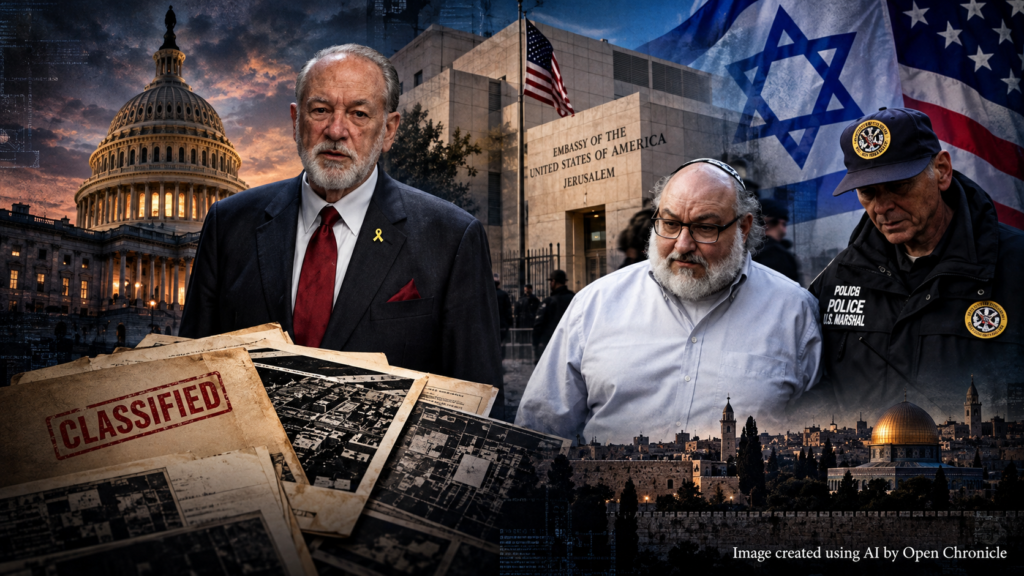
Allegations that a senior aide to Ambassador Mike Huckabee altered or suppressed sensitive diplomatic assessments have renewed scrutiny of Washington’s relationship with Israel. The controversy raises broader questions about intelligence, political influence and whether American diplomats can report independently on developments in the occupied Palestinian territories.
By Open Chronicle News Desk
WASHINGTON / JERUSALEM | October 15, 2026
Allegations of political interference inside the United States Embassy in Jerusalem have brought renewed attention to a sensitive question in American foreign policy: whether diplomatic reporting on Israel and the Palestinian territories is reaching Washington without being reshaped by officials’ political preferences.
At the centre of the controversy is David Milstein, a senior aide to US Ambassador Mike Huckabee, who has reportedly exercised considerable influence over the embassy’s reporting on the occupied West Bank and Gaza.
According to an October 8 investigation by The New York Times, based on interviews with people familiar with the embassy’s operations, Milstein repeatedly intervened in diplomatic assessments concerning Israeli settlement expansion, violence in the West Bank and humanitarian operations in Gaza.
The allegations suggest that some reports were rewritten, delayed or prevented from reaching the State Department in their original form.
If substantiated, such practices would raise serious questions about the reliability of information provided to American policymakers.
The controversy is especially significant because US diplomatic reporting helps inform decisions concerning military assistance, regional security, sanctions, humanitarian policy and relations with both Israeli and Palestinian authorities.
It also emerges against the backdrop of a long and sometimes troubled intelligence relationship between the United States and Israel.
However, the current allegations concern diplomatic management and political influence. They do not, by themselves, establish espionage, unlawful conduct or the existence of a foreign intelligence operation.
The Allegations Against a Senior Embassy Aide
Milstein serves as a senior adviser to Ambassador Huckabee and has reportedly played an important role in overseeing the embassy’s work concerning the West Bank and Gaza.
His influence has attracted scrutiny following accounts from current and former personnel who described disagreements over the handling of sensitive diplomatic reports.
According to The New York Times, Milstein intervened in assessments that presented Israeli government policies in an unfavourable light.
The reported interventions involved issues central to American policy in the region, including settlement construction, violence against Palestinians and the conduct of humanitarian operations.
Diplomatic cables are an essential part of the State Department’s information system.
They allow embassies to provide Washington with political assessments, accounts of meetings, observations from the field and analysis of developments that may affect American interests.
Although senior officials have legitimate authority to review diplomatic reporting, concerns arise when factual assessments are allegedly changed or suppressed to support a predetermined political conclusion.
The distinction between editorial supervision and political distortion is therefore central to the controversy.
The accounts attributed to embassy personnel warrant scrutiny, but the supplied material does not establish that an official investigation has determined Milstein engaged in misconduct.
Settlement Expansion and a Report That Allegedly Never Reached Washington
One reported episode concerned the Israeli government’s approval of additional settlement construction in the occupied West Bank.
Settlement expansion remains among the most contentious issues in the Israeli-Palestinian conflict.
Most of the international community considers Israeli settlements in occupied territory contrary to international law, a position Israel disputes.
According to the reporting, embassy personnel prepared an urgent assessment warning that new Israeli construction approvals could conflict with President Donald Trump’s stated opposition to formal annexation.
The document reportedly did not leave Jerusalem.
If accurate, the episode would raise questions about whether policymakers in Washington received the full range of assessments prepared by their diplomatic staff.
The issue is not simply whether the American administration supports or opposes a particular settlement decision.
It is whether officials responsible for evaluating developments can communicate relevant information, including assessments that may be politically inconvenient.
A diplomatic reporting system that consistently excludes unfavourable information risks weakening the government’s ability to anticipate crises and assess policy consequences.
West Bank Violence and Competing Accounts
A second allegation concerns the embassy’s reporting on violence in the occupied West Bank.
Attacks involving Israeli settlers and Palestinians have become a major source of concern for humanitarian organisations, diplomats and international observers.
The supplied material describes embassy personnel preparing an assessment documenting failures by Israeli authorities to prevent or adequately address attacks against Palestinian communities.
According to The New York Times account, Milstein revised the material before it was transmitted to Washington.
The resulting diplomatic cable reportedly carried the title “Government Cracks Down on Escalating West Bank Violence.”
That formulation suggested a more favourable assessment of Israeli enforcement efforts than the one reportedly contained in the original draft.
The precise wording and full contents of the documents have not been independently examined for this article.
Nevertheless, the alleged discrepancy illustrates why the integrity of diplomatic reporting matters.
American officials assessing developments in the West Bank need accurate information about the scale of violence, the response of law enforcement and the risks of further escalation.
Reporting that systematically understates such problems could affect decisions about diplomatic engagement, accountability measures and security cooperation.
Questions Over Humanitarian Reporting in Gaza
The controversy also extends to reporting on humanitarian operations in Gaza.
According to the supplied account, embassy personnel raised concerns about the conditions surrounding distribution sites associated with the Gaza Humanitarian Foundation.
The concerns reportedly involved disorder and deadly incidents around aid distribution.
Milstein was said to have offered a more positive assessment of the operation.
The Gaza humanitarian crisis has generated extensive international debate over the effectiveness, security and accessibility of aid delivery mechanisms.
Accurate reporting is particularly important because assessments of humanitarian operations can influence American funding decisions, diplomatic positions and discussions with Israeli authorities.
The allegations do not independently establish the complete circumstances of every reported incident at distribution sites.
They do, however, raise a broader institutional question: whether field reporting was assessed on its evidentiary merits or filtered through political preferences.
American Citizens Killed in the West Bank
Another disputed episode concerns investigations into the deaths of Palestinian Americans in the occupied West Bank.
Senator Chris Van Hollen and congressional colleagues have sought information from the administration about accountability for the deaths of American citizens.
According to the supplied material, a group of 30 lawmakers pressed for answers concerning nine Palestinian Americans killed in incidents involving Israeli settlers or security personnel.
Embassy staff reportedly prepared an assessment indicating limited investigative progress and a lack of criminal charges.
The account alleges that the report was set aside in favour of a response portraying Israeli authorities as appropriately handling the cases.
The distinction is significant.
When American citizens are killed abroad, US officials have a responsibility to seek reliable information about the circumstances and the status of investigations.
Congress also has an oversight role in examining whether the executive branch is adequately protecting American citizens’ interests.
A misleading account of investigative progress, if established, could undermine both diplomatic accountability and congressional oversight.
The underlying allegations require examination of the relevant correspondence and investigative records.
A Reported Decline in Diplomatic Cables
Beyond individual documents, the New York Times investigation reportedly described a decline in cable traffic from embassy personnel responsible for Palestinian affairs.
According to the account, reporting that had previously been sent several times a week fell to only a few communications each month.
Some staff members reportedly feared that their work would be blocked, rewritten or used against them professionally.
A reduction in diplomatic reporting is not, on its own, proof of improper interference.
Reporting volumes can change because of staffing, operational priorities or administrative decisions.
However, if diplomats stopped submitting assessments because they believed their findings would be suppressed, that would represent a potentially serious institutional problem.
Diplomatic missions depend on professional personnel being able to communicate candid assessments to headquarters.
The value of an embassy lies partly in its ability to identify developments that political leaders may not wish to hear about.
When that function is weakened, decision-makers can become increasingly dependent on incomplete or selectively favourable information.
Political Alignment Versus Professional Responsibility
The allegations also involve the political environment within the embassy.
According to the supplied reporting, Milstein questioned personnel about whether they were supportive of Israel or sympathetic to Hamas.
If accurately reported, such exchanges would raise concerns about the standards used to evaluate diplomatic staff.
American officials are expected to carry out lawful administration policy.
They are not required to hold identical personal political views.
Professional disagreements over facts, assessments or policy consequences should not automatically be treated as evidence of disloyalty.
This distinction is essential in diplomatic institutions.
A diplomat may support a government’s overall policy while also reporting that a particular measure has failed, that an ally has acted contrary to American interests or that official statements are inconsistent with observed events.
Such reporting is not inherently political opposition.
It is part of the professional responsibility of informing government decisions.
The relevant standard is whether officials accurately and lawfully serve the United States, not whether they hold particular religious beliefs or ideological commitments.
Huckabee’s Embassy and the Politics of US-Israel Relations
Ambassador Mike Huckabee has long been associated with strong political and religious support for Israel.
His views are well established in American public life.
An ambassador is entitled to advocate the policies of the administration that appointed him.
That includes policies involving Israel’s security, diplomatic relations and regional strategy.
However, the responsibility to implement administration policy is distinct from the responsibility to ensure that factual reporting remains reliable.
The controversy surrounding Milstein therefore raises questions about institutional practice rather than simply political ideology.
A diplomatic mission can legitimately pursue a strongly pro-Israel policy while still providing Washington with accurate accounts of settlement expansion, violence and humanitarian conditions.
Indeed, reliable reporting is particularly important when a government maintains a close relationship with another country.
Alliances do not eliminate disagreements or remove the need for independent assessments.
The Historical Shadow of Jonathan Pollard
The allegations have revived comparisons with earlier controversies involving Israeli intelligence activity in the United States.
The most prominent case remains that of Jonathan Pollard.
Pollard, a civilian intelligence analyst working for the US Navy, was arrested in 1985 after providing classified American intelligence to Israel.
He pleaded guilty to conspiracy to commit espionage and received a life sentence in 1987.
Pollard was released on parole in 2015, after serving approximately three decades in prison.
Israel initially distanced itself from the operation before formally acknowledging in 1998 that Pollard had acted as an Israeli agent.
The case caused considerable damage to trust between American and Israeli intelligence institutions.
Pollard transferred highly sensitive classified material, and American authorities considered the compromise exceptionally serious.
Some intelligence assessments and subsequent reporting also raised concerns about whether information obtained through the operation may have reached other countries.
Claims about the full extent of any onward transfer, including allegations involving the Soviet Union, should be distinguished from the espionage offences established in Pollard’s case.
The Pollard affair demonstrates that even close allies can conduct intelligence operations against one another.
But it does not establish that contemporary American officials who favour Israel are engaged in espionage.
That distinction is essential.
Other Cases Involving Israeli Intelligence Interests
Pollard was not the only individual prosecuted in the United States in cases involving classified information and Israeli interests.
Lawrence Franklin, a Pentagon analyst, pleaded guilty in 2005 to offences involving the unauthorised disclosure of classified defence information.
His case involved contacts with an Israeli diplomat and representatives of the American Israel Public Affairs Committee, commonly known as AIPAC.
Ben-Ami Kadish, a former US Army engineer, pleaded guilty in 2008 in a case involving classified documents provided to an Israeli government contact.
He was sentenced without imprisonment.
Another case involved former NASA scientist Stewart Nozette, who was arrested following an FBI operation in which an undercover agent posed as an Israeli intelligence representative.
Nozette’s case involved attempted espionage rather than proof that he had successfully transferred information to an actual Israeli intelligence officer during the sting.
These cases illustrate the distinction between documented criminal activity and broader claims about political influence.
Espionage involves conduct that can be assessed through evidence, legal proceedings and established offences.
Political advocacy, ideological alignment and disagreements over foreign policy are not equivalent to espionage.
The Iraq War and the Debate Over Foreign Policy Influence
The broader argument about American policy toward Israel also reaches back to the years preceding the 2003 invasion of Iraq.
Several influential American policymakers advocated a more assertive US approach toward Saddam Hussein’s government.
Among them were Richard Perle, Douglas Feith and Paul Wolfowitz, who held or had held influential defence-policy roles.
Perle and Feith were also associated with the 1996 policy paper A Clean Break: A New Strategy for Securing the Realm, prepared for incoming Israeli Prime Minister Benjamin Netanyahu.
The document advocated a substantial reorientation of Israeli regional strategy and discussed the removal of Saddam Hussein as part of a broader approach to Middle Eastern security.
The overlap between some policy arguments in that document and later American debates over Iraq has attracted considerable historical scrutiny.
However, the existence of that overlap does not establish that the Iraq War was undertaken on Israel’s behalf or that American officials involved were acting as foreign agents.
The decision to invade Iraq emerged from a combination of American government assessments, strategic assumptions, political decisions and claims about Iraqi weapons programmes.
Those decisions remain open to extensive historical criticism.
But criticism of their consequences should not be substituted for evidence concerning the motivations or loyalties of individual officials.
The Role of Advocacy and Political Networks
American foreign policy is shaped by a wide range of actors.
These include elected officials, government agencies, think tanks, lobbying organisations, advocacy groups, religious movements, businesses and media commentators.
Pro-Israel organisations are among the participants in this system.
So are organisations advocating Palestinian rights, arms-control policies, military restraint and alternative approaches to Middle Eastern security.
The influence of any group should be evaluated through identifiable activities such as lobbying, campaign contributions, public advocacy, access to decision-makers and participation in policy discussions.
A strong political preference for Israel does not establish improper conduct.
Nor does criticism of Israeli government policy establish hostility toward Jewish Americans or Judaism.
Maintaining those distinctions is necessary for a credible examination of US foreign policy.
The relevant questions concern transparency, accountability, evidence and the public interest.
Where officials have financial conflicts, improperly disclose classified information or manipulate official reporting, those actions can be examined under applicable rules.
Where they advocate controversial policies through lawful channels, their arguments and decisions can be challenged through public debate and democratic oversight.
The Media Dimension: Advocacy, Commentary and Government Service
The supplied commentary also raises questions about individuals who have worked in both political communication and advocacy concerning Israel.
One example is David Frum, a former speechwriter for President George W. Bush.
Frum is associated with the phrase “axis of evil,” which became prominent in the administration’s early national-security rhetoric.
The phrase helped frame American discussion of Iraq, Iran and North Korea.
Reporting has also described Frum’s involvement in preparing speeches for an Israeli diplomatic representative.
Such work can raise legitimate questions about transparency and professional relationships, depending on the circumstances.
However, writing for officials from different governments does not by itself establish espionage, improper foreign control or responsibility for a subsequent war.
Similarly, the existence of pro-Israel ownership interests, editorial positions or political advocacy within media organisations does not demonstrate collective control of American journalism.
Claims about media influence require evidence about specific decisions, financial relationships or editorial practices.
Broad allegations that an ethnic or religious group controls the media are not a substitute for such evidence.
Why Accurate Diplomatic Reporting Matters
The central issue in the Jerusalem embassy controversy is the integrity of information moving through government institutions.
Diplomatic reporting is not merely an administrative process.
It is one of the ways governments understand political developments, assess risks and evaluate the consequences of their policies.
An embassy’s assessment of settlement expansion can affect diplomatic negotiations.
Reporting on violence against civilians can inform accountability measures.
Information about humanitarian operations can influence assistance decisions.
And assessments concerning the deaths of American citizens abroad can shape congressional oversight and relations with foreign governments.
If reports are systematically altered to produce politically convenient conclusions, policymakers may lose access to the information necessary for sound decisions.
The consequences can extend beyond a single country or administration.
A culture of self-censorship may persist even after individual officials leave their positions.
That is why allegations concerning suppressed diplomatic reporting deserve careful examination regardless of the country involved.
What Remains Unanswered
Several questions emerge from the reporting.
Did embassy personnel prepare assessments that were materially changed or prevented from reaching Washington?
Were those decisions based on legitimate supervisory review or an effort to exclude politically inconvenient information?
Did senior State Department officials receive alternative accounts of the same events?
Were congressional inquiries about American citizens’ deaths answered with an accurate representation of the available evidence?
And did embassy personnel face professional pressure that discouraged candid reporting?
Answering these questions would require access to relevant diplomatic records, testimony from personnel and responses from the officials concerned.
The supplied material does not establish that such an inquiry has reached definitive findings.
The allegations should therefore remain clearly identified as allegations.
The Big Picture: Allies, Intelligence and the Independence of American Diplomacy
The United States and Israel maintain a close strategic relationship built on military cooperation, intelligence exchanges, diplomatic coordination and extensive political ties.
That relationship has endured through major disagreements and historical intelligence controversies.
The Pollard case demonstrated that cooperation between allies does not eliminate the possibility of espionage.
The current allegations involving the US Embassy in Jerusalem raise a different concern: whether internal political pressure can affect the accuracy of information supplied to Washington.
The two issues should not be conflated.
Espionage involves the unauthorised acquisition or disclosure of protected information.
Political interference in diplomatic reporting involves questions about administrative authority, institutional independence and the integrity of official assessments.
Both can damage government decision-making, but they require different evidence and different forms of accountability.
The most important principle is straightforward.
American diplomatic personnel are responsible for serving the United States and carrying out lawful government policy.
That responsibility includes providing accurate information about allies as well as adversaries.
A close relationship with Israel does not require American officials to disregard evidence of settlement expansion, violence or humanitarian problems.
Nor does criticism of Israeli policy justify assumptions about the loyalty of officials based on their religious beliefs or political identity.
If the allegations about the Jerusalem embassy are substantiated, the central failure would not be that officials supported Israel. It would be that political preferences were allowed to interfere with the factual reporting on which American foreign policy depends.
That is the question at the heart of the controversy—and the one that warrants institutional scrutiny.
Open Chronicle | Intelligence & International Relations
Sources and Further Reading
Investigative reporting, historical intelligence cases, congressional oversight and official institutional resources concerning American diplomacy and US-Israel relations.
01 | Investigative Reporting
The New York Times
Investigation into David Milstein and Reporting at the US Embassy in Jerusalem — October 8, 2026.
Reporting concerning allegations that sensitive diplomatic assessments were rewritten, delayed or suppressed within the American embassy.
02 | Diplomatic Reporting
Northwest Arkansas Democrat-Gazette
Aide to Mike Huckabee Said to Revise US Embassy Reporting — October 9, 2026.
Coverage of the allegations concerning the handling of diplomatic cables and assessments relating to Israeli government policies.
03 | Congressional Oversight
Office of Senator Chris Van Hollen
Van Hollen and Congressional Colleagues Press Administration for Accountability in Deaths of American Citizens in the West Bank
Congressional correspondence concerning investigations into the deaths of Palestinian Americans.
04 | Intelligence History
The Guardian
Historical Reporting on Jonathan Pollard and US-Israel Intelligence Relations — January 12, 1999.
Reporting concerning the Pollard espionage case and intelligence concerns arising from the transfer of classified American material.
05 | Espionage Case Study
Military.com
Jonathan Pollard Was One of the Most Damaging Spies in US History
Historical examination of Pollard’s espionage activities and the consequences for American intelligence security.
06 | Historical Context
Jewish Telegraphic Agency
Jerusalem Square to Be Named After Pollard — December 31, 2007.
Reporting on the public commemoration of Jonathan Pollard in Israel.
07 | US Espionage Prosecutions
The New York Times
Reporting on the Ben-Ami Kadish Espionage Case — May 29, 2009.
Coverage of the sentencing of a former American defence employee in a case involving classified information provided to an Israeli contact.
08 | US Foreign Policy History
CNN
David Frum and the Origins of the “Axis of Evil” — January 20, 2003.
Historical context concerning the rhetoric of the George W. Bush administration and the development of American foreign-policy messaging.
09 | Official US Diplomacy
US Department of State
Official information concerning American diplomacy, foreign policy, diplomatic missions and departmental responsibilities.
10 | National Security & Law
US Department of Justice
Official information concerning espionage prosecutions, national-security law and federal criminal proceedings.
Open Chronicle | Editorial Transparency
Editorial Note
This article is an original Open Chronicle editorial synthesis based on the supplied commentary and its references to reporting by The New York Times, historical espionage cases, congressional correspondence and US-Israel diplomatic relations.
The allegations concerning David Milstein and the US Embassy in Jerusalem are attributed to the reporting identified in the supplied material. They have not been independently verified for this article, and no official finding of wrongdoing is established here.
The article distinguishes documented espionage prosecutions from allegations of political interference, ideological advocacy and disputes over diplomatic reporting.
Historical references to Jonathan Pollard, Lawrence Franklin, Ben-Ami Kadish and Stewart Nozette concern distinct cases with different legal outcomes. They should not be treated as evidence of a coordinated contemporary operation.
Political support for Israel, Zionist beliefs, Jewish identity, evangelical Christianity or participation in lawful advocacy does not constitute evidence of espionage or disloyalty.
The article does not endorse unsupported allegations of collective media control, collective responsibility or divided national loyalty based on ethnicity or religion.
Discussion of the Iraq War, political advocacy and the independence of diplomatic reporting constitutes historical context and editorial analysis.
The institutional sources listed above provide background and avenues for further examination. Their inclusion does not imply that every allegation in the supplied material has been independently confirmed.
Open Chronicle
Independent. Global. Trusted.