
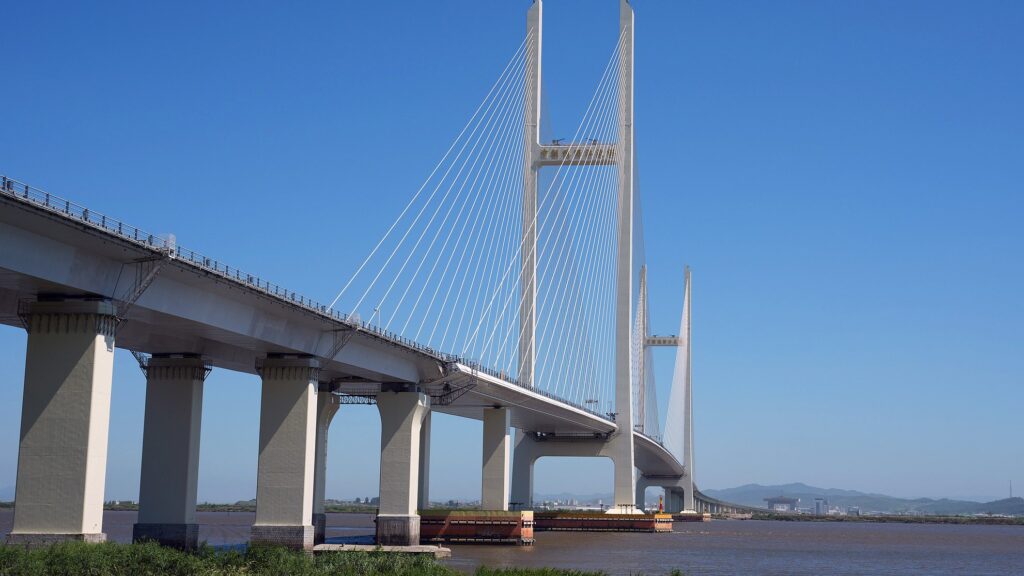
Image: from Bridging News X @BridgingNews_
The long-delayed, three-kilometre border crossing linking Dandong and Sinuiju is expected to strengthen trade, improve transport capacity and reinforce the strategic relationship between China and North Korea at a time of shifting geopolitical alliances in Northeast Asia.
By Open Chronicle News Desk with Agencies
BEIJING / PYONGYANG | October 15, 2026
China and North Korea have officially opened the long-delayed New Yalu River Bridge, establishing a major new transport connection between the two countries and signalling their determination to expand economic cooperation despite continuing international tensions over Pyongyang’s nuclear weapons programme.
The bridge, linking the Chinese city of Dandong in Liaoning province with Sinuiju in North Korea, was inaugurated on Thursday during a ceremony attended remotely by senior officials from both governments.
According to China’s official Xinhua news agency, the opening was celebrated with trucks displaying the national flags of both countries, while Chinese and North Korean flags decorated the four-lane crossing.
Chinese Premier Li Qiang described the bridge as a new symbol of the countries’ longstanding relationship and called for stronger economic connectivity and greater cooperation in border regions.
North Korean Premier Pak Thae Song also addressed the ceremony by video.
The inauguration represents an important development in cross-border infrastructure between China and North Korea, two neighbours whose political and economic relationship remains central to the security balance in Northeast Asia.
The bridge is also expected to provide an alternative to the ageing Sino-Korean Friendship Bridge, which has long served as the principal transport connection between Dandong and Sinuiju.
A New Gateway Between China and North Korea
Open Chronicle | From the Source
New Yalu River Bridge
Xinhua News Agency reports on the opening of the new border crossing connecting China and North Korea.
A new bridge will officially open to traffic on Thursday
across China’s border river with the Democratic People’s
Republic of Korea (DPRK).
#XinhuaNews
https://t.co/5fqTqOxK4S— China Xinhua News (@XHNews)
Source: China Xinhua News (@XHNews) on X.
Embedded original social media publication.
<text weight=”medium”>The New Yalu River Bridge</text> extends approximately three kilometres, or 1.8 miles, across the Yalu River, which forms part of the international boundary between China and North Korea.
Its four-lane design offers substantially greater road capacity than the existing Friendship Bridge.
The older crossing, which carries both railway traffic and road vehicles, is constrained by its narrow structure and can accommodate road traffic in only one direction at a time.
These limitations have historically complicated the movement of goods across one of North Korea’s most economically important borders.
The new crossing is designed to improve the movement of commercial vehicles and provide additional capacity for cross-border transportation.
Its opening could help reduce congestion and facilitate the movement of merchandise between the two countries.
However, the scale of its eventual economic impact will depend on how extensively the crossing is used, the efficiency of customs procedures and the development of associated logistics infrastructure.
The inauguration marks the beginning of a new phase of operations rather than proof that trade volumes have already increased.
Li Qiang Celebrates a Symbol of Traditional Friendship
Speaking during the inauguration ceremony, Chinese Premier Li Qiang described the bridge as a “new landmark” of the two countries’ “traditional friendship.”
His remarks reflected Beijing’s emphasis on maintaining stable relations with Pyongyang while developing practical cooperation along their shared border.
According to Xinhua, Li encouraged both countries to use the bridge’s opening as an opportunity to deepen connectivity and identify additional areas of economic cooperation.
The language used by the Chinese premier underscores the political importance Beijing attaches to the relationship.
China remains North Korea’s most important economic partner and an essential source of commercial connections to the outside world.
For Pyongyang, maintaining reliable access to Chinese markets is especially significant because international sanctions and diplomatic isolation have restricted many other economic relationships.
North Korean Premier Pak Thae Song’s participation in the ceremony further demonstrated the importance both governments attached to the inauguration.
Although neither leader attended the opening in person, their video addresses gave the event a prominent diplomatic character.
The ceremony was therefore more than the opening of a transport facility.
It was also a public affirmation of continued political and economic engagement between Beijing and Pyongyang.
Dandong and Sinuiju: The Economic Heart of the Border
The cities of Dandong and Sinuiju occupy a particularly important position in trade between China and North Korea.
Dandong is a major commercial centre in northeastern China, situated directly across the Yalu River from Sinuiju.
The two cities have long served as a principal gateway for goods moving between the countries.
According to Chinese data cited in the supplied reporting, more than 70 percent of official bilateral trade currently passes through the existing Sino-Korean Friendship Bridge.
That concentration makes the crossing strategically important but also creates logistical vulnerabilities.
A transport disruption, infrastructure failure or administrative restriction at the bridge can affect a substantial share of the trade moving between the two countries.
The new bridge is intended to provide additional capacity and reduce some of that dependence.
For Chinese businesses operating in the border region, improved road connections could create opportunities in transportation, warehousing and logistics.
For North Korea, the crossing could facilitate access to imported goods and support commercial activity in Sinuiju and surrounding areas.
The actual benefits will depend on trade regulations, infrastructure readiness and the broader political environment.
A Long-Delayed Infrastructure Project
The opening concludes a prolonged period of uncertainty surrounding the bridge’s development.
Although the crossing was conceived as a major improvement to the China-North Korea transport network, its introduction into service took considerably longer than initially anticipated.
The supplied reporting describes the bridge as long delayed but does not establish the precise reasons for every postponement.
Large cross-border infrastructure projects can face complications involving customs facilities, connecting roads, financing, operational arrangements and political decisions.
The New Yalu River Bridge also sits within a region where international sanctions and changing diplomatic relations can affect commercial planning.
Its inauguration therefore carries symbolic importance beyond the physical infrastructure.
It indicates that both governments are prepared to activate a transport connection that could support closer economic engagement.
However, the opening does not itself establish whether the bridge will operate at full capacity immediately or what restrictions will apply to particular categories of goods.
North Korea Seeks Greater Economic Connectivity
For North Korea, the opening comes at a time when the government is seeking to strengthen relationships with its principal international partners.
China has traditionally played a central role in North Korea’s external economic relations.
The relationship provides Pyongyang with access to markets, transportation networks and commercial channels that are difficult to replace.
North Korea’s international economic position remains constrained by sanctions imposed in response to its nuclear weapons and ballistic missile programmes.
These restrictions limit a range of commercial activities, financial transactions and technology transfers.
The new bridge does not remove those restrictions.
Trade using the crossing remains subject to applicable international sanctions and national regulations.
Nevertheless, additional transport capacity may make permitted trade more efficient and support the movement of goods that can legally cross the border.
The distinction is important.
An expansion of physical infrastructure does not necessarily translate into an unrestricted expansion of commerce.
The Growing Importance of Russia
The inauguration also takes place against the backdrop of North Korea’s increasingly prominent relationship with Russia.
Pyongyang has sought to strengthen its political and strategic connections with Moscow while maintaining its longstanding ties to Beijing.
The two relationships serve different but potentially complementary purposes.
China remains central to North Korea’s economic connectivity.
Russia offers an additional major-power relationship with strategic and diplomatic significance.
For North Korea, closer engagement with both countries may help reduce its dependence on any single international partner.
For Beijing, maintaining a stable relationship with Pyongyang helps preserve China’s influence over developments on the Korean Peninsula.
However, cooperation between China, Russia and North Korea should not automatically be understood as a fully coordinated alliance with identical objectives.
Each government has its own strategic interests, priorities and concerns.
China, in particular, has traditionally placed considerable importance on preventing instability along its northeastern border.
The new bridge reinforces that geographic and economic relationship without establishing any new formal security arrangement.
A Border Network Stretching 1,400 Kilometres
The China-North Korea border extends for approximately 1,400 kilometres, or 870 miles.
According to figures cited from the South Korean government, at least 17 road and railway connections are active along the frontier.
These crossings vary in their capacity, location and economic significance.
Despite the existence of multiple connections, Dandong and Sinuiju remain particularly important because of their established commercial infrastructure and proximity to major transport networks.
The New Yalu River Bridge adds a substantial road connection to this system.
Its design may provide greater flexibility for freight movements than the older Friendship Bridge.
Over time, additional capacity could support the development of border logistics and commercial facilities.
However, the extent to which the new crossing changes regional trade patterns will depend on the policies adopted by both governments and the volume of goods permitted to move across the frontier.
What the Opening Means for Regional Trade
The economic significance of the bridge lies in its potential to improve transport efficiency.
A modern four-lane crossing can accommodate more road vehicles than an older bridge constrained by narrow traffic arrangements.
That capacity may reduce delays, support more predictable freight movements and improve the resilience of transport connections.
For traders and logistics operators, reliability can be as important as overall capacity.
However, infrastructure alone cannot determine trade growth.
Border inspections, customs processing, commercial demand, payment arrangements and regulatory restrictions also influence how much merchandise moves between countries.
International sanctions remain a particularly important consideration in North Korea’s case.
The opening should therefore be viewed as an expansion of potential transport capacity rather than evidence of an immediate transformation in bilateral commerce.
The available reporting does not provide new trade-volume projections or official estimates of the bridge’s expected economic contribution.
The Strategic Significance for Beijing
China’s relationship with North Korea is shaped by geography, history and security considerations.
The Korean Peninsula remains strategically important to Beijing because instability there could affect China’s border regions and wider Northeast Asian security.
China has an interest in maintaining communication with Pyongyang and avoiding developments that could trigger a major regional crisis.
Economic connectivity provides one channel through which Beijing can sustain its relationship with the North Korean government.
The New Yalu River Bridge strengthens that physical connection.
At the same time, China’s relationship with North Korea involves diplomatic complexities.
Beijing must balance its bilateral ties with broader regional security concerns, international obligations and relations with other countries.
The opening does not resolve those tensions.
It does, however, demonstrate that China continues to regard practical cooperation with North Korea as an important element of its regional policy.
Implications for South Korea and Northeast Asia
The bridge’s inauguration will also attract attention in Seoul.
South Korea closely monitors economic and political developments involving North Korea, particularly those that may affect Pyongyang’s access to international markets and strategic partners.
Expanded transport capacity between China and North Korea could influence assessments of the North Korean economy and its ability to maintain external commercial relationships.
However, the opening does not necessarily indicate a major change in North Korea’s economic policy or diplomatic posture toward South Korea.
Nor does it establish that Beijing has altered its position on the Korean Peninsula’s broader security challenges.
The development is best understood as part of a wider pattern in which infrastructure, trade and diplomacy remain closely connected in Northeast Asia.
The Big Picture: A Bridge With Economic and Geopolitical Significance
The opening of the New Yalu River Bridge represents a notable development in relations between China and North Korea.
At the practical level, the crossing provides additional road capacity between two cities that already handle a substantial proportion of official bilateral trade.
At the political level, the inauguration allows Beijing and Pyongyang to reaffirm their relationship publicly.
For North Korea, the bridge offers another potential means of improving economic connectivity while the country remains subject to international sanctions.
For China, it strengthens an established transport corridor and reinforces its position as Pyongyang’s principal economic partner.
The development also takes place in a changing regional environment in which North Korea is cultivating closer ties with Russia.
However, the bridge’s longer-term significance will depend on how extensively it is used, whether associated transport facilities operate efficiently and how both governments manage trade within existing regulatory constraints.
The New Yalu River Bridge is more than a new road crossing. It is a visible expression of the continuing strategic importance of China-North Korea relations and the role that economic infrastructure plays in Northeast Asian diplomacy.
Open Chronicle | News Desk
Sources and Further Reading
Official reporting, diplomatic information, trade statistics and international documentation concerning the opening of the New Yalu River Bridge and relations between China and North Korea.
01 | Primary News Reporting
Xinhua News Agency
Official Coverage of the New Yalu River Bridge Opening — October 15, 2026.
Chinese state-media reporting concerning the inauguration ceremony, remarks by Premier Li Qiang and the participation of North Korean Premier Pak Thae Song.
02 | Official Chinese Diplomacy
Ministry of Foreign Affairs of the People’s Republic of China
Official Chinese diplomatic statements and information concerning bilateral relations and regional cooperation.
03 | Customs & Trade Data
General Administration of Customs of China
Official Chinese customs information and trade statistics relevant to cross-border commerce.
04 | Korean Peninsula Affairs
Ministry of Unification, Republic of Korea
South Korean government information concerning North Korea, inter-Korean affairs and developments affecting the Korean Peninsula.
05 | International Sanctions
United Nations Security Council
Official documentation concerning Security Council sanctions and measures relating to the Democratic People’s Republic of Korea.
Open Chronicle | Editorial Transparency
Editorial Note
This article is an original Open Chronicle news synthesis based on the supplied reporting concerning the opening of the New Yalu River Bridge between China and North Korea on October 15, 2026.
Statements attributed to Chinese Premier Li Qiang and North Korean Premier Pak Thae Song are based on the Xinhua reporting described in the source material.
The bridge’s length, four-lane configuration, location and stated transport significance are presented according to the supplied account.
The figure indicating that more than 70 percent of official bilateral trade passes through the existing Friendship Bridge is attributed to Chinese data cited in the reporting. The figure concerning active border connections is attributed to South Korean government information.
The article distinguishes the bridge’s inauguration from projections concerning future trade growth, which remain uncertain.
Discussion of sanctions, regional security and the strategic implications of China-North Korea relations provides editorial context and does not establish that the bridge’s opening changes existing international obligations.
The institutional sources listed above offer additional background and avenues for verification. They have not all been independently consulted for this article.
Open Chronicle
Independent. Global. Trusted.