
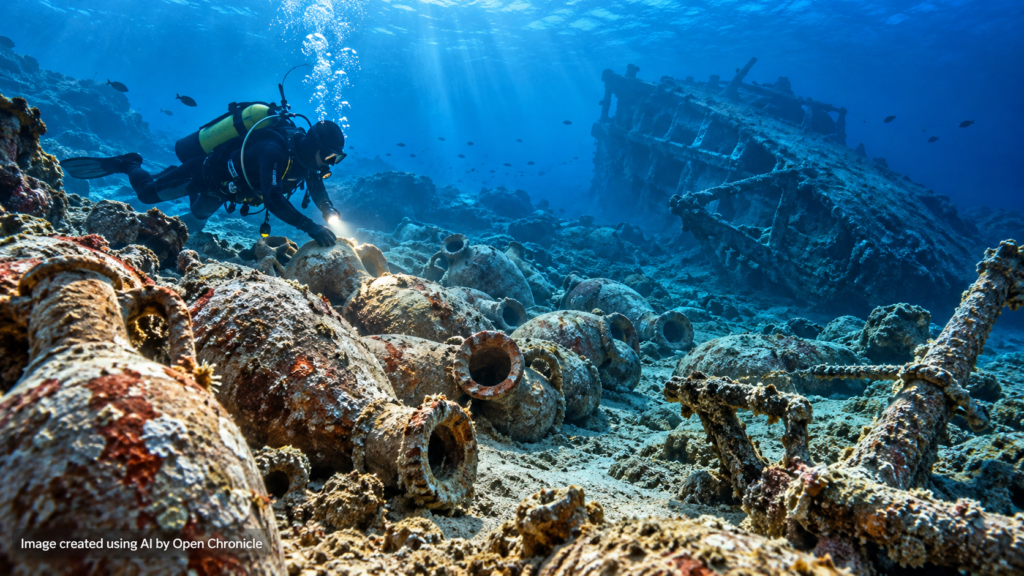
Dozens of ceramic vessels and ancient anchors discovered near Kekova Island could provide new evidence of Mediterranean trade during the Early Bronze Age, when the Egyptian pyramids were being built.
By Open Chronicle Science Desk
An extraordinary underwater archaeological discovery off the southern coast of Turkey could transform our understanding of ancient Mediterranean navigation. Researchers investigating a submerged collection of ceramic vessels and anchors near Kekova Island, in Antalya province, believe the remains may belong to a merchant ship that sank between 4,400 and 4,700 years ago.
If the proposed dating is confirmed, the discovery could represent one of the oldest known maritime cargo wreck sites in the Mediterranean, offering rare evidence of commercial connections between ancient societies during the Early Bronze Age.
The discovery has attracted attention not only because of its potential age but also because of what the surviving cargo may reveal about trade routes linking the eastern Mediterranean, Anatolia, Egypt and the Aegean world thousands of years before the rise of classical Greece and Rome.
An Ancient Vessel Hidden Beneath the Mediterranean
The underwater site was identified in 2022 by a research expedition led by Professor Hakan Öniz, a marine archaeologist at Akdeniz University in Turkey, working in connection with the Mediterranean Archaeology Association.
Divers discovered at least 30 ceramic storage vessels and three anchors resting on the seabed near Kekova Island.
Although the wooden structure of the ship has not survived, researchers believe the arrangement of the objects may indicate the remains of a cargo vessel approximately 10 metres (33 feet) long.
Wood exposed to marine environments can deteriorate over thousands of years, particularly when it is not protected by sediment. Ceramic vessels and stone anchors, however, are much more likely to survive, sometimes preserving evidence of maritime activity long after the ships themselves have disappeared.
The discovery therefore presents archaeologists with an unusual challenge: reconstructing the history of a vessel primarily from the objects it carried rather than from its hull.
A Discovery Whose Importance Was Initially Overlooked
When the archaeological team first examined the underwater site, the ceramic vessels did not immediately appear extraordinary.
Their shapes resembled pottery associated with much more recent historical periods, leading researchers initially to underestimate their possible age.
That interpretation changed when Professor Öniz encountered comparable vessel forms in archaeological publications concerning ancient Egypt.
The similarities prompted the team to return to the site and reassess the finds.
According to Öniz, the ceramic forms resembled examples associated with archaeological material from the Giza pyramid complex in Egypt.
The comparison generated considerable excitement among the researchers, raising the possibility that the underwater objects belonged to a period far earlier than initially suspected.
The team subsequently proposed a date of approximately 2700–2400 BCE, placing the possible wreck within the Early Bronze Age.
However, similarities in pottery shape alone do not conclusively establish the age of an archaeological site. Further examination of the ceramics, their manufacturing techniques and their archaeological context will be important for assessing the proposed chronology.
A Mediterranean Trading Network Thousands of Years Old
During the third millennium BCE, the eastern Mediterranean was already a region of substantial economic and cultural interaction.
Communities across Anatolia, the Levant, Egypt and the Aegean exchanged agricultural products, raw materials and manufactured goods through interconnected land and maritime routes.
The researchers believe the ceramic vessels discovered near Kekova may have originated in the Jordan Valley, a region with a long history of agricultural production and commercial exchange.
The containers could have transported commodities such as olive oil or wine, both valuable products in ancient Mediterranean economies.
One possibility is that the ship was travelling westward toward coastal Anatolia or the Aegean, potentially connecting with trading communities in regions later associated with Troy or the civilizations of Crete.
These proposed origins, contents and destinations remain hypotheses rather than established findings.
Nevertheless, the discovery may contribute to a broader understanding of how early maritime commerce helped connect societies separated by considerable geographical distances.
Wine, Olive Oil and the Commodities of the Bronze Age
Ceramic storage vessels were essential to ancient trade.
Before modern packaging and shipping containers, pottery provided a practical way to transport and store liquids, foodstuffs and other valuable commodities.
Large containers could be arranged within the cargo space of a vessel, allowing merchants to move goods between coastal settlements and trading centres.
Across the Bronze Age Mediterranean, maritime commerce involved a wide range of products, including copper, tin, precious metals, ivory, pottery, textiles and luxury materials.
Obsidian, a volcanic glass valued for its sharp cutting edges, also circulated through ancient exchange networks.
Agricultural products were equally important. Olive oil, wine and other foodstuffs could support both local consumption and wider commercial activity.
If chemical residue analysis eventually identifies the original contents of the Kekova vessels, researchers may gain valuable information about agricultural production, trade practices and consumption patterns in the Early Bronze Age.
Such evidence could also help clarify whether the containers were manufactured locally or transported from another part of the eastern Mediterranean.
Could the Ship Have Been Heading Toward Troy?
One of the more intriguing possibilities raised by the researchers concerns the vessel’s potential destination.
The ancient settlement of Troy, located in northwestern Anatolia, occupied a strategically important position near routes connecting the Aegean Sea and the waterways leading toward the Black Sea.
Archaeological evidence indicates that the wider region participated in networks of exchange during the Bronze Age.
A merchant vessel travelling along the southern Anatolian coastline could potentially have been part of a larger trading system extending toward the western coast of Anatolia.
Crete represents another possible destination within the broader Aegean trading world.
However, the identification of a specific destination would require additional evidence, including information about the cargo’s origin, the vessel’s probable route and the commercial networks operating at the time.
For now, the suggestion that the ship was heading toward Troy remains an intriguing possibility rather than a demonstrated historical fact.
The Search for the Mediterranean’s Earliest Shipwrecks
The waters surrounding Turkey contain an exceptional concentration of underwater archaeological remains.
The region’s position between the eastern Mediterranean and the Aegean made it an important maritime crossroads for thousands of years.
According to Professor Öniz, research teams working under permits issued by Turkey’s Ministry of Culture have identified hundreds of archaeological shipwrecks.
The Kekova discovery could add an important early chapter to this maritime record.
Other ancient wrecks have demonstrated how much information can survive underwater even when a vessel’s wooden structure has deteriorated.
The famous Uluburun shipwreck, discovered off Turkey’s southern coast and dated to the Late Bronze Age, revealed an extraordinary cargo of copper, tin, glass, ivory and other goods associated with international trade.
Elsewhere in the eastern Mediterranean, researchers have identified ancient wrecks at depths approaching 1,800 metres, demonstrating that significant archaeological material can survive far below the reach of conventional diving operations.
The proposed Kekova wreck is potentially much older than these better-documented Late Bronze Age examples.
Its precise place in maritime history, however, will depend on further scientific investigation and independent confirmation of its age and identification as a shipwreck.
What Happens Next?
The archaeological team has so far examined only a portion of the material associated with the site.
Further investigation may help answer several important questions.
Researchers will need to determine whether the ceramic vessels belong to the same chronological period, whether the anchors are directly associated with the cargo and whether the distribution of objects is consistent with a single shipwreck event.
Detailed ceramic analysis could help establish the geographical origin of the containers.
Residue testing may identify traces of substances once stored inside them, while underwater mapping could provide a clearer picture of the original cargo arrangement.
The researchers may also investigate whether any organic material has survived beneath the seabed.
Together, these studies could strengthen or revise the proposed interpretation of the site.
A New Window Into the Ancient World
The potential importance of the Kekova discovery extends beyond the age of a single shipwreck.
If confirmed, the site could offer valuable evidence of the technological capabilities, economic connections and maritime practices of societies living more than four millennia ago.
Long before modern navigation systems, ancient sailors relied on practical knowledge of winds, currents, coastlines and seasonal conditions to move goods across the Mediterranean.
Their voyages helped connect distant communities and facilitated the exchange of materials, technologies and ideas.
The objects discovered beneath the waters of Kekova may represent the surviving traces of one such journey.
Although important questions remain about the vessel’s age, cargo and destination, the site offers another reminder that the Mediterranean seabed preserves a vast archaeological record of human activity.
And with continued underwater exploration, archaeologists may yet uncover evidence of even earlier maritime journeys.
Historical Significance
The discovery is particularly important because the surviving cargo has been provisionally dated to a period preceding many of the Mediterranean’s best-known shipwrecks.
Excavations began in 2026 under the Antalya Museum Directorate, and a preliminary scientific report by Hakan Öniz and Ceyda Öztosun was published in the Journal of Maritime Archaeology. The research supports the identification of Early Bronze Age ceramics at the Kekova site, although the interpretation of the remains as the world’s oldest shipwreck should still be treated as provisional.
Sources and Further Reading
Scientific research, institutional documentation and independent reporting supporting this article.
Journal of Maritime Archaeology — Preliminary Scientific Report
Hakan Öniz and Ceyda Öztosun, Preliminary Report on the Early Bronze Age Shipwreck in the Kekova Region of Antalya (2026). DOI: 10.1007/s11457-026-09532-3.
Akdeniz University — Official Research Announcement
University information on the excavation, the Early Bronze Age pottery and evidence of maritime trade.
Reuters — Archaeologist Reports 4,700-Year-Old Shipwreck
Reporting from 14 October 2026, including comments from Hakan Öniz about the dating and possible ancient trade connections.
Archaeology Magazine — World’s Oldest Shipwreck Discovered in the Mediterranean
Coverage published on 15 October 2026, including the surviving cargo, anchors and planned residue analysis.
Editorial Note
This article is based on archaeological research and reporting available as of 16 October 2026. The estimated age of the Kekova shipwreck is based primarily on ceramic typology and comparisons with archaeological material from other Early Bronze Age sites. Further investigation may refine the dating, identification of the cargo and interpretation of the vessel’s original voyage.