
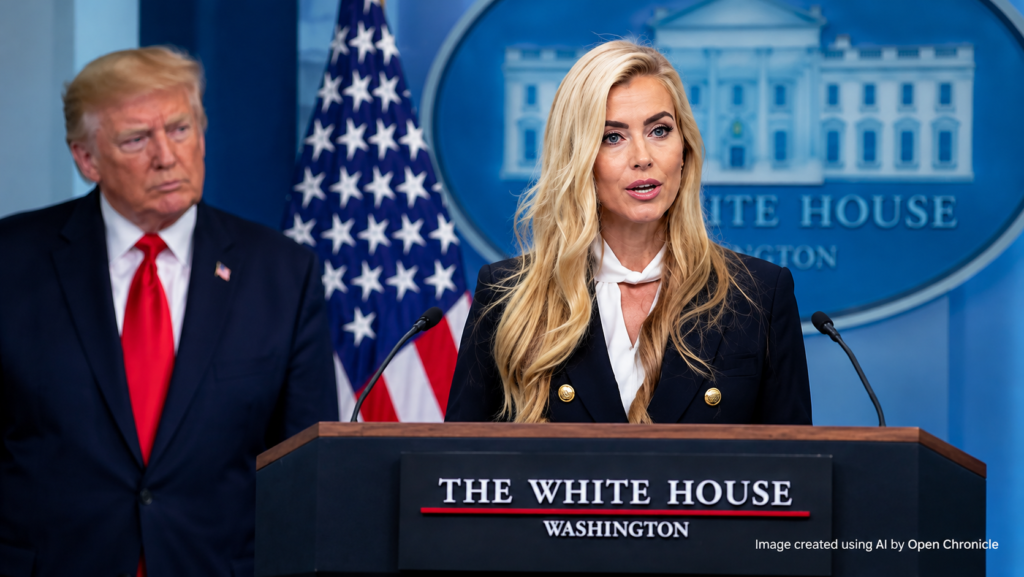
The White House says Katie Zacharia is leaving her position only days after taking office, following a difficult debut briefing, questions about her legal credentials and controversial remarks about China.
By Open Chronicle News Desk with Agencies
WASHINGTON | October 16, 2026
US President Donald Trump’s administration has removed White House Press Secretary Katie Zacharia from her position after just five days, according to a White House official cited in the supplied reporting, bringing an abrupt end to one of the shortest tenures in the history of the administration’s senior communications team.
The decision followed a turbulent first week in which Zacharia faced criticism over her initial White House press briefing, questions about her professional qualifications and a diplomatic controversy involving China.
Speaking to reporters as he departed the White House, Trump said he had personally encouraged Zacharia to reconsider whether the demanding position was right for her.
“I told her: ‘I think you’re better off being happy, and I’m not sure you can ever be happy in this stuff.’ There’s nothing easy about this stuff,” the president said.
Trump added that he had advised her to think carefully about remaining in the role.
“I said to her honestly, ‘If I were you, I’d reconsider… think about it. But I would reconsider.'”
Fox News subsequently reported, citing a White House official, that Zacharia was transitioning out of the press secretary position.
The administration’s description of her departure left some uncertainty about whether the decision should be characterised as a dismissal, a resignation or a mutually agreed transition.
A White House Appointment That Lasted Less Than a Week
Zacharia began her duties on Monday, October 12, after being selected to succeed Karoline Leavitt as the administration’s principal spokesperson.
According to her own account, she received an initial telephone call concerning the position the previous Wednesday and was formally offered the job on Friday.
Trump subsequently announced her appointment, describing Zacharia as an attorney.
Her selection placed her in one of Washington’s most visible and demanding communications positions.
The White House press secretary serves as the administration’s principal public spokesperson, regularly explaining presidential decisions, responding to questions from journalists and communicating official government positions.
The role requires familiarity with domestic and foreign policy, the ability to respond under intense scrutiny and close coordination with senior White House officials.
For Zacharia, however, the transition from appointment to departure unfolded within a matter of days.
By Friday, October 16, her brief tenure had effectively ended.
A Difficult First Briefing Draws Criticism
Zacharia’s first appearance in the White House briefing room on Tuesday quickly attracted criticism.
The briefing lasted less than 15 minutes and began with a lengthy, slowly delivered account of what she described as Trump’s achievements.
She then answered only three questions from reporters before concluding the session.
The limited exchange became a focus of public scrutiny, particularly because the press secretary’s position traditionally involves responding to a wide range of questions on government policy and current events.
A debut briefing can be especially important for establishing a spokesperson’s authority and relationship with the White House press corps.
In Zacharia’s case, the short appearance contributed to questions about her preparedness for the role.
Although the duration of a briefing does not by itself determine a press secretary’s effectiveness, the criticism surrounding her first appearance became part of a wider controversy over her appointment.
The episode also demonstrated how quickly the demands of the position can place newly appointed officials under national attention.
Questions Emerge Over Her Legal Credentials
Another controversy developed over Zacharia’s professional qualifications.
Trump had described her as an attorney when announcing her appointment.
Zacharia is a graduate of Pepperdine University’s law school in California, according to the supplied reporting.
However, questions emerged about whether she had passed the bar examination required for admission to practise law in the relevant jurisdiction.
During a Fox News interview reported this week, Zacharia acknowledged that she had not passed the bar.
The admission intensified scrutiny of the way her professional background had been presented.
Graduating from law school does not automatically confer a licence to practise law in the United States.
Legal licensing requirements vary by jurisdiction, but admission to a state bar generally involves satisfying educational, examination and character requirements.
The distinction between holding a law degree and being licensed to practise law is therefore important.
The controversy did not establish that Zacharia had engaged in unauthorised legal practice.
It did, however, raise questions about the accuracy of the professional description used in announcing her appointment.
Remarks About China Spark Diplomatic Controversy
Zacharia faced further criticism after making disparaging remarks about China during an interview with conservative commentator Jack Posobiec.
Discussing perceptions of China’s economic development during the 2016 US presidential election, she recalled questioning predictions that China would overtake the United States.
“I remember this very distinctly, having just come from China, thinking, ‘How is China the next country on the horizon? They don’t even have proper toilets,'” she said.
The remarks attracted attention because of their dismissive character and the sensitivity of relations between Washington and Beijing.
They also came shortly after Chinese President Xi Jinping had visited Washington for high-level meetings with Trump.
China’s Foreign Ministry responded publicly.
Spokeswoman Mao Ning suggested that Zacharia should visit China more frequently.
The response added an international dimension to what had initially been a domestic political controversy.
For a White House press secretary, public remarks about foreign countries can carry particular significance because they may be interpreted abroad as reflecting the administration’s broader diplomatic position.
The incident illustrated the potential consequences of informal political commentary when delivered by an official responsible for communicating on behalf of the president.
The Diplomatic Sensitivity of US–China Relations
The controversy unfolded during a period in which the United States and China were attempting to manage a complex relationship involving trade, technology, military competition and international security.
High-level exchanges between Trump and Xi have been an important part of that diplomatic effort.
Both governments face pressure to defend their national interests while preventing disagreements from escalating into broader confrontation.
Public statements by senior officials can complicate that process, particularly when they concern national development, economic standing or perceived cultural differences.
Zacharia’s remarks were therefore significant not because they represented a formal policy announcement, but because of the office she occupied when making them.
The White House press secretary is expected to communicate the administration’s position with precision.
Comments that appear dismissive of another country can create unnecessary diplomatic distractions, even when they are made in interviews rather than official briefings.
There is no indication in the supplied reporting that the remarks produced a formal diplomatic dispute beyond the Chinese Foreign Ministry’s public response.
Nevertheless, they added to the scrutiny surrounding Zacharia’s brief appointment.
Trump’s Explanation Focuses on the Pressures of the Job
Trump’s public explanation for encouraging Zacharia to reconsider the position focused on the personal demands of working in the White House.
His remarks suggested that he believed she might be better suited to a role outside the intense scrutiny associated with the press secretary’s office.
The president did not, in the quoted comments, explicitly identify the debut briefing, the legal credentials controversy or the remarks about China as the reasons for her departure.
That distinction is important.
Although all three controversies occurred during Zacharia’s brief tenure, the supplied reporting does not establish that any single incident directly caused the decision to remove her.
The White House official’s account and Trump’s comments confirm that her departure was being discussed publicly, but they do not provide a comprehensive explanation of the administration’s internal decision-making.
The distinction between the administration’s stated explanation and the controversies surrounding the appointment remains central to understanding the episode.
Comparisons With Anthony Scaramucci’s Brief Tenure
Zacharia’s departure recalls another unusually short appointment during Trump’s first presidency.
Anthony Scaramucci served as White House communications director for approximately 10 days in July 2017.
His brief tenure became one of the most widely discussed personnel episodes of Trump’s first administration.
Although the positions of communications director and press secretary have different responsibilities, both are senior White House communications roles requiring close coordination with the president and his advisers.
The comparison underscores the political sensitivity of appointments to positions responsible for shaping the administration’s public message.
Rapid personnel changes can create uncertainty over communications strategy and raise questions about the process used to select senior officials.
However, a short tenure alone does not establish the broader effectiveness or stability of an administration’s communications operation.
Departure Comes Ahead of Congressional Midterm Elections
The personnel change comes as Trump and the Republican Party prepare for the November 3 congressional midterm elections.
The president has been travelling across the country in an effort to support Republican candidates and strengthen the party’s electoral prospects.
According to the supplied reporting, opinion polls have suggested a difficult electoral environment for Republicans.
The White House press secretary plays an important role during such periods, particularly when an administration is responding to criticism over its policies and political performance.
The position requires the ability to manage daily questions concerning the economy, foreign policy, domestic legislation and presidential statements.
A sudden change in the office can therefore create additional communications challenges at a politically sensitive moment.
At the same time, the political significance of Zacharia’s departure should not be overstated.
The supplied information does not demonstrate that the episode has materially changed voter preferences or the broader electoral outlook.
Its immediate consequences are primarily institutional and political, involving the administration’s public communications and the management of an unexpected personnel transition.
Who Will Replace Katie Zacharia?
The supplied reporting does not identify a confirmed successor to Zacharia.
It also does not establish whether the White House intends to appoint a permanent replacement immediately or rely on other communications officials during the transition.
The administration will need to determine how future briefings and media engagements are managed.
The selection of a successor may attract particular attention following the controversies surrounding Zacharia’s appointment.
Professional experience, communications skills and the ability to represent the president’s positions under questioning are likely to be important considerations.
Until an official announcement is made, speculation about potential replacements should be treated cautiously.
The Big Picture: A Communications Setback at a Sensitive Political Moment
Katie Zacharia’s reported departure after only five days represents an unusually rapid change in one of the White House’s most prominent public-facing positions.
Her appointment was followed almost immediately by a difficult introductory briefing, scrutiny of her legal qualifications and controversial remarks about China.
Together, these developments placed the new press secretary under intense attention before she had an opportunity to establish herself in the role.
Trump’s public comments framed the situation in terms of the personal pressures associated with White House service, while a White House official confirmed that Zacharia was leaving the position.
The episode highlights the importance of careful appointments to senior communications roles, particularly during periods of political uncertainty and heightened international scrutiny.
For the Trump administration, the immediate priority will be restoring continuity to its press operation as the president campaigns ahead of the November congressional elections.
The broader significance of Zacharia’s departure will depend on how the White House manages the transition and whether the controversy has lasting consequences for its communications strategy.
For now, the episode stands as another reminder of how quickly a high-profile appointment can become a political liability in Washington.
Sources and Further Reading
1. Reuters — Katie Zacharia’s Departure from the White House
Reporting on the press secretary’s departure, President Trump’s statements and the controversies surrounding her brief tenure.
2. Associated Press — White House Communications and Political Developments
Independent reporting on the Trump administration, White House personnel changes and political developments.
3. The White House — Official Statements and Briefings
Official presidential statements, press briefings and administration communications.
Editorial Note
This article is an original Open Chronicle news synthesis based on the supplied reporting concerning Katie Zacharia’s reported departure from the White House press secretary position.
The article distinguishes statements attributed to President Donald Trump, reported personnel decisions and controversies surrounding Zacharia’s appointment. The precise circumstances of her departure and the reasons behind the decision should be understood within the limits of the available reporting.
The sources above are general institutional and news portals, not independently verified direct references confirming every detail of the reported October 16, 2026, events.
Open Chronicle | Independent. Global. Trusted.