
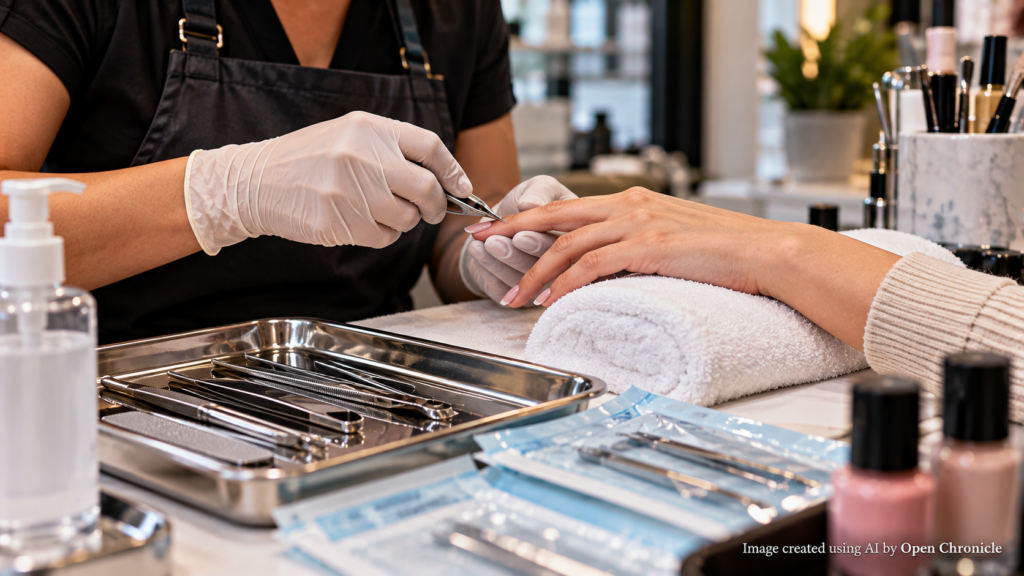
Health specialists say HIV is not transmitted through ordinary manicure procedures or casual contact at nail salons. While contaminated sharp instruments can present a theoretical blood-exposure risk, experts emphasise that standard hygiene and sterilisation procedures are essential for preventing infections.
By Open Chronicle News Desk with Agencies
HEALTH & SCIENCE | October 16, 2026
Claims circulating about the possibility of contracting HIV during a manicure have prompted renewed attention to infection prevention and the importance of understanding how the human immunodeficiency virus is transmitted.
Medical experts stress that ordinary manicure procedures, including nail trimming, filing, polishing and cuticle care performed without exposure to infected blood, do not transmit HIV.
The virus cannot spread through casual skin contact, touching hands, sharing a room or contact with intact skin.
However, healthcare professionals distinguish routine beauty treatments from situations involving contaminated sharp instruments that break the skin.
Although the possibility of HIV transmission through a contaminated manicure instrument is considered extremely remote, proper cleaning, disinfection and sterilisation remain essential safeguards against bloodborne infections.
The discussion also highlights the importance of separating medically established transmission routes from misleading claims that can create unnecessary fear and reinforce stigma against people living with HIV.
How HIV Is Actually Transmitted
HIV attacks the immune system and, without treatment, can progressively weaken the body’s ability to fight infections.
The virus is transmitted through specific bodily fluids from a person with HIV, including blood, semen, vaginal and rectal fluids, and breast milk.
For transmission to occur, these fluids must enter another person’s bloodstream or come into contact with susceptible mucous membranes or damaged tissue.
Established routes of transmission include unprotected sexual exposure, sharing contaminated injection equipment and transmission during pregnancy, childbirth or breastfeeding when effective prevention measures are not in place.
HIV is not transmitted through ordinary social contact.
Handshakes, hugs, shared utensils, public toilets, swimming pools and contact with unbroken skin do not spread the virus.
This distinction is particularly important when evaluating claims involving nail salons, where most procedures involve the external surfaces of nails and skin rather than direct exposure to blood.
Can a Manicure Transmit HIV?
The central medical question is whether a manicure can create the conditions necessary for HIV transmission.
Under ordinary circumstances, the answer is no.
Routine nail care does not involve the exchange of infectious bodily fluids required for HIV transmission.
A theoretical risk could arise if an instrument contaminated with infectious blood were immediately reused in a way that punctured or cut another person’s skin.
However, such a scenario requires a specific sequence of events and should not be confused with ordinary manicure services.
HIV is relatively fragile outside the human body, and environmental exposure reduces its ability to remain infectious.
There is no established evidence that routine manicure services constitute a common route of HIV transmission.
Importantly, the absence of a significant HIV risk does not mean that nail salon instruments can be reused without appropriate hygiene measures.
Other infections may be more readily transmitted through improperly cleaned equipment.
Why Nail Salon Hygiene Still Matters
Manicure and pedicure services frequently involve instruments such as nail clippers, cuticle nippers, scissors, files and other tools that may come into contact with skin.
If equipment is improperly maintained, it can contribute to the spread of certain bacterial, fungal or viral infections.
Bloodborne pathogens such as hepatitis B and hepatitis C are particularly relevant when contaminated instruments cause skin injuries.
Hepatitis B is more environmentally stable than HIV and can remain infectious on surfaces for considerably longer.
This makes proper instrument processing an important public-health requirement.
Health authorities recommend that reusable tools be cleaned and processed according to their intended use and applicable infection-control standards.
Instruments that may penetrate the skin require an appropriate level of sterilisation, while single-use equipment should not be reused between customers.
Nail salons should also follow procedures for handling accidental cuts, disposing of contaminated materials and maintaining clean workstations.
The Difference Between Cleaning, Disinfection and Sterilisation
Experts distinguish three important infection-control procedures.
Cleaning removes visible dirt, organic material and debris from instruments and surfaces.
Disinfection uses approved chemical or physical methods to destroy many disease-causing microorganisms, although effectiveness depends on the disinfectant and its intended application.
Sterilisation is a more comprehensive process designed to eliminate all forms of microbial life, including resistant bacterial spores.
The appropriate procedure depends on the instrument, its intended use and whether it may penetrate the skin.
Simply wiping tools with a cloth or briefly rinsing them under water is not sufficient when proper disinfection or sterilisation is required.
Similarly, ultraviolet storage cabinets should not automatically be considered substitutes for validated sterilisation equipment.
Professional establishments should follow recognised infection-control practices and local health regulations.
What Customers Should Look for in a Nail Salon
Customers can reduce infection risks by choosing salons that follow transparent hygiene procedures.
Reusable instruments should be visibly clean and processed appropriately between clients.
Single-use items should be discarded after use when their design or local regulations require it.
Technicians should maintain clean hands and workstations and avoid procedures that unnecessarily damage the skin.
Customers with open wounds or active infections around their nails may benefit from postponing treatments until the affected areas have healed.
If a cut occurs during a manicure, the technician should stop the procedure, manage the injury safely and ensure that contaminated instruments are appropriately processed before reuse.
These precautions protect both customers and salon workers.
What Happens if Someone Is Accidentally Cut?
An accidental cut during a manicure does not mean that HIV transmission has occurred.
Most minor cuts do not involve exposure to infectious blood from another person.
The appropriate response is to clean the wound and assess whether a meaningful exposure to potentially infectious material has taken place.
If there is credible evidence that an instrument contaminated with another person’s blood penetrated the skin, prompt medical advice is appropriate.
A healthcare professional can assess the circumstances and determine whether testing or other measures are needed.
For a substantial potential HIV exposure, post-exposure prophylaxis, commonly known as PEP, may be considered.
PEP must be started as soon as possible and no later than 72 hours after a possible exposure.
It is not routinely recommended for ordinary manicure procedures or situations without a plausible route of HIV transmission.
HIV Testing and Modern Treatment
HIV testing remains an essential part of prevention and early diagnosis.
Modern laboratory tests can detect HIV infection at different intervals following exposure, depending on the type of test used.
People concerned about a genuine exposure should seek guidance from a healthcare professional rather than relying on symptoms or unverified online information.
Advances in antiretroviral treatment have transformed HIV from a frequently fatal infection into a manageable chronic condition for many people with access to consistent care.
Effective treatment can suppress the virus to undetectable levels.
People living with HIV who maintain an undetectable viral load do not transmit the virus sexually, a principle known as Undetectable = Untransmittable, or U=U.
This established scientific finding has become central to public-health efforts to improve treatment access and reduce stigma.
Misinformation Can Reinforce HIV Stigma
Misleading claims about HIV transmission can have consequences beyond unnecessary anxiety.
They may reinforce misconceptions about people living with HIV and discourage individuals from seeking testing, treatment or reliable medical advice.
Public-health specialists emphasise that HIV is not transmitted through everyday social interactions.
Accurate information is therefore essential for protecting public health while respecting the dignity of people affected by the virus.
The most effective response to misleading claims is to explain the actual routes of transmission and distinguish realistic infection risks from hypothetical scenarios.
Nail salon customers should expect proper hygiene, but they should not be led to believe that ordinary manicures represent a significant HIV threat.
The Big Picture: Infection Prevention Without Unnecessary Fear
The discussion surrounding HIV and manicure services illustrates a broader challenge in public-health communication.
A theoretical possibility of bloodborne infection can sometimes be presented as though it were a common or established route of transmission.
That distinction matters.
Routine manicures do not transmit HIV through ordinary contact, and there is no basis for treating nail salons as a common source of HIV infection.
At the same time, strict hygiene standards remain essential because contaminated instruments can transmit other infections and, in unusual circumstances, create opportunities for blood exposure.
The appropriate public-health message is therefore balanced: customers should choose establishments that follow proper infection-control procedures, while avoiding unnecessary fear about HIV transmission through routine beauty treatments.
Reliable medical guidance, responsible reporting and accurate information remain the strongest tools for protecting health and preventing stigma.
Sources and Further Reading
1. Centers for Disease Control and Prevention (CDC) — How HIV Spreads
Official guidance explaining established HIV transmission routes, including why ordinary skin contact and routine beauty treatments do not transmit the virus.
2. British HIV Association (BHIVA) — Guidance on Cosmetic Treatments and HIV
Specialist clinical guidance stating that people living with HIV do not pose a transmission risk during routine beauty treatments, including manicures and pedicures, when standard precautions are followed.
3. CDC — Healthy Habits: Nail Hygiene
Recommendations for cleaning and sterilising nail-care equipment and preventing infections in commercial nail salons.
4. AIDS Research and Human Retroviruses — Possible HIV Transmission Associated With Manicure Care
A 2014 case report investigating a possible HIV transmission involving shared manicure instruments. The study suggested a potential association but did not conclusively establish the transmission route.
5. CDC — Clinical Guidance for HIV Post-Exposure Prophylaxis
Clinical recommendations concerning the assessment of potential HIV exposure and the use of preventive medication within 72 hours when medically indicated.
Editorial Note
This article is an original Open Chronicle health and science synthesis based on established medical guidance from the US Centers for Disease Control and Prevention, the British HIV Association and published scientific research.
The evidence does not support claims that ordinary manicure procedures or casual contact in nail salons transmit HIV. A rare, historical case report involving shared manicure instruments has been discussed in the scientific literature, but the proposed transmission route was not conclusively established.
The article distinguishes routine nail care from hypothetical exposure involving blood-contaminated sharp instruments and damaged skin. It also emphasises the importance of appropriate infection-control procedures to prevent other infections.
The headline refers to expert medical guidance rather than to a newly documented October 2026 investigation or named expert interviews. No specific viral social-media claim was supplied for independent fact-checking.
Open Chronicle | Independent. Global. Trusted.