
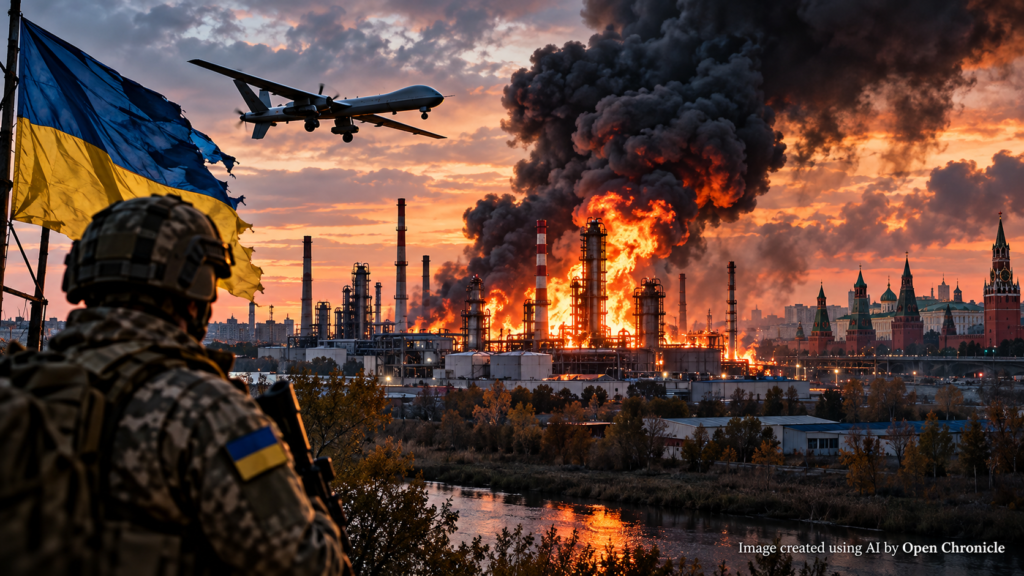
A Ukrainian drone attack on an oil refinery in Russia’s Ryazan region marks a renewed escalation in the energy war between Kyiv and Moscow. President Volodymyr Zelenskyy accuses Russia of disregarding a US-backed truce and warns that restrictions on American intelligence and satellite communications are undermining Ukraine’s ability to defend itself.
By Open Chronicle News Desk with Agencies
KYIV, UKRAINE | October 16, 2026
Ukraine has resumed attacks on Russian oil infrastructure following the apparent collapse of a short-lived energy truce promoted by US President Donald Trump, opening a new phase of confrontation that threatens to further strain relations between Kyiv and Washington.
A Ukrainian drone struck an oil refinery in Russia’s Ryazan region on Thursday, October 15, reportedly causing a fire at the facility approximately 290 kilometres southeast of Moscow.
Russian authorities, including the Defence Ministry and regional Governor Pavel Malkov, acknowledged the incident. A senior Ukrainian official, speaking anonymously because of the sensitivity of the operation, confirmed to The Associated Press that Ukrainian forces had targeted the refinery.
The strike followed days of mounting frustration in Kyiv over continued Russian attacks on Ukrainian energy infrastructure, restrictions affecting Ukrainian military communications and intelligence, and a controversial agreement between Washington and Moscow involving Russian diesel imports.
President Volodymyr Zelenskyy has accused the Trump administration of placing increasing pressure on Ukraine while failing to secure comparable restraint from Russia.
The dispute has developed into one of the most serious diplomatic confrontations between Washington and Kyiv since Trump returned to the White House.
The Collapse of a Fragile Energy Truce
The latest escalation follows an initiative announced by Trump calling on Russia and Ukraine to suspend attacks against each other’s energy infrastructure.
The arrangement was intended to reduce damage to electricity generation, oil facilities and other infrastructure as diplomatic efforts to end the war remained stalled.
Ukraine initially agreed to observe the proposed restrictions.
However, Zelenskyy accused Moscow of continuing its aerial bombardment of Ukrainian energy installations despite the American president’s demand.
The Ukrainian leader argued that the arrangement had become untenable because Russia was not respecting the same limitations expected of Kyiv.
In an interview with the Financial Times published Thursday, Zelenskyy announced that Ukrainian attacks against Russian refineries would resume.
“We’re done,” he said.
Moscow disputed Kyiv’s account.
Kremlin spokesperson Dmitry Peskov claimed Ukraine had never stopped attacking Russian oil infrastructure, while Foreign Minister Sergey Lavrov described the renewed strikes as a direct challenge to Trump’s diplomatic initiative.
The competing claims could not be independently verified in full.
The disagreement illustrates the fundamental weakness of the proposed truce: without a mutually accepted monitoring mechanism and enforceable conditions, each side can accuse the other of violating the arrangement.
Why Russian Oil Refineries Are Strategic Targets
Russian refineries have become important targets in Ukraine’s long-range strike campaign.
Oil processing facilities contribute to Russia’s domestic fuel supply, military logistics and broader energy economy.
Attacks against them can interrupt production, require expensive repairs and force Russian authorities to devote additional air-defence resources to protecting infrastructure far from the battlefield.
The Ryazan refinery is located within operational reach of Ukrainian long-range drones, demonstrating Kyiv’s continuing ability to strike targets deep inside Russian territory.
For Ukraine, such operations offer a means of imposing economic and logistical costs on Moscow despite Russia’s advantages in manpower and conventional military resources.
However, strikes on energy infrastructure also raise concerns about escalation, civilian consequences and the potential disruption of international energy markets.
The latest attack therefore carries significance beyond the immediate damage inflicted on the facility.
It signals that Kyiv is prepared to continue its campaign against Russian energy assets even at the risk of further disagreement with Washington.
Zelenskyy Says He Feels Betrayed by Trump
The deterioration in US–Ukrainian relations has become increasingly personal.
In an interview with British journalist Piers Morgan, Zelenskyy acknowledged feeling betrayed by the American president’s recent decisions.
Asked directly whether he felt betrayed by Trump, Zelenskyy replied:
“Really, yes, between us.”
The Ukrainian leader cited Washington’s approach to the energy truce, restrictions affecting satellite communications and a reported agreement allowing the United States to import Russian diesel.
Zelenskyy said Ukraine continued to regard the United States as an essential strategic partner but expressed concern that Washington was moving away from its traditional position of supporting Kyiv against Russian aggression.
He also suggested that Trump’s approach was being influenced by people encouraging a position that was not consistent with what he described as the right side of history.
The comments reflect a growing perception within Ukraine’s leadership that the Trump administration is treating Kyiv and Moscow differently.
For Ukraine, the issue is not merely diplomatic.
American military assistance, intelligence cooperation and communications technology have been essential components of its defence since Russia launched its full-scale invasion in February 2022.
Any reduction in that support could have immediate operational consequences.
Trump Criticises Zelenskyy and Defends His Approach to Putin
Trump responded with unusually sharp criticism of the Ukrainian president.
Speaking to Newsmax on Thursday, he expressed dissatisfaction with Zelenskyy’s decision to resume strikes against Russian energy infrastructure and questioned his willingness to negotiate a settlement.
“Zelenskyy is not a good guy for us to deal with,” Trump said.
The US president also stated that he found Zelenskyy more difficult to negotiate with than Russian President Vladimir Putin.
Trump suggested that Ukraine should hold elections and argued that Russia possessed significant military advantages because of its size.
His remarks underline the widening gap between the administration’s approach to ending the war and Ukraine’s insistence that any settlement must preserve its sovereignty and security.
Kyiv has repeatedly maintained that a ceasefire without credible guarantees could allow Russia to regroup and resume military operations.
Washington, meanwhile, has emphasised the urgency of reaching a negotiated settlement.
The disagreement is increasingly shaping the wider transatlantic debate over responsibility for Ukraine’s defence.
Russian Diesel Agreement Sparks Further Controversy
Another source of tension is a reported agreement between Trump and Putin involving American imports of Russian diesel.
Zelenskyy criticised the arrangement, arguing that renewed commercial dealings with Russia could provide Moscow with additional revenue while its invasion of Ukraine continues.
The issue is particularly sensitive because Western sanctions have sought to restrict Russia’s ability to finance its military operations through energy exports.
Any relaxation of restrictions on Russian petroleum products could weaken the economic pressure that Ukraine and several European governments consider essential to influencing Moscow’s decisions.
The reported agreement also raises questions about the consistency of Western sanctions policy.
For Kyiv, the concern is that economic concessions to Russia may be introduced without corresponding commitments to reduce military attacks or negotiate a durable peace.
The broader consequences will depend on the precise terms of the arrangement, its implementation and the response of European governments.
Starshield Restrictions Raise Serious Military Concerns
Ukraine’s concerns extend beyond diplomacy and sanctions.
Zelenskyy has complained about restrictions affecting satellite communications used by Ukrainian forces, particularly systems supporting drone operations.
The controversy involves Starshield, the military-oriented satellite service associated with SpaceX’s Starlink technology.
Satellite connectivity plays an important role in Ukrainian battlefield communications, command coordination and certain unmanned systems.
According to the supplied reporting, Ukrainian officials experienced limitations affecting the use of American-supported communications capabilities.
A Ukrainian official said Kyiv had not received a satisfactory explanation from SpaceX or the Pentagon regarding the reported slowdown.
Elon Musk stated on X that the military version of the system, Starshield, is controlled by the US military and the Trump administration.
The Pentagon had not provided a substantive response to questions cited in the original reporting.
The precise technical scope of the restrictions, the systems affected and their operational consequences remain unclear.
Nevertheless, the episode has intensified concerns in Kyiv about the risks of depending on technologies that can be restricted through decisions taken outside Ukraine.
Intelligence Sharing Becomes Another Point of Friction
Zelenskyy also raised concerns about interruptions in Western intelligence relating to Russian ballistic missile attacks.
Such intelligence can provide critical warning time, helping Ukrainian forces identify incoming threats and coordinate defensive responses.
Ukraine’s air-defence network depends on a combination of radar systems, interceptors, intelligence cooperation and rapid communications.
Any reduction in early-warning information could increase the vulnerability of military facilities, energy installations and civilian population centres.
Trump has denied that the United States stopped sharing intelligence with Ukraine.
The conflicting accounts have not been independently reconciled.
However, the controversy illustrates the strategic importance of intelligence cooperation and the potential consequences when political disagreements affect military support arrangements.
For Ukraine, the immediate concern is maintaining the ability to detect and respond to Russian missile and drone attacks.
Russia Launches Massive Overnight Drone Barrage
The diplomatic confrontation unfolded against the backdrop of another large-scale Russian aerial assault.
According to Zelenskyy, Russia launched more than 850 drones against Ukraine between midnight and Thursday morning.
The Ukrainian president said 15 regions were targeted.
Ukraine’s air force reported intercepting or otherwise neutralising 536 Russian drones, while impacts were recorded at 31 locations.
In the central Kirovohrad region, a prolonged drone attack reportedly killed three civilians and injured six others.
Ukraine’s emergency services said the assault lasted more than ten hours.
The reported scale of the bombardment highlights the continuing intensity of Russia’s aerial campaign and the enormous demands placed on Ukraine’s air-defence network.
The figures are attributed to Ukrainian authorities and have not been independently verified in their entirety.
Zelenskyy argued that the attacks demonstrated Moscow’s willingness to escalate while Ukraine’s defensive capabilities were facing external restrictions.
Ukraine Reports Strike Against Russian Military Aircraft
Ukraine also claimed a successful strike against a Russian military airfield.
Zelenskyy said a Ukrainian missile destroyed six Russian warplanes at an airbase in southwestern Russia.
According to the Ukrainian president, the aircraft had been used to launch glide bombs against Ukrainian positions and civilian areas.
The reported destruction of the aircraft could represent a significant tactical success if independently confirmed.
Russian glide bombs have posed a persistent challenge to Ukrainian forces because they can be launched from aircraft operating at a distance from the front line.
Russia’s Defence Ministry separately claimed that its air defences had intercepted 166 Ukrainian drones overnight.
Moscow also reported strikes against two vessels allegedly transporting military cargo.
Neither side’s battlefield claims could be independently confirmed in full.
Zelenskyy Turns to Europe as Confidence in Washington Weakens
Amid growing uncertainty about American support, Zelenskyy travelled to Brussels on Thursday for discussions with European Union leaders.
The visit coincided with a two-day EU summit addressing security, economic and political challenges.
Zelenskyy planned meetings with NATO Secretary-General Mark Rutte, French President Emmanuel Macron and the leaders of Poland, Denmark and Belgium.
The Ukrainian president had also visited London, where British Prime Minister Andy Burnham pledged additional assistance.
The diplomatic activity reflects Kyiv’s efforts to reinforce European support as relations with Washington become increasingly unpredictable.
European governments have provided extensive military, financial and humanitarian assistance to Ukraine, but replacing certain American capabilities would present major challenges.
These include advanced air-defence systems, intelligence assets, satellite communications and the production of specialised military equipment.
For European leaders, the immediate priority is maintaining Ukraine’s defensive capacity while preventing further escalation of the conflict.
European Union Rejects Pressure on Ukraine to Concede
The European Union’s foreign policy chief, Kaja Kallas, publicly criticised the idea of pressuring Ukraine into accepting a settlement favourable to Moscow.
Speaking to reporters in Brussels, Kallas emphasised that Europe and the Trump administration have different approaches to the conflict.
“We see that we have to pressure the aggressor to stop the war, not the victim to surrender,” she said.
Kallas added that Europe would continue supporting Ukraine rather than endorsing pressure on Kyiv to make unilateral concessions.
Her comments illustrate the increasingly visible divergence between Washington and several European capitals.
European officials have repeatedly warned that any peace agreement must include credible security arrangements and respect Ukraine’s sovereignty.
They also argue that rewarding military aggression could undermine the broader European security order.
The disagreement is therefore about more than the immediate future of Ukraine.
It concerns the principles that will govern European security after the war.
The Big Picture: Ukraine’s War Enters a New Diplomatic Phase
The renewed Ukrainian strike against the Ryazan refinery is significant not only as a military operation but also as a political signal.
Kyiv is demonstrating that it is unwilling to maintain restrictions on its own military operations while Russian attacks continue.
At the same time, Ukraine is confronting growing uncertainty over the reliability of its most powerful international partner.
The Trump administration’s approach appears increasingly focused on obtaining a negotiated settlement, even as disagreements persist over the balance of pressure placed on Moscow and Kyiv.
For Zelenskyy, the challenge is to preserve American assistance without accepting conditions that Ukraine considers dangerous to its sovereignty and long-term security.
Russia, meanwhile, continues its military operations while seeking to exploit political divisions among Ukraine’s supporters.
European governments are being pushed toward a greater role in financing, equipping and sustaining Ukraine’s defence.
The collapse of the energy truce illustrates the difficulty of negotiating limited agreements in the absence of broader trust or credible enforcement mechanisms.
Without effective guarantees, even narrowly defined arrangements can quickly unravel.
More than four and a half years after Russia’s full-scale invasion, the war remains both a military confrontation and a test of international alliances.
The immediate question is whether renewed diplomacy can produce meaningful restraint or whether the breakdown of the energy truce will accelerate a wider cycle of strikes against infrastructure on both sides.
For Ukraine, the central objective remains unchanged: defending its territory, protecting its population and securing a peace that does not leave the country vulnerable to renewed aggression.
Sources and Further Reading
1. Associated Press — Ukraine Resumes Strikes on Russian Oil Infrastructure
Primary reporting on the Ryazan refinery attack, the collapse of the energy truce and growing tensions between Kyiv and Washington.
2. Associated Press — Trump, Russia and Ukraine Diplomatic Tensions
Background reporting on Trump’s statements concerning Russia and Ukraine and the deterioration in relations with Zelenskyy.
3. Associated Press — Russia’s Attacks on Ukrainian Energy Infrastructure
Reporting on Russian energy strikes and the proposed suspension of attacks on energy facilities.
4. Associated Press — Trump and Putin’s Russian Diesel Agreement
Reporting on the controversial agreement involving Russian diesel imports and its implications for relations with Ukraine.
5. Financial Times — Ukraine and Russia Coverage
Financial Times reporting and interviews concerning Zelenskyy’s decision to resume refinery strikes.
6. NATO — Official Website
Institutional information on NATO’s support for Ukraine and the alliance’s security priorities.
7. European Council — Official Website
Institutional information concerning European Union summit discussions and political support for Ukraine.
8. Ukrainian Air Force — Official Communications
Official Ukrainian military reporting concerning Russian aerial attacks and interception claims.
Editorial Note
This article is an original Open Chronicle news synthesis based primarily on the Associated Press reporting supplied concerning the October 15, 2026, Ukrainian strike against a Russian oil refinery and the deterioration in relations between Kyiv and Washington.
Statements attributed to Presidents Volodymyr Zelenskyy and Donald Trump, Russian officials, European Union representatives and other public figures reflect the accounts contained in the supplied material.
Military claims, including reported drone interception figures, refinery damage, aircraft losses and attacks against military or civilian infrastructure, are attributed to the relevant authorities. They have not all been independently verified.
The article distinguishes reported restrictions on satellite communications and intelligence sharing from confirmed technical or operational findings. The precise scope and consequences of those restrictions remain uncertain.
The discussion of energy security, sanctions, military technology and European strategic autonomy provides explanatory editorial context and should not be interpreted as confirmation of claims beyond those supported by the cited reporting.
Open Chronicle
Independent. Global. Trusted.