
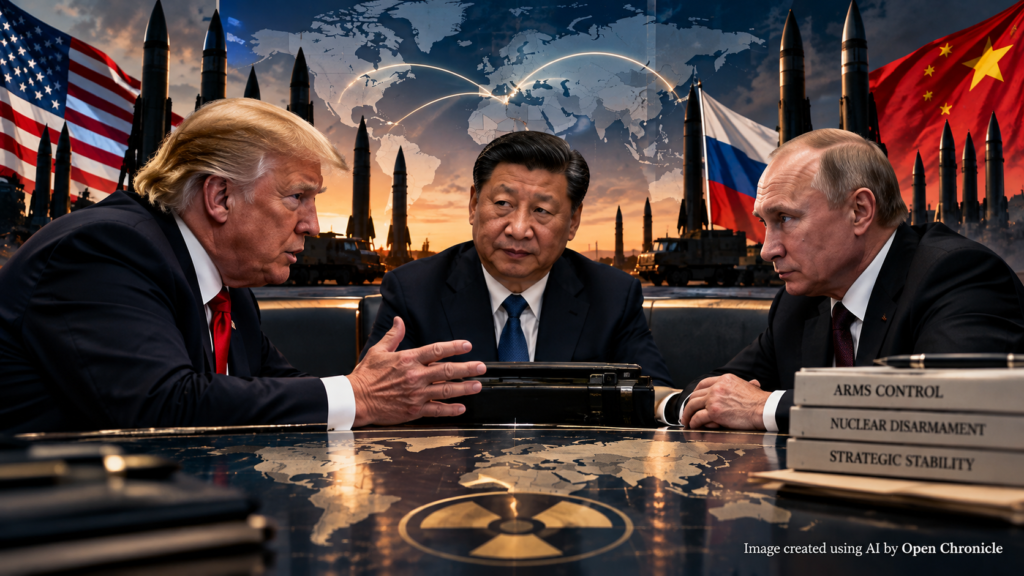
The US president says Washington is holding discussions with Moscow and Beijing on reducing nuclear arsenals, raising the prospect of renewed arms control diplomacy following the expiration of the New START treaty. But major differences over nuclear stockpiles, verification and strategic security remain unresolved.
By Open Chronicle News Desk with Agencies
WASHINGTON | October 16, 2026
US President Donald Trump has said the United States is holding discussions with Russia and China about nuclear disarmament, signalling an attempt to revive arms control diplomacy at a time of growing strategic competition and uncertainty over the international framework governing nuclear weapons.
Speaking in an interview with Newsmax on Thursday, October 15, Trump said Washington was engaging both Moscow and Beijing in conversations about reducing nuclear arsenals, expressing concern about the enormous destructive capacity of the world’s leading nuclear powers.
“The whole thing is a shame, because I’d love to denuclearize if possible, but we’re actually talking to Russia about that, and we’re talking to China about that denuclearization,” Trump told the broadcaster.
His comments come months after the expiration of New START, the last major bilateral treaty limiting the deployed strategic nuclear forces of the United States and Russia.
The president’s remarks suggest a possible diplomatic opening, although no formal trilateral negotiations, binding commitments or timetable for nuclear reductions have been announced.
The discussions also take place against a complicated geopolitical backdrop, with Washington and Moscow divided over the war in Ukraine and relations between the United States and China shaped by competition over security, technology and influence in the Indo-Pacific.
Trump Calls for Nuclear Restraint Among the World’s Leading Powers
Trump’s comments reflect his longstanding interest in negotiating a broader nuclear arms control arrangement involving the United States, Russia and China.
During his interview, the president suggested that China’s expanding nuclear capabilities could eventually narrow the gap between Beijing and the two established nuclear superpowers.
He said he expected China to catch up with the United States within approximately five years.
That assessment should be distinguished from independent estimates of existing nuclear stockpiles, which continue to show substantial differences between the three countries.
According to the Stockholm International Peace Research Institute (SIPRI), Russia and the United States collectively possess the overwhelming majority of the world’s nuclear weapons.
China has a considerably smaller arsenal, although its nuclear forces have been expanding.
The strategic significance of China’s modernisation programme has become an increasingly important issue in American defence planning.
Washington is concerned not only about the number of Chinese warheads but also about developments involving delivery systems, missile silos, submarines and the potential expansion of Beijing’s operational nuclear capabilities.
For the Trump administration, bringing China into future arms control discussions could represent a major diplomatic achievement.
However, Beijing has consistently resisted the argument that it should immediately accept limitations comparable to those historically negotiated between Washington and Moscow.
Russia and the United States Still Dominate Global Nuclear Stockpiles
The scale of the nuclear imbalance between the three countries remains central to the diplomatic challenge.
Russia is estimated to possess the largest overall inventory of nuclear warheads, including weapons held in military stockpiles and those awaiting dismantlement.
The United States maintains a similarly extensive arsenal and, according to the figures cited in the supplied reporting, exceeds Russia in the number of deployed warheads.
China ranks third among the countries discussed, but its total stockpile remains substantially smaller than those of Russia and the United States.
These distinctions matter because nuclear inventories are measured in different ways.
A country’s total inventory may include deployed strategic weapons, reserve warheads, non-strategic weapons and retired warheads awaiting dismantlement.
The number of deployed weapons therefore does not necessarily correspond to the overall size of a country’s nuclear stockpile.
SIPRI’s assessments also depend partly on estimates because governments do not disclose every aspect of their nuclear capabilities.
The continuing dominance of Washington and Moscow reflects the legacy of the Cold War, when both countries accumulated vast arsenals capable of inflicting catastrophic destruction.
Despite decades of arms control agreements and significant reductions from historical peaks, their nuclear forces remain central to global strategic stability.
New START Expiration Leaves a Major Gap in Arms Control
Trump’s remarks come at a particularly sensitive moment following the expiration of the New Strategic Arms Reduction Treaty, commonly known as New START.
Signed in 2010 by US President Barack Obama and Russian President Dmitry Medvedev, the treaty entered into force in 2011.
It established legally binding limits on deployed strategic nuclear weapons and associated delivery systems.
Among its principal provisions were limits of 1,550 deployed strategic warheads and 700 deployed intercontinental ballistic missiles, submarine-launched ballistic missiles and heavy bombers counted under the treaty.
New START also included verification arrangements designed to improve transparency and reduce uncertainty about the nuclear capabilities of both countries.
These mechanisms included data exchanges, notifications and inspection provisions.
In 2021, then-US President Joe Biden and Russian President Vladimir Putin agreed to extend the treaty for five years, using its single permitted extension.
That extension carried the agreement to February 2026.
With the treaty’s expiration, Washington and Moscow no longer have the same legally binding framework governing their deployed strategic nuclear forces.
Any continuation of comparable limits would require a new political understanding or agreement rather than another extension under the treaty’s original provisions.
The absence of a replacement raises concerns about transparency, predictability and the possibility of renewed competition in strategic weapons.
Why the End of New START Matters
For more than a decade, New START provided a framework through which the world’s two largest nuclear powers could monitor and constrain important elements of their strategic arsenals.
Its importance extended beyond the numerical limits imposed on weapons.
The agreement also helped maintain channels of communication between military and diplomatic officials responsible for nuclear security.
Verification arrangements reduced uncertainty about deployments and provided a mechanism for addressing questions concerning treaty implementation.
Without a comparable agreement, each government may become increasingly dependent on intelligence assessments and assumptions about the other’s military intentions.
That uncertainty can influence defence planning.
If one side believes its rival is expanding nuclear capabilities, it may respond by increasing its own forces, accelerating modernisation or changing deployment patterns.
Such developments can produce an arms competition even when neither government initially intends to initiate one.
A renewed arms control process could therefore provide benefits beyond reducing the number of nuclear warheads.
It could also restore transparency, establish predictable limits and reduce the risk of strategic miscalculation.
Washington and Beijing Discuss Possible Nuclear Site Visits
Alongside Trump’s statements, separate reporting suggests that American and Chinese officials have been exploring confidence-building measures involving visits to nuclear-related facilities.
CNN reported on October 6, citing sources familiar with the discussions, that Washington had considered reciprocal visits to nuclear sites as part of broader engagement with Beijing.
According to the report, the possibility of such exchanges was initially raised by Chinese officials during meetings with their American counterparts earlier this year.
Discussions reportedly included visits to US Department of Energy national laboratories and equivalent facilities in China.
Such visits could provide opportunities for technical dialogue, professional exchanges and greater familiarity with aspects of each country’s nuclear infrastructure.
However, visits to research laboratories should not automatically be interpreted as inspections of deployed nuclear weapons or verification of warhead inventories.
Those activities involve different objectives, security requirements and legal arrangements.
The reported proposals therefore appear to represent possible confidence-building measures rather than a fully developed nuclear arms control verification regime.
Reuters said it could not immediately independently verify CNN’s account.
The White House and the Chinese embassy in Washington did not respond to requests for comment outside business hours, according to the supplied reporting.
Discussions Take Place Within the UN Security Council Framework
According to CNN, much of the recent engagement between American and Chinese officials has occurred on the sidelines of meetings involving the five permanent members of the United Nations Security Council.
The group, commonly known as the P5, consists of the United States, Russia, China, France and the United Kingdom.
All five countries are recognised as nuclear-weapon states under the Treaty on the Non-Proliferation of Nuclear Weapons.
The P5 framework provides an established diplomatic setting for discussions concerning nuclear doctrines, strategic risks and arms control.
Although the five countries maintain different security interests, they share an interest in preventing nuclear conflict and avoiding dangerous misunderstandings.
Dialogue within this framework can address issues such as crisis communication, nuclear risk reduction and transparency.
It does not, however, guarantee progress toward binding disarmament commitments.
Differences over strategic capabilities, regional security and the relationship between conventional and nuclear forces remain significant obstacles.
Nevertheless, continued engagement can be valuable at a time when relations among major powers are increasingly strained.
China Remains Reluctant to Join Trilateral Arms Control Negotiations
Beijing’s position remains one of the principal challenges facing Trump’s proposal.
China has repeatedly argued that its nuclear arsenal is much smaller than those maintained by the United States and Russia.
On that basis, Chinese officials have maintained that the two largest nuclear powers should bear primary responsibility for making substantial reductions.
Beijing has therefore resisted calls to participate immediately in trilateral negotiations based on comparable limits.
From China’s perspective, accepting restrictions alongside Washington and Moscow could institutionalise an unequal arrangement or constrain its strategic development while the other two countries retain substantially larger forces.
American officials, by contrast, have argued that China’s expanding arsenal makes its participation increasingly important to any future arms control architecture.
The disagreement reflects two different approaches to strategic stability.
Washington seeks a framework that accounts for the capabilities of all three major powers.
Beijing argues that meaningful progress must begin with reductions by the countries possessing the largest stockpiles.
Reconciling these positions would require difficult negotiations over transparency, verification, numerical limits and the broader security environment.
Trump Raised Trilateral Arms Control With Xi Jinping
The latest comments follow discussions between Trump and Chinese President Xi Jinping during their meeting last month.
According to the supplied reporting, Trump raised the possibility of trilateral nuclear arms control negotiations involving Washington, Beijing and Moscow.
The leaders did not, however, discuss the proposed reciprocal nuclear site visits during their meeting, CNN reported, citing a US official.
That distinction suggests that different aspects of the nuclear dialogue may be advancing through separate diplomatic channels.
High-level political discussions can establish broad objectives, while technical exchanges between officials may explore practical measures.
Progress in one area does not necessarily mean that an agreement is close in another.
Trump’s statement that he has spoken with Xi about denuclearisation indicates presidential-level interest, but it does not establish that China has accepted the American proposal for formal trilateral negotiations.
Beijing’s publicly stated reservations remain important to assessing the prospects for any agreement.
Further Trump–Xi Meetings Could Shape the Negotiations
Additional diplomatic engagement may take place before the end of the year.
Another meeting between Trump and Xi is considered possible, with international gatherings offering potential opportunities for direct talks.
The supplied reporting identifies November’s Asia-Pacific Economic Cooperation summit in China and December’s Group of 20 meetings in the United States as possible diplomatic occasions.
CNN reported that further lower-level discussions concerning nuclear site visits were expected before the two presidents met again.
Such contacts could help clarify whether the proposed exchanges are technically feasible and politically acceptable.
They might also provide an opportunity to identify areas where both governments see value in greater transparency.
However, any substantial nuclear agreement would require a broader negotiation process involving military experts, diplomats and national security officials.
Issues such as inspection access, sensitive information, verification standards and reciprocity would be particularly difficult to resolve.
The possibility of a presidential meeting therefore represents an opportunity for diplomacy rather than evidence that an agreement is imminent.
Nuclear Disarmament and Arms Control Are Not the Same
Trump’s use of the term denuclearisation raises an important distinction.
Nuclear disarmament generally refers to reducing or eliminating nuclear weapons, potentially with the ultimate objective of a world without nuclear arsenals.
Arms control is a broader concept that can include numerical limits, transparency measures, verification arrangements, restrictions on particular weapons systems and mechanisms to reduce the risk of conflict.
Countries can pursue arms control without committing to complete nuclear disarmament.
For example, a treaty may limit the number of deployed strategic warheads while allowing both parties to retain substantial nuclear deterrents.
Similarly, reciprocal visits to research facilities may improve transparency without requiring either government to reduce its arsenal.
The discussions described by Trump and in the CNN reporting appear to cover several possible forms of nuclear diplomacy.
It remains unclear whether Washington is seeking immediate reductions, a new strategic arms limitation agreement, confidence-building measures or a longer-term framework combining these objectives.
Clarifying those goals would be an essential first step toward meaningful negotiations.
The Strategic Challenge of a Three-Power Nuclear Framework
Historically, the most significant nuclear arms limitation agreements have been bilateral arrangements between Washington and Moscow.
Those negotiations were shaped by the existence of two overwhelmingly dominant nuclear superpowers.
The strategic environment is now more complex.
China’s expanding capabilities have introduced an increasingly important third dimension to nuclear deterrence calculations.
At the same time, technological developments involving missile defence, hypersonic systems, space infrastructure and advanced conventional weapons complicate traditional arms control models.
The three countries also face different security environments.
Russia’s nuclear strategy is influenced by its confrontation with NATO and the war in Ukraine.
China’s strategic calculations are shaped partly by its rivalry with the United States and regional security issues in the Indo-Pacific.
The United States must consider the deterrence requirements associated with both competitors, as well as its security commitments to allies in Europe and Asia.
These overlapping relationships make a trilateral agreement considerably more complicated than a conventional bilateral treaty.
A successful framework would need to account for different arsenal sizes, military doctrines and security priorities without creating incentives for any participant to abandon the process.
The Big Picture: A Possible Opening in a Dangerous Nuclear Era
Trump’s announcement offers a potential opening for renewed nuclear diplomacy at a time when established arms control mechanisms have weakened.
The expiration of New START has removed a central element of the framework that governed US–Russian strategic nuclear forces.
China’s expanding arsenal has meanwhile intensified debate over whether future agreements can remain exclusively bilateral.
The reported discussions concerning reciprocal nuclear facility visits suggest that Washington and Beijing may be exploring limited measures to improve confidence and communication.
Such initiatives could help create conditions for more ambitious negotiations.
Yet the obstacles remain substantial.
Russia and the United States are deeply divided over European security and the war in Ukraine.
China continues to reject the assumption that its smaller arsenal should be subject to restrictions comparable to those imposed on the two largest nuclear powers.
And no detailed negotiating framework has been publicly established.
The immediate significance of Trump’s remarks therefore lies less in the prospect of rapid nuclear disarmament than in the possibility of reopening channels for strategic dialogue.
A new agreement could help restore predictability, reduce uncertainty and establish mechanisms to manage the risks associated with nuclear competition.
But achieving meaningful reductions would require sustained diplomacy, credible verification and political commitments from all participating governments.
For now, the world’s leading nuclear powers appear to be discussing the possibility of a new arms control framework without having resolved the fundamental disagreements that have complicated such negotiations for years.
The challenge is to transform those discussions into practical arrangements before the absence of binding limits encourages a new phase of nuclear competition.
Sources and Further Reading
1. Reuters — International Reporting on Nuclear Arms Control
Reporting on Trump’s comments concerning nuclear disarmament, US–Russia relations and discussions with China.
2. CNN — US–China Nuclear Diplomacy and Proposed Facility Visits
Reporting on discussions concerning reciprocal visits to nuclear-related facilities and diplomatic engagement between American and Chinese officials.
3. Stockholm International Peace Research Institute (SIPRI) — Nuclear Forces and Armaments
Independent research and estimates concerning global nuclear arsenals, deployed warheads and nuclear modernisation.
4. US Department of State — Arms Control and International Security
Official American institutional information concerning arms control, non-proliferation and international security diplomacy.
5. US Department of Energy — National Nuclear Security Administration
Institutional information concerning US nuclear security infrastructure, laboratories and stockpile stewardship.
6. United Nations Office for Disarmament Affairs — Nuclear Weapons
International information concerning nuclear disarmament, arms control and the Treaty on the Non-Proliferation of Nuclear Weapons.
7. Arms Control Association — New START Treaty
Background information concerning the treaty’s limits, verification mechanisms and role in US–Russian strategic arms control.
8. International Atomic Energy Agency — Official Website
Institutional information concerning nuclear safeguards, verification and peaceful nuclear activities.
Editorial Note
This article is an original Open Chronicle news synthesis based on the supplied reporting concerning President Donald Trump’s October 15, 2026, statements about nuclear disarmament discussions with Russia and China.
The president’s remarks, including his assessment of China’s future nuclear capabilities, are attributed to his Newsmax interview and should not be interpreted as independently established forecasts.
Information concerning proposed reciprocal visits to nuclear-related facilities is attributed to CNN’s reporting, which Reuters said it could not immediately independently verify. No formal agreement on such visits has been established in the supplied material.
The discussion of global nuclear stockpiles draws on the institutional research framework of the Stockholm International Peace Research Institute. Estimates of nuclear inventories may vary according to the reporting date, methodology and distinction between deployed, stored and retired warheads.
The article distinguishes nuclear disarmament from arms control and confidence-building measures. Diplomatic discussions do not necessarily imply agreement on numerical reductions, inspections or binding treaty commitments.
Institutional sources listed above provide background and further reading. They should not be interpreted as direct confirmation of every statement concerning the reported October 2026 diplomatic contacts.
Open Chronicle | Independent. Global. Trusted.