
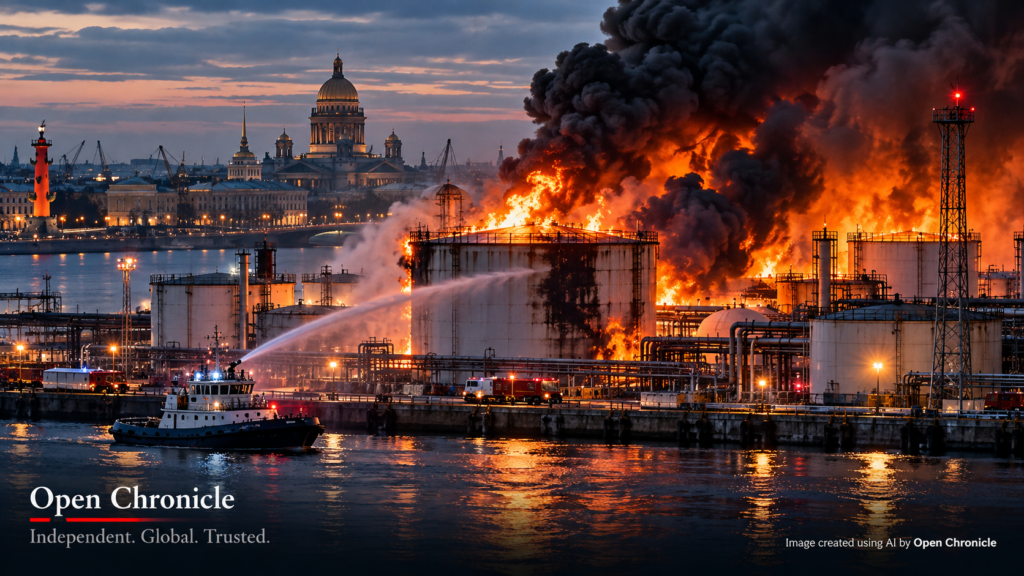
At least one person has been killed and five injured after overnight attacks struck two major oil facilities in St Petersburg. Fires also broke out at an Ozon logistics centre and a VKontakte data centre, while Moscow claimed to have intercepted more than 1,000 Ukrainian drones across Russian territory. The strikes come amid growing tensions over a US-brokered energy ceasefire and Washington’s controversial decision to ease sanctions on Russian oil.
By Open Chronicle News Desk with Agencies
ST PETERSBURG, RUSSIA | October 18, 2026
A wave of overnight drone attacks struck Russia’s second-largest city, St Petersburg, killing at least one person, injuring five others and setting fire to two important oil facilities, according to regional authorities.
The strikes targeted the St Petersburg Oil Terminal and the Ruchyi oil depot, both significant components of the region’s energy infrastructure.
Governor Alexander Beglov said emergency services were working to extinguish fires at the installations following the attacks, which also damaged residential buildings and disrupted operations at the city’s international airport.
Additional strikes reportedly hit a logistics centre operated by Russian e-commerce company Ozon and a regional data centre belonging to VKontakte, Russia’s largest domestic social networking platform.
The attacks represent a significant escalation in the campaign against Russian energy and economic infrastructure as the war in Ukraine approaches another winter.
Kyiv had not publicly commented on the latest strikes at the time of the initial reporting.
The attacks also come against the backdrop of a growing diplomatic dispute involving Washington, Moscow and Kyiv over energy infrastructure, sanctions relief and efforts to negotiate a ceasefire.
Two Major Oil Facilities Targeted
The St Petersburg Oil Terminal and the Ruchyi oil depot were among the principal targets of the overnight attacks.
Governor Beglov confirmed that fires had broken out at both facilities and that emergency crews were attempting to bring them under control.
The St Petersburg Oil Terminal is an important part of the city’s petroleum logistics infrastructure, serving oil-product storage and maritime transport operations in the Baltic region.
The Ruchyi depot also forms part of the wider network used to store and distribute petroleum products.
Damage to such facilities can disrupt fuel storage, distribution and export-related operations, although the full consequences of the latest strikes have not yet been established.
Russian authorities have not provided a comprehensive assessment of the damage or indicated how long operations at the facilities might be affected.
The reported attacks follow previous strikes against energy installations in and around St Petersburg.
The city’s oil terminal was also targeted in July, according to earlier reporting.
While Russian regions closer to Ukraine have experienced more frequent drone attacks, the latest incident demonstrates the vulnerability of infrastructure much farther from the front line.
One Dead, Five Injured as Residential Buildings Damaged
According to the regional governor, at least one person was killed and five others were injured during the attacks.
The circumstances of the fatality and the conditions of the injured were not immediately disclosed.
Beglov also reported damage to 12 apartment buildings and two private homes.
The extent of the residential damage remains unclear, and officials have not specified whether the buildings were struck directly or affected by falling debris, fires or blast effects.
Emergency services were deployed across affected areas as authorities assessed the damage and worked to secure the sites.
The attacks have again highlighted the risks posed to civilian communities by long-range drone warfare, particularly when strikes occur in densely populated urban regions.
St Petersburg, one of Russia’s largest cities and an important economic centre, has extensive residential districts surrounding industrial and transport infrastructure.
Pulkovo Airport Temporarily Closed
The attacks also disrupted transport operations.
Pulkovo Airport, St Petersburg’s principal international airport, was temporarily closed during the overnight emergency.
Such restrictions are commonly imposed during drone alerts to reduce risks to civilian aircraft and allow air-defence operations to proceed.
Authorities also warned that mobile internet services could be disrupted.
Temporary restrictions on mobile connectivity have become increasingly common in Russian regions during drone incidents, although officials have not provided a detailed explanation of the specific disruptions reported in St Petersburg.
The combined effects of airport closures, emergency operations and telecommunications interruptions underline how drone attacks can affect civilian life beyond the facilities directly targeted.
Ozon Logistics Centre Hit by Drone
Russian e-commerce company Ozon confirmed that one of its logistics centres in the St Petersburg area had been targeted by a drone.
The strike sparked a fire at the facility.
According to the company, employees were evacuated and no injuries were reported among its staff.
Ozon also announced that it had temporarily stopped accepting shipments from sellers at the affected location.
The company said the facility was being used for other operational purposes following the incident.
Often described as Russia’s equivalent of Amazon, Ozon plays a significant role in the country’s online retail and delivery network.
The reported strike suggests that the attacks extended beyond conventional military and energy targets to infrastructure supporting commercial logistics.
However, the available reporting does not establish whether the Ozon facility was deliberately selected as a target or struck under other circumstances.
VKontakte Data Centre Also Targeted
VKontakte, commonly known as VK, confirmed that a drone had targeted one of its regional data centres.
Users reported service disruptions during the early hours of Sunday.
The company said its services remained available as usual despite the incident.
VK is one of Russia’s most important domestic technology companies, operating social networking and digital services used by millions of people.
Data centres form a critical part of modern communications infrastructure, supporting digital platforms, business services and online information systems.
Damage to such facilities can create operational risks even when backup systems allow services to remain available.
The reported attack follows earlier strikes this month against infrastructure associated with Yandex, Russia’s largest search engine.
Those incidents reportedly caused service interruptions.
Taken together, the attacks indicate an expanding pattern of disruption affecting Russian economic and technological infrastructure.
Moscow Claims More Than 1,000 Drones Intercepted
Russia’s Defence Ministry said its air-defence systems had intercepted more than 1,000 Ukrainian drones over Russian territory during the overnight attacks.
The figure, if confirmed, would indicate an exceptionally large drone operation.
However, the claim has not been independently verified.
Russian military statements concerning the number of drones intercepted cannot, on their own, establish the total number launched or the effectiveness of the country’s air defences.
The fires and infrastructure damage reported in St Petersburg demonstrate that several locations were affected despite Moscow’s claims of extensive interceptions.
The Russian authorities have not provided a complete public breakdown of the reported interceptions by region.
Ukraine has not confirmed responsibility for the St Petersburg strikes in the supplied reporting.
Ukraine’s Campaign Against Russian Energy Infrastructure
Ukraine has repeatedly targeted Russian oil refineries, storage facilities and other energy infrastructure during the war.
Kyiv has argued that such operations are intended to reduce the revenues and logistical capabilities supporting Russia’s military campaign.
Oil and petroleum products remain important sources of income for the Russian economy.
Strikes against refineries, depots and export facilities can also complicate domestic fuel distribution and impose additional costs on repair and security operations.
The effectiveness of these attacks depends on the extent of the damage, the ability of Russian operators to restore facilities and the availability of alternative transport and storage capacity.
The latest strikes against St Petersburg’s oil infrastructure therefore carry both operational and economic significance.
They also have political implications at a time when Washington is attempting to secure agreements aimed at reducing attacks on energy facilities.
Dispute Over Trump’s Energy Ceasefire
The overnight attacks followed a controversial announcement by US President Donald Trump concerning an energy ceasefire between Russia and Ukraine.
According to the supplied reporting, Trump declared an arrangement last week intended to halt attacks on energy infrastructure.
Ukraine subsequently suspended its strikes against Russian oil facilities for three days.
Kyiv, however, accused Moscow of continuing to target Ukrainian energy infrastructure during that period.
Ukraine resumed attacks earlier this week, prompting criticism from the American president.
Trump has called for a renewed truce as part of his broader efforts to negotiate an agreement with Russian President Vladimir Putin.
The dispute illustrates the difficulty of maintaining a limited ceasefire when both sides accuse the other of violating its terms.
The precise provisions of the reported energy ceasefire, including any monitoring or enforcement mechanisms, have not been established in the supplied account.
Without independent verification of those arrangements, the competing allegations should be treated as claims by the governments involved.
Zelensky Says Russia Attacked Ukraine’s Energy Sector 76 Times
Ukrainian President Volodymyr Zelensky accused Russia of continuing attacks on his country’s energy infrastructure despite the reported ceasefire initiative.
Speaking on Saturday, Zelensky said Russia had targeted Ukraine’s energy sector 76 times since Trump’s announcement.
The Ukrainian president also reported that Russian forces had launched nearly 2,700 drones, 1,700 aerial bombs and 66 missiles over the preceding week.
According to Zelensky, most of those attacks were directed at energy facilities.
The figures have not been independently verified in this article.
Nevertheless, the scale of the reported attacks reflects the intensity of the continuing conflict.
Zelensky said tens of thousands of Ukrainians remained without electricity on Saturday following Russian strikes.
Damage to power stations, substations and transmission infrastructure has become a central humanitarian concern as colder weather approaches.
US-Russia Diesel Agreement Deepens Diplomatic Tensions
The attacks have unfolded amid deteriorating relations between Washington and Kyiv following a reported agreement for the United States to import Russian diesel.
According to the supplied reporting, Trump reached the arrangement with Putin in an effort to reduce American energy prices.
Fuel costs in the United States have risen sharply amid the ongoing conflict involving Iran and the resulting disruption to international energy markets.
With American midterm elections approaching, the administration faces pressure over energy prices and broader economic conditions.
The reported diesel agreement has generated criticism because of concerns that purchases of Russian petroleum products could provide Moscow with additional revenue.
Zelensky suggested that the arrangement amounted to American investment in Russia’s war effort.
The Ukrainian government’s position reflects a longstanding argument that restricting Russian energy income is essential to weakening Moscow’s capacity to sustain the invasion.
However, the exact commercial terms, volumes and implementation arrangements of the reported diesel agreement have not been independently established in the supplied material.
Washington’s Sanctions Pause Draws Criticism
Trump’s decision to temporarily suspend a series of sanctions against Russia has added to the diplomatic controversy.
The administration has presented the move as part of its efforts to review the economic consequences of sanctions and facilitate negotiations.
Critics argue that easing pressure on Moscow risks weakening Western leverage while Russian military operations continue.
The decision has reportedly drawn objections from some Republican lawmakers as well as Ukraine’s international supporters.
For Kyiv, the sanctions debate is particularly sensitive because energy revenue remains closely linked to Russia’s ability to finance the war.
The disagreement also exposes a broader tension between Washington’s efforts to stabilise energy prices and Ukraine’s demands for sustained economic pressure on Moscow.
Whether the sanctions pause will produce diplomatic progress remains uncertain.
Russia and Ukraine Intensify Attacks Before Winter
Both Russia and Ukraine have increased attacks against energy-related infrastructure as the conflict enters its fifth year.
For Ukraine, strikes on Russian oil facilities are intended to impose economic and logistical costs.
For Russia, attacks on Ukrainian electricity generation and distribution systems have caused widespread civilian hardship.
Moscow maintains that its military operations target infrastructure used by Ukraine’s armed forces.
Ukrainian officials and international organisations have repeatedly raised concerns about the consequences of strikes on civilian energy systems.
According to the supplied reporting, the United Nations warned on Friday that the first two weeks of October had been the deadliest period for Ukrainian civilians in years.
That assessment underscores the humanitarian impact of the continuing conflict.
The approaching winter increases the danger posed by prolonged electricity and heating disruptions.
Ukraine Faces Another Difficult Winter
Russian attacks on Ukraine’s energy network have left hundreds of thousands of people without electricity at different points during the conflict.
Damage to power infrastructure can disrupt heating, water supply, hospitals, communications and other essential services.
Even when electricity is restored, repeated strikes can exhaust repair crews and reduce the availability of replacement equipment.
Zelensky’s statement that tens of thousands of people remained without power on Saturday highlights the continuing vulnerability of Ukraine’s energy system.
The humanitarian consequences could become more severe if further attacks occur during periods of freezing temperatures.
Ukraine has sought international assistance to strengthen air defences and protect critical infrastructure.
The ability to maintain electricity and heating services will be an important factor in civilian resilience during the coming months.
The Baltic Dimension of the War
The strikes on St Petersburg also carry strategic implications because of the city’s location near the Baltic Sea.
The region is an important hub for Russian maritime trade, industrial activity and petroleum logistics.
Attacks on oil infrastructure in this area can have consequences beyond the immediate physical damage.
They may require Russia to divert air-defence resources, strengthen security around industrial installations and reassess the vulnerability of critical transport networks.
The temporary closure of Pulkovo Airport illustrates how an attack on industrial infrastructure can also disrupt civilian transportation.
The involvement of logistics and digital infrastructure in the latest incidents further broadens the potential economic impact.
Although the actual damage remains uncertain, the attacks reinforce the expanding geographical reach of the conflict.
The Big Picture: Energy Infrastructure at the Centre of a Wider War
The latest strikes on St Petersburg demonstrate how energy infrastructure has become both a military objective and a diplomatic bargaining instrument in the Russia-Ukraine war.
For Ukraine, attacks on Russian petroleum facilities are part of a strategy to impose costs on Moscow’s war economy.
For Russia, continued attacks on Ukrainian electricity infrastructure place pressure on civilian resilience and the country’s ability to function through winter.
For the United States, the conflict has become increasingly entangled with global energy prices, sanctions policy and negotiations over a possible ceasefire.
The reported US-Russia diesel arrangement and sanctions pause have complicated Washington’s relationship with Kyiv at a particularly sensitive moment.
The overnight attacks also reveal the broader consequences of long-range drone warfare.
Oil terminals, commercial warehouses, data centres, residential buildings and airports can all be affected when attacks reach major urban and industrial centres.
The immediate consequences in St Petersburg include at least one reported death, five injuries, fires at two oil installations and disruption to civilian infrastructure.
The longer-term consequences will depend on the extent of the damage, the outcome of investigations and whether diplomatic efforts can reduce attacks on energy facilities.
As winter approaches, the conflict over energy infrastructure is likely to remain one of the most consequential dimensions of the war.
The strikes on St Petersburg are another indication that the battle over energy is increasingly inseparable from the wider military and diplomatic struggle between Russia and Ukraine.
Sources and Further Reading
The following sources provide international news coverage and institutional information concerning the Russia-Ukraine war, attacks on energy infrastructure, diplomatic developments and the humanitarian consequences of the conflict.
1. BBC News — Russia and Ukraine War
International reporting on the attacks against Russian oil infrastructure, the continuing conflict and diplomatic developments.
2. Reuters — Russia and Ukraine
International reporting on military operations, energy infrastructure, sanctions and diplomatic negotiations.
3. United Nations Human Rights Monitoring Mission in Ukraine
Independent monitoring and reporting concerning civilian casualties, attacks affecting essential infrastructure and the humanitarian consequences of the war.
Editorial Note
This article is an original Open Chronicle news synthesis based on the supplied reporting concerning overnight attacks on St Petersburg and Russian energy infrastructure on October 18, 2026.
Descriptions of the fires, casualties, damage to residential buildings and attacks on Ozon and VK facilities are attributed to Russian regional authorities and company statements identified in the supplied account.
Claims concerning the interception of more than 1,000 drones, Russian attacks on Ukrainian energy facilities and the figures provided by President Volodymyr Zelensky have not been independently verified for this article.
The reported US-Russia diesel agreement, energy ceasefire and sanctions pause are presented as described in the supplied material and require confirmation through official documentation and independent reporting.
The listed sources provide relevant reporting and institutional background rather than direct verification of every development described.
Open Chronicle | Independent. Global. Trusted.