
How a remote Russian colony became American territory, why the purchase was controversial, and how Alaska eventually emerged as one of the most strategically important regions in the world.
By Open Chronicle History Desk
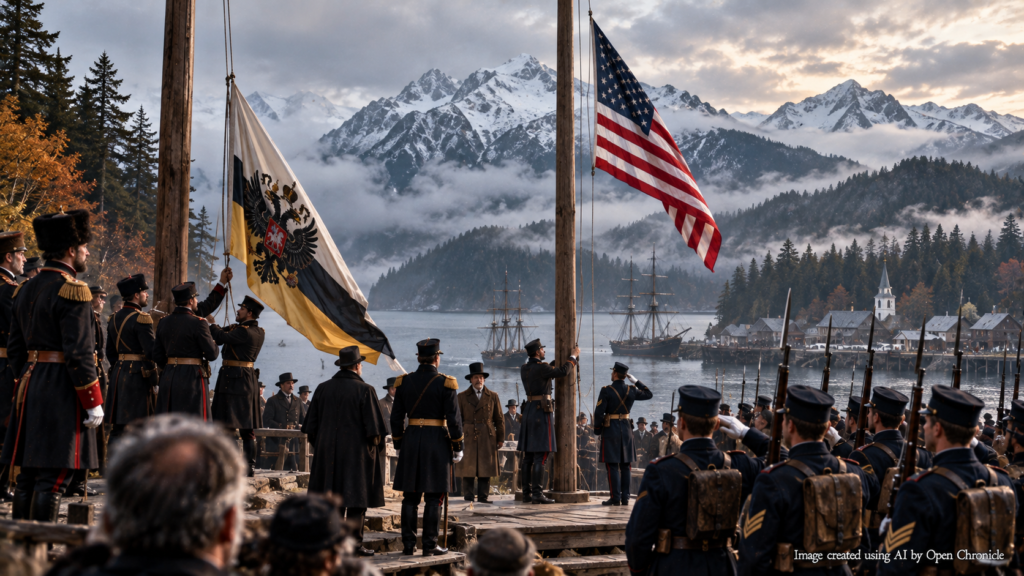
On October 18, 1867, a ceremony took place in Sitka, a small settlement on the Pacific coast of North America.
Representatives of the Russian Empire and the United States gathered to mark the formal transfer of Alaska from Russian to American sovereignty.
The Russian flag was lowered.
The American flag was raised.
With that symbolic act, a vast territory covering approximately 1.5 million square kilometers passed into the possession of the United States.
The agreement had been signed in Washington on March 30, 1867.
The purchase price was $7.2 million.
For the United States, it was an extraordinary expansion.
For Russia, it was the end of an imperial venture in North America that had begun more than a century earlier.
Yet the ceremony at Sitka told only part of the story.
The land was not empty.
Alaska was home to Indigenous peoples whose societies, cultures and political relationships long predated Russian colonization.
The transfer was negotiated between two governments without their consent.
It therefore represented not only a diplomatic transaction but also another chapter in the expansion of imperial authority over Indigenous territories.
At the time, many Americans knew little about Alaska.
Some questioned whether the acquisition was worthwhile.
The territory was remote.
Its climate was harsh.
Its economic possibilities were uncertain.
Critics portrayed it as an expensive wilderness.
Supporters saw something very different.
They recognized the value of its coastline, fisheries, natural resources and strategic location between North America and Asia.
Over the following century, Alaska would become central to the American economy, military planning and Arctic geopolitics.
The discovery of gold, the development of fisheries, the Second World War, the Cold War and the exploitation of petroleum transformed perceptions of the territory.
But the deeper history of Alaska cannot be reduced to the purchase price.
It is a history of Indigenous sovereignty, colonial expansion, environmental wealth and the changing balance of power in the northern Pacific.
On October 18, 1867, the United States acquired far more than a distant territory.
It acquired a new geographical position in the world.
1. Alaska Before European Colonization
Long before European explorers arrived, Alaska was inhabited by diverse Indigenous peoples.
Their communities developed sophisticated ways of living in Arctic, subarctic and coastal environments.
Among them were the Iñupiat, Yup’ik, Unangax̂ (Aleut), Alutiiq (Sugpiaq), Tlingit, Haida, Athabaskan peoples and others.
These societies were not culturally or politically identical.
They spoke different languages.
They maintained distinct traditions.
Their economies included fishing, hunting, trade and the management of local resources.
Many communities possessed detailed knowledge of seasonal changes, animal migrations and maritime navigation.
Alaska was therefore not an unoccupied wilderness awaiting European discovery.
It was a region with established societies and complex histories.
2. The Geography of Alaska
Alaska occupies the northwestern extremity of North America.
It extends from the Pacific Ocean to the Arctic Ocean.
Its coastline includes thousands of islands, bays and inlets.
The Aleutian Islands stretch westward toward Asia.
The Bering Strait separates Alaska from Siberia.
At its narrowest point, the strait is approximately 82 kilometers wide.
This geographical position would eventually become central to Alaska’s strategic importance.
But in the eighteenth century, it attracted attention primarily because of exploration, maritime trade and the fur industry.
3. Russia Looks Across the Pacific
Russian expansion across Siberia began long before the purchase of Alaska.
By the seventeenth century, Russian explorers and traders had reached the Pacific coast.
The Russian Empire was interested in territory, commerce and valuable animal furs.
Sea otter pelts were particularly prized.
Their dense fur commanded high prices in Asian markets.
Russian merchants and officials increasingly looked toward the islands and coastlines of the North Pacific.
Alaska appeared to offer commercial opportunities.
4. The Expedition of Vitus Bering
In 1741, expeditions associated with Vitus Bering and Aleksei Chirikov reached parts of the North American coast.
Their voyages helped establish Russian knowledge of Alaska.
The expeditions were dangerous.
Ships encountered storms, disease and navigational difficulties.
Bering died during the return journey.
But reports of valuable furs encouraged further Russian commercial activity.
Over the following decades, traders and hunters expanded their operations in the region.
5. The Fur Trade
The fur trade became the economic foundation of Russian colonial activity in Alaska.
Sea otters were especially important.
Russian traders sought pelts for export to markets in Asia.
The industry depended heavily on Indigenous labor and maritime expertise.
In many areas, Russian traders used coercion, violence and hostage-taking to compel Indigenous hunters to supply furs.
The exploitation of sea otters also placed enormous pressure on animal populations.
The colonial economy was profitable for some merchants but destructive for many local communities.
6. Indigenous Resistance
Russian expansion encountered resistance.
Indigenous peoples defended their territories, communities and economic independence.
The Tlingit, in particular, resisted Russian efforts to establish control in southeastern Alaska.
Conflict erupted around the Russian settlement at Sitka.
In 1802, Tlingit forces attacked and destroyed a Russian outpost.
In 1804, Russian forces returned and fought a major battle against Tlingit defenders.
The conflict became a defining episode in the history of Russian Alaska.
It also demonstrated that Russian authority was neither uncontested nor absolute.
7. The Russian-American Company
In 1799, Emperor Paul I granted a charter to the Russian-American Company.
The company received extensive commercial privileges.
It became the principal organization responsible for Russian colonial administration and trade in Alaska.
Its operations combined business interests with imperial authority.
The company established settlements, managed trade and maintained relations with Indigenous communities.
It also depended on supply routes stretching across enormous distances.
These logistical challenges would eventually weaken the Russian position.
8. Sitka: The Colonial Capital
Sitka became the administrative center of Russian America.
The settlement was known to Russians as Novo-Arkhangelsk, or New Archangel.
Its location on the southeastern coast offered access to maritime trade routes.
The town developed warehouses, administrative buildings, religious institutions and commercial facilities.
Russian Orthodox missionaries also became active in Alaska.
Their presence left a lasting religious and cultural legacy.
By the middle of the nineteenth century, Sitka represented the center of Russian imperial authority in North America.
9. The Limits of Russian Control
Although maps depicted Alaska as Russian territory, effective colonial control varied considerably.
Russian settlements were concentrated in particular coastal areas.
Large inland regions remained outside direct Russian administration.
Indigenous peoples continued to govern many aspects of their own communities.
The Russian population was relatively small.
The empire faced difficulties supplying and defending its distant possessions.
The distinction between imperial claims and actual control is essential to understanding Alaska’s history.
10. The Decline of the Fur Economy
By the nineteenth century, the fur trade was becoming less reliable.
Overhunting had reduced sea otter populations in many areas.
Commercial returns declined.
The Russian-American Company faced increasing financial difficulties.
Maintaining distant settlements was expensive.
Transportation across the Pacific was difficult.
Russia also had other imperial priorities.
The economic justification for retaining Alaska was weakening.
11. The Crimean War Changes Russian Thinking
The Crimean War of 1853–1856 exposed important weaknesses in the Russian Empire.
Russia fought against an alliance that included Britain and France.
The war placed enormous pressure on Russian finances and military resources.
It also raised concerns about vulnerable imperial possessions.
British North America lay relatively close to Alaska.
Russian officials feared that Britain might seize the territory during a future conflict.
Selling Alaska to the United States offered a way to prevent such an outcome while gaining financial compensation.
12. Russia and the United States
Relations between Russia and the United States were generally cordial during much of the nineteenth century.
The two countries had reasons to cooperate.
Both were wary of British power.
Russia saw the United States as a useful counterweight to Britain in North America.
American expansionists, meanwhile, viewed the Pacific as an area of growing economic importance.
These shared interests created favorable conditions for negotiations over Alaska.
13. American Expansionism
The United States had expanded rapidly during the nineteenth century.
The Louisiana Purchase of 1803 had greatly increased its territory.
The annexation of Texas and the Mexican-American War brought further expansion.
The acquisition of Alaska continued this broader movement.
But it also represented a new direction.
Alaska was geographically separated from the contiguous United States.
Its acquisition extended American influence into the North Pacific.
The purchase therefore reflected both territorial ambition and emerging strategic thinking.
14. William H. Seward
William Henry Seward was the United States secretary of state under President Abraham Lincoln and later President Andrew Johnson.
He strongly supported American expansion.
Seward believed that the United States had an important future as a Pacific power.
He saw commercial opportunities in Asia.
He also recognized the potential value of northern territories.
Alaska fitted into his broader vision.
The purchase would become one of the defining achievements of his diplomatic career.
15. Eduard de Stoeckl
Eduard de Stoeckl served as the Russian minister to the United States.
He played a central role in the negotiations.
Stoeckl understood American politics and maintained relationships with influential figures in Washington.
He worked with Seward to develop the agreement.
Both governments had reasons to move quickly.
Russia wanted to dispose of a costly and vulnerable colony.
The United States saw an opportunity to acquire an enormous territory at a relatively modest price.
16. The Negotiations of March 1867
Negotiations intensified in March 1867.
Seward and Stoeckl discussed the terms of the proposed sale.
The agreement was reached after a period of concentrated diplomatic activity.
On March 30, 1867, the two men signed the treaty.
The United States agreed to pay $7.2 million in gold.
In return, Russia would cede its territorial claims and possessions in Alaska.
The agreement required approval through the American constitutional process.
17. The Price: $7.2 Million
The purchase price was approximately two cents per acre.
Measured by the enormous size of the territory, the cost was remarkably low.
But price alone did not determine whether the purchase was attractive.
The United States still faced the expense of administration, transportation and development.
Much of Alaska was poorly understood by American policymakers.
Its economic potential remained uncertain.
The purchase was therefore both an opportunity and a gamble.
18. The Senate Approves the Treaty
The United States Senate approved the treaty on April 9, 1867.
The vote was 37 to 2.
The result demonstrated substantial support among senators.
Although the purchase later became associated with public criticism, it was not narrowly approved.
The Senate’s decision reflected confidence in Seward’s diplomacy and the strategic value of the acquisition.
Formal ratification followed.
The transfer ceremony was scheduled for October.
19. Was Alaska Really Called Seward’s Folly?
The expression “Seward’s Folly” became closely associated with the Alaska Purchase.
It suggested that Seward had wasted public money on a frozen and useless territory.
Another nickname was “Seward’s Icebox.”
But the historical record reveals a more complicated public reaction.
Some newspapers criticized the purchase.
Others strongly supported it.
Commercial interests and expansionists recognized its potential.
The idea that almost everyone considered the purchase foolish is an exaggeration created partly by later retellings.
20. October 18, 1867: The Transfer Ceremony
The formal transfer took place at Sitka on October 18, 1867.
Russian and American representatives attended.
The ceremony involved the lowering of the Russian flag and the raising of the American flag.
The transfer marked the official change of sovereignty.
The United States assumed control of the territory under the terms of the treaty.
For the Russian Empire, the ceremony ended its principal colonial possession in North America.
For the United States, it opened a new chapter of territorial expansion.
21. The Symbolism of Two Flags
The lowering of one flag and raising of another became the defining image of the transfer.
Flags represented imperial authority.
Their replacement signaled a change in the state claiming sovereignty.
But the ceremony did not reflect the consent of Alaska’s Indigenous peoples.
Their communities had existed long before either flag arrived.
The transaction between Russia and the United States treated the territory as transferable imperial property.
This contradiction remains central to modern historical interpretations.
22. Indigenous Peoples and the Purchase
The purchase agreement was negotiated without the participation of Alaska Native nations.
Indigenous peoples did not receive the $7.2 million.
Nor did they collectively agree to the transfer of their lands.
The treaty contained provisions concerning inhabitants of the ceded territory, but it did not recognize Indigenous sovereignty on equal terms with the contracting states.
The new American administration inherited and expanded colonial structures.
For many Alaska Native communities, 1867 marked another stage in a longer history of external political domination.
23. The Beginning of American Administration
The United States initially placed Alaska under military administration.
The territory lacked the institutions found in established American states.
Its population was geographically dispersed.
Transportation and communications were difficult.
The federal government had limited experience governing such a remote region.
American officials struggled to establish effective administration.
Alaska would pass through several forms of governance before achieving territorial status and eventually statehood.
24. Alaska Under Military Rule
From 1867 to 1877, the United States Army administered Alaska.
Military officers exercised important governmental functions.
Their authority was limited by resources and distance.
The territory did not immediately receive the full civil institutions available elsewhere in the United States.
Many Alaska Native communities continued to face uncertainty about land rights and political status.
The transition from Russian to American rule was therefore uneven.
25. The Department of Alaska
After the initial military period, Alaska experienced further administrative changes.
The Treasury Department and Navy assumed responsibilities at different stages.
The territory remained difficult to govern.
Federal institutions developed slowly.
Economic activity was concentrated in particular coastal settlements and commercial centers.
The absence of a comprehensive civil government became an increasingly serious issue.
26. The Organic Act of 1884
In 1884, Congress passed legislation establishing a civil government for Alaska.
The law created the District of Alaska.
It provided for a governor and other officials.
The measure represented an important step toward regularized administration.
But Alaska still lacked the political rights and institutions associated with statehood.
Indigenous land claims remained unresolved.
The new government reflected federal priorities rather than a comprehensive settlement of local political questions.
27. Gold Changes Alaska
The discovery of gold transformed Alaska’s economic prospects.
Gold discoveries in the late nineteenth century attracted prospectors and investors.
The Klondike Gold Rush of 1896–1899 brought international attention to the region, although the Klondike itself lay in Canada’s Yukon Territory.
Alaska served as an important gateway to the goldfields.
Other discoveries within Alaska stimulated settlement and commercial activity.
Mining towns developed.
Transportation networks expanded.
The territory began to attract a larger non-Indigenous population.
28. The Nome Gold Rush
Gold discoveries near Nome in 1898 helped produce another major rush.
Prospectors arrived in large numbers.
Mining camps expanded into settlements.
The gold industry generated wealth and new infrastructure.
But it also intensified competition over land and resources.
Indigenous communities faced growing pressures from outside settlement.
The economic transformation brought opportunities for some and dispossession for others.
29. Fisheries and Maritime Wealth
Alaska’s coastal waters contained enormous biological resources.
Salmon fisheries became particularly important.
Commercial fishing expanded during the late nineteenth and twentieth centuries.
The industry required canneries, ships and processing facilities.
It connected Alaska to markets across the United States and beyond.
But commercial exploitation also affected Indigenous subsistence practices and local ecosystems.
Conflicts over fishing rights and resource management became recurring features of Alaska’s history.
30. Alaska and the North Pacific
Alaska’s geographical position became increasingly important as the United States developed into a Pacific power.
Its coastline extended American influence toward Asia.
The Aleutian Islands formed a chain across the northern Pacific.
The territory provided potential locations for ports, communications facilities and military installations.
As international competition intensified, Alaska’s strategic significance grew.
Its value could no longer be measured solely through immediate commercial returns.
31. Alaska in the Second World War
The Second World War dramatically demonstrated Alaska’s strategic importance.
In June 1942, Japanese forces occupied Attu and Kiska in the Aleutian Islands.
The occupation brought enemy forces onto territory under American sovereignty.
The United States launched military operations to recover the islands.
The Battle of Attu in May 1943 was particularly costly.
The Aleutian campaign revealed the challenges of warfare in harsh northern environments.
It also confirmed Alaska’s importance in Pacific defense planning.
32. The Alaska Highway
During the Second World War, the United States and Canada cooperated in constructing the Alaska Highway.
The road connected Alaska with the North American road network through Canada.
Construction began in 1942.
The project was driven by military necessity.
It provided a land transportation route that could support Alaska’s defense.
The highway also had long-term economic and social consequences.
It increased accessibility and encouraged development.
33. The Cold War Transforms Alaska
After 1945, Alaska became a crucial region in the confrontation between the United States and the Soviet Union.
Its proximity to Soviet territory gave it exceptional strategic importance.
The Bering Strait separated the two powers by a relatively narrow distance.
Alaska became a location for radar stations, air bases and early-warning systems.
Military planners regarded the region as a potential approach route for Soviet aircraft.
The territory that Russia had sold in 1867 now stood at the frontier of a new geopolitical rivalry.
34. Alaska and the Arctic Frontier
During the Cold War, the Arctic became an important strategic region.
The shortest routes between parts of North America and Eurasia crossed northern latitudes.
Long-range bombers and later intercontinental missiles made Arctic geography increasingly relevant.
Alaska’s location allowed the United States to monitor northern approaches.
Military installations expanded.
The territory became part of a broader continental defense system.
Its strategic significance extended far beyond its population or economic output.
35. The Road to Statehood
Alaska’s political status remained a subject of debate for decades.
Residents sought greater representation and self-government.
The territory became formally organized as the Territory of Alaska in 1912.
Campaigns for statehood intensified during the twentieth century.
Supporters argued that Alaskans deserved the same political rights as residents of existing states.
Opponents raised concerns about population, distance and economic viability.
Eventually, Congress approved statehood.
36. January 3, 1959: Alaska Becomes a State
On January 3, 1959, Alaska became the forty-ninth state of the United States.
President Dwight D. Eisenhower signed the proclamation admitting Alaska to the Union.
Statehood transformed its political status.
Alaska gained representation in Congress.
Its residents obtained a stronger role in national political institutions.
But statehood did not resolve every historical question.
Alaska Native land claims remained a major issue.
The relationship between Indigenous communities and federal authority continued to evolve.
37. The Discovery of Oil
In 1968, major petroleum deposits were discovered at Prudhoe Bay on Alaska’s North Slope.
The discovery transformed the state’s economic future.
It attracted investment and intensified debates over resource development.
Oil production required extensive infrastructure.
The Trans-Alaska Pipeline System became one of the most significant engineering projects in the region.
It began operating in 1977.
Petroleum revenues would become central to Alaska’s economy and public finances.
38. The Alaska Native Claims Settlement Act
In 1971, Congress passed the Alaska Native Claims Settlement Act.
The legislation addressed longstanding Indigenous land claims through a distinctive system of land transfers and financial compensation.
It established Alaska Native regional and village corporations.
The act transferred approximately 44 million acres of land and provided financial compensation.
It represented a major legal and political development.
But its corporate structure and treatment of Indigenous land rights have remained subjects of debate.
The act did not erase the historical consequences of colonization.
39. Alaska’s Environmental Importance
Alaska contains some of North America’s most extensive wilderness areas.
Its landscapes include glaciers, tundra, forests, mountains and coastal ecosystems.
The state supports important wildlife populations.
Its fisheries are economically and ecologically significant.
Climate change has made Alaska particularly important to environmental research.
Arctic warming affects sea ice, permafrost, glaciers and coastal communities.
The region has become a major focus of scientific study.
40. The Arctic in the Twenty-First Century
Alaska remains strategically important.
The Arctic is experiencing environmental and geopolitical change.
Reduced sea ice has increased interest in northern shipping routes and resource access.
The United States, Russia and other powers maintain significant interests in the region.
Military infrastructure, maritime security and environmental protection have become central policy concerns.
Alaska’s geographical position continues to shape American strategy.
The territory acquired in 1867 remains one of the country’s most important northern frontiers.
41. Was the Purchase a Bargain?
From the perspective of later American economic and strategic interests, the Alaska Purchase appears extraordinarily advantageous.
The territory contains valuable fisheries, mineral resources and petroleum deposits.
Its location has supported American military and geopolitical objectives.
But the calculation changes when viewed through Indigenous history.
The purchase price did not compensate Alaska Native peoples for the transfer of sovereignty over their homelands.
The agreement was a transaction between empires.
Its consequences were experienced by communities that had not participated in the negotiations.
The historical significance of the purchase therefore extends beyond whether the United States received good financial value.
42. Why October 18 Matters
October 18, 1867 marks the formal transfer of Alaska from Russian to American sovereignty.
The event ended Russia’s principal colonial presence in North America.
It expanded the United States into the North Pacific.
It created the geographical foundation for future American influence in the Arctic.
It also placed Alaska Native communities under a new colonial administration without their collective consent.
The event was simultaneously a diplomatic success for American expansionists, a strategic decision by Russia and a profound political change for Indigenous peoples.
Its consequences continue to shape the region.
October 18, 1867: The Day Alaska Changed Empires
Imagine the ceremony at Sitka.
A small gathering of officials and soldiers stands beneath the autumn sky.
The Russian flag is lowered.
The American flag rises.
A distant imperial possession changes hands.
The governments involved believe they have completed a diplomatic transaction.
Russia has received $7.2 million.
The United States has acquired an enormous territory.
But the future significance of the agreement is not yet clear.
No one at the ceremony can fully anticipate the gold rushes, the military campaigns of the Second World War, the Cold War radar stations or the petroleum discoveries that will transform Alaska.
Nor can the ceremony resolve the rights of the Indigenous peoples whose homelands are being transferred without their consent.
The event is both an ending and a beginning.
For Russia, it marks the retreat of an empire from North America.
For the United States, it opens a new chapter of Pacific and Arctic expansion.
For Alaska’s Indigenous communities, it represents another change in the external powers claiming authority over their lands.
The purchase would eventually be celebrated as one of the most advantageous territorial acquisitions in American history.
But its true historical significance is far larger than the price paid.
On October 18, 1867, the United States formally took possession of Alaska. The transfer reshaped the map of North America and helped establish the geopolitical landscape of the modern Arctic.
Historical Sources and Further Reading
Explore the original Alaska Purchase Treaty, American diplomatic records, historical financial documents and research on the Indigenous peoples whose homelands were affected by the transfer of sovereignty in 1867.
Alaska Purchase Treaty: Primary Documents in American History
A research guide containing historical documents and references concerning the treaty signed by William H. Seward and Eduard de Stoeckl on March 30, 1867.
Explore the Treaty Documents →
Purchase of Alaska, 1867
An official historical overview of the negotiations, Russia’s strategic calculations, American expansionism, Senate approval and the formal transfer of Alaska to the United States.
Check for the Purchase of Alaska, 1868
The original financial documentation for the $7.2 million transaction, accompanied by the text and historical context of the Treaty of Cession.
1867: Alaska Natives Were Not Consulted
A historical resource examining the absence of Alaska Native participation in the transfer of their homelands between Russia and the United States.
Explore the Indigenous Perspective →
The Alaska Purchase Treaty was signed on March 30, 1867, and the formal transfer of sovereignty took place at Sitka on October 18, 1867. The $7.2 million payment was completed in 1868. This article distinguishes the diplomatic transaction between Russia and the United States from the histories and political rights of Alaska Native peoples, who were not consulted in the agreement. The economic and strategic value of Alaska became increasingly apparent in subsequent decades, but the long-term consequences of colonial rule and Indigenous dispossession remain essential to understanding the event.